What Are Exchange Fees?
Learn what exchange fees are, how maker-taker pricing works, and why fee schedules shape liquidity, order routing, and trading costs.
Introduction
Exchange fees are the prices an exchange charges (and sometimes pays) when traders use its market. That sounds straightforward, but the real importance is deeper: fees are not just a bill for using infrastructure. They are part of the mechanism that determines where liquidity shows up, how brokers route orders, and why the same trade can cost different amounts depending on how it reaches the market.
Most people first think of fees as a small deduction after a trade. Exchanges, however, use fees more actively than that. A venue can charge for removing liquidity, offer a credit for adding it, vary rates by volume tier, and apply separate charges for routing, connectivity, or special auction processes. Once you see that, exchange fees stop looking like an administrative detail and start looking like a system of incentives.
That system matters to different users in different ways. An occasional retail trader may mostly notice whether a broker’s all-in execution feels cheap or expensive. A market maker or active firm, by contrast, may design its quoting and routing around fee schedules that change the economics of every order. And a broker sitting between customers and exchanges has to manage a harder question: whether the venue that pays the best rebate is also the venue that offers the best execution.
What do exchange fees actually price and why does maker vs. taker matter?
| Side | Definition | Book effect | Fee sign | Example |
|---|---|---|---|---|
| Maker | Adds resting liquidity | Improves displayed depth | Rebate to maker | Limit order that rests |
| Taker | Removes resting liquidity | Consumes displayed depth | Pays taker fee | Market order fill |
| Inverted model | Charges providers instead | Discourages resting postings | Rebate to taker | Some crypto venues |
At first principles level, an exchange is solving two problems at once. It must provide a place where orders can meet, and it must persuade enough participants to post tradable quotes so that other participants can actually trade. Those are related but not identical goals. A market with no resting liquidity is not very useful, even if matching technology is excellent.
That is why exchange fees usually distinguish between taking liquidity and making liquidity. If your order immediately trades against an order already resting on the book, you are removing liquidity. If your order sits on the book and waits for someone else to hit it, you are providing liquidity. Exchanges often charge these two actions differently because they contribute differently to the market the exchange is trying to build.
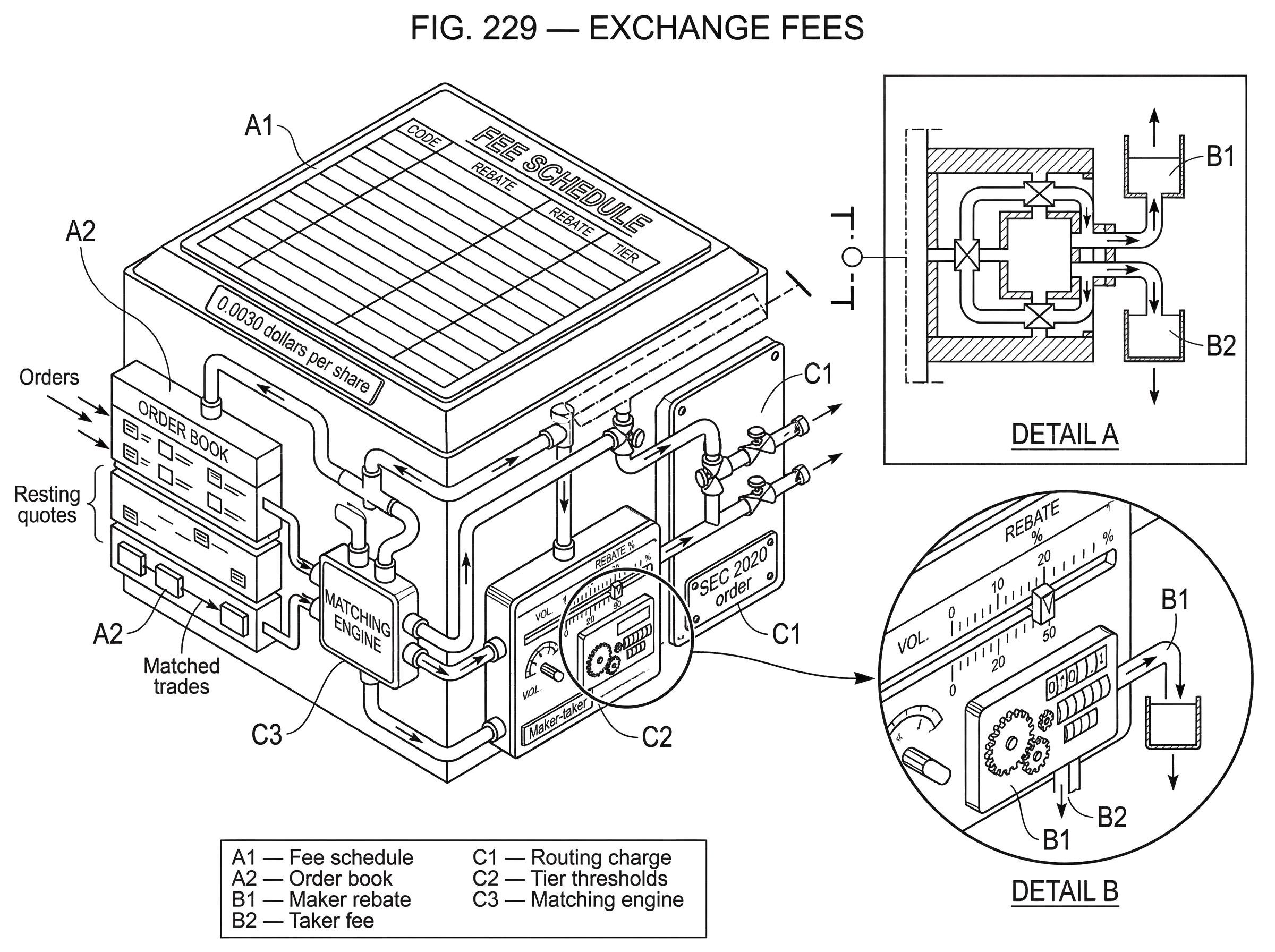
In U.S. equities, the best-known version is the maker-taker model. Under this structure, the liquidity provider receives a rebate and the liquidity remover pays a fee. The SEC describes the model directly: the maker gets a per-share rebate, while the taker pays a fee to the market. A less common variant is the inverted or taker-maker model, where providing liquidity is charged and removing liquidity is rebated.
The key idea is simple: displayed liquidity is valuable to the venue, so the venue may subsidize it. That subsidy is usually funded by charging the other side of the trade. In equities, Regulation NMS Rule 610 caps certain exchange access fees at 0.0030 dollars per share for protected quotations, which puts an upper bound on how far this basic design can go.
How do maker and taker fees apply in real trades?
Imagine you place a limit order to buy shares and your order rests on the exchange book. Later, another participant sells into it. From the exchange’s perspective, your order helped populate the book before the trade occurred, so you were the maker. The incoming seller was the taker. Under a maker-taker schedule, the exchange may charge the seller a taker fee and pay you, or your broker, a maker rebate.
Now imagine the opposite. You send an aggressive order that immediately executes against the best displayed offer. In that case, you are not helping the exchange advertise liquidity in advance; you are consuming liquidity that was already there. So you pay the taker side of the fee schedule.
Here the important subtlety appears: the fee depends on how the order executes, not just on the label attached to the order. That is explicit in exchange documentation outside equities as well. OKX, for example, explains that maker and taker fees depend on whether an order adds or removes liquidity, not merely on whether it is called a market order or a limit order. A limit order can still be a taker order if it crosses the book and fills immediately.
This is also why published fee schedules can look so dense. The exchange is not merely posting one trading fee. It is mapping many possible execution paths to different economic outcomes. Nasdaq publishes separate displayed add-liquidity rebates, remove-liquidity fees, routing charges, and specialized incentive programs. NYSE and Cboe do the same, often with different fee codes, tape distinctions, auction charges, and tier conditions. What looks like complexity for its own sake is, at least in part, the exchange pricing different forms of market participation differently.
Why do exchanges offer tiered rebates and incentive programs?
Once an exchange begins paying for some behavior and charging for other behavior, the next question is obvious: which behavior is worth paying for the most? The answer is usually the behavior that improves the venue’s competitive position.
That is why fee schedules are heavily tiered. A venue may pay better rebates to firms that add more liquidity, quote more consistently at the national best bid or offer, support particular products, or route enough volume through the exchange to qualify for lower net rates. Nasdaq’s Qualified Market Maker program and NBBO-linked rebate programs are examples of this logic. NYSE similarly offers structured credits and programs for members such as designated liquidity providers. Cboe BZX publishes multiple volume-based tiers with higher rebates for firms meeting thresholds based on added volume or share of total consolidated volume.
The mechanism is economic rather than ceremonial. If an exchange can attract more displayed orders, it may improve its quoted spread, depth, or market share. In turn, that can attract more incoming orders. Fees are therefore not just revenue extraction; they are a competitive tool for shaping the order book.
A concrete example makes this clearer. Suppose a firm posts enough liquidity on one venue to qualify for a higher rebate tier next month. The marginal trade is no longer just a trade. It may help the firm unlock a better schedule across millions of shares. That can make one venue economically superior even if its raw posted spread looks similar to another venue’s. For high-volume participants, fee schedules are part of market design, not a back-office detail.
Do maker-taker rebates tighten spreads or distort broker routing?
| Model | Spread effect | Routing conflict | Displayed liquidity | Best for |
|---|---|---|---|---|
| Maker-taker | Narrows quoted spreads | Higher conflict risk | More displayed liquidity | Retail execution claim |
| No rebates | Spreads may widen | Lower conflict risk | Display may thin | Simpler routing |
| Lower cap | Mixed spread effect | Reduces incentive distortions | Partial liquidity loss | Policy compromise |
The strongest argument for maker-taker pricing is that rebates can encourage displayed liquidity and narrow quoted spreads. The SEC’s summary memo notes that proponents argue these rebates can artificially narrow displayed spreads and improve execution prices for retail investors. The word artificially matters here: the exchange is using fee transfers to subsidize posting.
But that same mechanism creates a tension. If a broker or trading firm keeps the rebate rather than passing it through to the customer, the venue offering the highest rebate may not be the venue offering the best execution. The fee schedule then stops being only a market-quality tool and becomes a possible source of conflict.
That concern is not theoretical. The SEC has highlighted broker-routing conflicts as a central criticism of maker-taker structures. Research cited in SEC materials found that some brokers routed nonmarketable limit orders toward venues with the highest rebates, and that higher take fees were associated with worse limit-order execution quality on some measures. The claim is not that every rebate is harmful. The point is narrower and more important: a broker’s incentives can diverge from the customer’s execution interest if the broker benefits from the venue’s payment structure.
The SEC’s 2020 order against Robinhood, while focused on payment for order flow rather than exchange maker-taker fees alone, shows the broader pattern. The agency found that the firm’s routing economics and inadequate best-execution oversight contributed to worse customer outcomes. That does not mean exchange rebates and payment for order flow are identical. It does show the general mechanism by which routing payments can distort execution choices when an intermediary controls venue selection.
Why are exchange fee schedules so complex?
There is a common reaction to exchange price lists: why are they so long? The answer is that modern exchanges are pricing a bundle of services, not a single act.
A participant may face transaction fees, rebates for adding liquidity, routing fees when the exchange sends an order elsewhere, auction-specific charges, connectivity fees for ports or sessions, market-data fees, and in some cases pass-through regulatory assessments such as CAT-related charges. NYSE’s public price list, for example, includes transaction charges, adding-liquidity credits, close-auction pricing, routing fees, and separate technology and regulatory pass-through items. Nasdaq and Cboe publish similarly layered schedules.
Part of this complexity comes from legitimate operational differences. A routed order uses different infrastructure than an order executed on-book. A market maker with quoting obligations is not the same as a casual participant. Low-priced stocks may be priced on a percentage-of-dollar-value basis rather than a per-share basis because per-share formulas behave strangely when share prices are very low.
But part of the complexity is strategic. The SEC has noted that maker-taker competition contributed to differentiated exchanges, tiered and frequently changing fee schedules, and order types designed to capture rebates or avoid fees. In other words, exchanges do not just run markets; they compete by redesigning fee incentives. Complexity is often the byproduct of that competition.
Which traders and firms need to care about exchange fees, and why?
If you trade through a retail broker, you may never see the exchange fee directly. Your broker may absorb it, bundle it into commissions or spreads, or route in ways that make the all-in cost hard to isolate. Even so, exchange fees still matter to you because they affect execution quality and routing.
If you are an active trader, market maker, or institution, fees become much more visible. Your economics depend on whether you add or remove liquidity, whether you qualify for tiers, and whether a strategy that looks profitable before fees still works after them. For these users, a fee schedule is as important as a matching-engine specification.
If you build trading systems, exchange fees are operational data. Coinbase’s Exchange API, for instance, exposes account-level maker and taker fee rates plus trailing volume, reflecting the practical reality that automated systems need current fee inputs to model expected costs. That is a reminder that fees are not only policy questions or public-market structure debates. They are parameters inside trading software.
How are exchange fees different from blockchain (network/gas) fees?
| Fee type | Charged by | When paid | What it pays for | Typical example |
|---|---|---|---|---|
| Exchange fee | Centralized venue | On trade execution | Market access and matching | Per-share maker/taker fee |
| Network fee | Blockchain miners/validators | On on-chain transfer | Transaction processing on chain | Gas to transfer tokens |
| Broker commission / PFOF | Broker or market-maker | On order routing/execution | Order handling or routing revenue | Payment for order flow |
Exchange fees are often mistaken for network or blockchain fees, especially in crypto. They are not the same thing.
An exchange fee is charged by the venue for facilitating trading. A network fee or gas fee is paid to the underlying blockchain network for processing a transfer or transaction on-chain. You can trade on a centralized exchange and incur exchange trading fees without making an on-chain transaction at that moment. Conversely, you can pay gas to move assets on-chain without trading on an exchange at all. The two costs may appear together in a user journey, but they arise from different systems and pay different parties.
Conclusion
Exchange fees are best understood as market incentives expressed in prices. They do not just recover costs; they shape liquidity, routing, and competition between venues.
If you remember one thing, remember this: the important question is not simply how much is the fee? It is what behavior is the fee trying to encourage, and whose incentives does that create? Once you ask that, exchange fee schedules become much easier to read; and much more revealing about how markets actually work.
How do exchange fees work?
Exchange fees are charged or rebated depending on whether an order adds resting liquidity (maker) or removes liquidity (taker). On Cube Exchange you can review per-market maker/taker rates, estimate the all‑in cost for a given order, and choose order types (for example, post-only limit to capture maker rebates or market order for immediate execution) before you trade.
- Fund your Cube account with fiat or a supported crypto transfer.
- Open the market details for the trading pair and view the displayed maker and taker fee rates and any volume-tier thresholds.
- Choose an order type: place a post-only limit order to try to capture a maker rebate, or use a market order if you must take liquidity immediately.
- Review the order preview to see estimated fees and net fill cost, then submit the order.
Frequently Asked Questions
Exchanges classify an order as maker or taker based on whether it adds resting liquidity to the book or immediately removes existing liquidity - not simply on whether it is labeled a limit or market order; a limit order can be a taker if it crosses the book and fills immediately (this distinction is explicit in exchange documentation such as OKX’s fee rules).
Exchanges pay rebates to liquidity providers because displayed liquidity improves quoted spreads, depth, and a venue’s attractiveness; the rebate is a strategic subsidy meant to change participant behavior and strengthen the exchange’s competitive position rather than merely cover costs.
Yes - fee schedules can create conflicts: brokers or market makers who retain rebates or routing payments may favor venues that pay the largest rebates rather than the venue that delivers the best execution for the customer, a concern highlighted by SEC enforcement and research into routing behavior.
Fee schedules are long because exchanges price a bundle of services, not a single action - typical components include add/remove (maker/taker) fees, routing charges, auction fees, connectivity and port fees, market-data charges, and pass-through regulatory assessments.
An exchange fee is charged by the trading venue for facilitating an on-exchange trade, while a network or gas fee is paid to a blockchain for processing an on‑chain transaction; you can incur one without the other depending on whether you trade on a centralized venue or move assets on‑chain.
Because rebates and tiers change the per-share economics, a marginal trade that helps a firm qualify for a higher rebate tier can be worth more than its immediate profit - unlocking a better schedule across many future shares can make one venue economically preferable even if posted spreads look similar elsewhere.
The evidence is mixed: proponents and some regulators argue maker-taker rebates can narrow displayed spreads and improve execution prices, but SEC analyses and academic studies have raised concerns that rebates and routing payments can worsen limit-order execution quality or create broker conflicts, which is why regulators have run pilots and sought more empirical study.
Tiers are typically computed from recent volume (e.g., prior-billing-month ADVs) and exchanges explicitly include exclusions and operational rules (such as excluding certain days or price bands), so edge cases - like which executions count toward a tier or how days with outages are treated - are governed by each exchange’s detailed price list and can vary across venues.
Related reading