What is Velodrome?
What is Velodrome? Learn how Optimism’s native DEX uses AMM pools, veNFT voting, gauges, and emissions to direct liquidity incentives.
Introduction
Velodrome is a decentralized exchange on Optimism designed to solve a specific problem: how do you keep liquidity both deep enough for traders and worth providing for the long term? Many DEXs can attract liquidity for a while by paying token rewards, but that liquidity often leaves when incentives fade. Velodrome’s design tries to make incentives more durable by letting the people who lock the protocol token decide which pools receive emissions.
That choice matters because liquidity is not equally valuable everywhere. A new protocol launching a token on Optimism may need a deep market. A stablecoin pair may need low-slippage execution. An active trading pair may already generate enough fees that it needs less subsidy. Velodrome is built around the idea that liquidity rewards should be routed, not sprayed.
At a user level, Velodrome looks familiar: you can swap tokens, provide liquidity, and earn fees. Under the hood, though, it combines an automated market maker with vote-escrow tokenomics, gauges, and a weekly emissions process. That mechanism is the reason Velodrome is more than just another AMM. It is a market for directing incentives.
What problem does Velodrome solve on Optimism?
A DEX needs liquidity because traders want execution without large price impact. Liquidity providers want compensation because their capital sits in pools and takes on market risk. Protocols launching on a chain want listings and trading depth, but they usually do not want to overpay forever. These interests naturally pull against each other.
Velodrome tries to coordinate them on Optimism. It is native to that network, so its pitch is not simply “here is a place to trade,” but “here is infrastructure for concentrating liquidity where the Optimism ecosystem needs it.” The protocol’s stated mission is to make liquidity on Optimism deep, efficient, and sustainable, and most of its mechanics follow from those three words.
The useful mental model is this: a normal AMM prices swaps; Velodrome also prices attention and incentives. Traders pay swap fees. LPs earn those fees. But the larger question is who gets newly emitted VELO rewards each week. Velodrome answers that through voting.
How do swaps, pool types, and routing work on Velodrome?
| Pool type | Best for | Pricing curve | Slippage near peg | Capital efficiency |
|---|---|---|---|---|
| Volatile pool | Uncorrelated token pairs | Constant-product | Higher near parity | Lower for tight spreads |
| Stable pool | Pegged or correlated assets | Stable invariant (x^3y + y^3x) | Very low slippage | High near peg |
Velodrome V2 uses AMM pools in a form familiar from Uniswap-style exchanges, but it supports two pool types because not all asset pairs behave the same way. For more volatile pairs, it uses a constant-product style pool. For correlated assets such as stablecoins, it supports stable pools with a different pricing curve designed to keep slippage lower near parity.
That distinction is important because the right pool shape depends on the asset relationship. If two assets regularly trade near the same value, a stable curve can make capital more efficient. If they move independently, the standard volatile design is usually the safer fit. Velodrome therefore lets liquidity be matched to the trading problem instead of forcing one invariant onto every pair.
For a trader, the experience is straightforward. The router contract can execute swaps across one or more pools, so a trade may pass through intermediate assets if that gives a better route. Because Velodrome is on Optimism, the protocol emphasizes low-cost, high-throughput trading relative to mainnet conditions. The user sees a swap interface; the mechanism underneath is a set of pools and routing logic deciding how to source the best path.
For an LP, providing liquidity starts the same way it does on many DEXs: deposit a token pair into a pool and receive LP tokens representing your share. Those LP tokens earn trading fees. But on Velodrome, fees are only the first layer of returns. If the pool has an attached gauge and receives votes, the LP can stake LP tokens into that gauge to earn VELO emissions as well.
How do veNFT locks and weekly votes direct VELO emissions?
| Model | Who decides | Allocation cadence | Incentive durability | Best use case | Main drawback |
|---|---|---|---|---|---|
| Fixed farming | Protocol or team | Predefined schedule | Often short lived | Simple bootstrap programs | Wrong pools get long subsidies |
| Voter-directed | veNFT holders (voters) | Weekly epochs | Can be sustained via locks | Targeted ecosystem liquidity | Votes influenced by bribes |
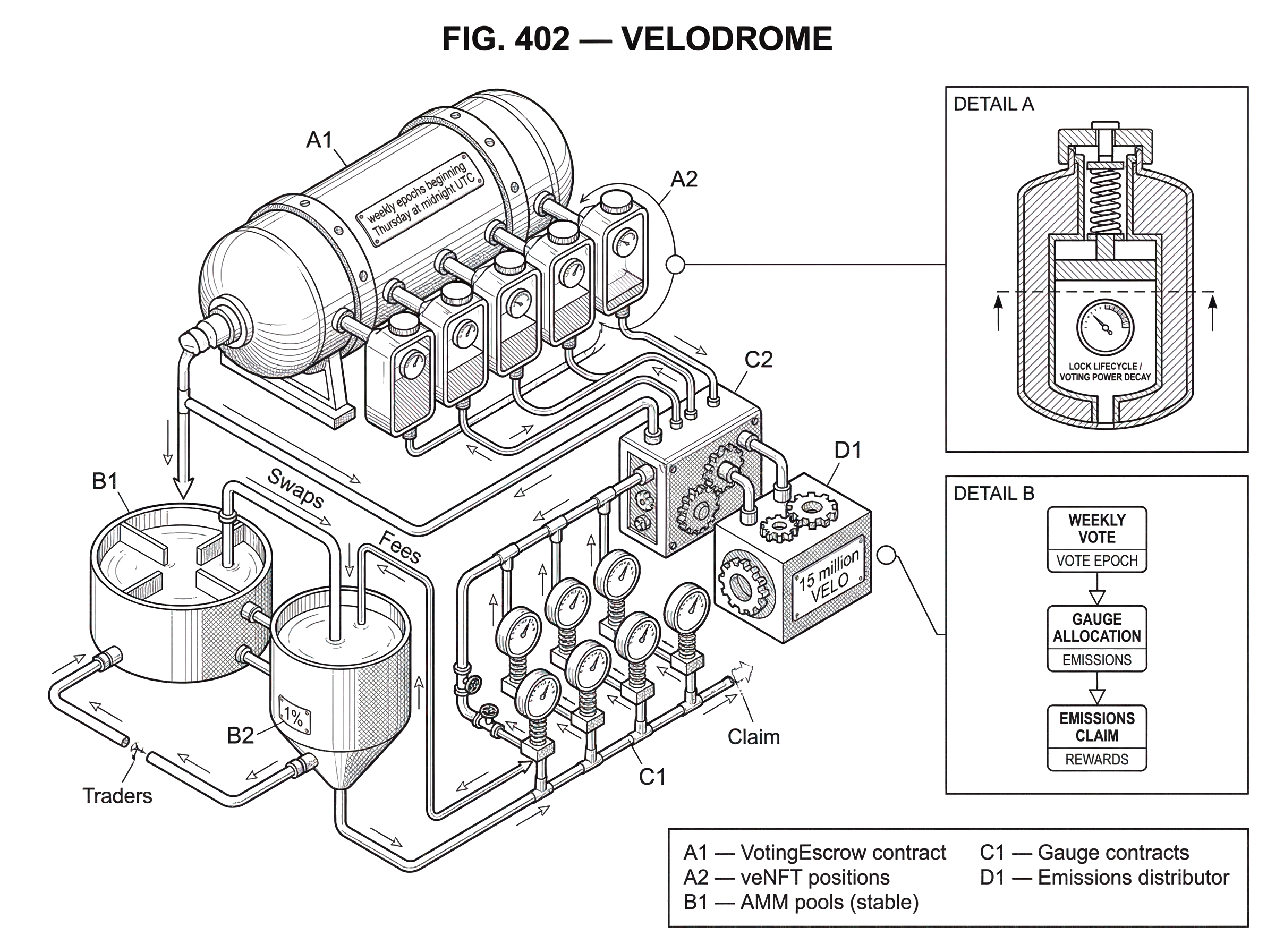
This is the central mechanism. Velodrome has a native token, VELO, and users can lock it in the VotingEscrow system. Locking VELO creates a veNFT, an NFT that represents the locked position and its voting power. Voting power depends on the lock and, for time-limited locks, decays linearly over time. Locks can run up to four years.
Why an NFT instead of a plain balance? Because the lock position is an object with a lifecycle. It can be merged, split, and in some cases managed in more advanced ways. That makes governance power more flexible than a single account balance, while still keeping the underlying rule intact: voting power comes from committing capital for time.
Each week-long epoch, veNFT holders vote on gauges. A gauge is attached to a pool. The Voter contract tallies those votes and routes that epoch’s VELO emissions to gauges in proportion to the voting support they received. Then LPs who have deposited LP tokens into those gauges can claim the resulting rewards.
So the path is: lock VELO -> receive voting power -> vote on gauges -> direct emissions -> LPs in those gauges earn VELO. That is the engine of Velodrome.
This solves a problem that ordinary liquidity mining does not solve well. In a fixed farming program, a team decides in advance which pools get rewards. In Velodrome, that allocation is continuously renegotiated on-chain. The protocol does not need to guess forever where incentives should go. It lets token lockers express that preference every epoch.
What are bribes on Velodrome and how do they influence gauge votes?
| Actor | Motivation | Action taken | Primary benefit | Primary risk |
|---|---|---|---|---|
| Protocol | Bootstrap liquidity | Offer bribes to veNFT voters | More emissions to its pool | Paying without durable liquidity |
| veNFT voter | Maximize rewards | Vote for bribed gauges | Bribe payouts plus emissions | Short-term profit over ecosystem |
| LP | Higher yield | Provide liquidity to incentivized pools | Fees plus extra incentives | Impermanent loss if incentives stop |
Once you let votes determine rewards, a second market appears. If a partner protocol wants more emissions flowing to its pool, it can offer incentives to veNFT voters. In Velodrome’s terminology, these are commonly called bribes. A protocol effectively says: “If you vote for this gauge, we will pay you additional rewards.”
That may sound strange at first, but it follows directly from the mechanism. Votes control a scarce resource: emissions. If emissions are valuable, then votes are valuable too. Bribes are simply the price signal that emerges when protocols compete for those emissions.
The important point is that this changes who Velodrome is for. It is not only for traders and LPs. It is also for protocols on Optimism that need liquidity and are willing to pay for it in a targeted way. Instead of blindly subsidizing all liquidity, they can try to attract votes to the specific pools that matter to them.
For a concrete example, imagine a new Optimism protocol launching a governance token. It needs a liquid token pair so users can enter and exit positions without heavy slippage. If it simply creates a pool and hopes LPs arrive, liquidity may stay thin. On Velodrome, that protocol can create or support a gauge for its pool, offer bribes to veNFT voters, and attract a share of weekly VELO emissions. That in turn makes the pool more attractive to LPs, because now they earn trading fees plus emissions, and perhaps external incentives as well. The mechanism works because each participant is responding to a real economic signal rather than a fixed admin schedule.
The trade-off is also clear: reward flows depend on governance and market competition. Pools do not receive emissions because they are morally deserving; they receive them because voters direct them there. That can be efficient, but it also means incentives can cluster where lobbying, bribes, or aligned governance power are strongest.
How often are VELO emissions allocated and what is the epoch schedule?
Velodrome’s system runs on weekly epochs beginning Thursday at midnight UTC. This is not just a calendar convention. It creates a predictable cadence for voting, distribution, and reward competition.
According to the published specification, base emissions begin at 15 million VELO per epoch and decay by 1% each epoch. Rebases are added on top, and a team portion is also taken. Once base emissions fall below roughly 6 million VELO after about 92 epochs, the system transitions to a tail-emissions model based on a percentage of circulating supply, with that rate adjustable through the EpochGovernor.
You do not need every parameter to understand the design. The principle is that early emissions are larger to bootstrap the system, then decline toward a steadier long-run regime. That is a common shape in token incentive systems. What matters in Velodrome is that those emissions are not merely issued; they are allocated by vote.
There are also timing rules around voting. Voting is generally once per epoch, and the specification notes that voting is disabled during the first and last hour of the epoch, with distributions occurring at epoch boundaries. Those constraints exist to make weekly accounting more predictable and reduce edge-case behavior around the rollover.
Which Velodrome actions are permissionless and which remain under admin control?
Velodrome uses governance both economically and administratively, and those are related but not identical. Economically, veNFT holders steer emissions through gauge votes. Administratively, there are contracts and roles that can whitelist tokens, create managed veNFT structures, adjust some emissions parameters, and control other protocol settings.
The protocol repository documents both public permissions and admin roles. Core DEX actions are permissionless: anyone can swap, provide liquidity, create a normal veNFT, incentivize pools, create a pool if needed, and create a gauge for whitelisted tokens. At the same time, some powers remain in designated team or council roles, with a stated path toward broader on-chain governor contracts such as VeloGovernor and EpochGovernor.
That is worth understanding as a practical matter. Velodrome is not just code floating in the abstract. It is a live protocol with governance machinery, some decentralized and some role-based. For users, the right conclusion is neither blind trust nor automatic suspicion. It is that governance structure is part of the product, because incentive routing and pool eligibility depend on it.
What security risks come from Velodrome’s design and how are they mitigated?
Velodrome emphasizes audits, monitoring, oracle safeguards, and conservative rollouts for new assets. Its repositories point to audits and bug bounty programs, and the protocol maintains a live Immunefi bounty. Those signals matter because an AMM with token emissions and governance contracts has a larger attack surface than a minimal swap contract.
Still, the important first-principles point is simpler: complexity buys coordination, but complexity also creates risk. Velodrome’s value comes from combining pools, gauges, escrow locks, emissions, and voting. The same combination means users should think in layers of risk. Traders care mostly about swap execution and pool quality. LPs add impermanent loss and Smart Contract Risk. VELO lockers add governance and tokenomic exposure. Protocols bribing for votes are taking strategic risk on whether those incentives actually create durable liquidity.
There are also technical nuances in the specification. Stable pools use a more complex invariant than standard constant-product pools, and the docs note that some assumptions integrations might make about invariant monotonicity do not always hold. That is not a problem for ordinary users to memorize, but it is exactly the kind of detail integrators and advanced LPs should care about.
Who should use Velodrome: traders, liquidity providers, or protocol teams?
Velodrome makes the most sense for users who want more than a one-off token swap. Traders can use it simply as an Optimism DEX, but the protocol is especially tailored to people and teams who care about the economics of liquidity.
If you are an LP, Velodrome is appealing when you want fee income plus a route to token incentives through gauges. If you are a long-term VELO holder, it is built for you to convert locked capital into voting power and fee- or incentive-related opportunity. If you are an Optimism-native protocol, Velodrome is designed as infrastructure you can use to bootstrap and defend liquidity by competing for gauge votes rather than relying only on direct subsidy.
That focus explains much of the product’s shape. Velodrome is not trying to be the simplest possible DEX. It is trying to be the exchange layer where Optimism protocols, LPs, and token lockers coordinate around liquidity.
Conclusion
Velodrome is best understood as an AMM plus an incentive market. The AMM part lets users swap and provide liquidity through volatile and stable pools. The distinctive part is that VELO lockers, using veNFTs, vote each week on which pools should receive emissions, while protocols can compete for those votes with extra incentives.
If you remember one idea, remember this: Velodrome does not just host liquidity; it governs where liquidity is rewarded. That is why it has become a meaningful piece of Optimism’s exchange infrastructure, and also why understanding its tokenomics is as important as understanding its swap interface.
How do you trade through a DEX or DeFi market more effectively?
Trade through a DEX more effectively by comparing liquidity, pool type, and expected price impact before you execute. On Cube Exchange, fund your account and choose an order type that controls slippage so you access DEX liquidity with predictable execution.
- Fund your Cube account with fiat on‑ramp or a crypto transfer to the deposit address.
- Before placing the trade, check the target pair’s liquidity and pool type (stable vs. volatile) on the DEX to estimate price impact and depth at your intended size.
- Open the relevant market on Cube and choose an order type: use a limit order to fix the execution price or a market order for immediate fill while setting a strict max slippage.
- For large orders, split into smaller tranches and monitor fills; re-evaluate pool depth between tranches to avoid crossing thin amounts.
- Review estimated fees, network confirmation times, and the final quoted slippage, then submit the order.
Frequently Asked Questions
VELO holders lock tokens in VotingEscrow to receive a veNFT whose voting power (which decays linearly for time-limited locks) is used each weekly epoch to vote on gauges; the Voter contract tallies those votes and allocates that epoch’s VELO emissions to gauges in proportion to votes, and LPs who staked LP tokens into those gauges then earn the emitted VELO.
Bribes are off‑chain or on‑chain incentives offered by protocols to veNFT voters to persuade them to vote for a particular gauge; because votes route scarce emissions, bribes naturally emerge as a market price for votes and can shift reward flows toward pools that pay for them.
Velodrome runs on weekly epochs (starting Thursday at midnight UTC); base emissions start at 15 million VELO per epoch, decay by 1% each epoch, and after roughly 92 epochs the system transitions toward a tail‑emissions model (based on circulating supply) with parameters adjustable by the EpochGovernor.
Velodrome supports two pool types: a constant‑product (volatile) pool for assets that move independently and a stable pool with a different pricing curve for correlated assets (like stablecoins) to keep slippage lower near parity, so pool shape should match the assets’ price relationship for capital efficiency.
The protocol’s combination of AMMs, gauges, veNFT voting, and emissions increases coordination power but also expands attack surface and compositional risk; Velodrome publishes audits, runs a public Immunefi bounty, and recommends cautious rollout and user risk awareness, while integrations should heed extra complexities like the stable‑curve behavior.
Core DEX actions such as swapping, providing liquidity, creating normal veNFTs, and creating gauges for whitelisted tokens are permissionless, but some administrative powers (whitelists, parameter updates, managed veNFT structures) remain in team or council roles with a stated path toward on‑chain governor contracts and partial decentralization.
LPs deposit LP tokens into a pool and, if that pool has a gauge and receives votes, they stake those LP tokens into the gauge to claim VELO emissions in addition to trading fees; emissions flow to gauges by vote every epoch and are then claimable by stakers in those gauges.
veNFTs can be merged, split, and managed as lock objects, but delegation is limited: the repository notes delegation is only supported for permanent locks while normal/locked NFTs cannot act as delegators, and voting power for time‑limited locks decays linearly up to a four‑year maximum lock.
Integrators should be careful: Velodrome’s stable‑pool invariant can be non‑monotonic (so assumptions like K/totalSupply monotonicity may break), and zapping tools only support standard ERC‑20 tokens (fee‑on‑transfer tokens are not supported for zaps), so advanced integrations should consult the SPECIFICATION and VOTINGESCROW docs.
Related reading