What is Liquidity Mining?
Learn what liquidity mining is, how DeFi protocols reward liquidity providers, how AMM pools and token emissions work, and why incentives can fail.
Introduction
liquidity mining is the practice of rewarding people for supplying assets to a DeFi protocol’s liquidity pools. The idea sounds almost circular at first: why should a market need to pay people just to make trading possible? The answer is that on-chain markets do not usually begin with a built-in class of professional market makers standing ready to quote prices. If a protocol wants deep liquidity early, it often has to buy that liquidity with fees, token rewards, or both.
That is the core intuition worth holding onto. A decentralized exchange can have elegant smart contracts, a clean interface, and even a strong community, but if traders face wide slippage or cannot reliably enter and exit positions, the market is weak. Liquidity mining exists because liquidity is infrastructure, and infrastructure often has to be subsidized before it becomes self-sustaining.
In practice, liquidity mining usually means depositing tokens into an automated market maker, or AMM, pool on a decentralized exchange and receiving compensation in proportion to your share of that pool. Some of that compensation comes from trading fees. Some comes from additional token incentives that the protocol emits on purpose. Those extra incentives are what make liquidity mining distinct from ordinary fee-earning liquidity provision.
The mechanism is common across DeFi, but it is not identical everywhere. A simple constant-product pool on Ethereum, a stablecoin pool using a different invariant, a concentrated-liquidity position, and a bonded-liquidity gauge on Cosmos all solve the same broad problem in different ways. The details matter, because the details determine who gets paid, for what behavior, and whether the program creates durable liquidity or just temporarily rented capital.
Why do DeFi protocols pay rewards to attract liquidity?
A market works only if someone is willing to take the other side of a trade. In traditional markets, that role is often played by specialized market makers using order books, inventory management, and off-exchange hedging. DeFi can imitate some of that, but many on-chain exchanges instead rely on pooled liquidity and AMMs, where users trade against assets already sitting in a smart contract rather than matching directly with another trader.
That design shifts the problem. Instead of asking, “Who will post quotes?” the protocol asks, “Who will deposit assets into the pool?” If nobody does, trading becomes expensive or impossible. Slippage rises, spreads worsen, and the protocol feels empty no matter how good the software is. So the protocol offers compensation to liquidity providers, or LPs, to offset the cost and risk of tying up capital.
This is why liquidity mining is best understood as an incentive system for market formation. The protocol is trying to create a pool large enough that traders want to use it. If traders use it, fee revenue begins to appear. If fee revenue becomes large and durable enough, the market may eventually need fewer token subsidies. That hoped-for transition (from subsidized liquidity to economically justified liquidity) is the basic developmental story behind many DeFi incentive programs.
But that transition is not guaranteed. If liquidity providers are present only because rewards are unusually high, then the protocol may not be building a real market at all. It may simply be renting balances that will disappear when emissions drop. This is the central tension of liquidity mining: it can bootstrap liquidity, but it can also manufacture an illusion of product-market fit.
How does liquidity mining work on AMMs and DEXs?
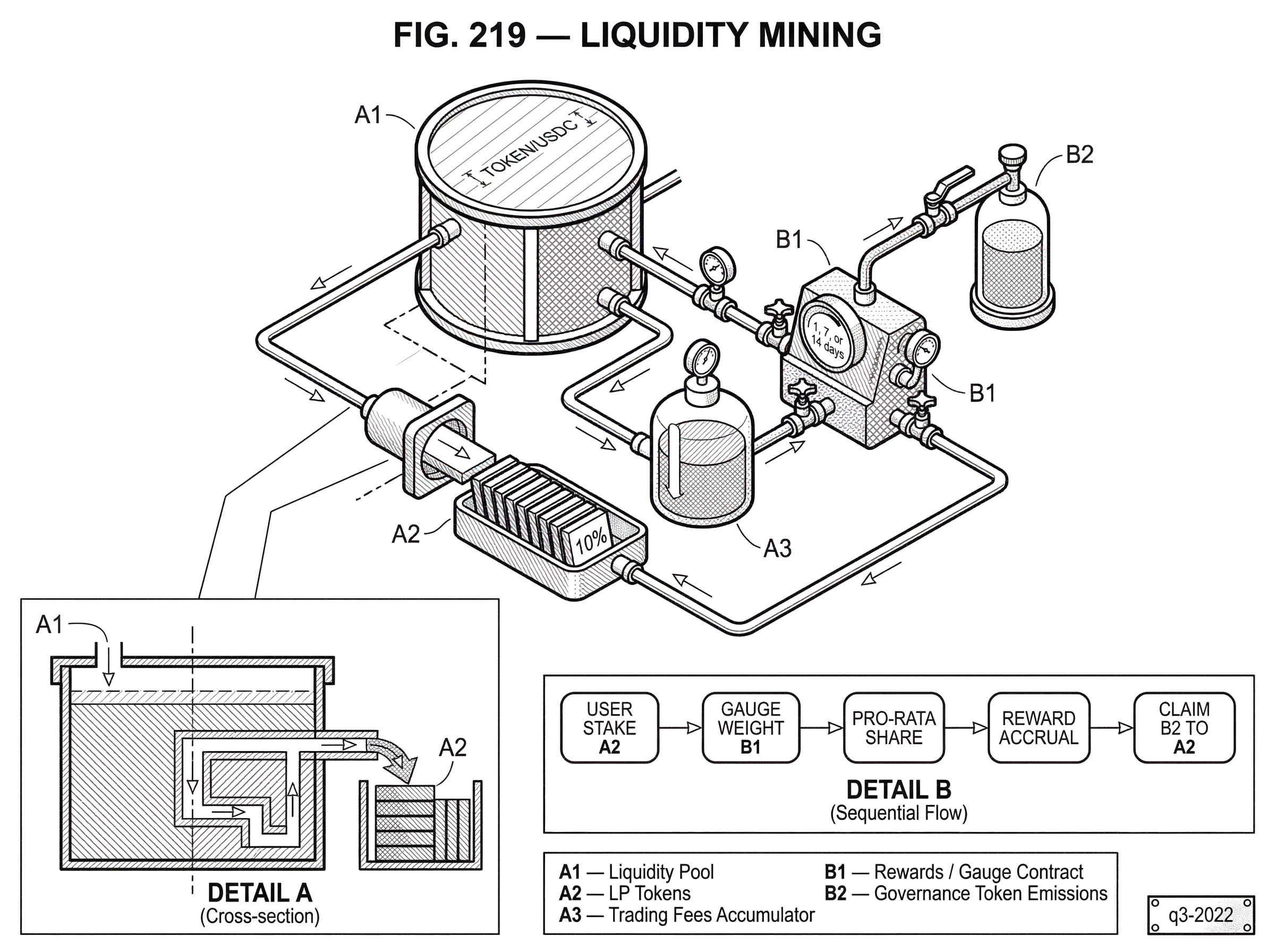
At the mechanical level, the simplest version starts with a liquidity pool containing a pair of tokens on a DEX. A provider deposits both assets into that pool. In return, the protocol tracks that provider’s fractional ownership of the pool. When traders swap through the pool, they pay fees, and those fees are distributed proportionally among providers according to their share.
The basic glossary description captures the core structure clearly: liquidity mining is a process in which participants supply cryptocurrencies into liquidity pools and are rewarded with fees and tokens based on their share. These pools commonly consist of paired assets on decentralized exchanges, and the contracts governing the pool execute pricing and reward logic on-chain. In a simple pool, the liquidity provider who creates it sets the initial asset proportion and starting price by choosing the opening balances.
A useful way to separate the moving parts is this: the pool provides execution, the LP provides capital, and the mining program adds extra rewards on top. Fees come from actual trading activity. Mining rewards come from a separate decision by the protocol, a sponsor, or governance. If a pool pays only fees, that is liquidity provision. If it pays fees plus an intentional stream of reward tokens, that is liquidity mining.
Consider a concrete example. Suppose a new DEX wants an active TOKEN/USDC market. If the pool is tiny, traders who buy TOKEN will push the price up sharply, and traders who sell it will push the price down sharply. That makes the market unattractive. So the protocol tells LPs: deposit TOKEN and USDC, and in addition to your trading fees, you will receive newly distributed governance tokens every day. If Alice provides 10% of the pool’s liquidity, she receives roughly 10% of the fees and 10% of the reward stream, subject to the protocol’s exact accounting rules. The DEX is not paying Alice because it likes depositors; it is paying her because her capital makes the market usable for traders.
That simple narrative covers a large share of early DeFi designs, including systems where LPs receive a fungible receipt token representing their claim on the pool. Those receipt tokens are often called LP tokens, and many protocols ask users to stake them in a separate rewards contract to earn the extra mining emissions. The LP token is effectively the proof that the user really supplied liquidity and therefore should share in the program.
How do AMMs adjust prices and what risk does that create for LPs?
| AMM type | Price exposure | Slippage | Capital efficiency | Best for |
|---|---|---|---|---|
| Constant-product | Continuous rebalancing | High for volatile pairs | Low to medium | General-purpose pairs |
| StableSwap | Tight near peg | Very low for like assets | High near equilibrium | Stablecoin-like pools |
| Concentrated liquidity | Range-bound exposure | Low within active range | Very high when concentrated | Active management, low slippage |
It is easy to misunderstand liquidity mining as a passive savings product. Mechanically, though, the LP is participating in a pricing system. In an AMM, each swap changes the relative balances in the pool, and the smart contract uses those balances to determine a new marginal price. The provider’s capital is therefore being continuously rebalanced by traders.
That mechanism explains both the appeal and the risk. The appeal is that anyone can help make a market without manually quoting bids and asks. The risk is that your asset mix does not stay fixed. If one asset becomes much more valuable relative to the other, arbitrage traders move the pool toward the external market price by buying the underpriced asset and selling the overpriced one against the pool. The LP ends up holding a different composition than they started with.
This is where a smart reader often needs a correction. The LP is not simply “lending” tokens to the protocol and earning interest. The LP is exposing capital to trading flow and relative price movement. Trading fees are compensation for that service. Liquidity mining rewards are additional compensation designed to make the service attractive enough to perform.
Different AMM designs change how this exposure behaves. Uniswap-style constant-product pools spread liquidity across the full price Curve. StableSwap-style pools, as used for assets expected to trade near the same price such as stablecoins, use a different invariant with an amplification parameter to reduce slippage near equilibrium. That is why stablecoin pools can often offer better trading conditions for like-priced assets and can look more like a low-slippage cash market than a general volatile-asset pool. The reason this matters for liquidity mining is straightforward: the same amount of rewards can buy very different market quality depending on the AMM design.
Fee income vs. token emissions: which makes liquidity sustainable?
| Source | Duration | Protocol cost | Signal of demand | Best for |
|---|---|---|---|---|
| Trading fees | Continuous while used | Revenue-dependent | Indicates real demand | Mature, fee-generating markets |
| Token emissions | Finite or decaying schedule | Inflationary dilution | Bootstrap liquidity quickly | Early-stage bootstrapping |
The cleanest way to understand liquidity mining economics is to separate its two revenue sources. There is organic yield, which comes from fees that real users pay for real trades. And there is subsidized yield, which comes from reward tokens distributed by design.
This distinction matters because the two sources tell different stories. Fee income means the market is actually being used. Token emissions mean the protocol is spending part of its balance sheet, or future token supply, to encourage behavior. A pool showing a high annualized percentage return may look attractive, but that number can be dominated by emissions rather than fees.
That is not automatically bad. In a launch phase, emissions can be a rational tool. If a protocol has no liquidity, it may need to subsidize the first wave of LPs until trading activity grows. The problem appears when the subsidy is mistaken for a permanent business model. If the protocol emits more value than the market it is creating can justify, the apparent yield is not self-sustaining. It is a transfer from future token holders to present LPs.
This is why many guides on sustainable program design argue that emission schedules should be finite, predictable, and often decaying. The point is not austerity for its own sake. The point is to force the protocol to answer a hard question: what behavior are these emissions buying, and will that behavior persist when the subsidy shrinks? If the answer is no, the protocol may be paying for temporary TVL rather than real liquidity.
How should a protocol design emissions to buy useful liquidity? (worked example)
Imagine a new protocol launching with a fixed budget of reward tokens. It wants to deepen trading in two pools: a volatile governance token against a stablecoin, and a stablecoin-to-stablecoin pool used as a routing market. If it distributes rewards evenly by headline TVL, it may overpay the first pool simply because speculators deposit capital to farm rewards, while underpaying the second pool even though the second pool generates more useful trade flow and lower slippage for users.
A better design asks what the rewards are meant to purchase. If the goal is reliable execution for common trades, then emissions should favor the pool whose depth most improves execution quality. If the goal is to launch the governance token with enough market depth to avoid chaos, the token pool may deserve an early subsidy; but probably not forever. In both cases, the reward design is not really about generosity. It is about allocating a scarce incentive budget to the liquidity that matters most.
This is also where governance often enters. In gauge-based systems, token holders or vote-locked token holders can direct emissions toward particular pools. Curve’s ecosystem popularized this logic: governance power can influence which pools receive more incentive flow, and intermediaries such as Convex built systems around accumulating and directing that power. The underlying idea is that emissions should not remain a static spreadsheet set by the founding team. They should become a contested resource allocated toward pools the ecosystem values.
How did concentrated liquidity change LP tokens and mining design?
In earlier AMM designs, liquidity providers in the same pool were often interchangeable enough that a fungible LP token could represent a share of pooled liquidity. That made mining programs relatively simple. Stake the LP token, track how many you staked and for how long, and distribute rewards accordingly.
Concentrated liquidity changes that simplicity. In Uniswap v3, liquidity is not just “in the pool”; it is assigned to a chosen price range. A position earns fees only while the market price remains inside that range. When price moves outside it, the position becomes inactive and stops earning fees until price re-enters. Because each position can have a different range, positions are no longer naturally fungible.
That has a deep consequence for liquidity mining. A protocol can no longer assume that every dollar of deposited capital is equally useful. Capital concentrated around the active trading price can be far more valuable than capital sitting far away and never executing. So reward systems must measure active liquidity, not just nominal deposits.
The Uniswap v3 whitepaper explicitly notes that it tracks a seconds-weighted liquidity accumulator, secondsPerLiquidityCumulative, that external contracts can use to implement liquidity mining fairly for active liquidity. The point is subtle but important: rewarding concentrated liquidity requires accounting for both how much liquidity a position supplies and how long it is actually in range. If the system pays the same reward to inactive and active positions, it buys less real market depth than it thinks.
This is one reason newer liquidity mining designs are harder than earlier “stake your LP token and farm” models. The protocol must decide whether it is paying for deposited capital, active capital, narrowly placed capital, long-duration capital, or some combination of all four.
What are gauges and bonding modules, and how do they direct liquidity rewards?
Once you see liquidity mining as buying a specific form of liquidity, many design variations make more sense. A gauge is just a structured way to decide where emissions go and how users qualify for them. The protocol might direct more rewards to high-volume pools, to strategically important pairs, or to pools favored by governance voting.
Osmosis provides a useful example on Cosmos. Its docs describe bonded liquidity gauges that distribute incentives to LP tokens bonded for minimum durations such as 1, 7, or 14 days. This changes the behavior being purchased. The protocol is not only buying liquidity; it is buying stickier liquidity by rewarding users who commit capital for longer periods. The duration split also changes realized incentives, because longer bonders can access a larger share of the incentive budget.
Osmosis also allows permissionless external gauges, meaning anyone can deposit tokens into a gauge to incentivize a pool. Raydium on Solana offers a comparable intuition through permissionless farms, where token issuers can add incentives to pools. These examples matter because they show liquidity mining is not an Ethereum-only pattern and not even necessarily a protocol-native-only pattern. Sometimes the exchange provides the reward rails, while third parties choose to fund the rewards.
That flexibility is powerful, but it also weakens any simple story that “high APR means a good market.” A pool may be paying well because it is strategically important, because governance chose it, because an outside token issuer is subsidizing it, or because the incentives are trying to offset unusual risk. The yield figure alone does not tell you which.
Why is TVL a poor proxy for actual trading liquidity?
A protocol can attract a very large total value locked, or TVL, and still fail to create good trading conditions. What matters for a trader is not just how much capital is somewhere in the system, but whether that capital improves execution where trades actually happen.
This is obvious in concentrated liquidity systems, where out-of-range positions do little for current trading. But the principle is broader. A huge stablecoin pool may be more useful than a larger volatile pair if it routes more volume. A deeply incentivized pool may look impressive until incentives fall and liquidity disappears. A pool dominated by a few large wallets may be fragile even if its headline TVL is high.
That is why serious program design increasingly focuses on retention and efficiency metrics rather than raw deposit size. Useful questions include: how much liquidity remains after rewards decline, how many fees are generated per token emitted, and how concentrated the liquidity base is. Those are not just dashboard niceties. They are attempts to measure whether emissions are purchasing durable market infrastructure or temporary balance-sheet decoration.
What are the main risks and failure modes of liquidity mining?
The most famous economic risk to liquidity providers is loss from relative price divergence between pool assets. If prices move enough, an LP can end up worse off than simply holding the assets outside the pool, especially after withdrawal. Trading fees and mining rewards can offset that, but they do not eliminate it.
There is also smart-contract risk, because pools and reward systems are executed by code. The evidence here is direct: liquidity pools and distributions are governed on-chain by smart contracts. If the contracts are flawed, misconfigured, or exploited, LPs can lose funds. That is not an incidental operational issue. In DeFi, code is part of the economic mechanism.
There are market-structure risks too. Oracle weaknesses can affect pricing in some systems. Large withdrawals can reduce depth and worsen execution. Governance-token rewards can be freely sold, which may create persistent sell pressure and dilute existing holders. If governance tokens also convey voting rights, distributing them to LPs can reshape protocol control in ways that do not always align with long-term usage.
And there is a more adversarial layer. Research on Ethereum has identified scams that drain liquidity pools gradually over time rather than through a dramatic one-shot rug pull. That matters because it reminds us that “providing liquidity” is not merely a financial decision about APY. It is also a decision about the integrity of the pool, token, contracts, and surrounding ecosystem.
How do real-yield and protocol-owned liquidity reduce dependence on emissions?
| Approach | Payout asset | Sustainability | Treasury exposure | Best use case |
|---|---|---|---|---|
| Token emissions | Native token | Often temporary | Low immediate, inflationary | Bootstrapping liquidity |
| Real yield (revenue-backed) | ETH or stablecoins | Higher if revenue persists | Depends on fee model | Mature protocols with revenue |
| Protocol-owned liquidity | Protocol-controlled LPs | Reduces mercenary risk | High asset and treasury exposure | Stabilizing key markets |
If token emissions are costly and often temporary, what is the alternative? One direction has been toward revenue-backed rewards, sometimes described as real yield: paying users in assets like ETH, AVAX, or stablecoins out of actual protocol revenue instead of relying mostly on inflationary token emissions. The appeal is not mystical. It is simply that revenue-backed rewards are harder to fake. They require the protocol to be used.
Another direction is protocol-owned liquidity, where the protocol itself accumulates and controls LP positions instead of perpetually renting liquidity from outside providers. This can reduce dependence on mercenary capital, though it shifts risk onto the protocol treasury, which now bears direct exposure to the pooled assets.
Neither approach makes liquidity mining obsolete. They are better seen as responses to a specific failure mode of classic mining: the possibility that continuous emissions become an expensive substitute for building a market that can stand on fees and product demand.
What is the purpose of liquidity mining in market formation?
By this point, the concept should look less like a strange yield trick and more like a market-design tool. Liquidity mining exists to solve a bootstrapping problem: traders want liquid markets, but liquid markets require capital, and capital usually needs compensation. AMMs let protocols turn pooled capital into continuous trading. Liquidity mining adds an incentive layer that can accelerate the formation of those pools.
Whether that acceleration is healthy depends on what exactly is being rewarded. If the program pays for active, useful, durable liquidity and gradually hands off the market to fee-driven participation, it can help a protocol cross the hardest early gap. If it overpays indiscriminately, it may buy only the appearance of success.
The simplest sentence to remember tomorrow is this: liquidity mining is how DeFi protocols pay for market depth before the market can fully pay for itself.
How do you trade through a DEX or DeFi market more effectively?
Trade through a DEX or DeFi market more effectively by matching your execution type to on-chain liquidity, controlling order size, and managing slippage before you submit. On Cube Exchange, the practical workflow is to fund your account, open the relevant market or transfer flow, then choose an execution path that fits the pair’s depth and your tolerance for price movement.
- Deposit funds into your Cube account (use the fiat on-ramp or send the exact token and network you plan to trade, e.g., USDC on Ethereum).
- Open the market or asset page for the token pair on Cube and check quoted spreads, displayed depth, and recent trade sizes to judge how much of the visible liquidity your order would consume.
- Choose an order type: use a limit order for price control or a market order for immediate execution. For orders larger than ~5–10% of visible depth, split into multiple smaller limit orders to reduce slippage.
- Set a slippage tolerance and expiry/deadline if available, submit the order, and monitor fills; if the pair is thin, consider entering via a smaller initial order then scale in after observing impact.
Frequently Asked Questions
Token emissions are intentional reward distributions from the protocol (new tokens paid to LPs) while fees are paid by traders for execution; emissions subsidize liquidity formation but do not necessarily reflect real trading demand, so high APRs can be driven mostly by emissions rather than durable fee income.
The main risks are that LPs can suffer losses from relative price divergence between pool assets (so they may be worse off than just holding the tokens), smart-contract bugs or exploits can drain funds, governance-token rewards can create sell pressure or change control, and adversarial designs can slowly extract liquidity rather than as a single rug pull.
Concentrated-liquidity systems require rewarding active, in-range positions rather than raw deposited value because positions only earn fees while the market price lies inside their chosen range; Uniswap v3 therefore exposes mining programs to the need for seconds-weighted or in-range accounting to avoid paying inactive capital the same as active liquidity.
TVL counts deposited value but not whether that capital improves execution where trades occur; useful liquidity metrics instead look at retention after rewards fall, fees generated per token emitted, depth at the active price, and concentration of providers to judge if incentives bought durable market infrastructure or only temporary TVL.
Protocols can favor sustainability by using decaying, predictable emission schedules, shifting toward revenue-backed (real-yield) rewards paid from actual fees, or by building protocol-owned liquidity so the treasury controls depth instead of perpetually renting external capital; each approach reduces dependence on continuous inflation but introduces trade-offs like treasury exposure or governance decisions.
A gauge is a mechanism that directs where emissions go (which pools and which durations qualify); gauge systems often let governance or vote-locked token holders allocate reward weight and some implementations (e.g., Osmosis) also reward longer bonded durations to buy stickier liquidity rather than just nominal deposits.
Because mining can be funded by outsiders, a high APR can reflect third-party subsidy rather than organic demand; permissionless or sponsor-funded incentives let token projects or external actors pay for depth, which can be useful for launch but also means the yield number alone doesn’t reveal who’s paying or whether liquidity will persist once subsidies stop.
Design failures include overpaying mercenary capital that exits when emissions drop, misallocating rewards by headline TVL instead of usefulness, poorly governed or adaptive emission rules that invite capture, and on-chain scams that incrementally drain incentivized pools rather than performing an immediate rug pull.
Related reading