What Is a Tokenized Money Market Fund?
Learn what tokenized money market funds are, how they work, why they matter for on-chain collateral, and the risks of this hybrid fund structure.
Introduction
Tokenized money market funds are money market fund shares issued or represented as blockchain tokens. That sounds like a packaging change, but the reason they matter is deeper: they try to turn a familiar off-chain cash vehicle into something that can move inside digital markets, serve as on-chain collateral, and still remain a regulated fund investing in short-term instruments such as Treasury bills, repo, commercial paper, deposits, or other eligible money market assets.
The puzzle is this: if a money market fund already exists, why tokenize it at all? Traditional money market funds already offer investors a relatively stable place to hold cash-like assets and earn short-term rates. But they do not plug naturally into blockchain-based markets, where assets are expected to settle quickly, interact with smart contracts, and remain visible in a shared ledger. Tokenization is an attempt to bridge that gap.
The bridge, however, is imperfect. A tokenized money market fund is not simply “cash on-chain,” and it is not the same thing as a stablecoin. It is still a fund share, and legally it is treated as a security. The underlying portfolio remains governed by the ordinary rules of money market funds, while the token adds a new transfer and recordkeeping layer. That hybrid design is the key to understanding both the appeal and the limits of the concept.
What is a tokenized money market fund and how does it differ from a regular MMF?
At the core, a tokenized money market fund, often shortened to TMMF, is a claim on a conventional investment vehicle. The fund invests in short-term money market instruments; the investor receives ownership in the fund; and that ownership is recorded or mirrored through blockchain tokens. The BIS describes TMMFs as tokenized representations of shares in funds that invest in money market instruments but circulate on public permissionless blockchains.
That means the economic substance is mostly familiar. The investor is not buying a free-floating cryptoasset whose value depends only on market sentiment. The investor is buying into a portfolio of short-duration assets managed under the rules that apply to money market funds in the relevant jurisdiction. In the EU, for example, an MMF must fit within an authorized category such as VNAV, public debt CNAV, or LVNAV, and must obey portfolio, liquidity, valuation, and disclosure requirements. In the US, money market funds remain subject to Rule 2a-7 and its liquidity, maturity, and stress-testing framework.
The token layer changes how ownership is represented and transferred, not the basic economic role of the fund. A useful way to think about it is this: the portfolio lives in traditional finance, while the receipt proving your share in that portfolio can live on a blockchain. That analogy explains why TMMFs can interact with digital wallets and smart contracts. It fails, however, if taken too literally, because the token is not merely a passive receipt. In practice, the token layer shapes compliance, settlement, transfer restrictions, recordkeeping, and collateral use.
This is why the product sits between two established categories. It is related to real-world assets, because a traditional pool of short-term securities is being represented on-chain. It is also related to blockchain-based financial infrastructure, because the token can be transferred, pledged, wrapped, or integrated into other digital systems. But unlike many crypto-native assets, the thing being tokenized is highly regulated, yield-bearing, and constrained by existing fund law.
Why do institutions use tokenized money market funds instead of stablecoins or cash?
| Instrument | Use | Yield | On-chain use | Legal status | Complexity |
|---|---|---|---|---|---|
| Tokenized MMF | Yield‑bearing on‑chain collateral | Passes money‑market yield | Pledgeable and programmable collateral | Regulated fund share / security | High; hybrid on/off‑chain ops |
| Stablecoin | Transaction medium and liquidity | Generally no pass‑through yield | Native settlement rail | Varies by issuer and design | Low to medium; simpler rails |
| Conventional MMF | Off‑chain treasury reserve | Passes money‑market yield | Limited; manual integration only | Regulated fund share / security | Lower; traditional fund ops |
The main economic problem TMMFs try to solve is simple: on-chain markets need collateral and cash management tools, but the dominant on-chain cash instrument, the stablecoin, has a structural limitation. Major stablecoins are designed to maintain a stable value, but they generally do not pass through money market yield to holders. If short-term rates are high, holding a stablecoin can mean forgoing return that would otherwise be available in Treasury bills or other money market instruments.
A TMMF tries to preserve the convenience of a token while restoring the economics of a money market fund. Instead of sitting in a non-yielding token, an institutional treasury, DAO treasury, trading desk, or fund can hold a tokenized claim on a portfolio of short-term assets and receive returns linked to money market rates. The BIS frames this directly: TMMFs provide a yield-bearing source of on-chain collateral.
That phrase matters because collateral, not just investment, is where the idea becomes powerful. In digital markets, the ability to post an asset as margin, move it across venues, and keep it visible to counterparties is often more valuable than merely owning it. A conventional MMF share is useful for treasury management but awkward inside blockchain-based workflows. A tokenized MMF share can, at least in principle, be pledged in smart-contract systems, integrated into automated collateral processes, or exchanged against tokenized cash instruments with shorter settlement times.
This is also why TMMFs are often discussed alongside stablecoins rather than alongside ordinary mutual funds. The competition is not only “which fund should I buy?” It is also “what should count as cash-like collateral inside a tokenized market?” A stablecoin offers transferability and simplicity; a TMMF offers yield and closer linkage to short-term financial assets. The trade-off is that the TMMF is more legally and operationally complex.
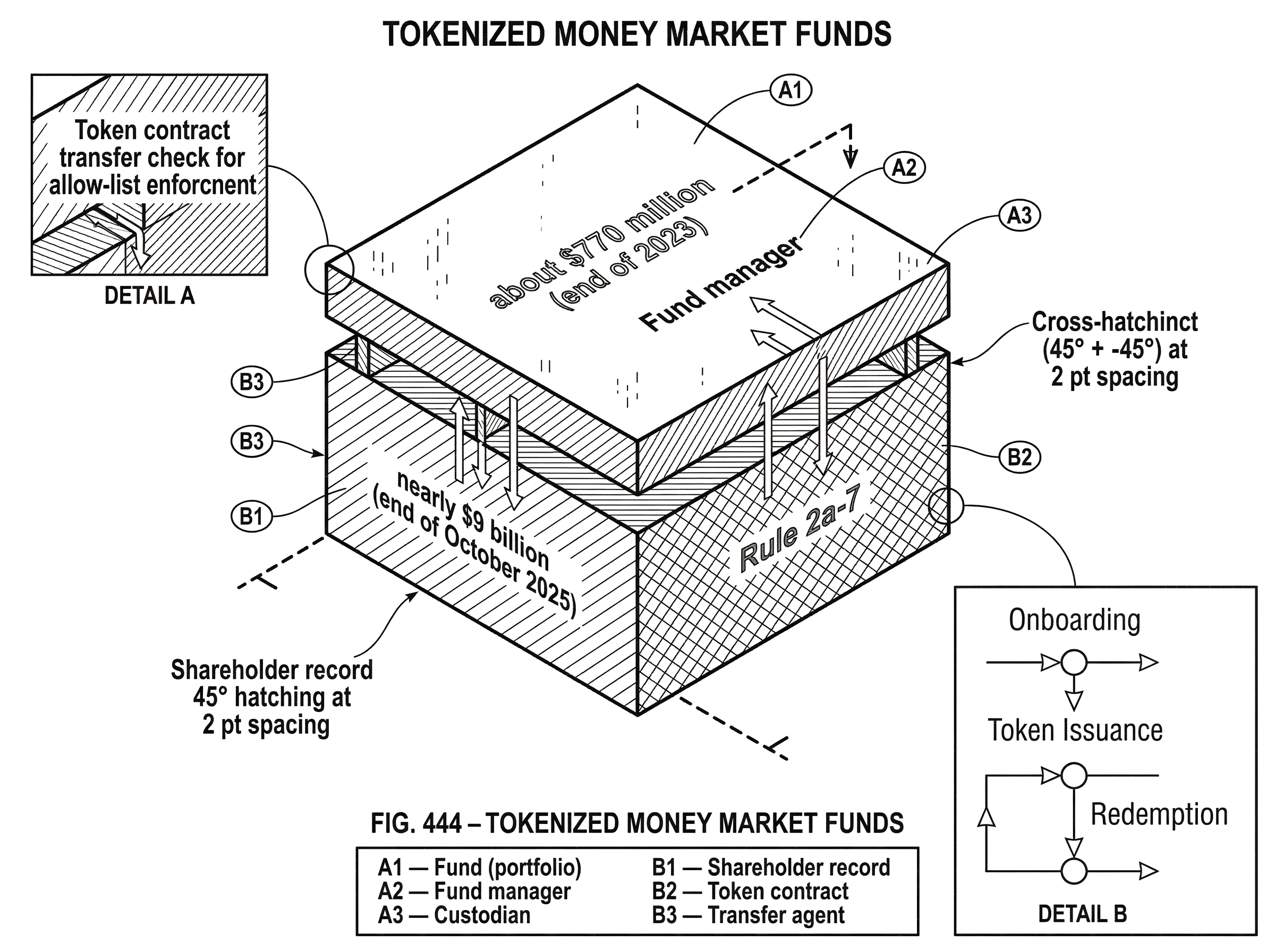
How do tokenized MMFs link off‑chain portfolios with on‑chain tokens?
| Layer | Where hosted | Primary function | Who controls | Settlement character |
|---|---|---|---|---|
| Fund (portfolio) | Off‑chain custodial systems | Asset selection and custody | Fund manager and custodian | Conventional settlement timelines |
| Shareholder record | Off‑chain books or synchronized ledger | Onboarding, redemptions, recordkeeping | Transfer agent / administrator | Daily reconciliation point |
| Token contract | Blockchain (eg Ethereum) | Transfer, collateralization, visibility | Smart contract + issuer controls | Near‑real‑time on‑chain transfers |
The basic mechanism has three layers, and the reason there are three is that tokenization does not erase the old financial system. It adds a programmable ownership layer on top of it.
The first layer is the fund itself. A manager creates or uses a money market fund that holds eligible short-term assets. Those assets remain in conventional custody arrangements and are valued under conventional MMF rules. Daily and weekly liquidity buffers, weighted average maturity, weighted average life, pricing, and portfolio reporting still matter because the token does not change the underlying portfolio risk.
The second layer is the shareholder record. Someone still needs to maintain who owns what, process subscriptions and redemptions, and distribute income. In conventional securities markets, these are transfer-agent-style functions. The SEC describes transfer agents as the parties that record changes of ownership, maintain security holder records, issue or cancel certificates, and distribute dividends. Tokenization does not eliminate those functions; it changes the tools used to perform them. In many TMMF structures, the blockchain ledger becomes part of the ownership record or a synchronized representation of it, but off-chain books and regulated intermediaries remain crucial.
The third layer is the token contract on a blockchain. This is the instrument investors actually hold in a wallet. The token can be transferred between approved addresses, shown as collateral, or sometimes used in other on-chain arrangements. Depending on the design, the token may live on Ethereum, Stellar, Polygon, or another network. The BIS notes that early activity leaned more heavily on Stellar, while institutional products increasingly favored Ethereum as smart-contract functionality and validator security became more important.
A worked example makes the interaction clearer. Imagine an institutional investor wants to move idle on-chain dollars into a tokenized government money market fund. The investor first completes onboarding with the fund administrator, who checks identity, eligibility, and anti-money-laundering requirements. Once approved, the investor’s wallet address is placed on an allow list. The investor subscribes to the fund through the normal process, and in return receives blockchain tokens representing fund shares. Over time, the underlying portfolio earns money market income. Depending on the product design, that return may appear through an increasing share value, a stable share value with accrued distributions, or another fund-specific method. If the investor later wants cash, the token is redeemed through the administrator, the shares are cancelled or burned in the token system, and the investor receives the corresponding cash or sometimes a linked digital cash instrument.
Every step in that story reveals the hybrid nature of TMMFs. The onboarding and eligibility checks are off-chain compliance functions. The fund accounting and custody of Treasury bills or repo positions are off-chain finance functions. The token transfer is on-chain. The whole product works only because these layers remain synchronized.
Why are tokenized MMF transfers typically permissioned and how is that enforced?
| Access | Typical transfer rule | Compliance fit | On‑chain openness | Best for |
|---|---|---|---|---|
| Permissioned token | Verified holders only (allow‑list) | Strong AML/CFT fit | Restricted transfers | Regulated fund shares |
| Permissionless token | Anyone with a wallet | Weak AML/CFT fit | Free transferability | Open DeFi assets |
| Hybrid (public chain, restricted token) | Public chain but gated holders | Designed for compliance | Network open, token restricted | TMMFs on public chains |
A common misunderstanding is to assume that once a fund share is tokenized, it can move as freely as any other blockchain token. In practice, that is usually false. Because TMMF shares are securities and because fund managers must satisfy investor eligibility and AML/CFT requirements, transfers are commonly permissioned.
This is where token standards such as ERC-3643 matter. The point of these standards is not just technical compatibility. It is compliance by design. They extend more basic token models by adding checks that ask whether a recipient wallet belongs to a verified, eligible holder before a transfer is completed. In other words, the smart contract becomes part of the transfer-control system.
This architecture explains why TMMFs can exist on public blockchains without becoming fully permissionless assets. The network itself may be open, but the token’s own rules restrict who can hold and receive it. That distinction is easy to miss. Public chain does not mean public access to every token on that chain.
Even so, the BIS notes an important caveat: allow lists constrain direct holding, but they are not perfect controls. Wrapping, repackaging, or platform-level trading can weaken the intended permission boundary. This is one of the recurring themes in tokenized finance. Compliance can be encoded, but not always completely enclosed.
What operational capabilities change when MMF shares are tokenized?
The most important change is not that the fund becomes “faster” in some vague sense. The real change is that the ownership claim becomes machine-readable and continuously mobilizable inside digital infrastructure.
On a blockchain, a token can be visible in near real time, can be moved outside traditional transfer windows, and can be linked to automated collateral or settlement logic. ECB material on tokenization in money markets emphasizes features such as 24/7 availability, shorter settlement windows, atomic exchange possibilities, and improved transparency. These features matter because conventional fund rails were not built for that style of usage.
Suppose a trading firm holds a conventional MMF position as liquidity reserve. Economically that is useful, but operationally the position may settle on traditional timelines, sit in separate record systems, and require manual coordination to use as collateral. If the same exposure is represented by a token integrated with digital market infrastructure, the firm may be able to mobilize it more directly. That is the mechanism behind the appeal of TMMFs in repo, uncleared derivatives margining, and digital treasury workflows.
This does not mean settlement is always fully on-chain. In fact, many current products are not. The BIS explicitly describes today’s TMMFs as operating in a hybrid on-chain/off-chain environment. Underlying securities are still custodied conventionally. Pricing often depends on off-chain sources or oracles. Redemptions often resolve through traditional payment rails or linked stablecoin arrangements rather than through native blockchain cash finality. So the gain is better described as partial programmability rather than full financial re-foundation.
How big is the tokenized MMF market today and who are the main holders?
The market has grown quickly from a small base. According to the BIS, total value locked in a sample of TMMFs rose from about $770 million at the end of 2023 to nearly $9 billion by the end of October 2025. That is rapid growth, even if the market remains small relative to the broader traditional MMF universe.
The composition of the investor base is also revealing. BIS analysis of Ethereum data found that DeFi protocol operators were major investors in BUIDL, described there as the largest TMMF at the time. That tells you demand is not coming only from conventional buy-and-hold fund investors. It is coming from actors who specifically value on-chain usability. In other words, the token form is not an incidental marketing choice. It is part of the product’s economic function.
The market is also concentrated. The BIS notes that for major funds such as BUIDL and WisdomTree’s WTGXX, around 90% of holdings were in the hands of only four wallet holders. That concentration matters because it means these products can look large on paper while still being dependent on a very small set of counterparties. A product designed to improve collateral mobility can, in its early phase, still be operationally narrow.
The chain choice has shifted as well. Some tokenized fund activity began on networks such as Stellar, where transfer and issuance were relatively straightforward. As institutional features became more important, activity moved more toward Ethereum, which the BIS says accounted for about half of TMMF TVL in its 2025 snapshot. That shift suggests institutions are valuing richer smart-contract ecosystems and deeper integration with other digital financial infrastructure.
Do tokenized MMFs eliminate liquidity mismatch and other classic MMF risks?
There is a temptation to think blockchain somehow solves liquidity problems because transfers are faster and records are more transparent. For money market funds, that intuition can be backwards.
The central risk is still liquidity mismatch. Investors may be able to redeem fund shares daily, or believe they can exit quickly, while the underlying assets settle on conventional timelines and may become harder to sell under stress. Tokenization does not make Treasury markets, commercial paper markets, or repo markets infinitely liquid. It only makes the claim on those markets easier to move.
In fact, the BIS argues that blockchain transparency can amplify run dynamics. If large movements or withdrawals are visible on-chain in real time, investors may respond faster and more synchronously. This is similar to a classic bank-run logic, but with better public observability and potentially lower friction for repositioning. What looks like transparency in normal times can become accelerant in stress.
That is why the older history of MMF fragility still matters here. Conventional MMFs have repeatedly faced redemption pressure severe enough to trigger official support measures. In March 2020, for example, the Federal Reserve established the Money Market Mutual Fund Liquidity Facility to support MMFs in meeting redemptions and preserve market functioning. The lesson is not that tokenized MMFs are uniquely fragile. The lesson is that tokenization does not erase the fragility already present in the underlying fund model.
What additional systemic risks arise from TMMF interconnection with stablecoins and DeFi?
If classic MMF risks remain, tokenization adds a second layer of vulnerability: tighter links to the rest of the digital-asset system.
Some TMMFs offer or partner on facilities that allow approved holders to exchange fund tokens for stablecoins quickly. That can be useful operationally because a user can move from yield-bearing collateral into transaction-ready digital cash without leaving the blockchain ecosystem. But it also creates a contagion channel. Stress in stablecoins can affect TMMFs, and stress in TMMFs can affect stablecoin users who rely on them for reserves or liquidity transformation.
The BIS also notes that TMMF tokens can be repackaged into other instruments or used as reserve assets backing stablecoins. Once that happens, the investor no longer faces only the risk of the underlying MMF. They face the layered risk of the wrapper as well. If those wrapped structures are then used with leverage, the system can produce the familiar pattern of collateral chains and deleveraging spirals.
This matters especially in strategies sometimes described as looping: posting one asset as collateral to borrow another, then reusing the proceeds to obtain more of the first asset or a related yield-bearing instrument. In benign conditions, this boosts returns. In stress, it forces synchronized selling. The FSB’s broader tokenization work highlights leverage, interconnectedness, liquidity mismatch, and operational fragilities as core financial-stability vulnerabilities. TMMFs are a concrete place where those abstract concerns can meet a real asset class.
How do existing MMF regulations apply to tokenized money market funds?
Another misconception is that tokenized MMFs exist outside the normal fund rulebook. The evidence points the other way. Regulators generally treat tokenization as a new operating layer on top of existing product law, not as a new exemption from it.
That is clear across jurisdictions. The EU MMF Regulation still governs eligible assets, valuation, liquidity buffers, reporting, and the prohibition on external support. US money market funds remain constrained by rules on liquidity, maturity, disclosure, and stress testing. Hong Kong’s SFC takes a “see-through” approach: the tokenized product must still meet the applicable authorization rules for the underlying investment product, with additional safeguards for the tokenization arrangement. The UK FCA similarly frames tokenized funds as authorized funds operating with new register and dealing models rather than as entirely separate legal species.
The practical consequence is that designers cannot ask only, “Can this token move on-chain?” They must also ask, “Who maintains the ownership record? What counts as final settlement? How are redemptions suspended if required? How is pricing sourced? Who is responsible for operational failures? How are investors onboarded? What happens across jurisdictions?” Those questions are not side issues. They are the product.
This is also why transfer-agent-style functions remain so important. Someone must still maintain accurate records of security holders, process corporate actions or distributions, and reconcile legal ownership. Tokenization can streamline these functions, but it does not make them disappear.
Which blockchains host tokenized MMFs and how do chain choices affect them?
TMMFs are not tied to a single chain architecture. The current market already shows different choices depending on what the issuer values.
Ethereum has become a major venue because it offers strong smart-contract composability and a deep ecosystem where tokenized assets can interact with wallets, custodians, DeFi protocols, and settlement experiments. That makes it attractive when the point of tokenization is not merely digital bookkeeping but integration with programmable financial infrastructure.
Stellar saw earlier use because asset issuance and controlled transfer are relatively straightforward there, which can be helpful when the product is closer to a permissioned digital register. Polygon has also appeared in institutional tokenized fund examples, including ECB material discussing tokenized MMF products launched across Ethereum and Polygon. The broader lesson is that the concept is architectural rather than chain-specific: a TMMF is defined by tokenized fund ownership plus regulated MMF exposure, not by loyalty to one network.
What changes across chains are mostly operational trade-offs: validator model, transaction costs, privacy tooling, compliance hooks, ecosystem depth, and how easily the token can connect to other digital cash or collateral rails. Those choices affect usability, but they do not change the underlying fact that the token remains a claim on a regulated off-chain portfolio.
What are the strengths and limitations of tokenized money market funds?
The durable insight behind tokenized money market funds is that there is real demand for an asset that is simultaneously cash-like, yield-bearing, and digitally mobilizable. That is the need stablecoins only partially satisfy and conventional MMF shares satisfy only off-chain. TMMFs are a plausible answer because money market funds already exist, already hold short-term instruments, and already serve treasury functions in traditional finance.
Where the idea breaks down is where people assume tokenization changes economic substance. It does not make the underlying assets settle instantly. It does not remove liquidity mismatch. It does not eliminate regulatory obligations. It does not guarantee unrestricted transferability. And it does not automatically deliver full decentralization, because most current designs depend on administrators, custodians, pricing systems, onboarding checks, and legal wrappers outside the chain.
So the right way to see TMMFs is not as “MMFs rebuilt from scratch on crypto rails.” They are better understood as regulated money market fund claims given a tokenized interface. That interface can be valuable enough to matter, especially for collateral and treasury use. But its value depends on a stack of assumptions holding together: the fund remains well managed, the off-chain record matches the on-chain token, redemption works when needed, compliance controls remain effective, and settlement connections to digital cash stay credible.
Conclusion
A tokenized money market fund is, at bottom, a money market fund share with a blockchain-native wrapper that makes it easier to hold, move, and use inside digital markets. The reason it exists is straightforward: investors want the yield and asset quality of short-term funds, but they also want the speed and programmability of tokenized infrastructure.
That combination is useful, but not magical. The token improves mobility; it does not erase the underlying fund’s legal, operational, or liquidity constraints. If there is one point to remember tomorrow, it is this: tokenized money market funds are not on-chain cash; they are regulated fund claims adapted for on-chain use.
Frequently Asked Questions
A tokenized money market fund is not a stablecoin or “cash on-chain”: it is a regulated fund share represented by a blockchain token, so legal ownership remains a claim on an off‑chain portfolio and the token is treated as a security rather than a native money‑market cash instrument.
No - most TMMF tokens are permissioned in practice: transfers commonly require onboarding, allow‑lists, and smart‑contract checks (e.g., standards like ERC‑3643) to enforce investor eligibility, although wrapping or platform trading can sometimes weaken those controls.
Not automatically; TMMFs typically operate in a hybrid on‑chain/off‑chain model where the underlying securities, custody, pricing and redemptions remain off‑chain, so token transfers do not by themselves guarantee instant settlement or cash finality.
Beyond the classic liquidity‑mismatch risk of MMFs, tokenization adds interconnection risks: TMMFs can be repackaged or used to back stablecoins, create contagion channels with stablecoin markets, enable leveraged ‘looping’ strategies, and make run dynamics faster because on‑chain movements are highly visible.
Regulators generally treat tokenization as an additional operating layer rather than a way to escape fund rules: tokenized MMFs must still meet existing MMF regulations (e.g., EU MMFR categories, US Rule 2a‑7) and supervisory requirements, while supervisors expect governance, custody, onboarding and recordkeeping to remain enforceable.
Yes - TMMFs are attractive as on‑chain collateral because they are yield‑bearing and transferable within digital markets, but their collateral usability is constrained by permissioning, off‑chain settlement links, and regulatory limits (for example restrictions under some MMF frameworks on securities‑lending or cash‑borrowing).
Pricing and NAV remain anchored to off‑chain valuation and fund rules; while oracles and on‑chain feeds may be used, how to operationalise on‑chain NAV calculations and reconcile them with regulatory valuation requirements (e.g., EU rules) is still unresolved and typically depends on off‑chain accounting and administrators.
Related reading