What Is 24/7 Trading?
Learn what 24/7 trading really means, how near-continuous markets work, and why market data, clearing, and liquidity matter as much as hours.
Introduction
24/7 trading is the idea that a market can remain available continuously, rather than opening and closing at fixed times each business day. That sounds like a small scheduling change. It is not. Once a market moves toward round-the-clock access, it has to answer deeper questions: when does a trading day begin and end, how do quotes and trades get consolidated, when do clearing systems apply settlement guarantees, and what safeguards still work when liquidity is thin and participants are scattered across time zones.
In traditional U.S. equity markets, the visible opening bell and closing bell are only the surface of a larger coordination system. Exchanges, market-data processors, brokers, and clearinghouses all use those shared boundaries to reset systems, process corporate actions, assign trade dates, and manage risk. Moving toward 24/7 trading means redesigning that coordination without losing the integrity that those boundaries quietly provided.
That is why the current push is usually not literally 24 hours a day, 7 days a week in the strict sense. In the U.S. equity market, the actual proposals and approvals are mostly near-continuous weekday trading: sessions that run from Sunday night through Friday evening, with a planned one-hour pause on weekday evenings for technical refreshes. The label “24/7” captures the ambition, but the mechanism is closer to 24x5 or 23x5, because continuous trading is constrained by market data, clearing, maintenance, and supervision.
The key idea is simple: a market is not just a venue where orders match. It is a synchronized network of trading, data, and settlement systems. 24/7 trading exists because investors increasingly want to react to news whenever it happens, hedge outside local market hours, and trade on a schedule that fits a global market rather than a single country’s workday. But whether that works well depends on how the rest of the network adapts.
Why did traditional markets have fixed trading hours?
| Model | Operational window | Data & reporting | Clearing & settlement | Liquidity profile |
|---|---|---|---|---|
| Fixed trading day | Predictable downtime | Daily consolidated tape | Daily trade-date assignment | Concentrated two-sided depth |
| Continuous trading | No natural downtime | Requires extended consolidated data | Ongoing intraday clearing needed | Fragmented, thinner depth |
A fixed trading day solves a coordination problem. If everyone knows when trading starts and stops, a large number of dependent processes can be organized around those boundaries. Exchanges can maintain systems during downtime. Market-data processors can reset and publish a clear daily record. Clearing systems can determine which trades belong to which trade date. Firms can reconcile positions, calculate margin, process cash movements, and handle corporate actions like splits or dividends.
None of those tasks are conceptually impossible in a continuous market. But when the market never really closes, they become harder to schedule and harder to make legible. A closing boundary does two things at once: it marks the end of price formation for the day, and it creates an operational window in which the rest of the financial system can catch up. That is why the move to 24/7 trading is not mainly about matching engines staying awake. Matching orders is the easy part. The harder part is preserving a coherent market day when the clock no longer gives you one for free.
There is also a price-formation reason. Liquidity is not evenly distributed through time. During normal business hours, more participants are active, more quotes are visible, and more competing orders narrow spreads. When fewer participants are present, prices can still move, but they tend to move with less depth behind them. That means the market can remain open while becoming less robust. The practical question is not only whether trading can happen at all times, but whether prices formed at those times are reliable enough for execution, reference, and risk management.
What does 24/7 trading mean for market structure?
| Design | Primary change | Who adapts | Key dependency | Effect |
|---|---|---|---|---|
| Venue-level continuity | Exchange session extension | Exchanges and brokers | Venue rules and ports | Longer matching window |
| Data-level continuity | SIP/processors extended hours | Data processors and vendors | Consolidated tape uptime | Continuous public quotes |
| Clearing-level continuity | Extended clearing coverage | Clearinghouses and brokers | CCP overnight guarantees | Settlement aligned with trade date |
In market structure terms, 24/7 trading means extending the time window in which orders can be entered, matched, reported, disseminated, and cleared, while redefining the boundaries that used to be tied to the regular session. The phrase covers several distinct designs that are easy to blur together.
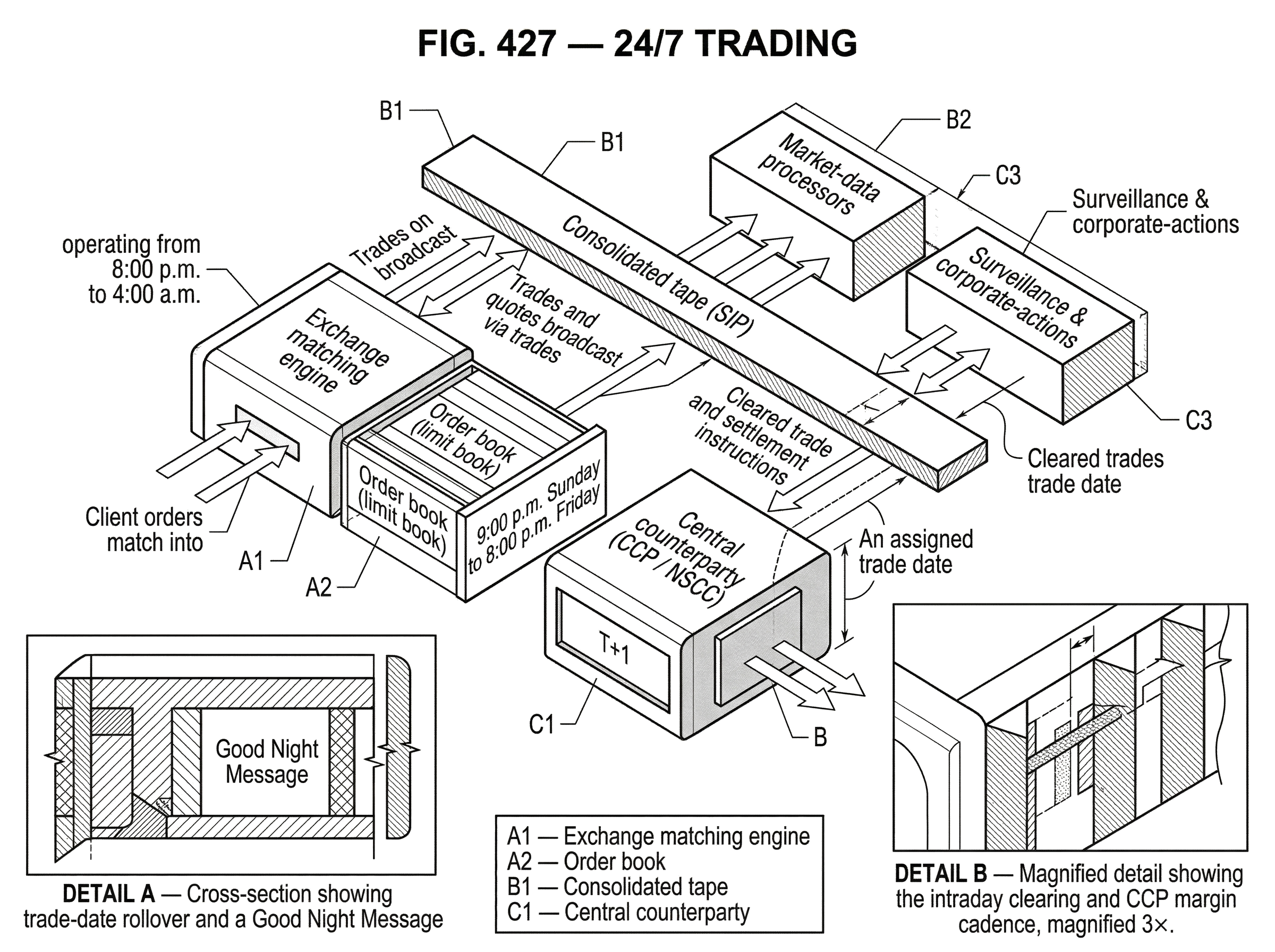
The first design is venue-level continuity. An exchange or alternative trading system may allow trading outside regular hours, including overnight. For example, 24X National Exchange was approved as a national securities exchange with a fourth trading session, the 24X Market Session, operating from 8:00 p.m. to 4:00 a.m. on nights preceding a U.S. business day. Nasdaq has proposed a Night Session from 9:00 p.m. to 4:00 a.m., paired with a daytime session from 4:00 a.m. to 8:00 p.m. In both cases, the exchange is not claiming that the entire ecosystem is fully continuous; it is proposing to extend the matching window.
The second design is data-level continuity. In U.S. equities, the consolidated tape and consolidated quotation system are governed by the Equity Data Plans and their processors. Extending exchange trading hours is not enough if consolidated quotes and trades are unavailable during those hours. That is why the CTA/CQ and UTP plan amendments are so important: they propose extending processor operating hours from 9:00 p.m. Sunday to 8:00 p.m. Friday, with a one-hour pause from 8:00 p.m. to 9:00 p.m. Monday through Thursday for technical refreshes. This means that overnight trading is being built not only at the venue level but at the consolidated-data level.
The third design is clearing-level continuity. DTCC’s materials on the shift to 24x5 make clear that clearing has to stay aligned with the trading window if overnight activity is to be more than a loosely connected side market. NSCC has described extending operating hours and applying its central counterparty guarantee to overnight transactions, while keeping settlement aligned with the existing T+1 framework. This is the point where 24/7 trading stops being a user-facing feature and becomes a change in the plumbing of the market.
So the practical meaning of 24/7 trading is not “the screen is always on.” It is a coordinated extension of matching, data dissemination, trade reporting, trade-date assignment, and clearing support across a much longer weekly interval.
How do exchanges create a legible near‑continuous trading day?
The hardest problem in 24/7 trading is not continuous time itself. It is making continuous time count as distinct market days. A market still needs to know which trades belong together for reporting, settlement, statistics, and regulation.
That is why proposed and approved systems create an artificial daily boundary even when trading spans midnight. Under the proposed Equity Data Plan changes, the processor would treat a trade date as beginning at 8:00 p.m. Eastern Time on the day before regular trading hours begin and ending at 8:00 p.m. on that day. Nasdaq’s proposal similarly assigns trades entered after the night session begins but before midnight to the next calendar day’s trade date. DTCC describes a related operational convention through its UTC “Good Night Message,” which standardizes the moment after which trades roll to the next trade date.
This is a good example of what is fundamental and what is conventional. It is not fundamental that a trade date must align with midnight. That is convention. What is fundamental is that the system needs a shared, deterministic cutoff so that everyone assigns the same trade to the same accounting and settlement cycle. Without that invariant, reconciliation would become chaotic.
The one-hour evening pause exists for the same reason. At first glance it seems to contradict the idea of continuous trading. In reality it is a compromise that keeps the rest of the system manageable. The UTP filing states directly that avoiding the pause would require designing and funding a duplicate fully continuous processor architecture, with corresponding burdens for participants. The pause allows exchanges, processors, and firms to refresh systems and process changes that still need a clean boundary. In other words, the pause is not evidence that 24/7 trading has failed. It is evidence that market continuity is limited by infrastructure continuity.
A worked example makes this clearer. Imagine a stock is actively traded on a Thursday evening after major news breaks in Asia. Orders begin interacting on an overnight exchange session at 9:30 p.m. Eastern Time. The matching engine can execute them immediately, but several other things have to happen in parallel. The quote and trade need to be disseminated through the appropriate market-data infrastructure, the trade has to be tagged as outside regular trading hours, the processor has to know which trade date that execution belongs to, and the clearing system has to capture it under the right settlement cycle. If the overnight market runs through midnight, nothing magical happens at 12:00 a.m.; what matters is whether the system’s defined rollover point has been crossed. Then, when the evening technical pause arrives on a later day, trading stops briefly not because participants lost interest, but because the market’s shared machinery still needs a reset point to stay synchronized.
That is the mechanism in plain terms: continuous access is created by replacing the old open/close boundary with a different, explicitly engineered daily boundary.
Why does extending trading hours often thin liquidity?
A common intuition is that longer trading hours should produce more liquidity because there is more time to trade. That is only partly true. Time does not create liquidity by itself. Liquidity comes from overlapping willingness to trade. If participants are spread over more hours without a comparable increase in total activity, the same amount of interest is simply distributed more thinly.
That thinning matters because it changes execution quality. Wider spreads, smaller displayed size, and larger price impact are all more likely when fewer firms are quoting competitively. This is why exchanges designing overnight sessions often restrict order functionality. 24X noted that some order types, including market orders and pegged orders, are ineligible during its overnight session. Nasdaq’s proposed Night Session likewise excludes many order types and attributes. These are not arbitrary omissions. They are attempts to limit behaviors that become riskier in a sparse book, where reference prices are less stable and aggressive orders can move the market sharply.
The deeper point is that continuous trading expands access faster than it expands two-sided depth. This is good for someone who urgently needs to trade after news, but less good for someone who assumes that an overnight price carries the same informational quality and execution certainty as a mid-session price during the regular day.
Empirical work on after-hours Nasdaq trading helps explain why. A study of after-hours trading found that prices are more efficient during the trading day than after hours, even though after-hours trading still contributes meaningful price discovery. It also found that individual after-hours trades can be more informative, especially before the open, while post-close trading can have a lower signal-to-noise ratio and more temporary price effects. The lesson is subtle but important: overnight prices are not useless; they are often more fragile. They may reflect real information, but they do so in a thinner environment where reversals are more common.
How does 24/7 trading change price discovery?
Price discovery is the process by which dispersed information becomes reflected in market prices. In a scheduled market, a lot of this process is concentrated near the open and close because that is when new information accumulated during downtime gets forced into active trading. In a 24/7 market, the hope is that information gets incorporated more continuously.
That hope is partly right. If a geopolitical event, earnings release, central-bank statement, or macro surprise occurs outside normal U.S. hours, a longer trading window gives market participants a way to react immediately rather than waiting for the next open. That can reduce the need for a dramatic gap at 9:30 a.m. because some repricing happens earlier. For globally followed securities and exchange-traded products, this is a real benefit.
But the consequence is not simply “better price discovery sooner.” It is often earlier but noisier price discovery. During regular hours, more market makers, institutional investors, arbitrageurs, and hedgers are active at once. Their participation disciplines prices. Overnight, some of those participants reduce activity or quote more cautiously, especially if hedging tools or correlated markets are less available. So information can enter the price earlier, but the path it takes may be more erratic.
This is why consolidated market-data rules propose marking trades executed outside regular trading hours as . T trades. Those trades would still count toward total trade volume for certain revenue calculations, but would not be used to determine the daily high, low, or last sale. The design choice reveals an important judgment: overnight trades are part of the market, but they should not automatically redefine the canonical daily reference statistics used by a broader audience. That is not because they are unreal. It is because the market recognizes that the informational context is different.
Which market infrastructure components must change for 24/7 trading?
| Dependency | What must change | Risk if missing | Who pays |
|---|---|---|---|
| Market data | Extend SIP operating hours | Unavailable consolidated quotes | Data consumers and exchanges |
| Clearing | 24x5 CCP guarantees and monitoring | Unmonitored counterparty exposure | Clearing members and CCPs |
| Corporate actions | Real‑time directory and entitlements | Incorrect entitlements or mismatched records | Listing markets and brokers |
| Surveillance | 24/7 monitoring and escalation | Delayed enforcement and blind spots | Exchanges and regulators |
The cleanest way to misunderstand 24/7 trading is to think it is mainly an exchange decision. It is not. A venue can extend its own session hours, but a durable move toward 24/7 trading depends on several outside systems being ready at the same time.
Market data is the first dependency. In U.S. equities, exchanges do not operate as isolated price islands. Quotes and trades are collected, consolidated, processed, and disseminated under national market system plans. Nasdaq’s proposal explicitly says it will not commence Night Session operations unless the Equity Data Plans have established a mechanism to support quotation and transaction dissemination during those hours. The 24X approval order similarly notes that 24X will join applicable national market system plans. This matters because a market without widely disseminated data is not just less visible; it is structurally different. Best execution, routing logic, price protection, and surveillance all depend on reliable shared information.
Clearing is the second dependency. Trading can occur without central clearing support, but scaling it safely is much harder. DTCC’s 24x5 materials stress that NSCC intends to extend clearing hours and central counterparty guarantees to overnight transactions, while monitoring exposures every 15 minutes and preserving tools like intraday margin calls. The reason is straightforward: when trading hours expand, the window for unmonitored counterparty exposure expands too. If the market stays open while clearing remains effectively “daytime only,” the mismatch creates operational and risk-management strain.
Corporate actions and symbol management are a third dependency. A stock split, dividend, name change, halt, or listing change has to be reflected consistently across exchanges, processors, brokers, and clearing systems. The plan amendments for extended SIP hours make implementation conditional on listing markets being able to support directory and corporate-action information during the longer window. This sounds administrative, but it goes to the heart of market integrity. If one part of the system thinks a symbol or entitlement changed and another part does not, overnight trading can produce confusion that is much more damaging than a few lost minutes of access.
Surveillance is a fourth dependency. 24X intends to outsource certain regulatory functions to FINRA through a regulatory services agreement while retaining legal responsibility for regulation. That arrangement highlights a broader point: market monitoring has to follow the market into extended hours. A near-continuous venue cannot assume that the same staffing patterns, alert thresholds, and escalation paths that worked for a shorter day will remain sufficient.
Why are exchanges adopting near‑24/7 trading despite the challenges?
If 24/7 trading is operationally harder and often less liquid, why push for it? Because it solves a real timing mismatch between modern information flow and traditional market hours.
News is already continuous. So are global macro markets, many derivatives markets, and digital-asset markets. Investors with exposures spanning regions do not stop facing risk just because a local cash equity exchange is closed. If a major event happens at 11:00 p.m. Eastern Time, waiting until the next morning can leave firms and individuals unable to adjust positions, hedge exposures, or express updated views. That problem becomes more visible as participation becomes more global.
There is also competitive pressure. Nasdaq’s filing notes that some alternative trading systems already offer 24/5 or 24/7 trading, and national exchanges do not want extended-hours demand to migrate entirely into other venues. In that sense, 24/7 trading is partly an access innovation and partly a venue-competition response. Once a credible overnight market exists somewhere, incumbent exchanges face pressure to provide a comparable session with their own rulebook, technology, and market-data footprint.
For some users, the value is practical rather than speculative. Global asset managers may want to rebalance when other regional markets are open. Retail investors may want to react to earnings releases or macro news outside work hours. Market makers may want to internalize or hedge risk sooner. The point is not that all participants value overnight access equally. The point is that enough of them do for exchanges and infrastructure providers to spend real effort building it.
When does 24/7 trading fail to deliver better outcomes?
The strongest misconception about 24/7 trading is that more access is automatically better for everyone. Access is a capability, not a guarantee of good outcomes.
The most immediate breakdown is execution quality. If an investor trades at a time when the book is thin, the ability to trade may come at the cost of a worse price. That is not a defect in the concept so much as a consequence of sparse participation. The market can be open and still not be deep.
Another breakdown is false symmetry. A market that is open overnight is not the same market as the regular daytime session with the same rules stretched across more hours. Order types may be limited. Reference prices may behave differently. Official daily statistics may exclude overnight trades from high-low-last calculations. Clearing and market data may use special trade-date conventions. A user who ignores those differences may think they are trading in a familiar environment when they are really in a distinct microstructure regime.
There is also an operational fragility point. The proposed systems are explicit that “24/7” really means near-continuous trading with planned pauses and readiness conditions. Processor changes depend on technical development and on clearing availability. Exchange launches depend on SIP readiness. Cost allocation has to be agreed among participants. These are not side issues. They show that round-the-clock trading is only as continuous as its least flexible shared dependency.
And there is a regulatory and governance constraint. Exchanges are self-regulatory organizations, which means governance, ownership limits, surveillance arrangements, and dedicated regulatory funding matter. The 24X approval order spent substantial attention on these topics, including ownership and voting limits, member representation, regulatory funding, and conditions tied to FINRA and Rule 17d-2 plans. That emphasis makes sense. Extending hours changes not only commercial opportunity but also the duration and complexity of the exchange’s regulatory obligations.
Key takeaways about near‑continuous (24/7) trading
24/7 trading is best understood as an attempt to make market access continuous without making market coordination collapse. The visible change is longer trading hours. The real change is underneath: redefining the trading day, extending consolidated data, aligning clearing and settlement, and managing the fact that liquidity does not stay constant as time expands.
That is why the current U.S. equity model is converging on something more precise than the slogan. It is not pure uninterrupted 24/7 operation. It is near-24-hour weekday trading with engineered boundaries (especially a nightly technical pause and explicit trade-date rollover rules) so that the market can remain legible to exchanges, brokers, processors, clearinghouses, and regulators.
The simplest durable takeaway is this: 24/7 trading is not mainly about keeping the exchange open. It is about keeping the entire market system synchronized when the exchange no longer closes.
Frequently Asked Questions
Because a continuous matching engine doesn’t by itself assign trades to accounting, reporting, and settlement cycles, U.S. proposals create an explicit daily cutoff (e.g., the SIP/processor convention that a trade date begins at 8:00 p.m. ET the prior evening or Nasdaq’s convention that night‑session trades roll to the next calendar day) so all participants deterministically assign trades to the same trade date.
The one‑hour evening pause (typically 8:00 p.m.–9:00 p.m. ET on weekdays in the filings) is a pragmatic compromise that gives consolidated processors and participants a predictable window for technical refreshes and state synchronization without building a fully redundant continuous processor architecture; regulators and filings treat it as part of “near‑24/7” operation rather than a failure of the concept.
24/7 proposals extend matching, consolidated data dissemination, and clearing support, but those three layers must be aligned: exchanges can open new sessions (venue‑level), SIPs must operate during those hours (data‑level), and DTCC/NSCC must extend intraday monitoring and apply CCP guarantees to overnight trades (clearing‑level); the initiative only succeeds if all layers are ready and coordinated.
Longer hours don’t automatically deepen the book because liquidity reflects overlapping willingness to trade; spreading the same participant activity across more hours tends to thin two‑sided depth, producing wider spreads, smaller displayed size, and greater price impact, which is why exchanges commonly limit risky order types overnight.
Yes and no: extended hours let information be incorporated earlier (reducing some morning gaps), but price discovery overnight is often noisier and more fragile because key liquidity providers and hedging venues may be less active; regulators and SIP proposals therefore contemplate special markings (e.g., “.T” for out‑of‑regular‑hours trades) and exclude overnight trades from official daily high/low/last calculations.
Proposals and approvals already impose order restrictions in overnight sessions - examples include 24X barring market and pegged orders in its overnight session and Nasdaq excluding many order types and attributes for its Night Session - because aggressive orders are riskier in thinner books.
Because consolidated SIP operation, DTCC clearing changes, corporate‑action messaging, and surveillance staffing all have to line up, exchanges have made operation conditional on plan‑amendment effectiveness and clearing readiness; filings target industry testing and a possible December 2026 implementation but emphasize that launch is contingent on approvals and system readiness.
Extending hours increases operational and regulatory obligations - exchanges must join applicable national market system plans, secure regulatory services agreements (e.g., with FINRA), meet surveillance and governance conditions, and sometimes accept temporary ownership/voting limits or disclosure commitments as part of SEC approvals - so governance and oversight change along with hours.
Because consolidated data and clearing are decisive dependencies, a venue that opens overnight without SIP feeds and central‑counterparty coverage would produce a structurally different, harder‑to‑monitor market; filings therefore condition venue launches on SIP amendments, TRF dissemination decisions, and DTCC/NSCC extended‑hours capabilities to avoid fragmentation and unmanaged risk.
Related reading