What is Camelot DEX?
Learn what Camelot DEX is, how its Arbitrum-focused AMM, concentrated liquidity, dynamic fees, and modular pools work, and who it serves.
Introduction
Camelot DEX is a decentralized exchange on Arbitrum designed to provide liquidity infrastructure for the broader Arbitrum ecosystem. That sounds generic until you look at the actual design choice underneath it: Camelot is not trying to be only a simple token swap venue. It is trying to be a flexible liquidity layer that projects, traders, and liquidity providers can shape to fit different kinds of markets.
That matters because a DEX has two jobs that pull in opposite directions. Traders want low slippage, low fees, and reliable routing. Liquidity providers want fees that compensate them for risk, especially when prices move fast or when tokens are unusual. Protocol teams want launch support, incentives, and market structure they can tune. A basic AMM can do some of this, but not all of it well at once. Camelot’s usefulness comes from how it tries to balance those demands inside the Arbitrum ecosystem.
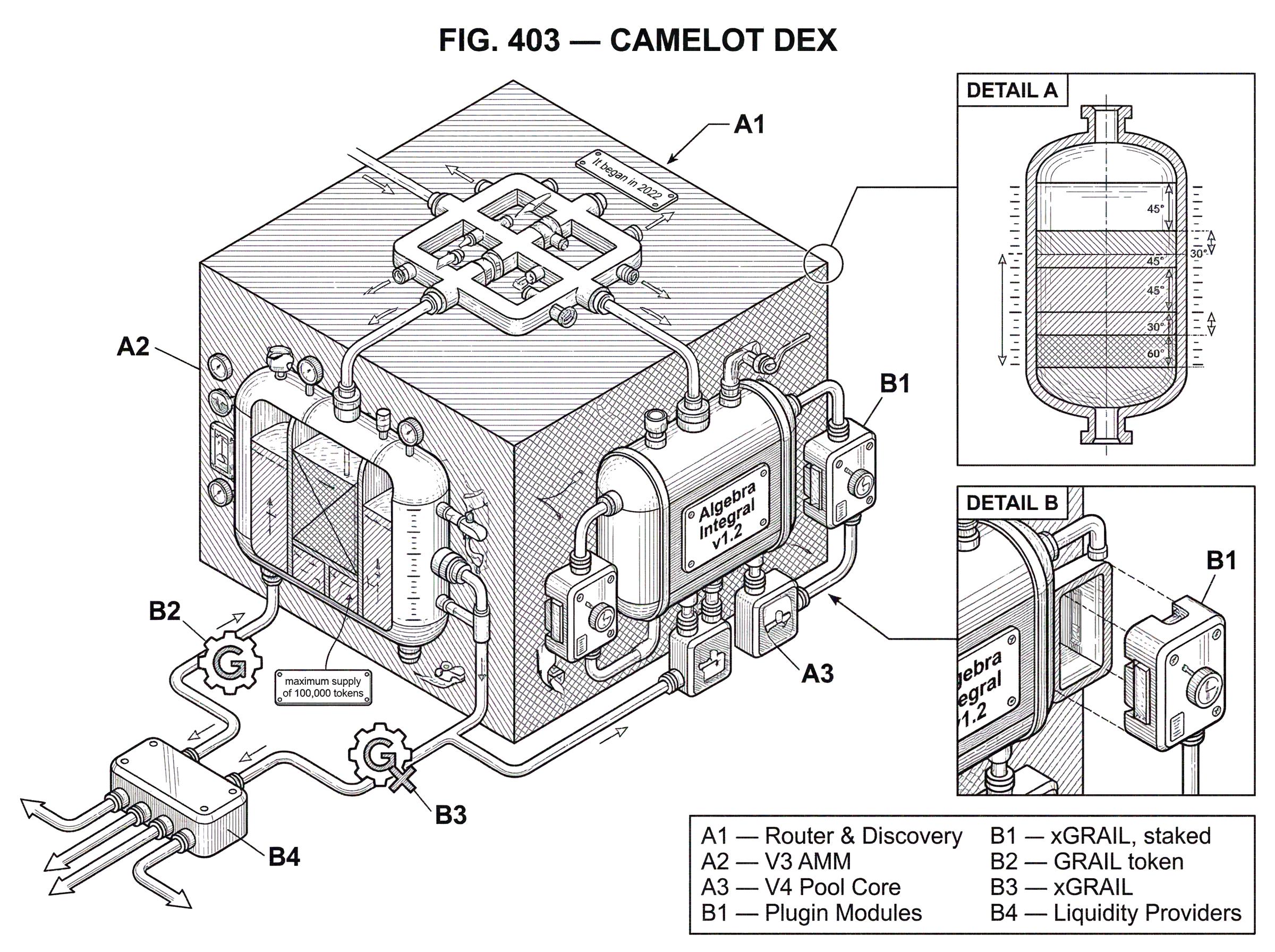
Camelot describes itself as decentralized and permissionless, and positions itself as a native Arbitrum exchange with efficient spot liquidity infrastructure. It began in 2022 and has expanded from Arbitrum One into Arbitrum Orbit chains as part of a broader vision it calls the Orbital Liquidity Network. At the highest level, then, Camelot is both a DEX people use today and an infrastructure project trying to coordinate liquidity across the Arbitrum family of chains.
Why does Camelot DEX exist and what market problems does it solve?
A decentralized exchange is not just an app for swapping tokens. Under the hood, it is a machine for keeping markets available without a central market maker. The hard part is that different assets behave differently. Stable pairs, volatile governance tokens, newly launched ecosystem assets, and rebasing tokens do not all need the same fee model, the same pool settings, or even the same surrounding logic.
Camelot’s answer is flexibility at the pool level. Instead of assuming one AMM design is enough for every market, it offers multiple AMM versions and, in its newer design, a modular system that lets pools carry different behaviors. This is the main idea that makes Camelot click: it treats liquidity pools as configurable pieces of infrastructure, not just interchangeable jars of tokens.
That choice explains who finds Camelot attractive. A regular trader may only notice that they can swap on Arbitrum. But projects launching tokens, liquidity providers choosing ranges, and developers who want custom pool behavior are the users who most directly benefit from Camelot’s design. The protocol is built for an ecosystem that wants market structure options, not only a default pool template.
How do swaps, routing, and execution work on Camelot DEX?
At the user-facing level, Camelot works like other DEXes. You connect a wallet, choose a token pair, review a quoted route, and submit a swap transaction. The protocol’s router is responsible for finding and executing paths across available liquidity. Audit materials describe a router architecture built around route discovery and execution, using adapter contracts to interact with different pool types.
That routing layer matters because liquidity on a modern DEX is fragmented by design. There may be multiple pools for the same pair, different fee settings, and different AMM implementations. A good route is not simply the shortest path from token A to token B. It is the path that gives the best effective execution after considering available liquidity, pool behavior, and fees. Camelot’s routing system exists to make that complexity usable.
For a trader, the experience is straightforward precisely because the complexity is pushed below the interface. Suppose someone wants to swap one Arbitrum ecosystem token for another. They do not need to decide whether the best path is a direct pool, a hop through a common quote asset, or a route that touches a different type of liquidity pool. The router searches available paths, returns a quote, and then executes the chosen trade. The mechanism is familiar, but the reason Camelot invests in it is that its market structure is more customizable than a single-pool DEX.
The trade-off is also familiar: routing quality depends on the correctness of integrations and adapter logic. Camelot has published audit links for protocol components and router-related code, but, as with any DEX, audits reduce risk rather than remove it.
Why does Camelot use concentrated liquidity and what are the trade-offs for LPs and traders?
| Model | Capital efficiency | Trader slippage | LP effort | Best for |
|---|---|---|---|---|
| Concentrated (tick-based) | High (range-focused) | Lower within active range | Active repositioning required | Volatile or launch tokens |
| Constant-product (xy=k) | Low (spread across range) | Higher in thin markets | Passive, less management | Stable pairs; passive LPs |
Camelot’s V3 and V4 AMMs use concentrated liquidity. The intuition is simple. In a traditional constant-product pool, liquidity is spread across the full theoretical price range, including prices that may never be reached. That keeps the design simple, but it wastes capital. Concentrated liquidity lets providers place capital only within chosen price ranges, so the same amount of capital can support deeper trading where activity is actually happening.
Camelot’s V3 AMM is based on Algebra v1.9, a tick-based concentrated liquidity design similar in broad shape to Uniswap v3. In a tick-based system, price space is divided into discrete intervals, and liquidity providers choose the range where they want their capital active. If the market price stays within that range, their liquidity is used efficiently and can earn fees with less idle capital. If price moves outside the range, the position stops being active until price returns or the provider repositions.
That produces the central bargain of concentrated liquidity. Capital efficiency improves, which can reduce slippage for traders and increase fee productivity for active LPs. But LPing becomes more strategic and more management-intensive. Passive liquidity across wide ranges is still possible, yet the design increasingly rewards users who understand volatility, price ranges, and how often they may need to adjust positions.
Camelot adds customization on top of this model. Its V3 docs highlight customizable tick spacing per pool. Tick spacing affects how finely LPs can position liquidity. A pool with tighter spacing can support more precise liquidity placement, while broader spacing may simplify the pool or better suit a market with different behavior. The point is not that one spacing is universally better. It is that different markets benefit from different liquidity granularity.
How do Camelot’s dynamic and directional fees work?
| Fee model | When fees rise | Trader cost predictability | LP compensation | Best for |
|---|---|---|---|---|
| Dynamic (Camelot V3) | Rising with volatility | Variable by condition | Responsive to adverse selection | Volatile token markets |
| Fixed (traditional AMM) | Never (static) | Predictable | May undercompensate in spikes | Stable low-volatility pools |
Fees on an AMM are not just a toll. They are also how LPs get paid for taking inventory risk. If fees are too low during sharp volatility, LPs may be undercompensated. If fees are too high during quiet conditions, trading becomes unnecessarily expensive. Camelot’s V3 tries to handle this with directional and dynamic volatility fees.
The basic mechanism is that pool fees can adjust with market conditions rather than staying fixed. Camelot says fees decrease in lower-volume, quieter periods and rise when volatility is higher. It also says fees can be directional, meaning buys and sells can have distinct volatility-based fee ranges. The exact mathematical parameterization is not specified in Camelot’s high-level docs, but the design intention is clear: use fees as a risk-sensitive control, not a static constant.
For traders, this means execution costs can vary with conditions. For LPs, it means the pool is attempting to charge more when adverse selection risk is higher. That does not eliminate impermanent loss or inventory risk, but it is an attempt to price those risks more intelligently than a fixed-fee pool can. In practice, this feature is most relevant in volatile token markets where the cost of being on the wrong side of fast-moving order flow is substantial.
What is Camelot V4’s plugin model and how do modular pools work?
Camelot’s V4 is where the protocol’s design becomes most distinctive. It integrates Algebra Integral v1.2 and uses a modular architecture that separates core liquidity storage from peripheral functions such as fees, oracles, and other pool logic. The important consequence is that non-core features can be updated or extended without migrating the liquidity itself.
This separation changes what a pool can be. In a monolithic AMM, the pool’s behavior is mostly fixed by the core contract. In Camelot V4, a pool can be extended through plugins. Camelot describes plugins as add-ons for a liquidity pool, and its current plugin set includes adaptive fees, a sliding fee, volatility and TWAP oracle functionality, and security features.
That plugin model is useful because it acknowledges a practical fact about onchain markets: the logic around a pool often matters almost as much as the swap invariant inside it. A project may want special fee behavior, extra oracle support, or additional safety controls. Developers can deploy custom pools with their own fee structures and plugins, while Camelot also maintains default pools surfaced as the standard frontend experience.
A concrete example makes this clearer. Imagine a protocol launching a token on Arbitrum that expects volatile early trading and wants tighter control over how liquidity behaves. On a simpler DEX, it might have to accept whatever the standard pool design offers. On Camelot V4, it can create a custom pool for the same token pair, configure different peripheral behavior, and even set a plugin fee so the deployer receives a share of swap fees. The pool is still an AMM, but the surrounding economic and operational logic becomes configurable.
That flexibility is powerful, but it introduces a trade-off. More custom behavior means more complexity, more room for integration errors, and more need to understand what kind of pool a user is interacting with. Camelot explicitly notes that AMM V4 is in beta and is being used to test plugin setups and configurations, which is useful context for anyone treating V4 as production infrastructure.
Which Camelot features matter for token projects, rebase tokens, and builders?
Camelot’s design also reflects the fact that not every token fits neatly into standard AMM assumptions. Its V4 docs note support for rebase tokens by directly distributing accrued rebasing tokens to liquidity providers rather than leaving those tokens stuck in pools. That is a narrow feature, but it shows the protocol’s orientation: it is built for an ecosystem with varied asset mechanics, not just plain ERC-20 spot pairs.
The protocol also allows an unlimited number of pools for the same token pair in V4, split between default pools and custom pools. This is good for experimentation and protocol-specific design, but it can fragment liquidity. Camelot’s router and frontend therefore matter even more, because users need help finding the pool and route that make sense without manually evaluating every variant.
For builders, this is part of Camelot’s appeal. The protocol’s stated goals include onboarding projects, providing broad token access with deep liquidity, and helping create sustainable yields. In plain language, Camelot is designed not just for someone making a swap, but for teams that need a market structure home inside Arbitrum.
What are GRAIL and xGRAIL and how do they affect rewards and plugin allocation?
| Token | Transferability | Primary use | How obtained | Best for |
|---|---|---|---|---|
| GRAIL | Transferable token | Native rewards token | Emissions and public sale | Traders and liquid holders |
| xGRAIL | Non-transferable (escrow) | Plugin allocation and governance | Stake GRAIL or farming | Long-term alignment and governance |
Camelot’s native token is GRAIL, on Arbitrum, with a documented maximum supply of 100,000 tokens. The docs describe GRAIL as a native token that can be earned as yield rewards. That makes it part of Camelot’s incentive layer: liquidity and participation are not only paid through trading fees, but also through token emissions and protocol-specific rewards.
The more distinctive piece is xGRAIL. Camelot defines xGRAIL as a non-transferable escrowed governance token corresponding to staked GRAIL. It can be earned from farming or by converting GRAIL, and its central use case is allocation to plugins. In other words, Camelot does not treat governance and rewards as purely liquid, freely transferable claims. It uses an escrowed form to tie some participation to longer-term alignment and protocol-specific utility.
There are limits to how far the public docs go here. They state that allocating xGRAIL to plugins provides various benefits, but the high-level pages do not fully specify all those benefits on-page. What is clear is the structure: GRAIL is the native token, while xGRAIL is the staked, non-transferable form used in plugin allocation and governance-related participation. That arrangement fits Camelot’s broader design philosophy of rewarding users who engage with the protocol more deeply than a one-time trader would.
What security controls does Camelot publish and what risks remain?
Camelot publishes an audit index and states that core components have been audited by firms including Paladin and BailSec, while its V3 and V4 AMMs rely on audited Algebra implementations. It also documents multisig structures for team and ecosystem control, including ownership of key contracts and treasury-related addresses.
The right way to read this is soberly. Audits and multisigs are meaningful risk controls. They show the protocol is not operating without review or operational structure. But they are not guarantees. Camelot’s own documentation is stronger on listing audits and multisig ownership than on providing detailed remediation narratives or incident reporting. That is common in DeFi, but users should understand the implication: using the protocol still involves smart contract, upgrade, routing, and market-structure risk.
Conclusion
Camelot DEX is best understood as Arbitrum’s configurable liquidity layer, not just another swap interface. Its core idea is that different markets need different pool behavior, so the protocol combines routing, concentrated liquidity, dynamic fees, and modular pool extensions to make onchain liquidity more adaptable.
That makes Camelot especially relevant for Arbitrum-native projects, active liquidity providers, and traders who benefit from deeper, more tailored markets. The simplest way to remember it is this: Camelot is a DEX built around the belief that liquidity should be programmable, not one-size-fits-all.
How do you trade on a DEX more effectively?
Trade on a DEX more effectively by checking liquidity, choosing the right order type, and limiting price impact; on Cube Exchange you can fund your account, view market quotes and depth, and place limit or market orders to control execution. Follow a clear pre-trade checklist and use concrete execution steps to reduce slippage and unexpected fills when accessing AMM liquidity.
Frequently Asked Questions
Camelot’s router discovers and evaluates multiple paths using adapter contracts that interact with different pool types, then returns a quoted route that balances available liquidity, pool behavior, and fees; routing quality therefore depends on correct integrations and adapter logic, and audits reduce but do not eliminate that risk.
Concentrated liquidity makes capital much more efficient and can reduce slippage for active price ranges, but it also requires more active position management - if price leaves an LP’s chosen range their liquidity becomes inactive - so passive providers may face higher operational complexity and inventory risk.
Camelot’s V3 supports dynamic and directional fees that rise with volatility and fall during quieter periods, and can charge different volatility‑based fee ranges for buys versus sells; however, the docs do not publish the exact mathematical parameterization (lookbacks, thresholds, or scaling factors).
AMM V4 separates immutable core liquidity storage from peripheral logic so pools can be extended with plugins (adaptive/sliding fees, oracles, security features, fee‑shares to deployers, etc.), enabling custom pool behavior without migrating liquidity while increasing integration complexity and risk because V4 and many plugins are currently in beta.
V4 permits an unlimited number of pools for the same token pair (default and custom pools), which supports experimentation but can fragment liquidity and make discovery harder; Camelot’s router and frontend aim to help users find appropriate pools, though the docs do not fully specify how default pools are chosen or surfaced in the UI.
GRAIL is Camelot’s native token (the docs state a maximum supply of 100,000) that can be earned via yield rewards, while xGRAIL is a non‑transferable escrowed governance/staked form used to allocate to plugins and capture protocol alignment; the public docs describe these roles but do not fully specify all conversion, lockup, or plugin‑benefit mechanics on‑page.
Camelot publishes multiple third‑party audits (e.g., Paladin, BailSec) and documents multisig ownership for key contracts and the treasury, which are meaningful risk controls, but the docs and audit listings do not guarantee safety, and remediation details or post‑audit mappings to deployed addresses are not comprehensively summarized.
AMM V4 includes explicit support for rebasing tokens by distributing accrued rebasing token balances to liquidity providers rather than leaving rebases stuck in the pool, reflecting Camelot’s orientation toward tokens with nonstandard mechanics.
Related reading