What is Luno?
What is Luno? Learn how Luno works as a centralized crypto exchange for buying, trading, custody, staking, and API-based access.
Introduction
Luno is a centralized crypto exchange and custody platform that turns a messy set of crypto tasks into a single managed service.
- funding an account
- storing assets
- placing trades
- moving between fiat and crypto
That matters because most people do not want to assemble their own wallet setup, learn private key management, and connect to multiple venues just to buy or trade digital assets. Luno’s basic promise is simpler: open an account, verify your identity where required, deposit funds, and use an app or exchange interface to buy, sell, hold, and in some cases stake or trade crypto.
The useful contrast is with self-custody. In self-custody, the user controls keys and bears most of the operational burden. In Luno’s model, Luno operates the infrastructure and holds assets on the customer’s behalf, so the product is easier to use but requires trust in the platform’s controls, solvency, and operations. Once that trade-off is clear, most of the product starts to make sense.
What services does Luno offer beyond just buying Bitcoin?
| Product | Best for | Complexity | Custody model | Key benefit |
|---|---|---|---|---|
| Buy | Newcomers / passive investors | Very low | Custodial | Simple fiat on‑ramp |
| Trade | Active retail traders | Medium | Custodial | Order‑book execution & charts |
| Earn (Staking) | Yield seekers | Low–Medium | Custodial (pooled) | Earn network rewards without infra |
| Predict (Markets) | Speculators | Medium | Custodial | Express market views |
| API / Institutional | Developers & institutions | High | Custodial | Programmatic access & deeper liquidity |
At first glance, Luno looks like a place to buy Bitcoin. That is true, but incomplete. The underlying product is managed access to crypto markets and crypto custody. Buying is just the first interaction. After that, users need somewhere to keep assets, a way to value them, ways to convert back into local currency, and sometimes tools to trade more actively or earn yield from supported assets.
Luno presents this as a product suite that includes Buy, Trade, Earn through staking, Predict for prediction markets, and an API for programmatic access. It also offers products aimed at professional and institutional users, where the emphasis shifts from simplicity toward execution quality, deeper liquidity, lower fees, and advanced order types. The common mechanism across these surfaces is the same: Luno acts as the managed intermediary between customers, market liquidity, custody systems, and local payment rails.
That design naturally fits a broad range of users. A newcomer may only want a straightforward app for periodic purchases. A more active trader may want an order-book exchange. A business or institution may want API access and more professional execution tools. Luno serves these users by exposing different interfaces to the same underlying platform rather than by asking each user to build their own crypto stack from scratch.
How does Luno work for a typical user (accounts, deposits, and withdrawals)?
From a user’s perspective, the flow is simple because Luno hides most of the machinery. You create an account, complete identity checks if your intended activity requires it, deposit funds or transfer in crypto, and then interact with the product layer you need. If you use the simpler buy flow, the experience is closer to a retail brokerage app: choose the asset, choose the amount, and execute. If you use the trading interface, the experience looks more like an exchange, with charts, order entry, and market depth.
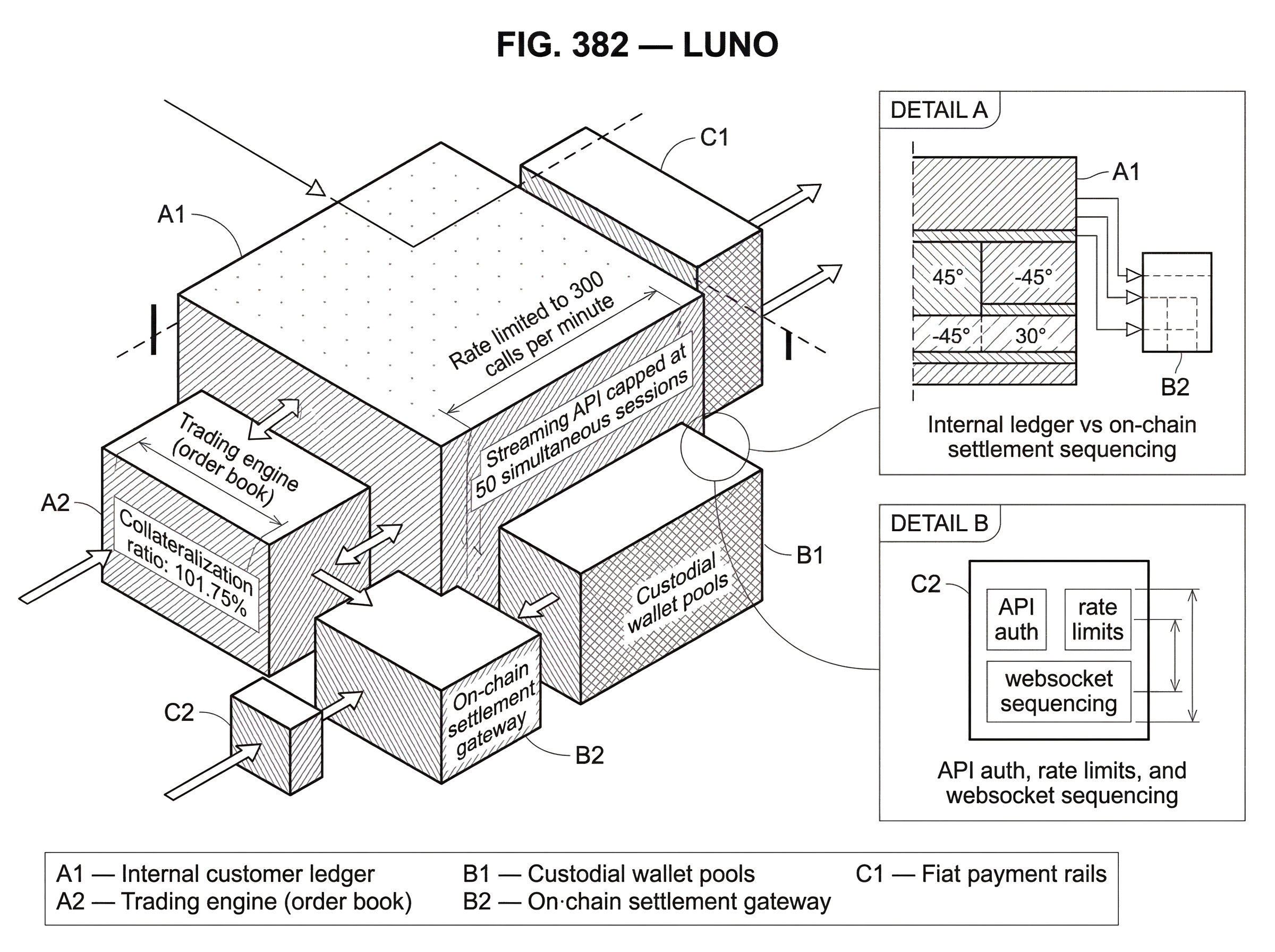
Here the core idea is that Luno keeps internal ledgers for customers while also interfacing with external blockchains and banking systems. The developer documentation makes this visible. Transactions operate on per-currency accounts, and those accounts behave like append-only logs of entries: entries are sequential, never reordered, and never deleted. Each account has a balance and an available balance. That distinction matters because assets can exist in the account while still being temporarily committed elsewhere; for example, to open orders or pending operations.
This is how a centralized exchange can feel fast. Not every user action requires an immediate blockchain transaction. Much of the movement that users perceive as balance changes happens first inside Luno’s own ledgering system. External settlement still matters for deposits, withdrawals, and custody, but the platform can provide a smoother experience by netting and recording many actions internally before interacting with slower external systems.
A concrete example makes this clearer. Imagine a user who wants to buy Bitcoin with local currency. They fund their Luno account using a supported payment method. Inside Luno, that deposit is reflected in the relevant fiat-denominated account. When the user places the purchase, Luno updates internal balances and executes against available liquidity through its buy or trade interface. The user now sees a crypto balance in the app. If they simply hold or later sell, much of that experience can remain inside Luno’s managed environment. Only when they withdraw crypto to an external wallet does the platform need to create and broadcast an on-chain transaction.
That is the convenience. It is also the dependency: the user relies on Luno’s books, controls, and operational integrity until assets are withdrawn.
Why does Luno require identity verification (KYC/AML)?
Many users encounter Luno first not as a trading venue but as a verification flow. That can feel like friction, but it follows directly from how a fiat-connected custodial platform works. If a service lets users move between traditional money and crypto while holding assets for them, it has to know who it is serving and monitor for misuse.
Luno explains that customers need to provide proof of identity and address as part of AML and KYC controls, particularly if they want to buy crypto or exceed account limits. Unverified users may still be able to send, receive, and store cryptocurrency in some cases, but the more the platform resembles regulated financial infrastructure, the more identity checks become part of the operating model. The checks are described as mostly manual with some automation, which helps explain why verification can be quick in straightforward cases but slower when extra due diligence is required.
This is important for understanding who Luno is really designed for. It is not built primarily for users who want the maximum possible anonymity or full self-sovereign control. It is built for users who prefer a regulated-style account experience over the complexity of interacting with crypto systems directly.
Luno simple buy vs advanced trading: what’s the difference?
| Interface | Intended user | Order types | Execution & liquidity | Typical friction |
|---|---|---|---|---|
| Buy flow | Casual investor | Market / instant | Broked liquidity, instant fills | Less control over execution |
| Exchange (orderbook) | Active trader | Limit, market, advanced | Deeper on‑book liquidity | Requires market knowledge |
| API / Institutional | Algo traders & firms | Programmatic / all types | Direct market access, deeper liquidity | Rate limits and session caps |
Luno’s product makes a deliberate distinction between simply getting exposure to crypto and actively trading it. That distinction matters because the two jobs are different. A casual investor usually wants low cognitive load: clear pricing, easy order entry, and a familiar app. An active trader cares more about order types, execution speed, market depth, and fees.
Luno addresses this by offering both a simpler buy experience and a more advanced trading environment. For professional traders, it highlights rapid and reliable trading, deep liquidity, low fees, and advanced order types. The point is not just feature variety. It is that different users need different abstractions over the same market infrastructure. A novice does not want an order book to buy a small amount of Bitcoin. A professional probably does.
For developers and institutions, the API extends this logic further. Authenticated API access uses HTTP Basic authentication with an API key ID and secret, and permissions are granular rather than all-or-nothing. Market data is available through HTTP endpoints, while live trading data can be consumed through a websocket streaming API. The streaming design is especially revealing: clients maintain in-memory state, receive ordered updates, and must reinitialize if they detect they are out of sequence. That is the kind of detail that matters only when a platform is supporting serious, stateful trading integrations.
The constraints also show where the boundaries are. API usage is rate limited to 300 calls per minute, and the streaming API is capped at 50 simultaneous sessions. Prices and volumes are represented as decimal strings rather than floating-point numbers to preserve precision. These are small implementation details, but they reflect a larger truth: a mature exchange is not just an app screen. It is a coordination system for balances, permissions, market data, and order execution.
What custody and security guarantees does Luno provide; and what limits remain?
| Measure | What it shows | Time coverage | Main limitation | Good for |
|---|---|---|---|---|
| Proof‑of‑reserves | Snapshot of asset backing | Single snapshot date | Not continuous assurance | Transparency about collateralisation |
| Status & incident pages | Operational uptime and outages | Near real‑time | Shows availability, not solvency | Expectations for service reliability |
| Custody control tests | Control of addresses/accounts | Audited or inspected moments | Scope and disclosure may be limited | Verify custodian control over assets |
Because Luno is custodial, the central question is not only whether the app is easy to use. It is whether users have reason to believe their assets are there and controlled appropriately. Luno emphasizes multiple layers of security and links to proof-of-reserves materials rather than treating trust as a purely marketing claim.
Its published proof-of-reserves reporting is useful here, with an important caveat. A proof of reserves is not the same thing as eliminating all risk. Luno’s more recent independently performed agreed-upon procedures report states that, at a specific snapshot date, reserves exceeded 100% of customer liabilities, with a reported collateralization ratio of 101.75%. The report used a Merkle tree proof-of-reserves method, allowing customer liabilities to be aggregated and inclusion-tested cryptographically, while reserve control was checked through inspection, test transactions, digital signatures, and custodian account verification.
The caveat matters because these reports are snapshot-based and are not full assurance opinions. The report explicitly says it is an agreed-upon procedures engagement, not an assurance engagement. That means it provides factual findings about defined procedures at a defined time, not a blanket guarantee about every future moment or every possible risk. Still, it is a meaningful transparency mechanism for a custodial exchange because it addresses a basic fear: that customer balances might not be fully backed.
Operationally, users should also think beyond reserves. A centralized platform can still have payment outages, staking delays, regional maintenance windows, or product-specific interruptions. Luno’s public status page shows exactly this kind of real-world operational layer, including incidents affecting specific regions or products. That does not make Luno unusual; it reflects the fact that a fiat-connected exchange depends on banking partners, app platforms, custody systems, and internal processing pipelines, any of which can create temporary friction.
How do Luno’s staking, prediction markets, and investment bundles work?
Luno is no longer just an exchange in the narrow sense. It also offers staking, Prediction Markets powered by Limitless, and investment bundles such as the Blue Chip+ Bundle. These products matter because they extend the platform from pure transaction execution into portfolio construction and engagement.
The mechanism is straightforward. Once a platform already has customer custody, identity, balances, and a trading interface, it can package additional financial actions on top. Staking lets supported assets participate in network reward systems without the user having to run validator infrastructure or learn the mechanics of delegation and lockups. Prediction markets turn the platform into a place not only to hold assets, but to express market views in a more specialized format. Bundles simplify diversification by wrapping multiple exposures into one purchase decision.
But these conveniences come with the same structural trade-off as the rest of Luno: the platform intermediates complexity on the user’s behalf. That is exactly why such products are attractive to mainstream users; and why product availability can vary by jurisdiction and operational conditions.
Key trade-offs to consider before using Luno
Luno is best understood not as “an app to buy crypto,” but as a managed crypto account system. It combines custody, fiat access, trading infrastructure, support, and additional products into one platform so users do not have to manage the technical and operational complexity themselves.
That makes it especially useful for people who want crypto exposure or trading access with a familiar account-based experience. The price of that convenience is custodial trust: users rely on Luno’s controls, verification processes, liquidity, and operational resilience rather than holding everything directly themselves. If you remember that single trade-off, the rest of the product becomes much easier to evaluate.
What should you look for before choosing a crypto exchange?
Before choosing a crypto exchange, focus on four things: custody model, execution quality, fees/liquidity at your trade size, and the funding/withdrawal rails you need. Use Cube Exchange as a practical comparison anchor by testing those items directly in its funding and market flows.
- Fund your Cube account with fiat (using the on-ramp) or a small supported crypto transfer.
- Open the market for the asset you plan to trade and place both a small limit order (price control) and a market order (immediate fill) to compare fills, slippage, and visible liquidity.
- Check custody and transparency: review Cube’s custody model (MPC/threshold signing) and compare the venue’s proof-of-reserves, audit statements, or custodian arrangements for the competitor you’re evaluating.
- Compare fees and API/workflow limits: note maker/taker or spread costs for your trade size, and if you plan programmatic access, verify API rate limits and streaming session caps in each platform’s docs.
Frequently Asked Questions
Using Luno trades technical self‑custody for a managed account: you get an easier, app‑based experience because Luno holds and operates the custody and trading infrastructure on your behalf, but you must trust the platform’s controls, solvency, and operations rather than holding private keys yourself.
No - many user actions are recorded in Luno’s internal append‑only ledgers and do not require an immediate on‑chain transaction; only external settlement events like deposits to or withdrawals from the platform trigger blockchain broadcasts.
Luno published a Merkle‑tree style proof‑of‑reserves and an independent agreed‑upon procedures report showing reserves exceeded customer liabilities at a specific snapshot (reported collateralisation 101.75%), but the engagement was snapshot‑based and not an assurance opinion, so it provides transparency at a point in time rather than a blanket future guarantee.
Identity and address checks are required for AML/KYC when you move between fiat and crypto or exceed limits; the checks are performed mostly manually with some automation, so verification can take a few minutes in straightforward cases but may take a couple of days if extra due diligence is needed.
No - the API has limitations: crypto Sends via the API are unavailable to users verified in jurisdictions with money‑travel rules, non‑TLS requests are rejected, API calls are rate limited (300 calls per minute), and the streaming API is capped at 50 simultaneous sessions; prices/volumes are returned as decimal strings to preserve precision.
When you withdraw crypto to an external wallet, Luno must create and broadcast an on‑chain transaction (whereas many in‑platform movements stay internal), so expect on‑chain network delays, custody partner processing, and possible product‑specific waits such as staking or regional maintenance windows to affect timing.
Not necessarily - products like staking, prediction markets, and investment bundles are offered on top of Luno’s custody and trading layers, but availability varies by jurisdiction and operational conditions, so these features may not be offered everywhere.
Luno publishes a public status page that lists incidents by region and product (for example bank transfer outages or staking delays), so you can check real‑time operational issues there; the status system is the platform’s canonical source for outages and updates.
Related reading