What Is Bitcoin Halving?
Learn what Bitcoin halving is, how it cuts block subsidies every 210,000 blocks, why it supports a finite supply, and what it means for miners.
Introduction
bitcoin halving is the protocol rule that periodically cuts the block subsidy (the new bitcoin created in each block) in half. It matters because Bitcoin is not just a payment system; it is also a machine for issuing money under fixed rules, and halving is the rule that makes that issuance slow down over time.
That simple description hides an important puzzle. If miners secure Bitcoin by spending real resources on proof of work, why would the system deliberately reduce their easiest source of revenue? The answer is that Bitcoin is trying to do two things at once: pay miners enough to secure the chain, while also preventing the money supply from growing without bound. Halving is the compromise mechanism. It creates a supply curve that is predictable and declining, while forcing the network over the long run to rely less on new issuance and more on transaction fees.
If you understand that tension, most of the topic clicks. Halving is not a marketing event and not an optional policy choice. It is a consensus rule embedded in Bitcoin’s monetary design. Every full node enforces it when checking whether a block’s coinbase transaction claims too much reward.
How are new bitcoins created in each block?
Bitcoin creates new coins in a very specific place: the first transaction in each block, called the coinbase transaction. Satoshi’s whitepaper describes this as a special transaction that starts a new coin owned by the block creator. In ordinary terms, when a miner finds a valid block, the protocol allows that miner to include an output paying itself newly created bitcoin, plus any transaction fees from the transactions in that block.
So the immediate source of new supply is not an account, treasury, or central issuer. It is the block reward. That reward has two parts: the block subsidy, which is newly minted bitcoin, and transaction fees, which are paid by users and merely redistributed to the miner. Halving affects only the subsidy part. Fees are not halved by protocol.
This distinction matters because people often say “the mining reward is halved,” which is true only if fees are ignored. Mechanically, what gets cut in half is the newly created portion. In some blocks, especially during periods of heavy demand for block space, fees can be a large share of total miner revenue. The 2024 halving block itself is a vivid example: block 840,000 reduced the subsidy from 6.25 BTC to 3.125 BTC, but the block’s total payout was much larger because it also included unusually high transaction fees.
Why does Bitcoin halve by block height instead of calendar dates?
Bitcoin does not say “halve every four years” in the sense of using a wall-clock timer. The actual rule is simpler and stricter: halve every 210,000 blocks. Because Bitcoin targets an average of about one block every 10 minutes through difficulty adjustment, 210,000 blocks works out to roughly four years. But “roughly” is doing real work here.
Block production is probabilistic. Miners search for a valid proof of work, and some blocks arrive faster than average while others take longer. Difficulty adjustment pushes the long-run average back toward the target, but it does not eliminate short-run variation. That is why halving dates are estimated in advance rather than known exactly. The protocol cares about block height, not the calendar.
This block-based design is more natural than a time-based one for Bitcoin’s architecture. Bitcoin already has a canonical shared counter that every node agrees on: the height of the chain. Using height avoids having issuance depend directly on external timekeeping. The network still uses time-related mechanisms in other places, but the monetary schedule is pegged to the thing the protocol itself natively counts: blocks.
How is the halving subsidy enforced in Bitcoin Core?
| Element | Computation | Code behavior | Effect |
|---|---|---|---|
| Interval | height / 210000 | count halvings as integer | occurs about every four years |
| Initial subsidy | starts at 50 BTC | right-shift (>>=) per halving | subsidy halves each era |
| Precision | values stored in satoshis | integer division rounds down | total slightly below 21M |
| Zero guard | halt after 64 shifts | force subsidy = 0 beyond limit | prevents undefined bit shifts |
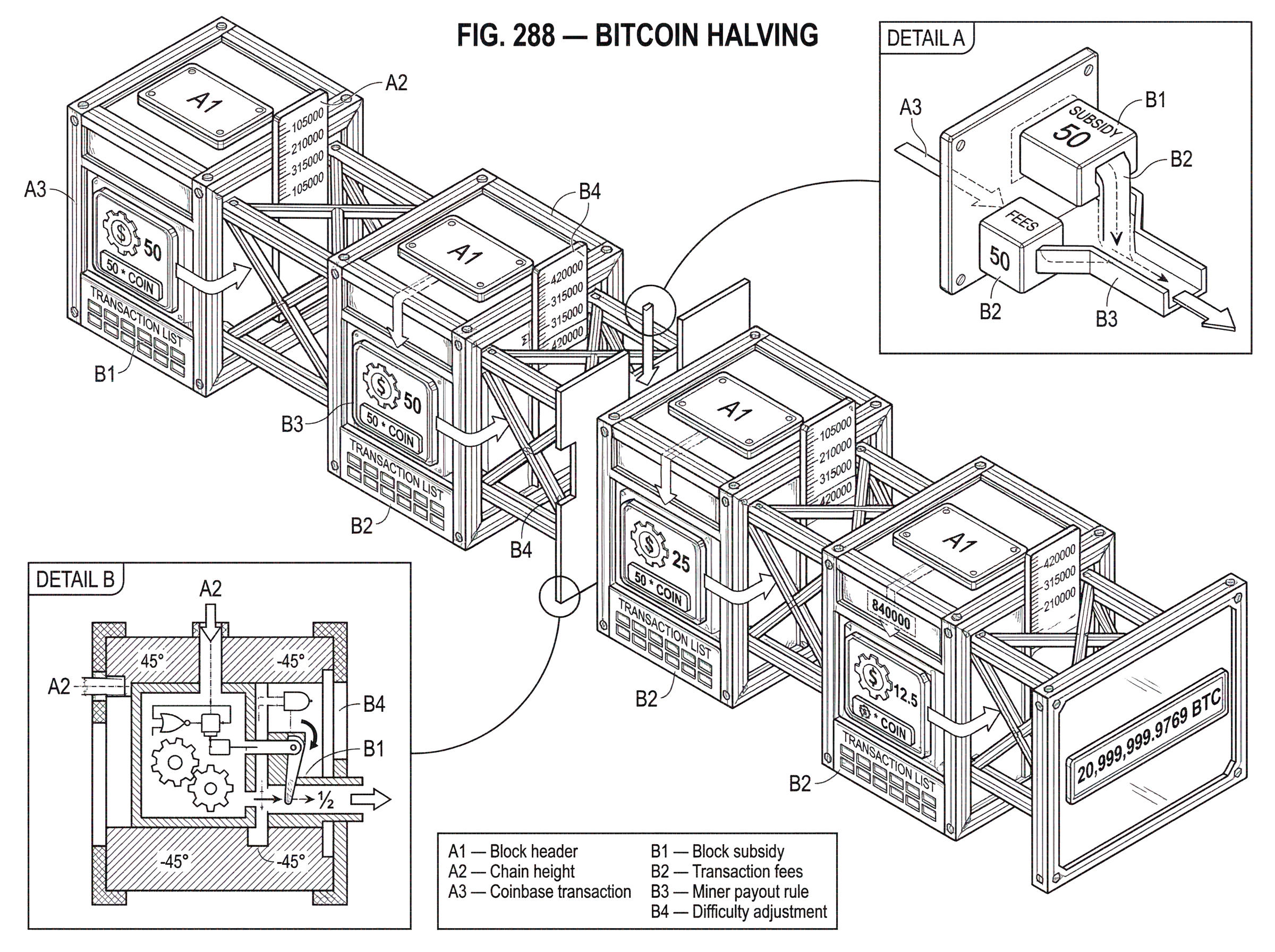
At the implementation level, the rule is brutally simple. Bitcoin Core computes the number of halvings as block height divided by the subsidy halving interval, 210000 on mainnet. It starts from an initial subsidy of 50 * COIN and right-shifts that integer by the number of halvings, which is equivalent to dividing by two repeatedly and rounding down at satoshi precision.
In prose, the idea is this: for heights 0 through 209,999, the subsidy is 50 BTC per block. For heights 210,000 through 419,999, it is 25 BTC. Then 12.5 BTC, then 6.25 BTC, then 3.125 BTC, and so on. Because values are represented in satoshis (the smallest unit, 0.00000001 BTC) each halving is exact only down to that integer unit. Eventually the subsidy becomes so small that another halving rounds it down to zero.
Bitcoin Core also includes a guard that forces the subsidy to zero once the number of halvings reaches 64, because shifting by too many bits is undefined behavior in low-level languages. That edge case is extremely far beyond the economically relevant horizon, but it shows something important: Bitcoin’s monetary policy is not just an abstract idea. It is implemented as concrete integer arithmetic, with exact behaviors at boundaries.
There is even a deployed BIP, BIP 42, titled A finite monetary supply for Bitcoin, referenced in the BIPs repository, which relates to making the supply finite in implementation terms. That is a reminder that finite supply is not merely a slogan; it must be encoded correctly in consensus rules and software behavior.
What exactly happens in a block at the moment of halving?
Take block height 840,000, the fourth halving. Before that height, blocks in the current era paid a subsidy of 6.25 BTC. At height 840,000 exactly, every node computes 840000 / 210000 = 4, meaning four halvings have occurred. Starting from 50 BTC and halving four times gives 3.125 BTC.
Now imagine a miner produces that block. It assembles transactions, computes the available fees from them, and creates a coinbase transaction that pays itself no more than 3.125 BTC + fees. Every validating node checks that claim. If the miner tried to claim even one satoshi above the allowed amount, the block would be invalid and rejected. If it claimed less, the block would still be valid; miners are allowed to underpay themselves, which means total realized supply can end up below the theoretical maximum.
That last point is easy to miss. Bitcoin nodes enforce a ceiling on the coinbase reward, not an obligation to collect the full amount. This is one reason the spendable or actually issued supply can be lower than the theoretical schedule. Lost coins are another reason, but they are a separate issue: halving defines how much may be issued, not how much remains accessible forever.
How does halving make Bitcoin’s supply converge to a finite total?
| Model | Per-era sum | Convergence reason | Net result |
|---|---|---|---|
| Ideal model | 210,000 × era subsidy | each era half previous era | mathematical sum → 21,000,000 BTC |
| Reference client | era totals in satoshis | integer halving rounds down | slightly less than 21M total |
| Practical outcome | theoretical ceiling only | miners can underpay or lose coins | 21M is an upper bound |
The deep reason halvings create scarcity is that they turn Bitcoin issuance into a geometric series. Each era lasts 210,000 blocks, but the subsidy per block is half the previous era’s subsidy. So the total issued in each era goes like this: 210000 * 50 BTC, then 210000 * 25 BTC, then 210000 * 12.5 BTC, and so on.
The crucial invariant is that each era contributes half as many new bitcoins as the previous one. When you add an infinite sequence where each term is half the last, the sum converges to a finite number. In Bitcoin’s case, the idealized sum approaches 21 million BTC. Secondary technical sources note that because implementation uses integer units and rounds down at satoshi precision, the exact total is slightly less than 21 million, often cited as 20,999,999.9769 BTC.
That is why people say Bitcoin has a 21 million cap even though the exact arithmetic is a little more precise. The memorable number is the conceptual target; the code-level number reflects integer granularity. The important thing is not the tiny difference. The important thing is that halving changes issuance from “steady forever” to “declining toward zero,” and that is what makes the supply finite.
What problem does the halving schedule aim to solve?
Bitcoin’s whitepaper says new coins are introduced through block creation and compares this to gold miners expending resources to add gold to circulation. It also says that once a predetermined number of coins has entered circulation, incentives can transition entirely to transaction fees and the system can become inflation-free. The whitepaper does not specify the exact halving schedule, but it clearly establishes the design goal: bootstrap security with issuance, then rely less on issuance over time.
So the problem halving solves is not merely “how do we make number go up more slowly?” The real problem is how to launch a proof-of-work system that needs to pay miners before there is a mature fee market, while also avoiding indefinite monetary expansion. Early on, users are few, transaction fees are thin, and block subsidies do most of the economic work. Later, if Bitcoin succeeds and block space becomes valuable, fees can plausibly replace more of that subsidy.
This explains why halving is a declining schedule rather than an immediate stop. If subsidy had gone to zero from the beginning, miners would have had little reason to secure a network that initially had few transactions and therefore few fees. If subsidy remained permanently high, Bitcoin would never achieve the controlled supply that is central to its monetary identity. Halving is the bridge between those two regimes.
How does halving affect miner revenue and operations?
| Factor | Immediate effect | Typical miner action | Network result |
|---|---|---|---|
| Subsidy cut | subsidy halves | shut off or upgrade rigs | downward pressure on hashrate |
| Fees share | fees unchanged | prioritize high-fee transactions | depends on fee-market maturity |
| Price change | price may offset loss | sell or hold reserves | can restore miner profitability |
| Difficulty feedback | blocks slow if hash drops | remaining miners regain share | security stabilizes after retarget |
For miners, a halving is a revenue shock unless price, fees, or both compensate. Their hardware and electricity costs do not get cut in half by protocol. Only the subsidy does. So when a halving arrives, the network effectively asks: which miners can still operate profitably under the new payout conditions?
That is why halvings often trigger discussion about miner capitulation, hash rate adjustments, and industry consolidation. If some miners were marginal before the halving, the subsidy cut can push them below breakeven. Those miners may shut off machines, upgrade hardware, relocate to cheaper energy, or sell bitcoin reserves to finance operations. Industry research around the 2024 halving estimated a materially higher post-halving cost of production and projected pressure on less efficient operators.
When enough miners drop out, total network hash rate can fall. That matters because hash rate is a security metric: more hashing power generally means greater resistance to attack. But Bitcoin has another feedback mechanism here. If hash rate falls, blocks tend to come more slowly until the next difficulty adjustment, after which mining becomes easier for the remaining miners. That restores, to a degree, the economics of block production.
So halving does not mechanically break the network, but it does force a repricing of security. The system relies on competition among miners and difficulty adjustment to absorb the shock.
Why does Bitcoin’s long‑term security become more uncertain as subsidies fall?
There is a common simplification that Bitcoin security depends on proof of work, full stop. That is true but incomplete. Proof of work is the mechanism for ordering blocks, yet miners still need to be paid to perform it. In practice, security depends on the value of the rewards available for honest mining relative to the gains from attacking or deviating.
The whitepaper already anticipated a transition from subsidy to fees. But whether a fee-dominant regime is as stable as a subsidy-heavy one is not something the protocol can guarantee by declaration. Research has argued that fee-only or fee-dominant environments may produce different strategic behavior, including stronger incentives to fork high-fee blocks or engage in selfish mining. Those results are model-dependent, and they should not be overstated as destiny. Still, they matter because they identify a real dependency in Bitcoin’s long-run security model.
The important distinction is between intended mechanism and proven outcome. The intended mechanism is clear: as subsidy shrinks, transaction fees increasingly fund miners. The proven outcome is less certain: it depends on future demand for block space, miner competition, market structure, and adversarial strategy. Halving does not solve that uncertainty. It exposes it gradually.
What are common misconceptions about Bitcoin halving?
A common misunderstanding is that halving reduces the total supply of bitcoin already in existence. It does not. It reduces the rate of new issuance. Existing coins are unaffected. Another misunderstanding is that halving guarantees the market price will rise. The protocol makes no such promise. It only changes future supply flow.
People also often treat halving as if it were mainly a narrative event for traders. Markets may care about it, but the underlying rule exists for protocol reasons, not publicity. Full nodes enforce it regardless of sentiment. If the market ignored halvings completely, the consensus rule would still operate exactly the same way.
A subtler misunderstanding is to confuse the subsidy schedule with actual circulating supply. The schedule defines a maximum issuance path. Actual spendable supply is lower because coins can be lost, burned, or never fully claimed by miners. So “21 million” is best understood as an upper bound implied by the subsidy mechanism, not a promise about how many coins will be economically available.
Can Bitcoin’s halving schedule be altered, and how hard would that be?
In principle, yes; but only by changing Bitcoin’s consensus rules. In practice, that is extraordinarily difficult, because every full node enforces the subsidy schedule as part of block validity. A block claiming a reward above the allowed subsidy is invalid under current rules. To change the schedule, the network would need coordinated adoption of new software with different consensus parameters.
That is not like changing a wallet setting or even a relay policy. It is a monetary-rule change touching one of the most socially salient parts of Bitcoin. The BIP process, developer discussion, and activation mechanisms such as BIP 9 or BIP 8 exist for coordinating consensus changes in general, but publication of a proposal does not imply acceptance. And a subsidy-rule change would likely be among the most contentious possible changes because it alters the system’s monetary contract.
So while the schedule is not metaphysically unchangeable, it is best understood as credibly rigid under Bitcoin’s current social and technical structure. Its force comes not only from code, but from the expectation that participants would strongly resist inflationary changes.
What implementation edge cases show how halving actually works?
One useful way to understand halving is to look at edge cases. Because the subsidy is implemented with integer arithmetic, tiny details matter. Rewards are stored in satoshis, halving is done by integer division through bit shifting, and eventually the subsidy rounds down to zero. This is why the total supply is slightly below a perfectly idealized 21 million.
Implementation discussions have also surfaced extremely long-term overflow concerns, such as what would happen if block height were represented in a type that eventually wraps around. These are not near-term threats (the cited issue projects the relevant overflow absurdly far in the future) but they are conceptually helpful. They show that a monetary policy in software is only as real as the code paths that implement and validate it.
In other words, Bitcoin halving is not just economics. It is economics made into deterministic machine rules.
Conclusion
Bitcoin halving is the rule that cuts the block subsidy in half every 210,000 blocks. That one mechanism does most of the work behind Bitcoin’s controlled supply: it slows issuance, makes total supply converge toward roughly 21 million BTC, and gradually shifts miner compensation from newly minted coins toward transaction fees.
The idea to remember is simple: halving is where Bitcoin’s money and security models meet. It limits inflation by paying miners less new bitcoin over time; and in doing so, it forces the network to prove that it can remain secure as subsidies fade and fees matter more.
How do you get practical exposure to Bitcoin?
You can get practical exposure to Bitcoin by buying or trading BTC on Cube Exchange. Cube supports a non-custodial MPC workflow so you can execute a spot purchase or transfer while retaining control over key material.
- Deposit fiat via the on‑ramp (bank transfer or card) or send supported crypto (e.g., USDC) to your Cube receive address.
- Open the BTC/USD or BTC/USDC market on Cube and choose an order type; use a limit order for price control or a market order for immediate execution.
- Enter the BTC amount or USD spend, review the estimated fill and total fees (exchange fee + on‑chain fee if withdrawing), and submit the order.
- Keep your BTC on Cube for trading, or withdraw on‑chain to an external wallet; if withdrawing to Bitcoin, request the transfer and wait for at least 3 network confirmations before treating funds as settled.
Frequently Asked Questions
Because the protocol counts blocks, not wall-clock time: the rule is "halve every 210,000 blocks," and since Bitcoin targets ~10‑minute blocks that works out to roughly four years on average, while short‑run variation in block times makes calendar dates only estimates.
No - halving only cuts the block subsidy (newly minted BTC); transaction fees paid by users are unchanged by the rule, so a miner’s total payout can fall by less than half if fees are large (the article cites block 840,000 as an example where fees materially increased total payout).
Halving makes issuance follow a geometric series (each era issues half the previous era’s coins), so the infinite sum converges to a finite total near 21 million BTC; because amounts are stored in satoshis and halving uses integer arithmetic, the exact code-level total is slightly below 21 million (commonly cited ~20,999,999.9769 BTC).
Yes in principle, but only by changing consensus rules: any change to the subsidy schedule would require a coordinated, contentious consensus upgrade that all validating nodes accept, so it is technically possible but credibly very difficult in practice.
A halving is a built‑in revenue shock for miners because only the subsidy is cut; marginal miners may shut off equipment or sell reserves, total hash rate can fall, and difficulty adjustment then slowly restores mining economics for remaining miners - the protocol absorbs the shock but security is repriced.
No - halving reduces the flow of new issuance going forward, not coins already in addresses; existing supply is unaffected, though lost or unclaimed coins mean circulating supply can be below the subsidy‑defined upper bound.
Eventually the subsidy arithmetically rounds down to zero because halving is implemented with integer shifts; Bitcoin Core also has a guard that forces the subsidy to zero after 64 halvings, and long‑term overflow/representation edge cases have been discussed though they occur on astronomically distant timescales.
It is uncertain: the whitepaper and later research note that security is intended to transition from subsidies to fees, but models and simulations show fee‑only regimes may change miner incentives and can, under some assumptions, produce instability or different adversarial behaviors - the outcome depends on future fee markets and miner structure.
Related reading