What is Paxos?
What is Paxos? Learn how Paxos issues regulated stablecoins like USDP and PYUSD, how reserves and redemption work, and who its infrastructure serves.
Introduction
Paxos is a regulated blockchain infrastructure company best known for issuing stablecoins and tokenized assets that are meant to be redeemed for the underlying asset at a one-to-one rate. That may sound straightforward, but the hard part is not creating a token on a blockchain. The hard part is making the token trustworthy enough that people, exchanges, wallets, and large companies will treat it like a dependable financial instrument rather than a speculative placeholder.
That is the problem Paxos is trying to solve. In crypto, a dollar token is useful only if users believe they can actually get a dollar back. So Paxos built its business around three linked pieces: regulated issuance, reserves held against the tokens, and redemption mechanisms that connect tokens back to traditional money. Its role is not just to put assets onchain. Its role is to make those assets legible to both blockchains and regulated finance.
How does a Paxos token combine on‑chain transfers with an off‑chain redemption promise?
The simplest way to understand Paxos is to separate the part you can see onchain from the part that gives it value offchain. Onchain, a stablecoin is just a token contract or token account balance. Offchain, it is a claim that the issuer will redeem that token for the underlying asset according to specific terms. Paxos’ products are useful because they try to make that offchain claim credible through custody, reserve management, attestations, and regulatory oversight.
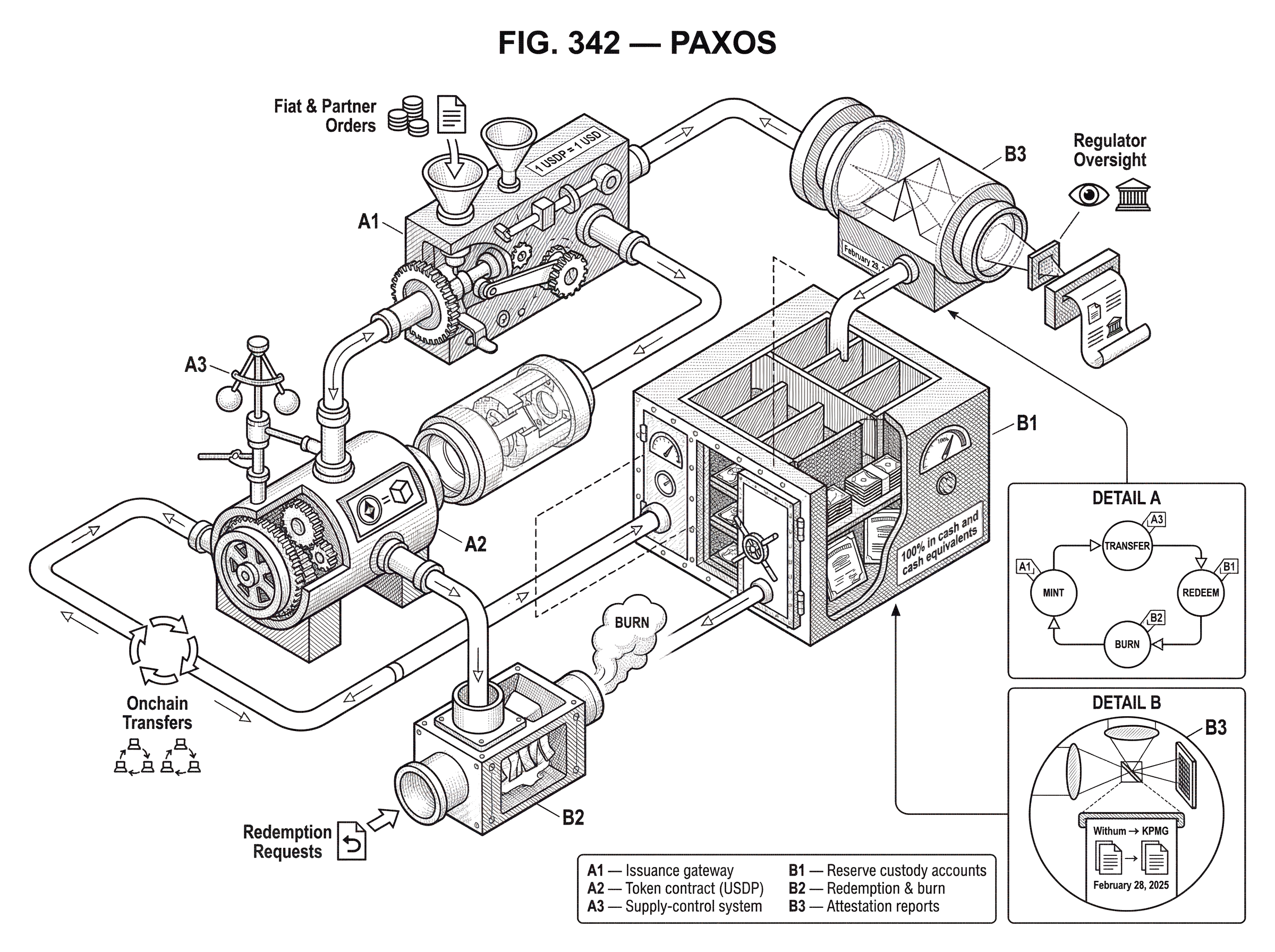
Take USDP, Pax Dollar. Paxos describes it as a U.S. dollar-denominated stablecoin that is fully redeemable on a one-to-one basis: 1 USDP = 1 USD. Paxos says USDP reserves are held 100% in cash and cash equivalents, and that customer assets are held in segregated, bankruptcy-remote accounts. The practical meaning is not that the token itself is magically stable. The token is stable because Paxos is saying, in effect: if you are eligible to redeem with us, we stand behind the token with reserve assets and operational processes designed to honor that redemption.
That same model extends beyond dollars. PAXG is a tokenized gold product that Paxos says is backed by one fine troy ounce of gold stored in LBMA vaults. The pattern is the same: a blockchain token becomes useful when it points to a clearly specified underlying asset and a redemption or ownership framework people trust.
How do Paxos stablecoin issuance and redemption work in practice?
The user-facing mechanism begins with issuance. Paxos creates tokens when customers acquire them through Paxos, and those tokens circulate on public blockchains where they can be transferred, traded, or integrated into apps. When eligible holders redeem directly with Paxos, tokens are taken back and burned, and dollars are returned on a one-to-one basis, subject to terms, minimums, compliance checks, and operational constraints.
That mint-and-burn loop is the economic anchor. If a stablecoin trades below a dollar, qualified market participants can buy it and redeem it, which tends to pull the price back up. If it trades above a dollar, they can mint or source fresh tokens and sell them, which tends to push the price back down. The peg is therefore not maintained by software alone. It is maintained by the existence of redemption and issuance channels tied to reserves.
A concrete example makes this clearer. Imagine a payments company or exchange that needs a dollar token for settlement. Holding ordinary bank deposits can be slow to move across platforms and jurisdictions, especially outside banking hours. Using USDP, that firm can keep value onchain and send it nearly instantly across supported networks. The reason this is useful is not merely speed. It is that the recipient is willing to accept the token because they believe it can be redeemed back into dollars. In other words, blockchain handles transfer, while Paxos’ reserve and redemption system supplies trust in convertibility.
Paxos also acts as issuer infrastructure for partners. PYUSD, PayPal USD, is issued by Paxos on behalf of PayPal and positioned as a payments stablecoin. This helps explain who Paxos is really designed for. The end user may hold the token in a wallet, but Paxos’ deeper customer base includes enterprises, fintechs, exchanges, and platforms that want blockchain-native settlement without building regulated issuance, reserve operations, and redemption rails from scratch.
Why do regulation and custody matter for Paxos stablecoins?
| Issuer type | Legal protection | Reserve segregation | Redemption access | Primary risk |
|---|---|---|---|---|
| Regulated trust issuer (Paxos) | Bankruptcy‑remote legal protections | Segregated customer accounts | Direct redemption for verified customers | Operational or regulatory failure |
| Unregulated issuer | Limited legal segregation | Possible commingling of funds | Redemption may be limited or uncertain | Reserve or custody failure |
For a stablecoin issuer, regulation is not decorative. It is part of the product mechanism. Paxos emphasizes that its digital assets are backed 1:1, that assets are held in accounts protected from bankruptcy, and that issuance is overseen by regulators. It has operated under New York trust oversight, has cited oversight from the Monetary Authority of Singapore, and has also described OCC-level oversight for parts of its trust structure.
The reason this matters is simple: stablecoin risk is mostly not blockchain risk. It is issuer risk, reserve risk, custody risk, and redemption risk. A token can transfer perfectly onchain and still fail its purpose if reserves are weak, custody is unclear, or redemption becomes uncertain. Paxos’ trust-company framing is meant to reduce that uncertainty by separating customer assets from company assets and embedding the issuer inside a more formal supervisory structure than many crypto-native projects use.
That does not eliminate risk. It changes the kind of risk you are taking. With Paxos, users are generally accepting a more centralized model in exchange for stronger claims about redeemability, segregation of assets, and compliance controls. If you want a censorship-resistant dollar substitute with no issuer discretion, this is not that design. If you want a token intended to behave like regulated financial infrastructure, this is much closer.
What reserve disclosures and attestations does Paxos provide and how should you interpret them?
| Report type | Speed | Independent review | Scope | Best use |
|---|---|---|---|---|
| Self-report | Published quickly (5 business days) | No | Unaudited portfolio composition | Rapid transparency for stakeholders |
| Independent attestation | Monthly snapshot timing | Yes (AICPA standards) | Examined reserves at reporting date | Institutional assurance and verification |
A stablecoin promise is only as good as the evidence behind it, so transparency matters. Paxos says it publishes monthly attestation reports for USDP, and its transparency materials distinguish between two kinds of disclosure. There are self-reported portfolio composition updates published shortly after month-end, and there are independent attestation reports issued by outside accounting firms under AICPA attestation standards.
That distinction is important. A self-report is faster, but Paxos itself notes that those reports have not been subjected to independent review. An attestation is stronger because an external firm examines whether the reserves met the stated standard at a specific point in time. Paxos’ transparency pages note a shift from Withum to KPMG for attestations posted on or after February 28, 2025.
Still, users should be precise about what transparency can and cannot do. An attestation is not the same thing as a real-time public view into reserves. It helps answer whether backing existed as claimed at a reporting date. It does not remove operational dependence on the issuer, nor does it guarantee that all future stresses will be handled perfectly. The main value is narrower but still meaningful: it gives institutions and counterparties more reason to believe the reserve story is not just marketing.
How are Paxos stablecoins implemented onchain and what issuer controls exist?
| Design | Governance | Onchain powers | Upgradeability | Best for |
|---|---|---|---|---|
| Paxos tokens | Central issuer control | Freeze, wipe, supply control | Proxy upgradeable contracts | Institutions needing compliance |
| Permissionless tokens | Community or holders | No admin freeze powers | Immutable or community upgrades | Censorship‑resistant use cases |
Onchain, Paxos stablecoins are not designed like permissionless community tokens. The public USDP contract repository shows why. The Ethereum version uses an upgradeable proxy pattern, and supply changes are managed through a separate supply-control system. The contracts also include an asset protection role that can freeze or unfreeze addresses and, after freezing, wipe balances to enable seizure of backing assets by authorities.
This is one of the clearest places where Paxos’ design philosophy shows itself. The point is not maximum decentralization. The point is controlled issuance that can satisfy legal obligations, support recovery and enforcement actions, and remain operable inside regulated markets. For some users, especially institutions, that is a feature. For others, it is a major constraint.
USDP also supports features like EIP-3009 and EIP-2612 for delegated or gas-efficient interactions. Those are useful implementation details for wallets and integrators, but they are secondary to the larger fact: Paxos tokens are centrally governed digital liabilities with blockchain mobility, not autonomous bearer assets with no administrator.
When should you use Paxos‑issued stablecoins versus other options?
Paxos makes the most sense where users care more about redeemability, compliance, and institutional integration than about pure decentralization. That includes exchanges needing settlement assets, fintechs embedding dollar tokens into products, payment flows that benefit from always-on blockchain transfer, and enterprises that want a regulated issuer behind a token they expose to customers.
Its partner model is especially revealing. A company like PayPal can offer a stablecoin experience to users while relying on Paxos for the difficult backend machinery: issuance, reserve administration, regulatory interfaces, and reporting. That is a different business from a crypto project issuing a token for its own ecosystem. Paxos is closer to infrastructure for tokenized financial products.
The trade-off is that access to the most important promise (direct redemption with the issuer) is not equally available to everyone in the same way. Paxos’ terms make clear that direct issuance and redemption are limited to verified customers and can be subject to jurisdictional restrictions, compliance checks, and operational discretion. So while anyone may hold or transfer the token onchain, the strongest version of the token’s utility belongs to participants who can connect it back to Paxos’ redemption rails.
What are the trust limits and failure modes of Paxos’ model?
The smartest misunderstanding to avoid is thinking that a regulated stablecoin is trustless because it lives on a blockchain. The blockchain helps with transfer and auditability of token movements. It does not by itself prove reserve quality, guarantee bank access, or force an issuer to redeem outside its legal and operational framework.
Paxos’ model can fail, if it fails, in familiar financial ways: reserve mismanagement, custodial problems, redemption bottlenecks, compliance breakdowns, or regulatory intervention. Some of that is not hypothetical. Paxos has publicly addressed historical compliance issues tied to its prior BUSD partnership with Binance, including a settlement with the NYDFS. That matters because it shows the right lens for evaluating Paxos: not as pure software, but as an operating financial institution whose controls, supervision, and execution quality are part of the product.
At the same time, the company points to a successful wind-down of large BUSD supply without a de-peg as evidence that reserve and treasury management matter in stress. Whether one sees that as reassurance or simply a useful historical data point, the broader lesson is sound: a stablecoin issuer is judged not only by normal operations, but by how cleanly it handles redemption pressure, partner risk, and regulatory demands.
Conclusion
Paxos is best understood as a bridge between blockchains and regulated finance. Its stablecoins and tokenized assets are useful because they combine onchain transferability with an offchain redemption promise backed by reserves, custody structures, reporting, and regulatory oversight.
The memorable version is this: Paxos does not make assets valuable by putting them on a blockchain; it tries to make blockchain tokens reliable by tying them to real-world claims that institutions are willing to trust.
How do you trade Paxos-related assets?
Trade Paxos-related assets on Cube Exchange by funding your account and placing spot orders on the relevant market. The workflow stays on Cube: fund, pick the Paxos asset market (for example USDP/USD or USDP/USDC), choose an order type, and execute.
- Fund your Cube account with USD or a supported stablecoin (USD bank transfer or USDC deposit).
- Open the Paxos market you want (for example USDP/USD or USDP/USDC). For thinly traded pairs, prefer a limit order to avoid slippage.
- Enter size and price, review estimated fill, fees, and any minimums, then submit the order.
- After execution, check on‑chain confirmations or your Cube trade history before withdrawing or using the asset in other flows.
Frequently Asked Questions
Paxos maintains the USDP peg through an on‑demand mint-and-burn model tied to off‑chain reserves and redemption rails: qualified participants can buy discounted tokens and redeem them for dollars or source new tokens and sell when the market is above $1, which creates arbitrage pressure that pulls the price toward $1. This mechanism depends on operational redemption/issuance channels and reserve backing rather than on autonomous smart‑contract logic alone.
No - Paxos publishes monthly attestation reports and faster self‑reported portfolio compositions, but attestations only verify reserves at specific reporting dates and self‑reports are not independently reviewed; Paxos does not provide a real‑time public view of reserve holdings. The company also changed attestation providers (Withum before Feb 28, 2025; KPMG on/after Feb 28, 2025), which affects continuity of reports.
Yes - Paxos’ smart‑contract design includes centralized controls: an asset protection role that can freeze or unfreeze addresses and wipe balances, upgradeable proxies, and supply‑control mechanisms that let the issuer pause, mint, or burn tokens to satisfy legal or operational requirements.
Direct redemption with Paxos is limited: tokens are redeemable on a one‑to‑one basis when holders are eligible, but Paxos’ terms make clear redemptions are available only to verified customers and can be restricted by jurisdiction, compliance checks, minimums, and operational discretion.
No - the stablecoin token itself is not FDIC insured; any FDIC coverage would apply only to underlying fiat deposits under pass‑through arrangements and subject to FDIC limits, not to the on‑chain token by default.
Paxos has faced regulatory scrutiny tied to its prior BUSD partnership and reached settlements (including with NYDFS); the company states these were historical compliance issues that have been remediated, but the episode illustrates that issuer‑level compliance and supervisory risk can affect stablecoin operations.
Paxos’ design intentionally prioritizes regulated issuance and administrative controls over decentralization: contracts are centrally governed and meant to satisfy legal obligations, which makes the tokens suitable for institutional settlement but not for users seeking censorship‑resistant, issuerless bearer assets.
The main failure modes are traditional financial ones: reserve mismanagement, custodial failures, redemption bottlenecks, compliance breakdowns, or regulatory intervention; blockchain transferability does not eliminate those issuer and operational risks. Paxos’ communications and attestations can reduce but do not remove those risks.
Related reading