What Are Stochastic Differential Equations in Finance?
Learn what stochastic differential equations are in finance, how drift and diffusion work, and why SDEs power option pricing, simulation, and risk.
Introduction
Stochastic differential equations in financeare the mathematical tool used when asset prices, interest rates, volatility, or credit variables evolve through time with bothsystematic structureandrandom shock. That combination is the central puzzle of markets: prices are not predictable in the simple sense, but they are not pure noise either. They trend, revert, cluster in volatility, co-move across assets, and react abruptly to information. An ordinary differential equation can describe structure without randomness. A pure time-series noise model can describe randomness without a clean mechanism. An SDE exists because finance usually needs both at once.
This matters in trading because many of the most important objects in quantitative finance are not just prices, but distributions of future prices. Option pricing, risk management, scenario generation, portfolio stress testing, execution models, and statistical arbitrage all depend on how uncertainty accumulates over time. An SDE gives a compact rule for that accumulation. It says, in effect,here is how the state changes over an instant: part due to a predictable force, part due to a random shock whose size may itself depend on the current state.
The key idea that makes SDEs click is simple: they are continuous-time models of conditional change. They do not try to predict an exact future path. They specify the mechanism by which uncertainty is added from one instant to the next. Once you have that mechanism, you can derive prices, simulate scenarios, estimate risks, or calibrate the model to market data.
Why are ordinary differential equations inadequate for modeling asset prices?
An ordinary differential equation describes motion as if the next instant were determined exactly by the current state. If a stock price S(t) followed dS/dt = μS, with μ a growth rate, then once you know the current price, the entire future path is fixed. That is fine for radioactive decay or a frictionless toy model of compounding, but it is not how traded prices behave. If two traders observe the same stock at the same moment, they do not know its exact value one second later.
Yet replacing the ODE with raw randomness is not enough either. Markets display patterns that suggest structure in how randomness enters. Volatility tends to scale with price level for many assets. Interest rates often pull back toward a typical range. Equity volatility tends to rise when prices fall. Credit spreads widen in stressed regimes. These are not exact laws, but they are strong enough regularities that trading models try to encode them.
An SDE is built to express exactly that compromise. In its most common Itô form, you can think of it as
dX(t) = μ(X(t), t) dt + σ(X(t), t) dW(t)
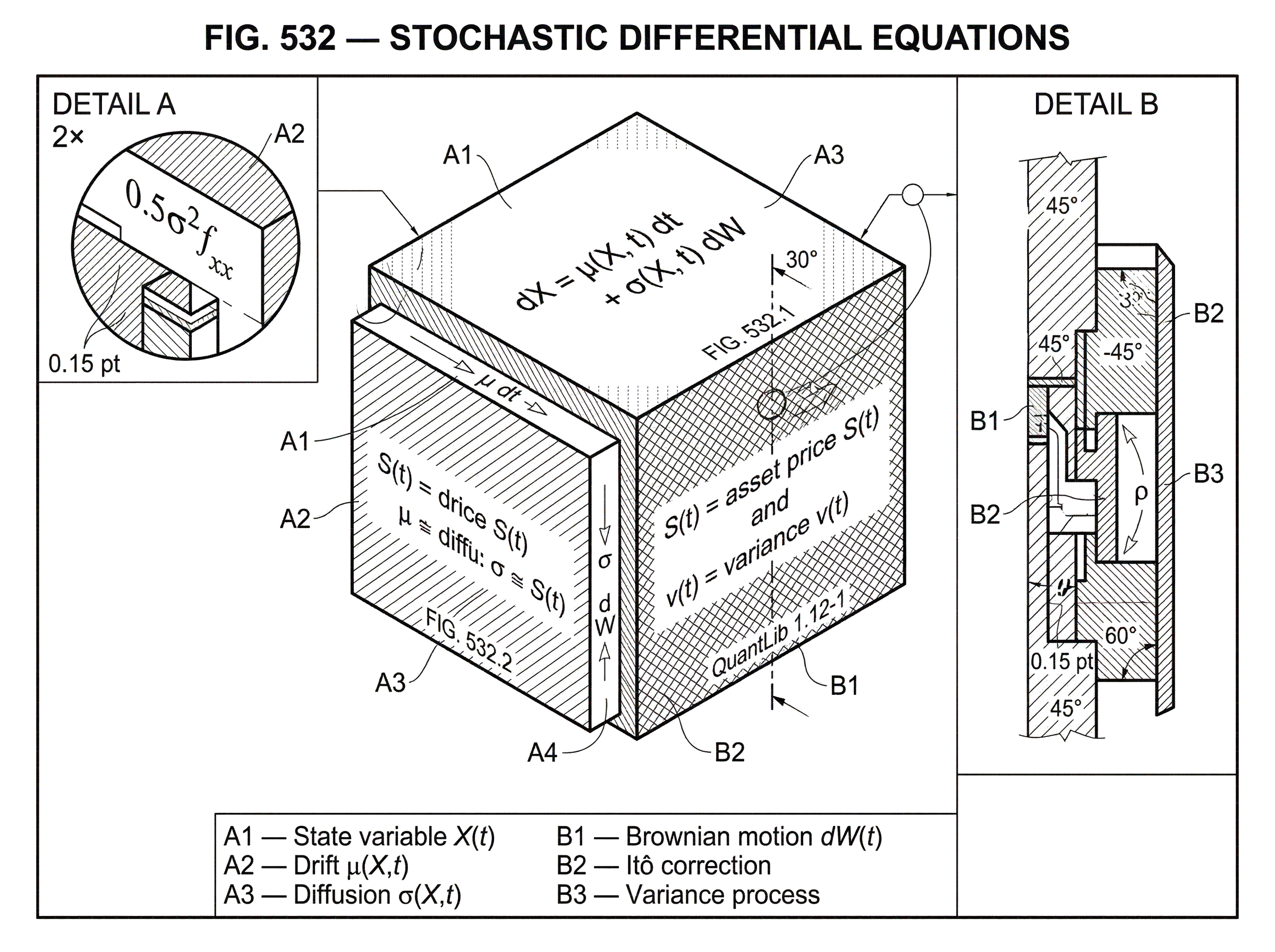
where X(t) is the state variable, μ is the drift, σ is thediffusion, and W(t) is Brownian motion. The notation looks compact, but the meaning is concrete. Over a tiny time interval dt, the state changes by a predictable part μ dt plus a random part σ dW. The random increment dW has mean zero and variance dt, so its typical size is on the order of sqrt(dt), not dt. That scaling is the whole reason stochastic calculus behaves differently from ordinary calculus.
How do drift and continuously arriving shocks form the SDE mental model?
The cleanest way to think about an SDE is to imagine time chopped into very small intervals. In each interval, the state moves for two reasons. First, there may be a directional tendency: mean growth, carry, mean reversion, convenience yield, or some other structural force. Second, there is a surprise term from new information, order flow, liquidity noise, or unresolved uncertainty.
As the intervals become smaller and smaller, the surprise does not disappear. It becomes a limiting object: Brownian motion. Brownian motion is not an ordinary differentiable path. It wiggles so violently that trying to treat dW/dt like an ordinary derivative fails. That is why SDEs need Itô calculus rather than standard calculus. The usual chain rule must be modified because the random term contributes second-order effects that do not vanish in the limit.
This is the first place many smart readers get tripped up. In ordinary calculus, terms of order dt^2 are negligible. In stochastic calculus, (dW)^2 behaves like dt. Since dW is of size sqrt(dt), squaring it produces something of order dt, which survives. That is the mechanism behind Itô's formula and behind many option-pricing derivations. The extra curvature term in Itô's formula is not a technical nuisance. It is the price of modeling uncertainty continuously.
What is geometric Brownian motion and why is it used in finance?
The most famous SDE in finance is the stock-price model behind Black–Scholes. It writes the asset price S(t) as
dS(t) = μ S(t) dt + σ S(t) dW(t)
with constant drift μ and constant volatility σ. This is called geometric Brownian motion. The random shock is proportional to S(t), so the model sayspercentage changes are noisy in a stable way, rather than dollar changes. That choice is not arbitrary. It keeps prices positive and makes returns, not price levels, the natural scale of uncertainty.
Here is the mechanism in plain language. Suppose a stock is trading at 100. Over a very short time, its expected change is roughly μ × 100 × dt. But the random change has size roughly σ × 100 × sqrt(dt). If dt is one trading day expressed in years, then the noisy part will usually dominate the drift over that horizon. That matches market intuition: on short horizons, noise overwhelms directional expectation. Over longer horizons, drift accumulates, but path uncertainty accumulates too.
This model became foundational not because anyone thought real stocks have constant volatility forever, but because it was the simplest nontrivial continuous-time model that made option pricing tractable. In the Black–Scholes framework, the stock dynamics are driven by this SDE, and the resulting option value can be derived by constructing a hedged portfolio and using Itô calculus. The famous pricing formula sits downstream of the SDE. The equation for price dynamics is the engine; the option formula is a consequence.
It is also worth noticing what this model gets right and wrong. It gets positivity, lognormal scaling, and a clean link between volatility and option prices. But it implies flat implied volatility across strikes and maturities if used literally. Markets do not behave that way. The volatility smile and skew are empirical evidence that the simplest SDE is too rigid.
Drift vs diffusion: what each term means in financial SDEs
In finance writing, drift and volatility are often introduced as a list of ingredients. It is better to see them as doing different jobs.
The drift μ governs the average conditional motion of the state over time. In trading applications under the real-world measure, drift may encode expected return, carry, or mean reversion. Under the risk-neutral measure used for derivative pricing, drift usually changes because tradable assets must grow at the financing-adjusted rate rather than their statistical expected return. That distinction is fundamental. The same diffusion structure can support two different drifts depending on whether you are modeling observed dynamics or pricing no-arbitrage claims.
The diffusion σ governs how uncertainty enters. If σ is constant, the noise scale is fixed. If σ depends on the state, the uncertainty is state-dependent. That state dependence is where a great deal of financial realism enters. In geometric Brownian motion, σ S means larger prices create larger dollar fluctuations. In mean-reverting rate models, diffusion may depend on the level to keep rates or variances nonnegative. In stochastic volatility models, the volatility itself becomes a random state variable with its own SDE.
This is why calibration effort in practice often focuses more on diffusion than drift. For many derivatives, especially in liquid markets, option prices are far more informative about forward uncertainty than about long-run expected return. Drift matters for forecasting and asset allocation. Diffusion matters enormously for pricing convex payoffs and computing risk.
Why does Itô calculus add an extra term and why does it matter for pricing?
Once the driving noise is Brownian motion, ordinary calculus stops being reliable. The correction appears most clearly in Itô's formula. If X(t) follows an SDE and f(X(t), t) is a smooth function of the state, then the change in f is not just the time derivative plus first derivative times dX. There is an additional second-derivative term coming from the randomness.
For a one-dimensional Itô process dX = μ dt + σ dW, the rule is
df = (f_t + μ f_x + 0.5 σ^2 f_xx) dt + σ f_x dW
where f_t is the partial derivative with respect to time, f_x with respect to the state, and f_xx the second derivative. Every symbol here has a role. The term 0.5 σ^2 f_xx is the stochastic correction. It says curvature matters because random motion samples the function around the current point. For convex payoffs, that curvature contribution is exactly why volatility has value.
This is not just a technical formula for mathematicians. It is the mechanism behind the Black–Scholes partial differential equation. Apply Itô's formula to an option price as a function of stock price and time, combine it with a hedge in the underlying, remove the dW term, and you get a deterministic PDE. The path from random motion to a deterministic pricing equation runs through Itô's correction term.
How does mean reversion work? The Ornstein–Uhlenbeck model explained
Not every financial variable is well modeled as a multiplicative random walk. Interest rates, spreads, convenience yields, and some statistical factors often behave as though deviations from a benchmark level are pulled back over time. A standard SDE for that is the Ornstein–Uhlenbeck form:
dX(t) = κ(θ - X(t)) dt + σ dW(t)
Here θ is the long-run level, κ controls the speed of pullback, and σ is the random shock scale. The drift is no longer proportional to the current value itself. Instead, it is proportional to the gap between the current state and the target level. If X(t) is above θ, drift points downward. If below, drift points upward.
The mechanism matters more than the label. Mean reversion is not just “a process with property X.” It is a balancing force that prevents uncertainty from wandering off indefinitely in the same way as Brownian motion with drift. That is why such models are attractive for rates and spreads. A purely diffusive random walk would imply unrealistically persistent deviations. Mean reversion builds in a restoring pressure.
In equity trading, this same idea appears in factor and spread models. A pair-trading signal, for example, is often easier to justify if the spread itself is modeled as a mean-reverting process rather than a price level with geometric growth. The state variable there is not the stock price itself, but the relative mispricing signal.
Why model volatility as a stochastic process (Heston and beyond)?
A constant-σ model is mathematically clean, but markets quickly reveal its limitations. Implied volatilities vary by strike and maturity, and realized volatility clusters through time. The natural response is to stop treating volatility as a fixed number and model it as part of the state.
The Heston model is a canonical example. In one standard form, the stock price S(t) and variance v(t) satisfy coupled SDEs:
dS(t) = μ S(t) dt + sqrt(v(t)) S(t) dW1(t)
dv(t) = κ(θ - v(t)) dt + ξ sqrt(v(t)) dW2(t)
with correlation between W1 and W2 equal to ρ. Here κ is the speed of variance mean reversion, θ its long-run level, and ξ the volatility of volatility. The key addition is not merely “another equation.” It is the feedback structure. Volatility is now a random state variable, and the correlation ρ lets price shocks and volatility shocks move together.
That correlation is why the model can generate skew. In equities, negative returns are often associated with rising volatility. A negative ρ builds that effect into the dynamics. This is a much closer fit to observed option markets than constant-volatility geometric Brownian motion.
In practice, models like Heston are used less because traders believe variance literally follows that exact square-root law and more because the law is a useful compromise: rich enough to reproduce important market features, structured enough to permit efficient pricing and calibration. QuantLib’s HestonProcess, for example, exposes this SDE and offers several discretization schemes because the model is both conceptually central and computationally delicate.
Local volatility: fitting today's option surface versus forecasting future smile dynamics
| Property | Local volatility | Stochastic volatility |
|---|---|---|
| Fit to today's market | Can match vanilla surface exactly | Fits approximately via parameters |
| Future smile dynamics | Deterministic surface evolution | Random, endogenous smile evolution |
| Volatility state | Deterministic function σloc(S,t) | Volatility is random state |
| Calibration focus | Surface inversion (Dupire) | Dynamics: κ, θ, ξ, ρ |
| Best for | Exact replication of vanillas | Skew dynamics and hedging |
Another important move is to let diffusion depend deterministically on both state and time rather than making volatility itself random. That leads to local volatility models, which can be written schematically as
dS(t) = μ S(t) dt + σ_loc(S(t), t) S(t) dW(t)
The purpose is subtle but important. If you observe a full surface of market option prices, you can ask for a state-and-time-dependent volatility function that reproduces that surface exactly, at least in principle. Bruno Dupire’s work made this idea central to modern derivatives modeling.
Local volatility is excellent at fitting today’s vanilla option prices because the diffusion function is chosen precisely for that purpose. But the model’s future smile dynamics can be unrealistic. This is the recurring tension in SDE modeling: a model can fit the cross-section well, or represent time evolution plausibly, or sometimes both approximately, but rarely all perfectly. Traders care because exotic pricing and hedging depend not just on matching current prices but on how the model says the surface will move after tomorrow’s shock.
This is why local volatility, stochastic volatility, and hybrid models coexist. They solve slightly different problems. The core SDE idea is the same; what changes is which state variables are allowed to evolve randomly and how the diffusion depends on them.
How do you simulate SDEs when closed‑form solutions are unavailable?
| Method | Strong order | Negative-variance risk | Complexity | When to use |
|---|---|---|---|---|
| Euler–Maruyama | 0.5 | May produce negatives | Very simple | Quick prototyping |
| Milstein | 1.0 | Reduced negative risk | Moderate | Higher accuracy small-step |
| Quadratic‑exponential (QE) | 1 | Designed to prevent negatives | Higher | Heston / square‑root variance |
| Broadie–Kaya exact | Pathwise exact | No negativity bias | High / complex | Exact sampling when available |
Most interesting SDEs cannot be solved in closed form. That does not make them useless. It means we simulate them.
The basic numerical method is Euler–Maruyama, the stochastic analogue of Euler’s method for ODEs. If dX = μ(X,t) dt + σ(X,t) dW, then over a small step Δt one approximates
X_(n+1) ≈ X_n + μ(X_n, t_n) Δt + σ(X_n, t_n) ΔW_n
where ΔW_n is sampled as a normal variable with mean zero and variance Δt. This works because Brownian increments over disjoint intervals are independent and normally distributed. The method is conceptually simple: update the state by drift plus a randomized shock of the right scale.
A worked example makes this concrete. Suppose you want to simulate a Heston path for an option Monte Carlo. You begin with today’s stock price and variance. Over the first tiny interval, you generate two correlated normal shocks. The stock moves according to its current variance, so if variance is high, the stock shock is larger in magnitude. The variance itself also moves: it is pulled toward its long-run level by the mean-reversion term, but it is jolted by its own random shock. If the correlation is negative and the stock receives a bad shock, the variance shock is more likely to be positive, which increases future stock uncertainty. You then repeat the mechanism thousands of times. By the end, each simulated path encodes not just a final price but a whole joint evolution of price and volatility.
That story also shows why discretization is not trivial. A naive scheme can produce negative variance in models where variance should stay nonnegative. This is why more careful methods such as Milstein corrections, full truncation, quadratic-exponential schemes, or exact-sampling variants are used in practice for certain models. Numerical method choice is not an implementation footnote. It can materially affect prices, Greeks, and risk numbers.
How do traders and quants use SDEs in pricing, risk, and execution?
In trading, SDEs are useful because they turn market beliefs into manipulable objects.
For vanilla and exotic derivatives, an SDE provides the law of motion needed to compute expected discounted payoffs under a pricing measure. Sometimes that leads to a PDE, sometimes to Fourier methods, sometimes to Monte Carlo. Carr–Madan style FFT pricing, for instance, exploits cases where the characteristic function of log-returns is analytically available. The SDE or related process specification is what makes that transform-based pricing possible.
For risk management, the same SDE defines how scenarios evolve through time. Value-at-risk, expected shortfall, exposure profiles, and stress scenarios all depend on a dynamic model of underlying factors. Even if the final implementation uses a large historical or filtered simulation framework, the conceptual language is often still stochastic differential dynamics: drift, diffusion, correlation, mean reversion, latent volatility.
For statistical trading, SDEs appear when modeling spreads, signal states, inventory, and execution uncertainty. An execution model might treat price impact or short-term alpha as a mean-reverting state. A rates strategy might model the short rate or basis spread continuously. A commodities desk might model spot and convenience yield jointly. In all of these cases, the SDE is valuable not because markets literally obey a clean continuous law, but because the law gives a disciplined way to connect micro assumptions to path distributions.
Itô vs Stratonovich: which stochastic integral should finance use and why?
| Feature | Itô | Stratonovich |
|---|---|---|
| Chain rule | Modified (Itô correction) | Ordinary chain rule |
| Anticipative | Non‑anticipative / adapted | Midpoint / pathwise |
| Drift correction | Includes extra correction term | No extra term |
| Typical use | Pricing, martingales, trading | Physics, geometry, manifolds |
| Conversion | Stratonovich → add drift | Itô → remove correction |
There are multiple ways to define stochastic integration, the two classic ones being ItôandStratonovich. For additive noise, they often agree. For multiplicative noise, they generally do not. The difference is not cosmetic. It changes drift terms and therefore changes model behavior.
Finance overwhelmingly uses the Itô interpretation. The reason is practical and conceptual. Itô integrals are non-anticipative: the integrand at time t depends only on information available up to t, not on the future. That matches trading and filtration-based modeling. Itô calculus also connects cleanly to martingales, conditional expectations, and no-arbitrage pricing.
Stratonovich calculus has geometric advantages and preserves the ordinary chain rule, which is why it is natural in some physics and manifold settings. But in finance, where adaptedness and pricing under information flow are central, Itô is usually the right language. Still, it matters to know the distinction, because taking a discrete-time model to continuous time can be ambiguous unless the interpretation is specified.
What are the limitations of SDE models in finance?
SDEs are powerful because they compress complicated uncertainty into a dynamic rule. They are dangerous for exactly the same reason.
First, a continuous diffusion misses jumps unless jumps are added explicitly. Earnings gaps, default events, macro surprises, and market halts are not well captured by pure Brownian motion. Some models extend the framework to jump-diffusions or pure-jump processes, but then pricing and calibration become harder.
Second, model parameters are rarely stable. A diffusion calibrated to yesterday’s option surface may fit badly tomorrow. Drift is notoriously hard to estimate from returns because signal is small relative to noise. Even volatility processes that look reasonable in one regime can fail in another. The model is not the market; it is a decision aid.
Third, calibration can be internally inconsistent. A model may fit spot dynamics reasonably but misprice options, or fit today’s option surface while implying implausible future dynamics. Practitioners therefore spend considerable effort on parameterizations and calibration procedures that avoid static arbitrage in implied-volatility surfaces, such as SVI or SSVI-style constructions, even when those are not direct structural SDEs themselves. The neighboring idea here is important: some objects are easier to model directly in price dynamics, others in implied-volatility space.
Finally, discretization and implementation details matter. Two teams using “the same” SDE can produce different results because they use different time steps, variance fixes, interpolation rules, or calibration targets. In production trading, much of the real work lies in these supposedly secondary choices.
Conclusion
A stochastic differential equation is a continuous-time rule for how a financial variable changes when both structure and randomness matter. The drift tells you how the system tends to move; the diffusion tells you how uncertainty enters; stochastic calculus tells you how those infinitesimal shocks accumulate.
That is why SDEs sit underneath so much of quantitative finance. Black–Scholes begins with one. Heston extends one. Local volatility reshapes one. Monte Carlo simulates them, PDE methods transform them, and calibration tries to align them with market prices. If you remember one thing tomorrow, remember this: an SDE is not mainly a fancy equation for price paths; it is a mechanism for turning uncertainty through time into something you can price, hedge, and manage.
Frequently Asked Questions
Itô is preferred because its integrals are non‑anticipative (the integrand uses only information up to time t), which matches trading/filtration assumptions and connects cleanly to martingales and no‑arbitrage pricing; Stratonovich preserves the ordinary chain rule but is less natural for pricing under information flow.
Apply Itô's formula to the option price as a function of stock and time and construct a hedge to cancel the dW term; the remaining deterministic term gives the Black–Scholes PDE, so the SDE for stock dynamics is the engine from which the pricing PDE follows.
Making volatility a state variable (as in Heston) lets the model reproduce time‑varying and correlated moves of variance and price; the correlation parameter ρ links price shocks to volatility shocks, and a negative ρ produces the equity skew seen in option markets.
Geometric Brownian motion keeps prices positive and gives lognormal returns, but with constant σ it implies a flat implied‑volatility surface across strikes and maturities - a mismatch with observed smiles and skews, so it is too rigid for many derivative pricing tasks.
Discretization matters because naive schemes (e.g., plain Euler) can produce biases or invalid paths (like negative variance); practitioners use Milstein corrections, full‑truncation, quadratic‑exponential, or exact‑sampling schemes because the numerical method can materially change prices, Greeks, and risk numbers.
Calibration effort typically focuses on the diffusion: option prices and implied volatilities are far more informative about forward uncertainty (σ) than about long‑run expected return; drift matters for forecasting and allocation, diffusion for pricing convex payoffs and risk.
Pure diffusions miss jumps - earnings gaps, defaults and abrupt events - so practitioners add jump terms or use jump‑diffusion models; doing so improves realism but makes pricing and calibration substantially harder.
The continuous‑time interpretation is not automatic: when noise is multiplicative the Itô and Stratonovich limits differ, so taking a discrete model to continuous time is ambiguous and you must specify which integral/interpretation you intend.
For stochastic‑volatility models like Heston there are two practical pitfalls: naive discretization can produce negative variances, and correlated shocks require careful joint sampling; QuantLib and practitioners therefore offer multiple discretizations and specialized schemes to preserve positivity and reduce bias.
Related reading