What Is the Black-Scholes Model?
Learn what the Black-Scholes model is, how it prices options through replication and hedging, and why traders still use it despite its limits.
Introduction
The Black-Scholes model is a way to price options by asking a deeper question than “what might this option be worth someday?” It asks what portfolio of traded assets would behave exactly like the option. If such a portfolio exists, then the option’s price cannot be arbitrary. It has to line up with the cost of building that portfolio, or arbitrage would appear.
That is why Black-Scholes became foundational in derivatives trading. It did not just produce a famous formula for a European call option. It provided a mechanism: model the stock as a continuous random process, hedge the option with the underlying stock, and force the remaining portfolio to earn the risk-free rate. From that logic come the pricing equation, the closed-form solution for plain-vanilla European options, and the Greeks used every day in trading and risk management.
The model is also a study in approximation. In its cleanest form, it assumes continuous trading, frictionless markets, and a stock price that follows a lognormal diffusion with constant volatility. Those assumptions are strong. Some are conventions for tractability; some are central to the model’s structure; and some are exactly where reality pushes back. Understanding Black-Scholes means understanding both why the model works and why traders so often use it while also adjusting, extending, or distrusting parts of it.
How does Black‑Scholes solve the option‑pricing problem?
An option is harder to price than a stock because the stock is the thing itself, while the option is a contingent claim on the stock. A share of stock has a market price because it is directly traded. A call option, by contrast, pays off only if the stock ends above a strike price by expiration. So its value depends on the future; but not in the simple way people often first imagine.
A natural beginner instinct is to say: estimate where the stock will go, weight the outcomes by their probabilities, and discount the expected payoff. The trouble is that this immediately raises a harder question: which probabilities? Real-world expected returns on stocks are difficult to know. Different investors disagree. If option pricing depended directly on every trader’s view of the stock’s average return, markets would be much less tightly anchored.
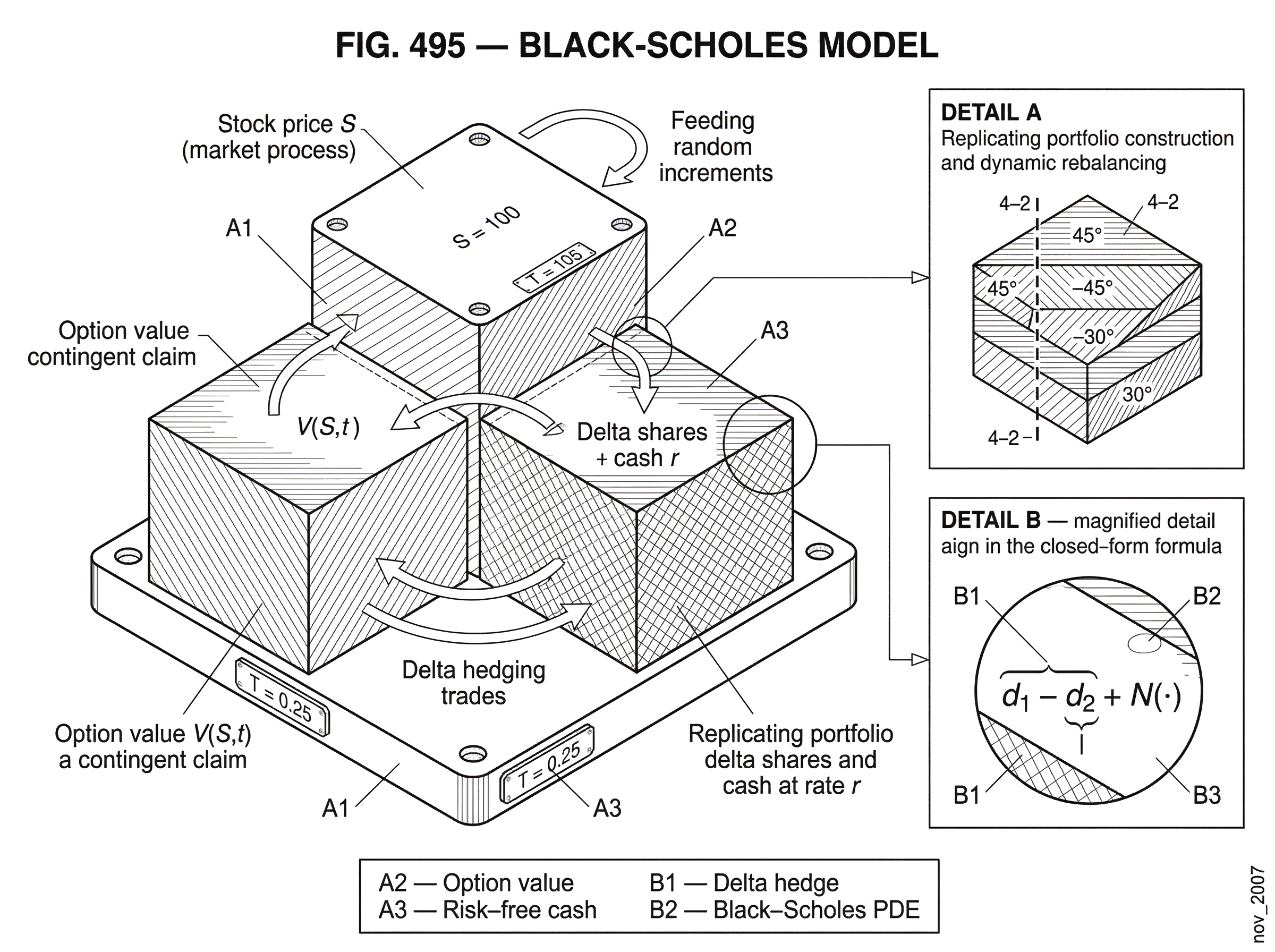
The central Black-Scholes insight is that for certain options, pricing can be separated from the stock’s expected return. That sounds surprising at first. After all, the option payoff depends on the stock price. But the mechanism is replication. If you can dynamically hedge an option by trading the stock and lending or borrowing cash, then you can build a portfolio with the same payoff pattern. Once two portfolios have the same future payoff, they must have the same price today, or arbitrage appears.
This is the compression point of the whole topic: Black-Scholes prices an option not by forecasting the stock’s average growth, but by finding the cost of replicating the option’s risk exposure. That is why the stock’s drift drops out of the pricing equation, while volatility remains. Drift is something the hedge can neutralize; volatility is what creates the option’s convex value in the first place.
What market assumptions underlie the Black‑Scholes model?
To make that logic work, Black-Scholes starts with a stylized market. There is a stock with price S, a risk-free asset growing at rate r, and an option with value V(S, t), where t is time. The stock price is assumed to evolve randomly, with a continuous diffusion component. In ordinary language, that means the stock wiggles unpredictably through time, but without sudden jumps in the basic model.
The standard assumption is that the stock follows a lognormal stochastic process. Intuitively, percentage changes matter more than dollar changes, and the randomness scales with the current stock price. This is why the model naturally keeps stock prices positive and why the final distribution of future prices has the lognormal form mentioned in many finance texts and lecture notes.
Volatility, written as σ, measures the size of the stock’s random fluctuations. In the model, σ is constant. That is not because real markets truly have constant volatility, but because constant volatility makes the mathematics tractable and yields a closed-form solution. This choice is one reason Black-Scholes became so influential: it is simple enough to calculate, yet rich enough to connect pricing and hedging.
The option price V depends on both the stock price and time. If the stock moves a little and time passes a little, the option value changes for multiple reasons at once. This is where stochastic calculus enters. MIT lecture notes on the Black-Scholes derivation emphasize that the standard route uses Ito’s lemma, which is the tool for tracking how a function of a random process changes through time.
Why does hedging eliminate the stock’s expected return in pricing?
Here is the mechanism in plain language before any equation. Suppose you hold one option and short some number of shares of stock. If you choose that share amount correctly, then over a very short interval the random part of the option’s movement is offset by the random part of the stock position. The combined portfolio becomes locally riskless, at least under the model’s assumptions.
Once a portfolio is riskless over that instant, it should earn the risk-free rate, not some arbitrary higher or lower return. If it earned more, traders could borrow at the risk-free rate, buy the portfolio, and lock in free profit. If it earned less, they could do the reverse. This no-arbitrage condition is what pins down the option pricing equation.
Now the key conceptual payoff appears: the stock’s expected return does not survive this construction. The hedge strips out the drift term because the risky exposure to the stock is canceled locally. What remains is a condition involving the option’s sensitivity to the stock price, the stock’s volatility, time decay, and the risk-free rate. This is why reputable finance lecture notes stress that the drift of the stock does not show up in the Black-Scholes equation because we hedge the option with the stock.
This is also the bridge to risk-neutral valuation. In a complete, arbitrage-free version of the Black-Scholes world, pricing as if the stock grows on average at the risk-free rate gives the same answer as the replication argument. Risk-neutral valuation is not a claim about what investors literally believe. It is a pricing device implied by no-arbitrage once replication is possible.
What is the Black‑Scholes PDE and what does each term mean?
After applying Ito’s lemma and imposing the no-arbitrage condition on the locally riskless hedge, the option value V(S, t) must satisfy the Black-Scholes partial differential equation:
∂V/∂t + (1/2)σ^2 S^2 ∂^2V/∂S^2 + rS ∂V/∂S - rV = 0
Each term has an economic meaning. The term ∂V/∂t captures how the option changes as time passes. The term involving ∂^2V/∂S^2 contains the curvature of the option value with respect to the stock price (what traders call gamma) scaled by volatility. This is the part that makes options fundamentally different from linear instruments like stock or forwards. The term rS ∂V/∂S reflects the financing effect of holding the stock hedge, and -rV enforces the risk-free return condition on the option value itself.
The equation matters more than the memorized formula because it tells you the structure of the problem. Black-Scholes is not fundamentally “a call-price formula.” It is a statement that in this market model, any derivative value must evolve in a way consistent with replication and no-arbitrage. For simple payoffs and boundary conditions, you get closed-form solutions. For more complicated derivatives, the same logic often survives even when the closed form does not.
The MIT notes also point out that this equation is mathematically close to the heat equation from physics. That analogy explains why standard transformation methods can solve it. The analogy helps with the mathematics, but it has limits: heat diffusion is a physical process, while option pricing is an economic no-arbitrage condition built on trading and hedging.
What is the closed‑form Black‑Scholes formula for a European call?
| Formula term | Symbol or expression | Economic role | Trader intuition |
|---|---|---|---|
| Stock term | S N(d1) | Upside exposure component | Like holding fraction of stock |
| Discounted strike | K e^(-rT) N(d2) | Present value of strike | Expected discounted exercise cost |
| N(d1) | Cumulative normal at d1 | Relates to delta and stock weight | Fractional stock hedge |
| N(d2) | Cumulative normal at d2 | Risk‑neutral exercise probability | Probability of exercise under RN |
For a European call option (exercisable only at expiration) the Black-Scholes PDE can be solved explicitly. The resulting call price C is
C = S N(d1) - K e^(-rT) N(d2)
where K is the strike price, T is time to expiration, and N(.) is the standard normal cumulative distribution function. The terms d1 and d2 are
d1 = [ln(S/K) + (r + σ^2/2)T] / [σ sqrt(T)]
d2 = d1 - σ sqrt(T)
This is the famous formula. But its meaning becomes much clearer once you see it as the output of the replication argument rather than a mysterious statistical trick. The term S N(d1) behaves like the stock-related part of the position, while K e^(-rT) N(d2) is the discounted strike payment weighted by risk-neutral exercise probability ideas.
A common misunderstanding is to treat N(d2) as a literal real-world probability that the option finishes in the money. In Black-Scholes it is more precise to say it is tied to a risk-neutral probability structure. Developer documentation such as QuantLib’s pricing-engine docs reflects this practical distinction by exposing functions that compute in-the-money probabilities under the risk-neutral measure, not subjective forecasts of what traders truly expect.
The put formula follows from the same framework, and put-call parity links puts and calls with the same strike and maturity. That parity is important because it is a pure arbitrage relation and does not rely on the full Black-Scholes machinery. Historically and practically, traders use such relations constantly alongside model-based pricing.
How do you apply Black‑Scholes in a worked example?
Imagine a stock trading at 100. A three-month European call with strike 100 is quoted in the market. To use Black-Scholes, a trader chooses inputs: current stock price S = 100, strike K = 100, time to maturity T = 0.25 years, risk-free rate r, and volatility σ. The model then produces a theoretical price.
But the deeper use starts after the price. Suppose the call’s delta (the sensitivity of the option price to the stock price) comes out near 0.52. That means the option behaves, for small stock moves, somewhat like owning 0.52 shares. If a market maker sells 1,000 calls, the book is now short positive Delta exposure, so the trader might buy about 520 shares to hedge the first-order stock risk. If the stock moves, the delta changes, because options are curved instruments. The hedge must then be adjusted.
This is the living mechanism of Black-Scholes: not “plug numbers into a formula once,” but price, hedge, observe the Greeks, and rebalance. Cboe’s options calculator page captures this practical role well when it describes using Black-Scholes-style inputs to generate theoretical prices and Greek values. In trading desks and software libraries alike, the model is as much a language for sensitivities as it is a pricing rule.
How do the Greeks arise from Black‑Scholes and how are they used?
| Greek | Definition | Use in trading | Hedge instrument |
|---|---|---|---|
| Delta | Sensitivity to stock price | First‑order hedge | Underlying stock |
| Gamma | Curvature to stock price | Measure rebalancing need | Options |
| Theta | Time decay | Estimate time erosion | Roll positions |
| Vega | Sensitivity to volatility | Manage vol exposure | Options or vega swaps |
| Rho | Sensitivity to rates | Rate risk assessment | Bonds or swaps |
The Greeks are not add-ons. They are the local coordinates of the Black-Scholes world. Because the option value is a differentiable function of price, time, volatility, and rates in the model, you can measure how the value changes when those inputs move.
Delta is ∂V/∂S, the slope of the option value with respect to the stock price. It tells you how many shares are needed for the local hedge. Gamma is ∂^2V/∂S^2, the curvature that explains why the hedge must be updated as the stock moves. Theta reflects time decay. Vega measures sensitivity to volatility. Rho measures sensitivity to interest rates.
QuantLib documentation highlights this implementation perspective clearly: a Black calculator provides analytical values for price and Greeks under lognormal assumptions. That is why Black-Scholes remains embedded in trading infrastructure. Even when traders know the world is not truly lognormal with constant volatility, they still need a coherent way to measure local risk exposures.
This leads to one of the model’s most durable real-world uses: implied volatility. In practice, traders often start with the market price of an option and invert the Black-Scholes formula to solve for the volatility σ that would make the model match that price. QuantLib documents this as solving for the implied standard deviation σ sqrt(T) numerically. The model then becomes a quoting convention: the market speaks in implied vols because they normalize option prices across strikes and maturities.
What does Black‑Scholes get right (and why is it useful)?
The model’s enduring success comes from several structural truths. First, it encodes no-arbitrage in a sharp and usable way. Second, it connects price and hedge, which is more powerful than a purely statistical forecast. Third, for European vanilla options under simple assumptions, it is analytically solvable. That combination is rare.
It also provided a unifying framework that later models extend rather than replace conceptually. Binomial models converge toward Black-Scholes under suitable assumptions. Finite-difference methods solve the same kind of pricing PDE numerically when no closed form exists. Monte Carlo pricing generalizes the risk-neutral expectation idea by simulating many paths, averaging payoffs, and discounting them. The MIT notes emphasize exactly this point: simulate risk-neutral paths, average the payoff, discount, and the same conceptual structure carries over into interest-rate and credit settings.
So even where the original formula is not used directly, the Black-Scholes worldview survives. The basic grammar is still there: specify dynamics, move to risk-neutral pricing, compute present value, extract hedges.
When and why do Black‑Scholes assumptions break down?
| Broken assumption | What breaks | Practical mitigation |
|---|---|---|
| Discrete hedging | Replication imperfect | Adjust for rebalancing risk |
| Transaction costs | Hedging becomes expensive | Include costs or trade less |
| Constant volatility | Smile and skew appear | Use local or stochastic vol |
| Price jumps | Jump risk not replicated | Use jump-diffusion models |
| Liquidity constraints | Cannot trade desired size | Hold reserves or size limits |
The most important thing to remember is that Black-Scholes is exact only inside its own idealized world. Continuous hedging is central. If you can hedge only at discrete times, the replication is no longer perfect. Between hedge updates, the stock can move in ways the hedge does not capture. Transaction costs then matter, because rebalancing is not free. Liquidity matters, because you may not be able to trade the required size at the observed price.
Volatility constancy is another fault line. Real markets do not assign the same implied volatility to every strike and maturity. Instead, traders observe smiles and skews. This means the market is telling you that the single-σ lognormal world is too simple. The model can still be used as a quoting map (price in, implied vol out) but the implied vol becomes strike- and maturity-dependent rather than a single structural constant.
Critics such as Haug and Taleb push this point hard. Their argument is not merely that Black-Scholes is imperfect (every model is) but that the continuous dynamic-hedging story is much more fragile than textbook presentations can suggest. If returns have jumps or heavy tails, if liquidity disappears, or if hedging itself moves the market, then replication can fail in precisely the moments when the hedge matters most. Whether one agrees with every historical claim in that critique, the practical warning is sound: a model of local risk control is not the same as a guarantee of global safety.
The simplest structural break is the presence of jumps. Black-Scholes assumes continuous price paths. But actual markets can gap on earnings, macro news, defaults, or crashes. Once jumps are allowed, a hedge built from only stock and cash cannot generally cancel all risk instantaneously. That is why jump-diffusion and stochastic-volatility models exist: they try to repair specific mismatches between the Black-Scholes world and observed market behavior.
Why do traders still use Black‑Scholes despite its flaws?
This is a reasonable question, and the answer is not that traders are naive. It is that Black-Scholes does several jobs at once, and some of those jobs remain useful even when the assumptions are visibly false.
At the most basic level, it is a common coordinate system. If two traders quote an option at 24% implied volatility, they can communicate faster than if they quote raw premium dollars across many strikes and expiries. The model compresses prices into a volatility language the market understands.
It is also a first-order hedging system. Even if the true dynamics are richer, delta and gamma from a Black-Scholes-style framework often provide a workable local description of exposure. Traders then layer adjustments on top: smile-aware vols, scenario analysis, stress testing, vega buckets, jump risk reserves, or alternative models such as local vol, Heston, SABR, or jump-diffusion depending on the asset class and product.
And in some markets, a close relative rather than the original equity version is used. QuantLib’s documentation distinguishes the Black formula for options on forwards and the Bachelier formula for normal dynamics, especially where rates can be near or below zero. This shows the deeper point: practitioners often preserve the no-arbitrage, risk-neutral pricing structure while changing the distributional assumption to better match the instrument.
What are Black‑Scholes’s practical uses in trading and risk management?
In live trading, Black-Scholes is commonly used in three intertwined ways. It prices plain-vanilla European options or serves as the benchmark from which richer models deviate. It converts observed option prices into implied volatilities, which then become the market’s standardized quote format. And it produces Greeks for hedging and risk reporting.
That is why exchanges, analytics platforms, and software libraries still expose Black-style calculators. Cboe’s educational tools frame the model as the place where theoretical option value and Greeks become concrete for traders. Quantitative libraries implement both pricing and inversion routines because a large part of daily workflow is not “compute the formula once,” but repeatedly solve the forward and inverse problems across an entire volatility surface.
In that sense, Black-Scholes is less like a final truth and more like a base layer. Many desks use it directly for simple products, indirectly for quoting, and conceptually as the foundation under more advanced models.
Conclusion
The Black-Scholes model is best understood as a no-arbitrage hedging argument before it is understood as a formula. Its central claim is that if an option’s risks can be replicated by trading the underlying and cash, then the option’s price is pinned down by that replication cost rather than by anyone’s guess about the stock’s average return.
That idea explains both the model’s power and its limits. It gives a precise equation, a closed-form price for European vanilla options, and the Greeks that organize option risk. But it depends on an idealized world of continuous hedging, smooth price paths, and stable volatility. Real markets violate those assumptions often enough that traders treat Black-Scholes as a foundation, a quoting language, and a local risk tool; not a complete description of reality.
If you remember one thing tomorrow, remember this: Black-Scholes works by turning option pricing into hedging. Everything else (the formula, implied volatility, and the model’s limitations) follows from that core idea.
Frequently Asked Questions
Because the replication/hedging argument cancels the stock’s drift: by dynamically hedging the option with the underlying and cash you create a locally riskless portfolio, so pricing follows a no‑arbitrage condition that does not involve the stock’s expected return - this is why the pricing can be done under the risk‑neutral measure instead.
The model assumes continuous trading, frictionless markets, and a lognormal stock process with constant volatility; these assumptions matter because discrete hedging, transaction costs, limited liquidity, volatility smiles/skews, and jumps violate them and break exact replication. Practitioners therefore treat Black‑Scholes as a first‑order tool and use extensions (local/stochastic volatility, jump‑diffusion) or adjustments when those failures matter.
Traders use Black‑Scholes chiefly as a common language and base layer: they invert market prices to implied volatility for quoting, use the Greeks it produces for local hedging and risk reporting, and treat it as the starting point for more advanced models or adjustments; exchanges and libraries (e.g., Cboe tools, QuantLib) implement these workflows.
No - N(d2) should not be read as the market’s subjective (real‑world) probability of finishing in the money; it reflects a risk‑neutral probability structure that emerges from the replication/no‑arbitrage argument.
If prices jump or returns have heavy tails, a hedge built only from the stock and cash cannot generally eliminate all risk instantaneously, so replication fails and dynamic hedging may perform poorly during the very events it is meant to protect against; this is why jump‑diffusion and stochastic‑volatility models are used as repairs.
The Greeks are the partial derivatives of the option value (delta, gamma, theta, vega, rho) that come out naturally from the model; traders use delta for the first‑order hedge, gamma to understand how that hedge will change, and the other Greeks to manage sensitivities to time, volatility, and rates.
Practitioners often switch model form to suit the asset: the Black (lognormal) formula is used for options on forwards, while the Bachelier (normal) formula is preferred where additive dynamics or near‑zero/negative rates matter; quantitative libraries document these variants and their numerical implementations.
Implied volatility is the volatility input that, when plugged into Black‑Scholes, reproduces a market option price; traders quote and compare options in implied‑vol terms because it normalizes prices across strikes and expiries, though the resulting implied vol surface typically shows smiles and skews rather than a single constant σ.
Related reading