What Is Implied Volatility?
Learn what implied volatility is, how it is calculated from option prices, why traders use it, and where model assumptions matter.
Introduction
Implied volatility is the volatility number hidden inside an option’s market price. Traders talk about it constantly because an option premium, by itself, is hard to compare across strikes, expirations, and underlyings; implied volatility turns that premium into a common language about expected future movement.
That makes implied volatility sound more objective than it really is. It is not a directly observed property of the underlying, like spot price. It is a value backed out from option prices using a pricing model. In the simplest textbook setting, you ask: “What volatility input would make this model produce the option’s actual market price?” The answer to that inversion problem is the option’s implied volatility, or IV.
The idea matters because options are priced mainly by how uncertain the future looks, not just by whether the underlying goes up or down. A stock at 100 can have a call option worth very different amounts depending on whether the market expects quiet trading or violent swings. Implied volatility is the market’s way of expressing that uncertainty through option prices.
The single most important thing to understand is this: implied volatility is not a forecast in the ordinary statistical sense; it is the volatility assumption consistent with current option prices under a chosen model. That is why IV is useful, and also why it can mislead if you forget the words “under a chosen model.”
Why do options use implied volatility instead of quoting premiums?
If two call options each trade for 3.00, that price alone tells you very little. One might be a one-week option on a quiet utility stock; the other might be a three-month option on a high-growth name ahead of earnings. Even for the same stock, an at-the-money option and a far out-of-the-money option can have similar prices for completely different reasons. Raw premium mixes together several forces: spot price, strike, time to expiry, interest rates, dividends, and volatility.
Volatility is the part traders especially want to isolate because it captures the dispersion of possible future outcomes. The Options Industry Council defines volatility as the standard deviation of day-to-day price changes, expressed as an annualized percentage. Historical volatility looks backward and summarizes what actually happened over some past window. Implied volatility looks forward in a market sense: it is extracted from what option buyers and sellers are currently willing to pay.
This is why options markets often quote contracts in volatility terms rather than dollar premium terms. If a trader says an option is “30 vol,” they are compressing many moving pieces into one number that can be compared with yesterday’s level, with another strike, or with another expiration. It is not that the premium stops mattering. Rather, IV is a better coordinate system for understanding what the premium means.
How is implied volatility obtained by inverting an option-pricing model?
Here is the mechanism in plain language. An option pricing model takes inputs and produces a theoretical price. Among those inputs is a volatility assumption. If you hold all the other inputs fixed and vary only volatility, the model price usually moves in one direction: higher volatility produces a higher option value for plain vanilla calls and puts, because more uncertainty increases the chance of a favorable payoff while losses remain limited to the premium paid.
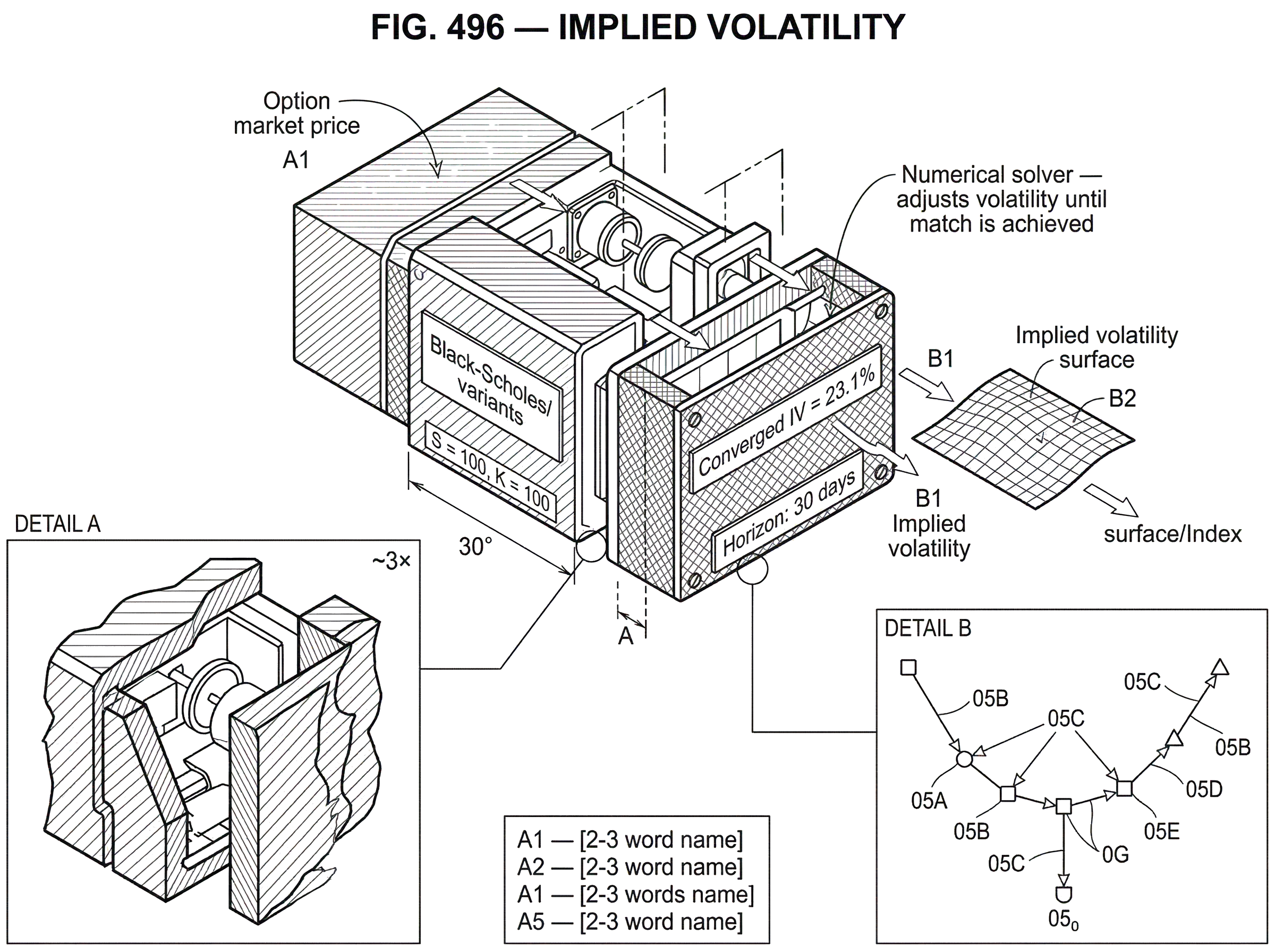
That one-way relationship is what makes inversion possible. Suppose the market price of a call is 5.20. You plug in spot, strike, time to expiry, rates, dividends, and an initial volatility guess. If the model outputs 4.80, your volatility guess was too low. If it outputs 5.60, your guess was too high. You keep adjusting volatility until the model price matches 5.20. The volatility that makes the model and market agree is the implied volatility.
This is why IV is often described as being “backed out” from price. The market does not publish volatility directly. The option publishes a price, and the model inversion translates that price into a volatility number.
For a vanilla equity option, the model used in basic discussions is usually Black-Scholes or a close relative. In production, systems may use variations that handle dividends, forwards, or other instrument-specific features. QuantLib, for example, exposes implied-volatility routines that require a specific pricing process and numerical search settings such as solver accuracy, iteration limits, and minimum and maximum volatility bounds. That detail is easy to overlook, but it matters: IV is a numerical output of a model and a solver, not a primitive market datum.
Example: calculate implied volatility from a market option price
Imagine a stock trading at 100. There is a one-month call with strike 100, and the market mid-price is 2.50. You choose a pricing model, specify the expiry, interest rate, and any dividend assumptions, and then ask what volatility input makes the model generate 2.50.
Start with a volatility guess of 15%. The model might return a call value of 1.80. That is too low relative to the market, which tells you the model is not allowing enough uncertainty. Increase the volatility guess to 25%, and maybe the model returns 2.70. Now you have gone too far. Try 23%, and the model returns 2.49. Try 23.1%, and the model returns 2.50 to within your numerical tolerance. You would then say the option’s implied volatility is about 23.1% annualized.
What happened economically? Nothing about the underlying changed during this calculation. You did not discover the stock’s “true” volatility in a physical sense. You found the volatility input that reconciles a model with the market price. If later the option price rises to 2.90 with all else unchanged, the implied volatility rises too. Traders would describe that move as volatility being bid up, even if spot barely moved.
This example also shows why the same underlying can have many implied volatilities at once. Each strike and each expiration has its own market price, so each has its own inversion result. There is no single IV for a stock in the abstract; there is an implied volatility surface spread across strike and maturity.
Why implied volatility is different from realized (historical) volatility
| Measure | Lookback vs forward | Drivers | Includes risk premium? | Typical use |
|---|---|---|---|---|
| Implied volatility | Forward-looking | Option prices and supply/demand | Yes | Pricing and hedging input |
| Realized volatility | Backward-looking | Actual past price moves | No | Performance measurement and backtests |
A common misunderstanding is to treat implied volatility as simply “expected realized volatility.” That is close enough for casual conversation, but not exact.
Realized volatility is computed from actual price moves over a period that has already occurred. Implied volatility is computed from current option prices for a period that has not yet occurred. So the two differ for at least three reasons. First, one is backward-looking and the other forward-looking. Second, implied volatility is shaped by supply and demand for options, not just statistical expectation. Third, implied volatility embeds risk pricing: investors often pay up for protection against bad tail events, especially in equity markets.
That last point is why options-implied measures of variance are so useful in practice. Research on variance swaps shows that a model-free combination of out-of-the-money option prices can recover a risk-neutral expected variance measure, and that the difference between realized variance and the option-implied variance swap rate captures a variance risk premium. In plain language, the market often prices volatility insurance richly. So IV is not just “what traders think will happen”; it is also “what traders are willing to pay to transfer volatility risk.”
Why a single underlying can have many implied volatilities across strikes and expiries
If the Black-Scholes world were literally true, all options on the same underlying with the same expiry would imply the same volatility. In real markets, they do not. Plot IV against strike for a fixed expiration and you often see a smile or a skew. Plot it across maturities and you get a term structure. Together these form the implied volatility surface.
This is not an incidental market imperfection. It is the market telling you that a single constant-volatility assumption is too crude. Real returns are not perfectly log-normal, tail risks matter, jumps occur, and downside protection is often in higher demand than upside exposure. The Options Industry Council notes that traders often use higher implied volatilities for out-of-the-money options because real-world price behavior deviates from the idealized distribution assumed by simple models.
In equity index markets, the skew usually slopes downward from low strikes to high strikes: out-of-the-money puts tend to carry higher IV than equidistant out-of-the-money calls. Mechanically, that reflects expensive crash protection. Economically, it reflects the fact that market participants care asymmetrically about downside outcomes.
So when someone asks, “What is the stock’s implied volatility?” a careful answer is, “Which strike and which expiry?” If they mean a summary statistic such as at-the-money one-month IV, that is a convention, not a law of nature.
Single-option IV vs. VIX-style volatility indices: what’s the difference?
| Type | Inputs | Horizon | Model dependence | Best for |
|---|---|---|---|---|
| Single-option IV | One option price (specific strike/expiry) | Contract expiry | High; depends on chosen pricing model | Relative-value trades and hedging |
| Index-style IV (VIX) | Many strikes across expirations | Standard 30-day (constant-maturity) | Lower; aggregation reduces single-model sensitivity | Benchmarking and volatility products |
There are two related but distinct ways people use the phrase “implied volatility.” The first is the single-option sense discussed so far: invert a pricing model for one contract. The second is the index-style sense used by measures such as VIX: aggregate many option prices to estimate expected future variance over a standard horizon such as 30 days.
This distinction matters because a VIX-style index is not just “the Black-Scholes IV of one at-the-money option.” Cboe’s methodology describes these indices as measures of the market’s expected 30-day volatility conveyed by option prices on the relevant underlying. The calculation aggregates weighted put and call mid-quotes across a wide range of strikes, rather than relying on a single option. Near- and next-term expirations are selected, single-term variances are computed, and those are combined into a constant-maturity 30-day measure.
The logic is simple once you see the problem being solved. A single option gives you a model-dependent IV for one point on the surface. But if you want a benchmark for overall market-implied volatility over the next 30 days, you would rather use a broad slice of option prices and interpolate to a fixed horizon. That produces a more stable, more representative index; though it still depends on methodology choices such as strike inclusion, quote filtering, data source, and interpolation rules.
Cboe’s methodology highlights several operational details that are easy to miss from the outside. Spot index values use bid/ask mid-quotes, only options with non-zero bids are included, and filtering algorithms are used when quotes widen or become unreliable. The formula uses the option-implied forward price F, the strike K0 just below that forward, the risk-free rate, and a weighted sum of out-of-the-money option prices. In other words, even a “headline volatility number” like VIX is the output of a carefully specified construction process, not a raw fact sitting in the tape.
What practical problems make implied-volatility calculations unreliable?
On a whiteboard, implied volatility looks neat. In live markets, the calculation is messier because market prices themselves are messy.
An option does not have a single indisputable price at every moment. It has bids, asks, sometimes stale quotes, sometimes crossed or abnormally wide markets, and often very poor liquidity in far strikes or very short-dated series. If you compute IV from the last trade, you may be using a price that is already obsolete or happened at an odd lot. If you compute from the mid, you may be using a midpoint that was never actually tradable. If you use every listed strike without filtering, illiquid tails can distort the surface badly.
That is why production systems rely on filtering, smoothing, and consistency checks. Cboe explicitly states that spot volatility indices are based on mid-quotes and include only options with non-zero bids, with filtering algorithms used when quotes are unreliable. This is not cosmetic housekeeping. It is part of the calculation itself, because bad inputs create bad implied volatilities.
There is also a numerical issue. Sometimes no volatility in your allowed range will make the model match the observed price closely enough. This can happen because the market price violates model assumptions, because the quote is stale, or because dividends, rates, or exercise features were specified incorrectly. Libraries therefore impose solver tolerances and volatility bounds. A returned IV is always conditional on those implementation choices.
Why traders fit an implied-volatility surface and how that prevents arbitrage
Once you move beyond one contract, the real object of interest is the surface: implied volatility as a function of strike or moneyness and time to maturity. But a market surface observed directly from quotes is noisy, incomplete, and sometimes inconsistent.
The problem is not only aesthetics. A jagged surface can imply arbitrage opportunities across strikes or maturities. For example, if call prices or total variance evolve in the wrong way across expiration, you can create calendar arbitrage; if the cross-strike shape is wrong, you can create butterfly arbitrage. So practitioners do not just collect pointwise IVs. They fit surfaces that are smooth enough to use and disciplined enough to avoid obvious static arbitrage.
This is where parameterizations such as SVI became important. Research on arbitrage-free SVI surfaces shows how a widely used implied-volatility parameterization can be calibrated so that static arbitrage is excluded. More recent work uses hybrid machine-learning approaches that model implied total variance and penalize arbitrage violations during training. The broad lesson is that implied volatility in practice is not just inverted, it is also cleaned, interpolated, and constrained.
That may sound like a technical nuisance, but it has direct trading consequences. A market maker hedging a book, a risk manager shocking short-dated options, and a volatility-arbitrage trader comparing implied to realized volatility all need a coherent surface, not a bag of disconnected quote-level IVs.
How traders and risk teams use implied volatility in trading, hedging, and risk management
| Use case | Primary goal | Typical horizon | Trader action |
|---|---|---|---|
| Quotation | Compare premiums across strikes/expiries | Intraday to days | Quote and communicate prices in vol terms |
| Relative-value trades | Exploit IV vs expected realized | Days to months | Buy or sell volatility/spreads |
| Risk management | Measure margin and stress moves | Short to long term | Calibrate shocks and hedge exposures |
| Benchmarking | Provide standardized volatility reference | 30 days | Underlie indices, futures, and ETPs |
The most immediate use of IV is quotation and comparison. A trader can tell whether today’s option premium is rich or cheap relative to yesterday, relative to neighboring strikes, or relative to a different underlying more meaningfully in vol terms than in dollar terms. This is especially helpful because raw premiums scale with price level and time to expiry in ways that obscure the real comparison.
A second use is relative-value thinking. Volatility traders compare implied volatility with their own view of future realized volatility. If implied looks high relative to expected realized, they may want to sell volatility; if low, buy it. This is the basic intuition behind volatility arbitrage, though in real books the trade is usually about spreads, surfaces, and hedging errors rather than a naive one-number comparison.
A third use is risk management. Changes in IV affect option values even if the underlying barely moves. Short-dated options can be especially sensitive around events, and clearinghouses explicitly model tenor-specific implied-volatility shocks for short-dated options because very near maturities can move differently from one-month tenors. That is a reminder that IV is not merely descriptive. It is a live risk factor used in margining, stress testing, and portfolio control.
A fourth use is as an input to benchmark volatility indices and volatility-linked products. VIX-style measures aggregate option prices into standardized 30-day implied-volatility benchmarks. Those benchmarks, in turn, can underlie futures, options, ETPs, and hedging programs. The XIV episode is an extreme reminder that products linked to implied-volatility indices can behave violently when implied volatility spikes.
What implied volatility does not reveal about direction, probabilities, or forecasts
It does not tell you direction. An option can have high implied volatility because the market expects a large move up or down; IV mostly speaks to magnitude, not sign.
It does not tell you the probability of every scenario unless you add much more structure. A single IV number compresses a distribution into one parameter. Even a full IV surface is still an encoded view through option prices, model conventions, and market frictions.
It does not tell you the market’s pure forecast under real-world probabilities. Option prices are closer to risk-neutral valuations than to survey expectations. That means insurance demand and risk premia matter.
And it is not universal across models. Change the pricing model, the dividend treatment, the exercise convention, or the forward input, and the implied volatility can change. This is obvious for American options, dividend-paying stocks, or products with special features, but the principle holds more generally: IV is always model-relative.
A simple analogy to understand implied volatility and its limits
A helpful analogy is that implied volatility is like the temperature setting you would infer from how fast ice is melting, rather than a thermometer reading directly from the room. The observed phenomenon is the option price. The hidden setting you infer is volatility. The analogy helps because it captures the inversion idea: you back out an unseen input from a visible output.
Where the analogy fails is just as important. In a room there really is a single underlying temperature. In options markets there may be many different implied volatilities across strikes and maturities, and the inferred value depends on the model and market microstructure. So IV is not a direct physical measurement. It is a standardized translation from prices into volatility units.
Conclusion
Implied volatility is the volatility input that makes an option-pricing model match the market price. That is the whole idea, and it explains both its power and its limitations.
Its power is that it turns hard-to-compare option premiums into a common language about expected movement, risk pricing, and relative value. Its limitation is that the number is never completely raw: it depends on the model, the quote, the solver, and, for surfaces and indices, the construction method.
The short version worth remembering tomorrow is this: implied volatility is not observed; it is inferred. And what it reveals is not certainty about the future, but the market’s priced uncertainty as encoded in option prices.
Frequently Asked Questions
Implied volatility is the volatility input that makes a chosen option-pricing model reproduce the option’s market price; practitioners find it by numerically inverting the model (for example Black–Scholes) while holding spot, strike, expiry, rates and dividends fixed, using a root solver with bounds and tolerances.
Because IV is the model-implied parameter for each contract’s market price, each strike and expiry can imply a different volatility; empirical features like fat tails, jumps, and asymmetric demand for downside protection produce the familiar smile/skew across strikes and a non-flat term structure across maturities.
No - implied volatility is not a pure forecast of realized volatility; it is a model-dependent, market-priced number that reflects supply and demand and risk premia (research on variance-swap replication shows option-implied variance often exceeds realized variance because markets price volatility insurance).
Volatility indices like VIX are constructed by aggregating many option mid-quotes across strikes and near-term expirations (using a specified weighting, the forward price F and strike K0, interpolation to a constant 30-day horizon), so they represent a broad, methodology-dependent Benchmark rather than the IV of a single at‑the‑money option.
Raw IVs can be distorted by stale trades, wide or crossed quotes, thinly traded strikes, and solver failures; production systems therefore apply filtering, mid-quote conventions, smoothing and consistency checks because bad inputs and numerical bounds/tolerances produce unreliable IVs.
Practitioners fit an entire surface rather than use pointwise IVs: they use parameterizations such as SVI, arbitrage-free calibration procedures, or machine-learning models with penalties for arbitrage violations to produce smooth, interpolated surfaces that avoid obvious static arbitrage across strikes and maturities.
No - implied volatility quantifies expected move size (magnitude), not direction; a high IV means big moves are expected but does not say whether the market expects up or down moves.
IV is sensitive to model and implementation choices: changing the pricing model, dividend/forward treatment, exercise convention (e.g., American vs. European), or numerical solver settings (bounds, accuracy) can change the inverted IV, so reported IVs are conditional on those choices.
Related reading