What is Risk-Neutral Measure?
Learn what the risk-neutral measure is, why no-arbitrage implies it, and how it makes derivative pricing a discounted expectation under Q.
Introduction
Risk-neutral measure is the probability measure used in modern derivative pricing under which discounted traded asset prices are martingales. That sentence is compact, and for many readers it sounds more mystical than helpful. The reason the concept matters is simple: it is the bridge between market prices today and uncertain payoffs tomorrow. Without it, pricing derivatives in a coherent, arbitrage-free way would be much harder; with it, a large class of pricing problems becomes “take an expected payoff and discount it back,” which is both mathematically clean and computationally practical.
The first thing to clear up is a common misunderstanding. A risk-neutral measure does not mean the real world is risk-neutral, or that investors stop caring about risk, or that expected stock returns in reality equal the risk-free rate. It is not a claim about beliefs or preferences. It is a pricing device implied by no-arbitrage conditions in a model. The deep idea is that there are two different roles for probability in finance: one is to describe what might actually happen in the world, and the other is to assign prices consistent with trading opportunities. The risk-neutral measure belongs to the second role.
That distinction is the point on which the whole topic turns. If you remember only one sentence tomorrow, remember this: risk-neutral probabilities are not meant to forecast the world; they are meant to price claims on the world.
Why derivative pricing uses a different probability measure than forecasting
| Method | Key input | Price uniqueness | Practicality |
|---|---|---|---|
| Real-world expectation (P) | Historical probabilities | Not unique if risk priced | Good for forecasting, poor for pricing |
| Equilibrium / utility methods | Investor preferences | Can yield unique equilibrium prices | Conceptual; hard to calibrate |
| Replication / no-arbitrage (Q) | Traded prices and hedges | Unique if market complete | Operational; standard for derivatives |
Suppose a stock can go up or down over the next year. If you ask an economist or a data scientist for probabilities, they might try to estimate the real-world chance of each outcome from historical data, macro conditions, or investor behavior. That gives a physical or real-world probability measure, often denoted P in textbooks. Under that measure, risky assets usually earn more than the risk-free rate on average because investors demand compensation for bearing risk.
Now ask a trader to price an option on that stock. At first glance it seems natural to take the expected payoff under real-world probabilities and discount it. But that approach runs into a basic problem: expected payoffs alone do not determine prices when risk matters. Two securities can have the same expected payoff and very different prices if one pays off in bad states of the world and the other in good states. Markets care not just about how much a claim pays on average, but when it pays relative to risk.
So pricing needs a way to encode market compensation for risk. One way is to work directly with investor preferences, marginal utility, equilibrium arguments, and stochastic discount factors. Another, and in derivatives the more operational route, is to exploit replication and no-arbitrage. If a derivative payoff can be replicated by dynamically trading underlying assets and cash, then its price must equal the cost of that replicating strategy. Otherwise there would be an arbitrage.
This is where the puzzle resolves. No-arbitrage often implies that we can rewrite prices as if investors were risk-neutral under a different probability measure. Under that measure, expected returns on traded assets, after discounting, behave in the simplest possible way: they have no predictable drift. That is what makes valuation tractable.
How discounting turns asset prices into 'fair games' (martingales) under Q
The cleanest mental model is to start with discounting. Money tomorrow is worth less than money today because you can invest at the risk-free rate. If the continuously compounded short rate is r and it is constant for simplicity, then one dollar tomorrow is worth exp(-rT) dollars today at maturity T. More generally, pricing naturally works with discounted asset values.
Under the risk-neutral measure, the discounted price of each traded asset is a martingale. In ordinary language, a martingale is a fair game: once you adjust for the information you already have, the best prediction of tomorrow’s discounted value is today’s discounted value. There is no extra expected gain left after removing the time value of money.
That is the important invariant. In the real world, a stock may have an expected return above the risk-free rate. Under the risk-neutral measure, that excess expected return disappears in the pricing calculation. Not because investors stopped demanding risk premia in reality, but because the change of measure absorbs those premia into the probabilities used for valuation.
Formally, if S(t) is an asset price at time t and D(t) is the discount factor from time t to today, then the defining property is that D(t) S(t) is a martingale under the risk-neutral measure, often written Q. The lecture notes in the supplied material state this directly: under a risk-neutral measure, discounted primary asset prices are martingales. Once that holds, the price at time t of a derivative paying X(T) at maturity T can be written as the risk-neutral conditional expectation of the discounted payoff.
In words rather than notation: today’s arbitrage-free price equals the expected discounted future payoff, where the expectation is taken under Q, not under the real-world measure P.
How the one-period binomial model demonstrates risk-neutral pricing
The idea is easiest to see in the binomial model because nothing is hidden behind advanced stochastic calculus. Imagine a stock priced at 100 today. Over the next period it will either rise to 120 or fall to 90. There is also a risk-free asset that grows from 1 to 1.05 over the same period. Consider a call option with strike 100. Its payoff will be 20 in the up state and 0 in the down state.
If you tried to price this option with real-world probabilities, you would need to know the true probability of the up move. But replication shows that you do not. The option payoff can be reproduced by holding some number of shares and borrowing or lending cash. Matching payoffs in the up and down states determines the hedge ratio and the cash position uniquely. The cost of that portfolio today is the option price.
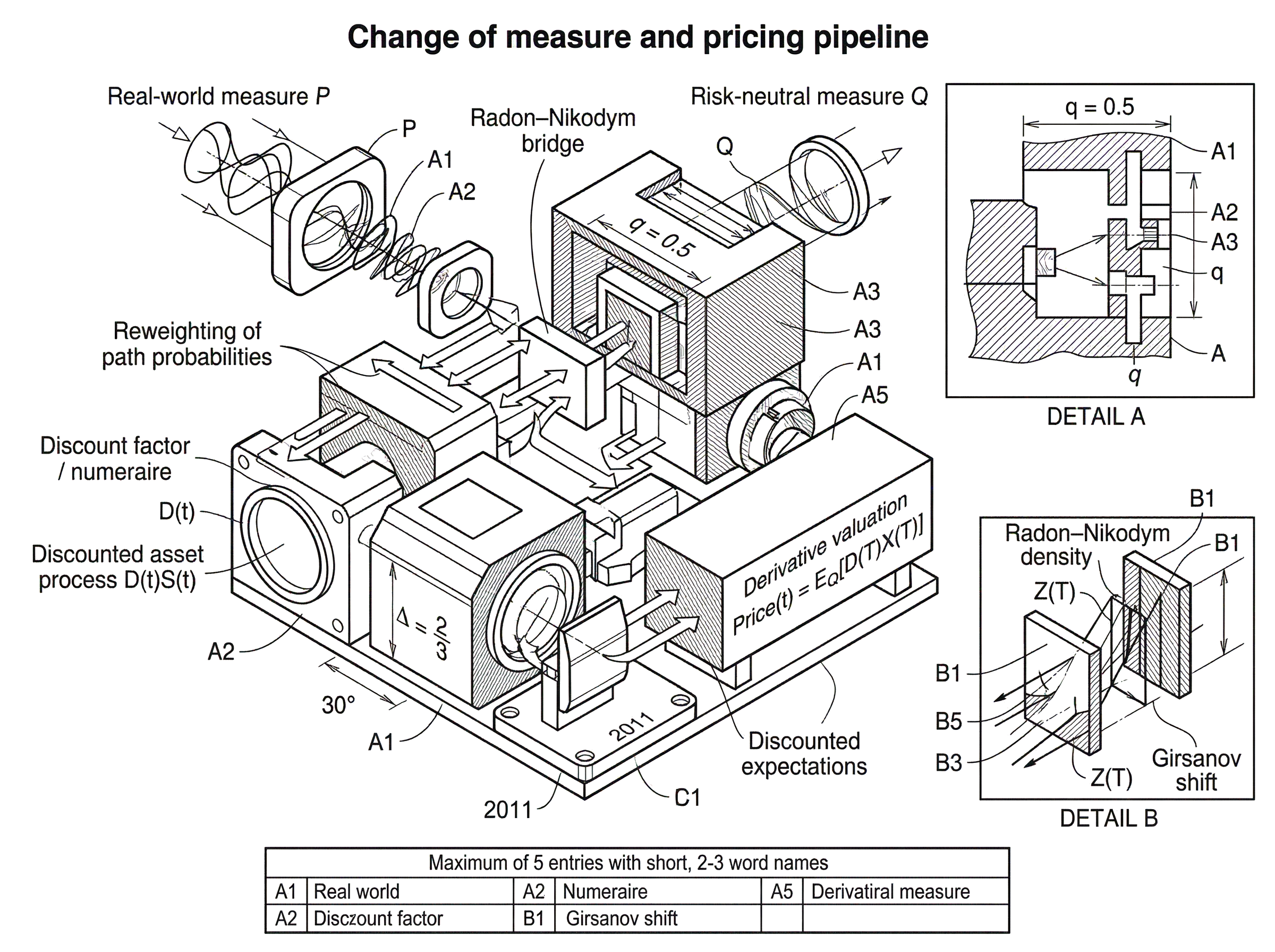
Here the hedge works as follows. If you hold Δ shares and B dollars in the bank, then next period the portfolio is worth 120Δ + 1.05B in the up state and 90Δ + 1.05B in the down state. To replicate the call, those values must equal 20 and 0 respectively. Solving gives Δ = 2/3 and B = -57.14 approximately. The portfolio therefore costs about 66.67 - 57.14 = 9.52 today, so the option price must be 9.52.
Now the striking part: the same price can be written as a discounted expectation under a specially chosen probability q. That probability is set so that the stock’s expected growth equals the risk-free rate: 100 1.05 = q 120 + (1 - q) * 90. Solving gives q = 0.5. Using that probability, the option price is 1/1.05 (0.5 20 + 0.5 * 0) = 9.52.
This q is the risk-neutral probability. It was not estimated from historical frequencies. It was implied by no-arbitrage and the traded prices of the stock and bond. In a one-period model, that is the entire idea in miniature.
The analogy is useful: the risk-neutral measure is like a change of accounting units that turns risky expected growth into risk-free expected growth for valuation purposes. What the analogy explains is the simplification of pricing. Where it fails is that this is not merely cosmetic relabeling; it is a mathematically precise change of probability measure tied to tradability and arbitrage constraints.
How the discrete risk-neutral probability q generalizes to a full measure Q
In richer models, the same logic survives but the notation becomes more formal. Instead of a single artificial probability q in a one-step tree, we work with a full probability measure Q on future paths. The condition is again that discounted traded prices are martingales under Q.
Why call it an equivalent martingale measure? Because the relevant measure must be equivalent to the real-world measure in the technical sense that it agrees on which events are possible and impossible. If an event has zero probability under one measure, it must have zero probability under the other. This prevents us from changing the model by declaring genuinely possible events impossible, or vice versa. The supplied lecture notes emphasize this through the Radon–Nikodym derivative Z(T), which must be strictly positive with expectation 1 in order to define a valid equivalent change of measure.
That density process is the mathematical object that tells us how probabilities are reweighted when moving from P to Q. Under the new measure, scenarios in which risky assets underperform relative to the risk-free asset are weighted differently from scenarios in which they outperform. The reweighting is exactly what eliminates risk premia from discounted price dynamics.
In continuous-time diffusion models, this reweighting is often implemented through Girsanov’s theorem. The supplied notes state the mechanism clearly: if Z(T) is the appropriate stochastic exponential, then under the new measure the Brownian motion is shifted by a drift term. Intuitively, we do not change the randomness itself so much as change which sample paths are given more or less weight. The effect is to replace the real-world drift of asset prices with the drift required for risk-neutral pricing.
What changes under the risk-neutral measure Q (drift vs. volatility)
| Quantity | Under P | Under Q | Why it matters |
|---|---|---|---|
| Drift | True expected drift (μ) | Risk-free drift (r) | Risk premia absorbed into probabilities |
| Volatility | Model volatility (σ) | Model volatility (σ) | Drives option value, unchanged for pricing |
| Discounted prices | Not generally martingales | Martingales by construction | Enables expectation-based pricing |
| Purpose | Forecasting and risk analysis | Arbitrage-free valuation | Different tasks require different measures |
| Calibration data | Historical time series | Market prices / implied vols | Determines inputs in practice |
This is where smart readers often get tripped up. When we move from P to Q, not everything changes.
The source of randomness stays the same in structure. If the stock follows a diffusion driven by Brownian motion, it is still driven by Brownian motion under the new measure, though with a different drift term after the measure change. In the standard Black–Scholes setting, if under the real-world measure the stock dynamics are dS = μ S dt + σ S dW, then under the risk-neutral measure they become dS = r S dt + σ S dW. The volatility σ does not change in that basic model; the drift changes from μ to the risk-free rate r.
That replacement of μ by r is one of the best-known formulas in finance, but it is easy to misread it. It does not say the stock truly grows at the risk-free rate. It says that for arbitrage-free pricing, once we switch to the pricing measure, the drift of the traded asset must be the one that makes the discounted process a martingale.
This is also why derivative prices in Black–Scholes do not depend on the stock’s expected return μ. That fact often surprises beginners because μ seems economically important. For forecasting long-run portfolio growth, it is important. For pricing a replicable option in an arbitrage-free model, it drops out because replication and no-arbitrage pin the price down without needing the real-world expected return.
How no-arbitrage implies an equivalent martingale (risk-neutral) measure
The formal connection is the Fundamental Theorem of Asset Pricing. In the supplied material, the course notes state a version of the first theorem: a model is arbitrage-free if and only if there exists an equivalent risk-neutral probability measure. They also state the second theorem: a model is complete if and only if that risk-neutral measure is unique.
These two statements are the structural backbone of the subject.
The first theorem explains why the risk-neutral measure exists at all. If there were no such measure, discounted prices could not be made into martingales, and that failure corresponds to an arbitrage somewhere in the model. Conversely, if such a measure exists, then pricing by discounted expectation is consistent with no arbitrage.
The second theorem explains when the price is unique. If the market is complete, every contingent claim can be replicated from traded assets, and the risk-neutral measure is unique. Then the derivative price is uniquely determined by arbitrage. If the market is incomplete, there may be many equivalent martingale measures. In that case, no-arbitrage alone usually gives a range of possible prices, not a single one.
That distinction matters in practice. In a simple Black–Scholes world with one source of randomness and enough trading ability, the market is complete and the pricing measure is unique. But if there are additional sources of randomness that are not spanned by traded assets, uniqueness can fail. The supplied notes give exactly this kind of example: if there is an extra independent driver, such as an interest-rate factor not fully hedgeable by available traded securities, then there can be infinitely many risk-neutral measures, and the market is incomplete.
Why Black–Scholes replaces μ with r under risk-neutral pricing
Consider a stock with current price S(0) and volatility σ, and a European call option with maturity T and strike K. In the Black–Scholes model, the stock under the risk-neutral measure follows geometric Brownian motion with drift r. The supplied course material states the terminal stock price in this setting as S(T) = S(0) exp((r - 1/2 σ^2) T + σ W(T)) under the risk-neutral dynamics.
Why does this produce the option price? Because once the drift has been changed to r, the present value of the option is the discounted risk-neutral expectation of its payoff max(S(T) - K, 0). That expectation can be computed analytically in Black–Scholes, yielding the familiar closed-form formula.
The mechanism matters more than the formula. The stock’s actual expected return does not appear because the option is replicable. A dynamic hedge made of stock and cash can reproduce the payoff. No-arbitrage says the option price must equal the cost of the hedge. The risk-neutral expectation is simply another way of expressing that same price.
This is not an accident specific to equity options. The same pattern shows up broadly in derivatives: once you identify the numeraire and the associated pricing measure, the discounted asset or forward price becomes a martingale under that measure, and valuation becomes expectation under the corresponding measure.
How traders and quants apply the risk-neutral measure in pricing and Monte Carlo
In practice, the risk-neutral measure is not just a theorem one proves and forgets. It is the operational language of pricing systems.
If a desk prices vanilla options from an implied volatility surface, it is implicitly working under a risk-neutral distribution extracted from option prices. If a quant runs a Monte Carlo engine for path-dependent options, the simulation is usually performed under risk-neutral dynamics and the payoff is discounted and averaged. The supplied Cambridge chapter summary states this operationally: under no-arbitrage, the price of a generic derivative can be expressed as the expected value of its discounted payouts, which is exactly why Monte Carlo applies. The Oxford lecture notes then make the same point from an implementation angle: Monte Carlo pricing starts from the risk-neutral form of the stochastic differential equation.
So the risk-neutral measure is the reason pricing engines can be built around simulation. Instead of asking “what will the asset really do on average?”, the engine asks “under the pricing measure consistent with market observables and no-arbitrage, what is the discounted expected payoff?” That shift is what turns derivative valuation into a computational problem.
This also explains calibration. In many models, we do not estimate parameters mainly from historical time series. We choose model parameters so that the model reproduces observed market prices of liquid instruments. The supplied notes mention Dupire’s formula, which recovers a local volatility surface from call prices. That is a strongly risk-neutral object: it is inferred from cross-sectional option prices, not from the asset’s real-world time-series behavior.
How funding, collateral and XVA modify the risk-neutral pricing framework
| Framework | Discounting | Numeraire | Main complexity | Best for |
|---|---|---|---|---|
| Textbook risk-neutral | Single risk-free curve | Bank account / risk-free bond | Simple martingale pricing | Vanilla options pre-crisis |
| Collateralized pricing (CSA) | Collateral (OIS/overnight) curve | Collateral account | Contract-dependent discounting | Collateralized swaps and cleared trades |
| Funding-inclusive / XVA | Multiple curves and funding spreads | Contract- and party-specific | Recursive valuation; CVA/DVA/FVA | Counterparty- and funding-sensitive deals |
The clean textbook statement “discount at the risk-free rate and take expectation under Q” is still foundational, but modern markets forced practitioners to become more precise about what exactly is being discounted, by which numeraire, and under which contractual setup.
Post-crisis derivative pricing made this very clear. The supplied research material on funding, collateral, and valuation adjustments emphasizes that once funding costs, collateralization, and counterparty risk are included, there is no longer a single naive discount curve for every purpose. Valuation can become recursive, contract-dependent, and sensitive to margining rules, close-out conventions, and funding asymmetries. A simple one-curve story is no longer enough.
This does not mean the risk-neutral framework was discarded. It means the framework had to be refined. The more general principle remains: price by no-arbitrage under an appropriate measure associated with the chosen numeraire and contractual cash-flow structure. But the clean “one universal risk-free rate” picture becomes less literal when overnight collateral rates, multiple forwarding curves, and valuation adjustments enter the problem.
That is why modern derivative pricing often talks about a risk-neutral pricing framework rather than a single universal formula. The supplied arXiv paper describes a framework that incorporates funding, margining, CVA, DVA, and collateral into a coherent risk-neutral setup, while also warning that the resulting equations can be recursive and do not always decompose neatly into additive adjustments.
So the fundamental idea survives, but its implementation depends on assumptions. The most important thing that changes is not the theorem about martingale measures; it is the market model to which the theorem is being applied.
When risk-neutral pricing fails: incompleteness, model risk, and unhedgeable risks
The risk-neutral measure is powerful, but not magic. It depends on modeling assumptions, market structure, and what is actually tradable.
If markets are incomplete, the risk-neutral measure may not be unique. Then no-arbitrage alone cannot tell you a unique price for every claim. Additional structure is needed: an equilibrium argument, a utility-based choice, a calibration convention, a minimum-variance hedge, or some other criterion to pick one measure or one price.
If the model is misspecified, the existence of a risk-neutral measure inside that model does not rescue the model from being wrong. You can always have a beautifully arbitrage-free price for the wrong dynamics. This is one reason model risk matters. The supervisory guidance in SR 11-7, included in the supplied material, is relevant here: complex pricing models create model risk both through fundamental modeling errors and through misuse or misunderstanding of assumptions.
If some risks are not hedgeable, then risk-neutral valuation may still be used for parts of the problem, but residual unhedgeable risks must be handled separately. That often shows up in insurance-like features, counterparty risk, liquidity effects, or exercise behavior models where no perfect replication exists.
And even in complete markets, numerical implementation can be fragile. Monte Carlo under Q still needs discretization, random number generation, variance reduction, and calibration. The supplied Oxford notes stress that practical simulation quality depends on these implementation choices. The theory gives the expectation representation; computation still has to approximate it well.
When to use P versus Q: forecasting with P, pricing with Q
It is worth ending the conceptual part by putting P and Q side by side.
The real-world measure P is for forecasting, risk management, and empirical modeling of what is likely to happen. If you want to estimate default frequencies, long-horizon equity premia, or macro scenarios, you are usually in P-world.
The risk-neutral measure Q is for arbitrage-free pricing of traded claims. If you want to compute an option value from a model consistent with observed prices and no-arbitrage, you are usually in Q-world.
These are not competitors so much as tools for different tasks. Confusing them causes endless errors. If you feed real-world expected returns directly into a replication-based pricing problem, you usually contaminate a no-arbitrage calculation with forecasting inputs it does not need. If you use risk-neutral distributions as literal forecasts of future spot prices, you mistake a pricing object for a belief object.
The two are connected mathematically by a change of measure, often through a density process or stochastic discount factor. But conceptually they answer different questions: P asks what happens?; Q asks what price avoids arbitrage?
Conclusion
The risk-neutral measure exists because derivative pricing is constrained more by tradability and no-arbitrage than by investors’ literal beliefs about the future. Its defining property is simple but powerful: under this measure, discounted traded asset prices are martingales. That one change lets arbitrage-free prices be written as discounted expectations.
The idea is not that the world becomes risk-neutral. The idea is that pricing can be done as if it were, once probabilities are reweighted in the way implied by market prices and hedgeability. In complete markets this gives unique prices; in incomplete markets it gives a framework, but not always a single answer.
If you remember the essence, remember this: the risk-neutral measure is the probability measure that makes pricing work, not the one that makes prediction true.
Frequently Asked Questions
The risk-neutral measure Q is the probability measure under which discounted traded asset prices are martingales, so derivative prices equal the discounted Q‑expected payoff; it is a pricing device implied by no‑arbitrage, not a statement that investors are literally risk‑neutral or that real returns equal the risk‑free rate.
Q is constructed so discounted asset prices have no drift (are martingales), and it is required to be equivalent to the real‑world measure P (i.e., it must agree on which events have zero probability); mathematically this is implemented via a strictly positive Radon–Nikodym density Z(T) with expectation one.
If the market is complete the equivalent martingale measure is unique and prices are uniquely determined by arbitrage and replication; if the market is incomplete there can be many equivalent martingale measures and no‑arbitrage alone typically yields a range of possible prices, so extra criteria (equilibrium, utility, calibration conventions, hedging rules) are needed to pick a price.
In standard diffusion models the change of measure replaces the real drift μ with the risk‑free drift r while leaving volatility σ unchanged, so Black–Scholes option prices do not depend on μ because replication and no‑arbitrage determine the price under the risk‑neutral dynamics.
Practitioners simulate under the risk‑neutral measure: pricing engines run Monte Carlo under Q to compute discounted expected payoffs, and model parameters are often calibrated to market observables (e.g., implied volatilities or a local volatility surface obtained via Dupire) rather than estimated from historical P‑dynamics.
The risk‑neutral framework still applies, but when collateral, funding costs, and counterparty risk matter there is no single universal discount curve; instead one must choose the appropriate numeraire and pricing measure for the contractual setup, which leads to recursive, contract‑dependent valuation equations (e.g., CVA/FVA frameworks).
No - Q is not a forecasting tool; P is used for forecasting and risk management while Q is the pricing measure that answers ‘what price avoids arbitrage?’, and confusing the two leads to mistakes such as inserting real‑world expected returns into replication problems.
Girsanov’s theorem provides the mechanism in continuous time: the measure change reweights path probabilities and shifts the Brownian motion drift so that under Q the discounted traded assets have the martingale drift needed for pricing, while the noise/volatility structure remains the same in basic models.
model risk and implementation matter: a model can be arbitrage‑free yet misspecified, and numerical methods (Monte Carlo discretization, RNG, variance reduction) and governance (validation, documentation, conservative adjustments) are necessary to control model and calibration risk.
When some risks are not spanned by traded assets (extra independent drivers or illiquid factors), replication fails and risk‑neutral pricing may give only a range of fair values; in practice firms select a pricing convention or hedging objective (e.g., minimum‑variance hedge, calibration choice or utility‑based price) to produce a single actionable price.
Related reading