What Is the Ornstein-Uhlenbeck Process? Mean Reversion in Trading Explained
Learn what the Ornstein-Uhlenbeck process is, how it models mean reversion in trading, and where OU-based spread models work - or fail.
Introduction
The Ornstein-Uhlenbeck process is the classic mathematical model for a price-like quantity that does not simply drift away, but instead keeps getting pulled back toward a typical level. That idea matters in trading because many strategies are built on exactly this intuition: a spread between related assets widens, looks unusually far from normal, and is expected to converge. The puzzle is that markets are noisy enough to look random and structured enough to display recurring equilibrium relationships. The Ornstein-Uhlenbeck, or OU, process is the simplest continuous-time model that holds both facts at once.
That is why it appears so often in quantitative trading. It is used to model residuals in statistical arbitrage, spreads in pairs trading, and short rates in fixed income through the Vasicek model. Traders like it not because reality is literally OU, but because the model gives a clean mechanism for mean reversion, an explicit distribution for future values, and estimable parameters that map to practical questions: Where is equilibrium? How fast do deviations decay? How much random noise remains?
The important thing to understand is that the OU process is not “a chart pattern formalized.” It is a stochastic dynamical system. At every instant, two forces act on the variable: a deterministic pull toward a long-run mean, and a random shock. The interaction between those forces is the whole model. Once that clicks, the formulas stop looking arbitrary and start reading like a compact description of cause and effect.
Why do traders model mean reversion for spreads?
Suppose you are watching the spread between two historically related assets. If the spread gets unusually wide, a mean-reversion trader wants to know whether that is just noise, a temporary dislocation, or evidence that the relationship has changed. Purely descriptive statistics can tell you the spread is “far from average,” but they do not tell you how deviations evolve in time. A trading decision needs more than a level; it needs a dynamic law.
That law has to do two things at once. First, it must allow randomness, because market variables never move deterministically. Second, it must make large deviations less persistent than a pure random walk would. If you model the spread as a random walk, shocks accumulate forever, and there is no natural tendency to come back. That contradicts the central premise of many relative-value trades. If you model it as pure deterministic decay, you ignore the fact that spreads keep wobbling even while they revert.
The OU process solves exactly this problem. It says: the current state matters because the distance from equilibrium determines the directional pull, but randomness never disappears because shocks keep arriving. In trading language, the model encodes a spread that is locally predictable in direction when it is far from fair value, yet still noisy enough that timing and risk remain difficult.
This is also why OU models are often used not on raw prices but on spreads, residuals, or factor-neutral portfolios. A single stock price is usually closer to a nonstationary process than to a stationary one. But a carefully constructed residual (after regressing on sector ETFs, market factors, or a cointegrating partner) may plausibly fluctuate around a stable level. The OU process is designed for the second object, not usually the first.
How does the OU process produce mean reversion (pull plus noise)?
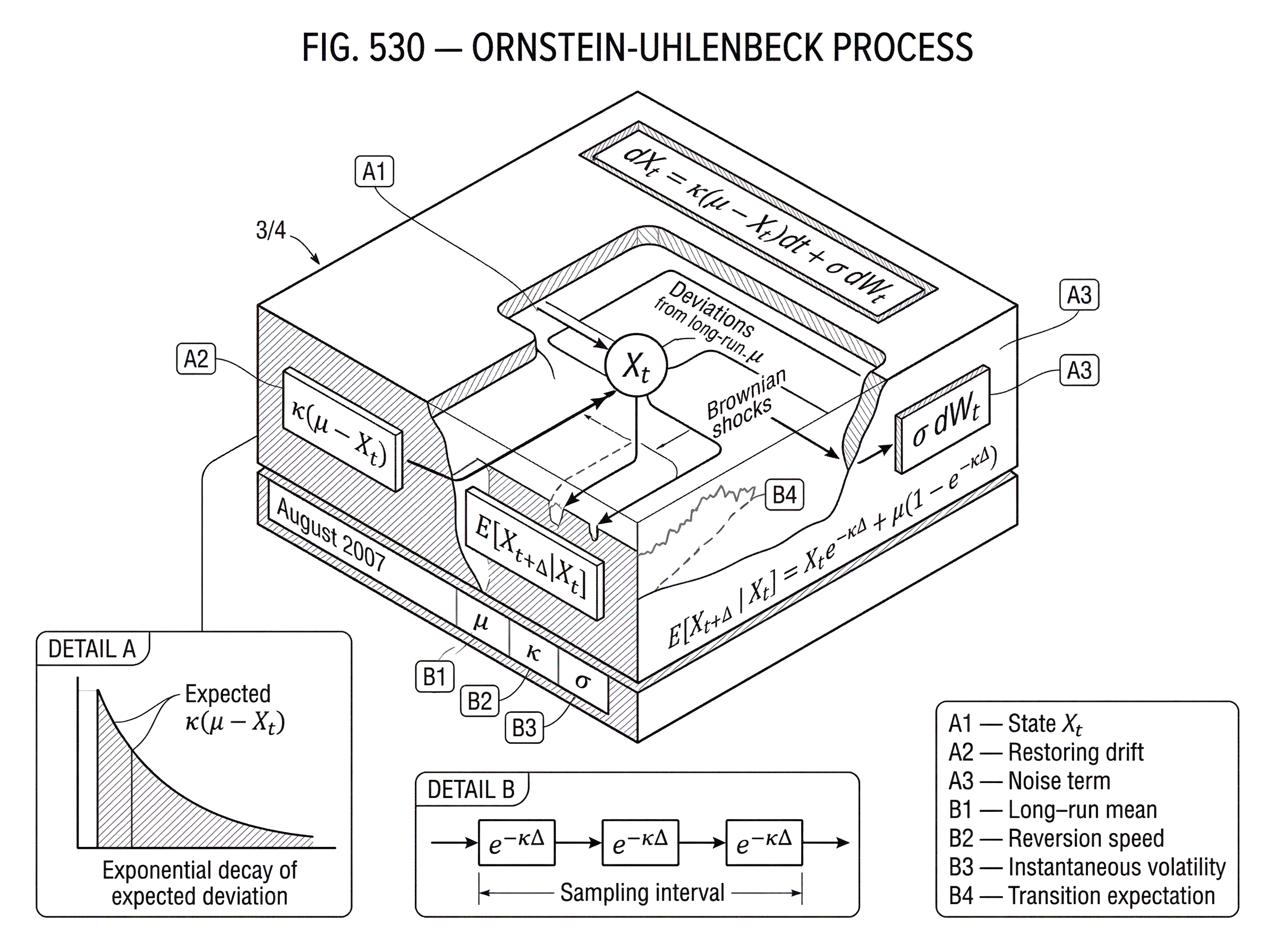
The most common form of the OU model is written as dX_t = κ(μ - X_t)dt + σ dW_t.
Here X_t is the state variable at time t, such as a spread or residual. The parameter μ is the long-run mean level. The parameter κ > 0 is the speed of mean reversion: it controls how strongly the process is pulled back toward μ. The parameter σ > 0 is the instantaneous volatility, and W_t is a standard Brownian motion, the source of continuous random shocks.
This equation becomes intuitive if you read each term mechanically. The drift term, κ(μ - X_t)dt, is the restoring force. If X_t is above the mean, then μ - X_t is negative, so the drift points downward. If X_t is below the mean, the drift points upward. And the farther X_t is from μ, the larger the pull. That linearity is the key simplification: distance from equilibrium translates directly into expected directional pressure.
The noise term, σ dW_t, keeps the process from collapsing onto the mean. Even if the variable is exactly at equilibrium, randomness pushes it away again. So the mean is not a resting point in the deterministic sense; it is the center of a noisy orbit. That is an important trading intuition. Mean reversion does not mean smooth convergence. It means that conditional expectation pulls inward even while realized paths remain jagged.
An analogy helps here. Imagine a particle in a bowl being buffeted by random kicks. The shape of the bowl pulls the particle toward the bottom, but the kicks prevent it from staying there. The analogy explains the coexistence of equilibrium and noise. Where it fails is market structure: a spread is not a physical particle, and the “restoring force” comes from economics, arbitrage, inventory pressure, or relative valuation; not mechanics.
What does an OU model predict about future values and half-life?
| Horizon | Expected deviation | Variance | Trading implication |
|---|---|---|---|
| Now (Δ≈0) | No decay | Near zero | No actionable signal |
| Short (<< half-life) | Small exponential decay | Rising but bounded | High timing risk |
| Half-life (≈ ln2/κ) | Deviation halves | Moderate | Natural holding period |
| Long (>> half-life) | Forgets initial state | Converges to stationary | Entry less state-dependent |
The most useful fact about the OU process is that it has an explicit solution in distribution. If the process is at X_t now, then over a horizon Δ, the expected future value is
E[X_(t+Δ) | X_t] = X_t e^(-κΔ) + μ(1 - e^(-κΔ)).
This expression says something very simple: today’s deviation from equilibrium decays exponentially. If you subtract μ from both sides, you get
E[X_(t+Δ) - μ | X_t] = (X_t - μ)e^(-κΔ).
That is the compression point of the model. Mean reversion in an OU process means exponential decay of expected mispricing. The decay rate is controlled by κ. Large κ means fast forgetting of the current deviation; small κ means a slow grind back toward equilibrium.
The variance over horizon Δ is also explicit. In the common parameterization, the conditional variance is proportional to 1 - e^(-2κΔ). So uncertainty rises with horizon at first, but unlike a random walk it does not grow without bound. As Δ gets large, the process approaches a stationary Gaussian distribution around μ with finite variance. That bounded long-run variance is exactly what makes the model suitable for stationary spreads.
This property has a direct trading consequence. In a random walk, the farther ahead you look, the more diffuse the forecast without any natural anchor. In an OU process, forecasts at long horizons stop depending much on the current state and instead converge toward the stationary distribution. Said differently: the process “forgets” where it started.
The usual summary statistic for that forgetting is the half-life of mean reversion. The half-life is the time it takes for the expected deviation from the mean to shrink by half. Since deviations decay like e^(-κΔ), the half-life is ln(2)/κ. This is not a mystical quantity. It is simply the time scale of the pullback built into the model. For trading, it helps align holding periods, rebalance frequency, and parameter-estimation windows with the modeled dynamics.
How would you trade a mean‑reverting spread? A concrete OU example
Imagine two mining-related ETFs whose prices tend to move together because they share exposure to the same underlying commodity complex. You build a spread by going long one and short a hedge-ratio-weighted amount of the other. After estimating the hedge ratio, the spread series looks fairly stable: it oscillates around a level instead of drifting indefinitely.
Now suppose the spread jumps well above its recent equilibrium. Under the OU model, that does not guarantee an immediate drop. What it says is narrower but actionable: the expected drift from here is negative, and the size of that expected pull is proportional to how far above equilibrium the spread currently sits. If the move is large relative to the stationary standard deviation, the expected reversion becomes economically more interesting.
This is the logic behind standardized distance measures such as the s-score used in statistical arbitrage research. Avellaneda and Lee model idiosyncratic residuals as OU processes and define a standardized equilibrium distance, then use threshold rules for entering and exiting contrarian trades. The model does not replace signal design; it gives the signal a dynamic interpretation. A residual two equilibrium standard deviations above its mean is not merely “high.” It is a state from which the model predicts negative drift, with a speed and uncertainty governed by κ and σ.
But now notice what the model does not tell you. It does not say the spread must converge on your schedule. It does not guarantee profitability after costs. And it does not tell you whether the equilibrium relationship itself is stable. Those are separate assumptions, and much of real trading pain comes from confusing them with the OU dynamics themselves.
Why is the Ornstein–Uhlenbeck model analytically convenient for traders?
The OU process is popular not only because it captures a useful intuition, but because it is unusually tractable. The transition distribution over any finite horizon is Gaussian with explicit mean and variance. That means likelihood-based estimation is straightforward from discrete observations. It also means simulation is easy: you do not need a crude time-step approximation when exact discrete-time transitions are available.
This tractability is more than mathematical elegance. It changes implementation. If you observe a spread daily, the OU process implies a discrete-time representation closely related to an AR(1) model. Specifically, the next observation is the current observation shrunk toward the mean plus Gaussian noise, with shrinkage coefficient e^(-κΔ) over sampling interval Δ. That bridge is why OU estimation and AR-style time-series estimation are so closely connected in practice.
For traders, this matters because most market data are discrete even when the model is continuous. The OU model lets you move between the two worlds cleanly. You can estimate from daily closes, reason in continuous time about entry and exit timing, and still retain a coherent parameter interpretation.
This tractability also extends to more advanced questions. Optimal stopping formulations treat entry and exit as value-maximizing timing decisions under transaction costs. Research on OU-based mean reversion trading shows that, once you assume OU dynamics for a spread, there can be analytically characterized optimal liquidation thresholds and entry intervals. That does not make the assumptions true, but it explains why the model remains so attractive: it supports decisions, not just descriptions.
How do μ, κ, and σ affect trading decisions and timing?
| Parameter | Role | What it controls | Trading effect |
|---|---|---|---|
| μ | Long-run mean | Equilibrium level | Entry and target anchor |
| κ | Mean-reversion speed | Decay rate / half-life | Holding period suitability |
| σ | Noise intensity | Short-run volatility | Execution risk and sizing |
If you fit an OU model to a spread, the three core parameters each answer a different trading question.
μ is the equilibrium level. In some spreads, especially residuals built by regression or cointegration, this level is close to zero by construction. In others it is not. What matters is that μ is the center around which the stationary distribution is supposed to fluctuate.
κ is the speed of mean reversion. This parameter matters most for timing. A spread that is far from equilibrium but has very low κ may be statistically mean-reverting and still be useless for trading because convergence is too slow relative to funding costs, borrow costs, stop-loss constraints, or capital lock-up. This is why some implementations explicitly reject candidates with AR(1) coefficients too close to one: the modeled half-life is too long.
σ is the noise intensity. It controls how violently the process gets kicked around between now and reversion. High σ creates opportunity and risk at the same time. A spread with strong pullback but even stronger noise can still be painful to trade because realized paths will wander widely before expected convergence materializes.
A subtle but important point is that profitability usually depends on ratios of these ingredients, not on any one of them in isolation. Fast reversion helps, but only if the expected pull dominates costs and uncertainty. A wide stationary distribution may create frequent threshold crossings, but that can be good or bad depending on turnover and execution quality.
When and why does the OU model fail in real markets?
| Failure mode | Typical sign | Effect on model | Mitigation |
|---|---|---|---|
| Nonstationarity | Persistent level shifts | Interprets regime change as mispricing | Retest stationarity, shorten window |
| State-dependent volatility | Vol spikes in stress | Underestimates tail risk | Model volatility or use CKLS |
| Jumps | Discrete gaps or spikes | Continuous-path assumption fails | Add jump component |
| Microstructure / crowding | Biased intraday estimates | ARMA-like biased fit | Adjust for noise, reduce frequency |
The OU model is elegant because it assumes a lot. In markets, those assumptions often fail in exactly the ways traders care about.
The first vulnerability is nonstationarity. The OU process assumes a fixed long-run mean and fixed dynamics. But spreads can change regime because of earnings, macro shifts, index reconstitutions, changes in ETF composition, or a deterioration in the economic link tying the assets together. When that happens, what looked like a temporary deviation may be a new equilibrium. The model then interprets structural change as tradable mispricing.
The second vulnerability is state-independent volatility. The basic OU process uses constant σ. Real spreads often become more volatile in stress, around news, or when crowded positions unwind. That means the noise term is not constant just when risk management matters most. Generalizations such as CKLS-type models or jump-driven OU processes exist partly to address this mismatch.
The third vulnerability is Gaussian shocks. OU paths are continuous under Brownian noise, but markets can gap. Commodity spot prices can spike. Equity spreads can jump when one leg has firm-specific news. Jump-diffusion extensions are often used in energy and commodity settings precisely because mean reversion alone does not explain spikes.
The fourth vulnerability is microstructure contamination at high frequency. If you estimate OU parameters from intraday data without accounting for bid-ask bounce and related noise, your estimates can be badly biased. Research on ultra-high-frequency OU estimation shows that noisy observed prices can turn the discrete representation into something closer to an ARMA(1,1) object rather than a clean AR(1). This is one reason naive intraday calibration often looks more precise than it really is.
And then there is the failure mode traders remember most vividly: crowding and forced unwinds. The August 2007 quant dislocation is a canonical reminder that mean-reversion strategies can suffer large losses not because mean reversion disappears forever, but because deleveraging, liquidity withdrawal, and common positioning overwhelm the short-run restoring mechanism. In those episodes, OU-style expected drift can remain inward while realized prices keep moving sharply outward for reasons the model does not contain.
How is OU modeling used in pairs trading and statistical arbitrage?
The OU process becomes most meaningful in trading once you separate price level from relative mispricing. In classic pairs trading, the economic idea is that two close substitutes should not drift too far apart for long. In time-series language, that means some linear combination of their prices may be stationary even if each price alone is not. Once you form that stationary spread, an OU model becomes a natural continuous-time approximation.
This is why cointegration and OU modeling often appear together. Cointegration answers the structural question: is there a stationary relationship here at all? The OU process then answers the dynamic question: if so, how does deviation from that relationship evolve through time? Confusing these two levels is a common mistake. OU is not proof of a valid spread. It is a model for a spread you have already argued is plausibly stationary.
In broader statistical arbitrage, the same logic applies after factor removal. A stock’s raw return contains market, sector, style, and idiosyncratic components. If you neutralize the systematic parts and model the residual as OU, you are saying the unexplained component behaves like a stationary deviation around zero or another stable mean. Avellaneda and Lee’s framework is a well-known example: residuals are modeled as mean-reverting OU processes, standardized into s-scores, and traded with threshold rules.
This also explains why factor choice matters so much. If your factor model is poor, the “residual” is not really idiosyncratic and may not be stationary. The OU fit can look mathematically clean while the economics underneath are unstable.
Which OU variants address jumps, log dynamics, and time‑varying volatility?
The plain OU process is only the beginning. Many practical extensions exist because real data are messier than the basic model allows.
A common variation is the Exponential OU, where the logarithm of the price-like variable follows OU dynamics. This preserves positivity for the modeled level and can be more natural for some commodities or spreads expressed in multiplicative terms. In that case, the underlying mean reversion is in log-space, not raw-price space.
Another family adds jumps. In energy markets, for example, spot prices are often modeled as the exponential of an OU component plus an independent jump process because markets show both reversion and spikes. The OU part explains pullback toward a normal level; the jump part explains sudden discontinuities that Brownian noise cannot.
There are also fractional OU models, motivated by long memory, and other state-dependent-volatility generalizations. These can fit certain empirical features better, but they sacrifice some of the simplicity that makes the basic OU model attractive in the first place. That tradeoff is worth remembering: every extension buys realism by giving up tractability or robustness of estimation.
What should a trader conclude after fitting an OU model to a spread?
If an OU calibration says a spread has a short half-life, moderate equilibrium variance, and an extreme current z- or s-score, the right inference is not “this trade will work.” The right inference is narrower: under the maintained assumptions of stationarity and OU-like dynamics, expected drift now points toward equilibrium, with a characteristic speed and uncertainty that can be quantified.
That is already useful. It helps compare candidates, size horizons, and design thresholds. It also gives a disciplined way to think about entry and exit rather than relying on visual impressions from charts.
But every practical deployment needs a second layer of judgment around the model. Are transaction costs low enough relative to expected pullback? Is the relationship still economically coherent? Are there event risks that make jumps likely? Is the spread crowded? Is the estimation window long enough to reduce noise but short enough to capture regime change? These are not side questions. They decide whether OU is a productive approximation or a dangerous one.
Conclusion
The Ornstein-Uhlenbeck process is the simplest continuous-time model of mean reversion under noise. A variable is pulled toward equilibrium at a speed proportional to its distance from that equilibrium, while random shocks keep knocking it around. That mechanism leads to exponential decay of expected deviations, a stationary distribution, and closed-form transition probabilities; exactly the features that make the model useful in trading.
Its value is not that markets are literally OU. Its value is that, for spreads and residuals that plausibly fluctuate around a stable level, the model turns the vague idea of “reversion” into a quantitative law. Used carefully, it is a powerful language for thinking about timing, risk, and equilibrium. Used carelessly, it mistakes structural change, jumps, crowding, or microstructure noise for temporary mispricing. The enduring lesson is simple: OU is best understood not as a promise of convergence, but as a disciplined model of how convergence competes with randomness.
Frequently Asked Questions
In an OU process the expected deviation from the long-run mean decays exponentially: E[X_{t+Δ}-μ | X_t] = (X_t-μ)e^{-κΔ}, so the half-life of mean reversion is ln(2)/κ. This gives a concrete time scale for how quickly expected mispricing fades.
Because individual asset prices are often nonstationary, OU is typically applied to spreads, residuals, or factor-neutral portfolios that plausibly fluctuate around a fixed level; the OU model is designed for a stationary quantity rather than raw prices.
μ is the long‑run equilibrium level, κ is the speed of mean reversion (important for timing and half-life), and σ is the instantaneous noise intensity; in practice profitability depends on the balance between expected pull (κ and distance from μ) and noise/costs (σ and transaction frictions).
When observed discretely the OU continuous-time model implies a discrete AR(1)-type representation with shrinkage coefficient e^{-κΔ} over sampling interval Δ, so likelihood-based estimation from daily data is straightforward and maps directly to AR estimation.
The OU model breaks down when its assumptions fail: nonstationary or shifting equilibria, state‑dependent volatility, jump events (gaps/spikes), microstructure contamination at high frequency, and crowding or forced unwinds can all make OU-based signals unreliable.
Practitioners extend OU to handle real‑world features: exponential‑OU for positive/multiplicative dynamics, jump-diffusion (Lévy‑ or Poisson‑driven) OU variants to capture spikes, CKLS‑style or state‑dependent volatility forms, and fractional OU for long memory - each adds realism at the cost of tractability.
Crowding and forced liquidations can swamp the OU restoring mechanism - the article cites the August 2007 quant dislocation as a canonical example where deleveraging and liquidity withdrawal drove realized prices away from model‑predicted reversion despite inward expected drift.
Microstructure noise biases high‑frequency OU calibration: naive intraday estimation can be contaminated by bid‑ask bounce and appear closer to an ARMA(1,1) process than to a clean AR(1), so specialized estimators or adjusted sampling are required for reliable parameter inference.
Related reading