What is On-Chain Art?
Learn what on-chain art is, how it works across NFT systems, and why storing art or generation logic on blockchain changes permanence and provenance.
Introduction
On-chain art is digital art whose essential media, rendering instructions, or generation logic lives on a blockchain rather than merely being referenced by a token. That sounds like a small technical distinction, but it changes the nature of the object. In a typical NFT, the token is on-chain while the image, animation, or metadata often lives somewhere else. In on-chain art, the stronger claim is that the artwork can be recovered from blockchain data itself, or from code and data stored there, without depending on a particular company’s server staying online.
That distinction exists because an NFT and an artwork are not the same thing. Standards such as ERC-721 define how to identify and transfer a non-fungible token, and optionally expose metadata through tokenURI, but they do not require the art file itself to be stored on-chain. A token can therefore be perfectly valid as an NFT while still pointing to media hosted elsewhere. On-chain art emerged as an answer to that gap: if the point of a blockchain collectible is durability, provenance, and independence from centralized infrastructure, why should the most meaningful part of the asset live off-chain?
The core idea is simple: put the part that makes the work what it is into the ledger itself. Sometimes that means storing the final artwork bytes directly on-chain. Sometimes it means storing a compact description such as SVG markup, ASCII output, or pixel data. Sometimes it means storing a program that generates the work from token-specific inputs. The mechanism varies, but the goal is the same: make the artwork reconstructable from the chain’s own permanent record.
How is a token different from on-chain artwork?
| tokenURI type | Where art lives | External host? | Permanence |
|---|---|---|---|
| HTTP(s) URL | Off‑chain server | Yes | Low |
| IPFS / Arweave URL | Decentralized storage | Maybe (pinning) | Medium |
| data: JSON with embedded image | Metadata payload | No | High |
| Contract stores generator | On‑chain code / recipe | No | High |
| Event / transaction inscription | Transaction data | No | High |
The easiest misunderstanding is to treat all NFTs as on-chain art. They are not. An NFT standard gives a contract a way to represent ownership and transfer rights over unique items. In ERC-721, each token is identified by an immutable tokenId within a contract, and the pair (contract address, tokenId) gives a globally unique identifier. The optional metadata extension can expose a tokenURI that points to JSON with fields such as name, description, and image. But a URI is just a pointer. It can point to a web server, IPFS, Arweave, or a data: URI containing the media inline.
That is the important boundary. If the token points to https://.../metadata.json, and that JSON points to https://.../image.png, the ownership record is on-chain but the artwork is not. If instead tokenURI returns a data: URI that contains SVG or JSON whose image field is itself an inline data:image/svg+xml,..., then the metadata and often the art may be directly embedded in chain-derived responses. If the contract stores the generation script and emits or returns the rendered output, the work is even more deeply tied to the chain.
So on-chain art is not a token standard. It is a storage and rendering design choice built on top of token systems. You can have on-chain art in an ERC-721 contract, in an ERC-1155 contract that manages multiple token types, in Cardano native tokens with metadata under label 721, in RMRK-style multi-resource NFTs on Kusama or Polkadot, or in Bitcoin inscriptions tracked by Ordinals tooling. The common thread is not the exact standard. The common thread is where the artwork’s essential data lives, and what assumptions a future viewer must trust to reconstruct it.
Why do artists and collectors put art on-chain?
The problem on-chain art tries to solve is not mainly transferability. Ordinary NFT standards already solve that reasonably well. The harder problem is durable legibility: decades later, can someone still determine what this token was supposed to represent, and can they reconstruct the work without privileged access to a vendor’s infrastructure?
A normal web application can serve media cheaply, update files, patch bugs, and optimize viewing. That is convenient, but it introduces dependency. If the domain expires, the storage bill goes unpaid, the API changes, or the company disappears, the token can remain transferable while the artwork becomes inaccessible or ambiguous. Even decentralized storage systems reduce this risk rather than eliminating it; they still rely on someone pinning, preserving, or serving the content.
On-chain art accepts a much harsher environment up front in exchange for a stronger preservation story.
- strict byte limits
- high storage costs
- expensive computation
This is why many artists and collectors treat on-chain art as a statement about medium, not just hosting. The blockchain is not merely a registry of ownership; it becomes part of the artwork’s material. Constraints such as gas costs, byte budgets, transaction limits, and deterministic execution shape what can be made. That is similar to working with stone, printmaking, or early console graphics: the medium’s limits are not an inconvenience added after the fact, but part of the aesthetic language.
There is also a provenance benefit. When the art bytes or generation logic are in the blockchain record, the link between token and work is less negotiable. Cardano’s CIP-25, for example, stores token metadata in transaction metadata under label 721, and retrieval is tied to the mint transaction history. That does not automatically mean the media itself is fully on-chain, but it shows the same principle: the authoritative token-to-metadata binding is established in the chain’s own data rather than by an external database. Strong provenance comes from reducing the number of off-chain moving parts that can drift or be rewritten.
How does on-chain art work in practice?
Mechanically, there are two main ways to make art on-chain: store the artifact or store the recipe.
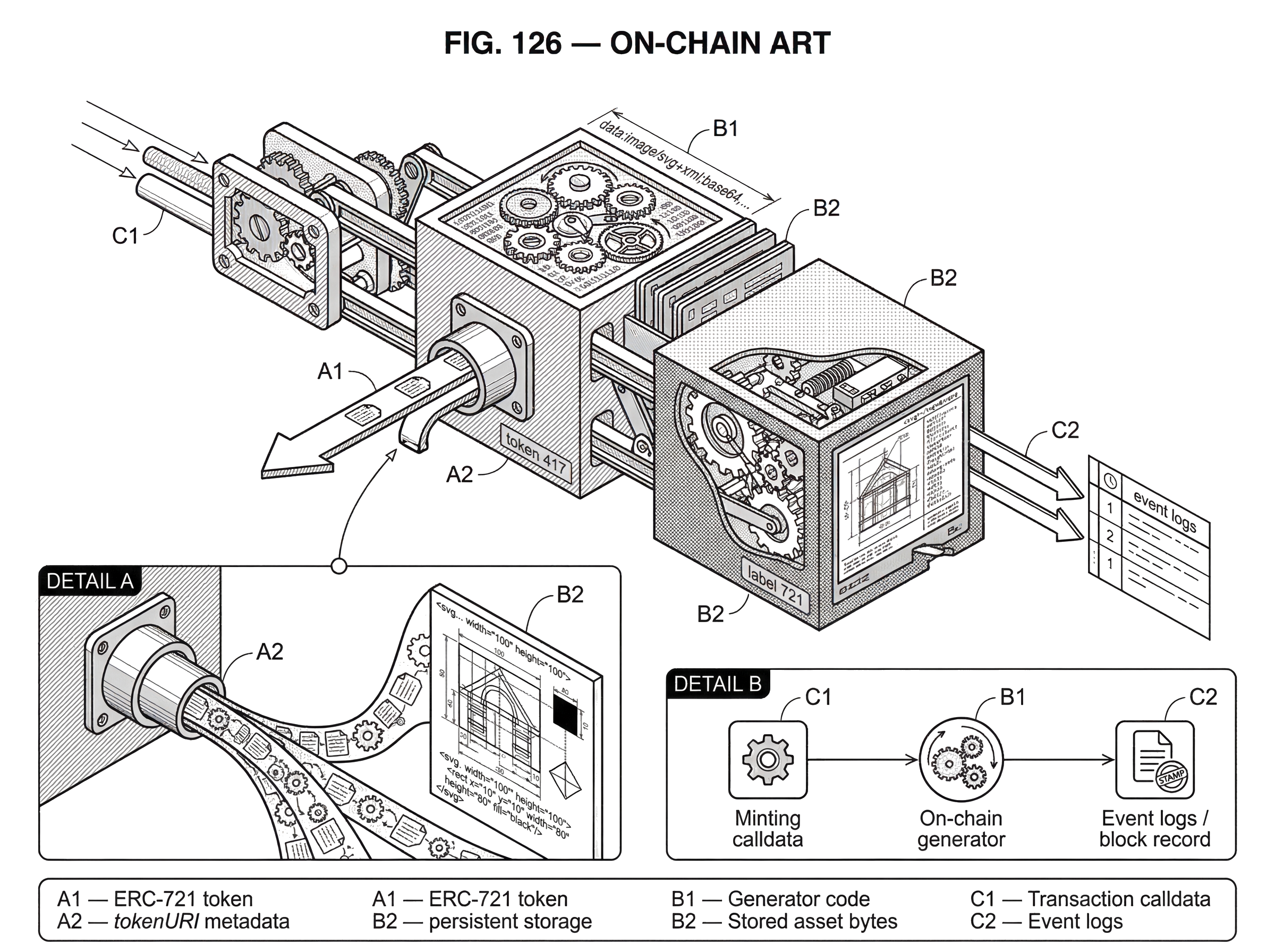
When a project stores the artifact, the final media is directly represented in blockchain data. The simplest version is text. Autoglyphs is the canonical example: the generator algorithm was embedded in the Ethereum contract, and the output of each minted piece was recorded as ASCII art in event data. The result matters because the artwork is not a pointer to an image generated elsewhere. The output itself is part of the chain record. A future viewer only needs the blockchain data and a renderer that understands plain text.
When a project stores the recipe, the contract contains code and data sufficient to reconstruct the work later. This is common in generative art. The token may have a seed, hash, or token-specific input. The contract or a chain-stored script uses that input to generate SVG, HTML, pixel layers, or other renderable output. In this design, the artwork is not a precomputed file but a deterministic function of on-chain state and embedded logic. That can be more storage-efficient because the contract stores a compact program instead of thousands of unique images, but it only works if the rendering environment is preserved well enough to interpret the output.
A concrete example makes the mechanism clearer. Imagine a generative art contract where minting token 417 assigns it a pseudo-random seed derived from transaction context and contract rules. The contract stores a JavaScript or SVG-generating script, and when someone calls a view function or reads tokenURI, the contract returns metadata encoded as JSON. Inside that JSON, the image field is not a link to a PNG on a server. It is an inline data:image/svg+xml payload built from the token’s seed. Nothing needs to be fetched from a separate host. The viewer asks the chain for the token’s metadata, decodes the embedded SVG, and renders it locally. The art appears dynamic to the user, but the mechanism is deterministic: same contract, same token, same result.
This is where token standards matter operationally, even though they do not define on-chain art itself. Wallets and marketplaces understand how to discover a token because ERC-721 and ERC-1155 standardize ownership, transfer, and metadata lookup patterns. ERC-721’s optional metadata extension exposes name, symbol, and tokenURI. ERC-1155 exposes uri, often with {id} substitution so clients can derive token-specific metadata paths. Those standards provide the interoperability layer; on-chain art uses that layer to return media embedded in the response, rather than a pointer to off-chain files.
What storage choices define 'on-chain' art?
| Option | Permanence | Cost | Best for |
|---|---|---|---|
| Calldata | Permanent | Low | Cheap permanent bytes |
| Contract code | Permanent | Medium | Write‑once large reads |
| SSTORE (contract storage) | Permanent | High | Mutable contract state |
| Event logs | Permanent | Low | Auditable outputs |
| EIP‑4844 blobs | Temporary | Very low | Short‑term rollup data |
| Off‑chain + L1 hash | Partial | Low | Large media with proofs |
The phrase on-chain can sound binary, but in practice it has degrees. The relevant question is: **which parts are actually in permanent blockchain data, and which parts still depend on external availability? **
Ethereum’s storage primitives make this concrete. Data can be placed in transaction calldata, contract code, event logs, or persistent storage, and these choices have very different costs and reading properties. Ethereum’s storage strategy guidance notes that calldata is the cheapest way to put data permanently into the blockchain record, while contract storage is far more expensive. Contract code is useful for write-once, read-many data, because deployment is costly but later reads can be cheaper for sufficiently large payloads. EIP-4844 blobs, by contrast, are explicitly temporary and therefore unsuitable as the sole long-term home for art meant to be permanent.
That means full on-chain art is often a compression problem disguised as an art problem. If storing one megabyte directly in contract storage is prohibitively expensive, artists look for representations that preserve the work while using fewer bytes: SVG instead of raster images, run-length encoding for pixel art, palettes and trait composition instead of full-frame storage, text output instead of bitmap output, or generative code instead of static media.
Projects built around pixel art and avatars often lean heavily on compact encodings. The Nouns ecosystem, for instance, exposes run-length encoded image data and SVG building utilities in its tooling. That design reflects the underlying constraint: storing raw images naively is expensive, but storing reusable parts and assembling them deterministically is much more feasible. The art remains reconstructable, but the chain stores a compressed representation rather than a bulky final asset.
The same principle appears in more elaborate systems. Art Blocks’ on-chain generator preserves the process of generating a viewable artwork on Ethereum by combining core contract data, project scripts, dependencies, and an on-chain HTML builder. The key advance is not that every viewer must use one exact website; it is that a viewer can reconstruct a piece from chain-stored ingredients with a single contract call. Their architecture also shows an important nuance: some dependencies such as common JavaScript libraries can be uploaded on-chain, but not every project is fully there yet. So even sophisticated “on-chain” systems may be partly progressive rather than absolute.
How can I tell if an NFT's artwork is truly on-chain?
Suppose you encounter an ERC-721 token in a wallet and want to know whether it is on-chain art in a meaningful sense. The first step is not visual; it is informational. You query the contract for tokenURI(tokenId). If the response is an ordinary web URL, you already know the artwork depends on off-chain hosting unless that URL simply redirects to chain-derived content. If the response is a data:application/json URI, you decode it and inspect the JSON.
Now imagine the decoded JSON contains name, description, and an image value that begins with data:image/svg+xml;base64,... . That is a stronger sign. The image is embedded directly in the metadata payload returned by the contract. If the SVG, once decoded, consists only of shapes, styles, and deterministic values, then the browser can render it without contacting any external server. At that point the token is not just pointing to media; the media is being carried by chain-derived data.
A more advanced project might return HTML instead of a simple image. Art Blocks’ on-chain generator architecture does exactly this kind of assembly: a generator contract pulls together token data, project scripts, and dependency references to produce ready-to-view HTML. Here the artwork is not a single stored PNG but a reproducible rendering environment. That broadens what on-chain art can be (interactive, animated, script-based) while keeping the preservation goal intact. But it also introduces a subtle dependency on the future ability to run web technologies like HTML and JavaScript. The work is on-chain, yet still mediated by software conventions outside the chain.
Bitcoin inscriptions arrive at a similar destination by a different path. With Ordinals, individual satoshis are tracked by serial assignment, and inscription data is attached in transaction witness structure and then indexed by tools such as ord. The chain does not natively know about “artworks” as a token standard knows about NFTs; the indexing and interpretation layer supplies that meaning. Yet from the collector’s perspective, the important property is familiar: the content bytes themselves can be embedded in the blockchain record rather than stored on a web server. The surrounding mechanism differs, but the preservation ambition is recognizably the same.
Why is generative art common on-chain?
On-chain art and generative art are not identical, but they fit together unusually well because blockchain storage is expensive while code can be compact. A small algorithm plus a token-specific seed can produce a large design space. That lets an artist put the system on-chain instead of every output image.
Autoglyphs showed this in a pure form. The generator lived in the contract, and minting ran the algorithm on Ethereum itself. That made the chain not just an archive but a performer: the network executed the artist’s rules to create the piece. The aesthetic sparseness of the outputs was not accidental. It followed from the fact that each artwork had to be created within a single Ethereum transaction, under strict computation limits. Here is the mechanism and the consequence in the same breath: because execution was scarce, the art had to be compressed into a minimal procedure, and that compression became part of the work’s identity.
This is one reason on-chain art is often discussed in unusually material terms for digital media. The artwork is shaped by byte cost, gas cost, contract size limits, and deterministic execution rules. The chain is not a neutral hard drive. It is a hostile, expensive substrate that rewards concise representations and penalizes excess. Artists who choose it are often choosing those constraints deliberately.
How do different blockchains implement on-chain art?
| Chain | Anchoring method | Metadata location | Typical constraint |
|---|---|---|---|
| Ethereum | ERC‑721/1155; calldata; contract code | tokenURI or contract response | Gas and byte cost |
| Cardano | CIP‑25 transaction metadata | Mint tx metadata (label 721) | Policy‑controlled updates |
| Bitcoin (Ordinals) | Inscription on satoshi witness | Transaction witness / indexer | Blockspace fees and indexing |
| Kusama / Polkadot (RMRK) | RMRK multi‑resource NFTs | On‑chain resources and links | Platform tooling and composability |
It is useful to see that on-chain art is not specific to Ethereum, because that separates the concept from one ecosystem’s conventions.
On Cardano, native tokens can bind metadata through CIP-25, where metadata is stored in transaction metadata under label 721. A third party retrieves a token’s metadata by locating the latest positive mint transaction for that token and reading the policy ID and asset name path under that label. This is not the same architecture as an ERC-721 contract exposing tokenURI, but the conceptual question is the same: is the token-to-media description anchored in chain data, and under what conditions can it change? Cardano makes that update path explicit: metadata can only be updated if the minting policy permits another positive mint. So permanence depends partly on policy design.
On Kusama and Polkadot, RMRK documentation emphasizes multi-resource NFTs and composability. That matters for on-chain art because some artworks are not a single image but a bundle of representations, layers, or interchangeable resources. A token might have different media resources for different contexts, or nested composable elements. In that world, “the artwork” is not always a single static file. It can be a structured set of chain-linked resources whose relationships are part of the piece.
On Bitcoin, Ordinals and inscriptions show a chain without a native NFT standard supporting a form of on-chain art anyway. The artifact is attached to satoshis and interpreted through ordinal indexing. Recent innovations such as recursion go even further by allowing inscriptions to reference other inscriptions, dramatically reducing repeated storage. Mechanically, that is similar to reusable dependencies in generative HTML systems on Ethereum: shared components live once, and later works compose them rather than duplicating them.
What are the limits and risks to on-chain permanence?
The strongest claim made about on-chain art is often permanence. That claim is partly true and partly conditional.
It is true in the narrow sense that blockchain data is hard to alter retroactively, and if the artwork’s essential bytes are there, a future observer can in principle recover them. But permanence of bytes is not the same as permanence of experience. A work encoded as SVG assumes future software still renders SVG in a roughly compatible way. A work assembled from HTML and JavaScript assumes browsers still support enough of that environment. A work that references chain-stored dependencies assumes those dependencies remain understandable. An ASCII artwork is comparatively robust because plain text is simple; a complex browser-based work has more interpretive layers.
There are also cost and scalability limits. Autoglyphs pushed close to Ethereum’s transaction computation ceiling, and its minting period consumed a meaningful share of network capacity. That does not make the project a mistake; it reveals the trade-off clearly. Full on-chain generation competes for scarce blockspace and execution with every other use of the chain. The more expressive the work, the more acute the tension becomes.
Security adds another layer. Because on-chain art often uses SVG, HTML, or JavaScript, viewers must treat artwork as untrusted content. CISA vulnerability summaries include concrete examples of XSS via SVG documents, which matters because many NFT viewers render exactly these formats. “On-chain” does not mean “safe.” In some cases it means the malicious payload, if one exists, is permanently preserved too. A gallery, wallet, or explorer still has to sanitize or safely sandbox what it renders.
And there is a broader ecosystem risk in arbitrary content storage. Research comparing Bitcoin and Ethereum arbitrary content notes that storing arbitrary data on public chains is useful for legitimate purposes but can also create systemic risk if abusive or illegal content is embedded immutably. That issue is not unique to art, but on-chain art participates in the same technical reality: a blockchain that can preserve beautiful media can also preserve harmful media.
What does buying on-chain art actually give you?
The cleanest answer is this: with on-chain art, the collector usually owns a token whose meaning is more tightly bound to blockchain-resident media or generation logic than a conventional NFT is. They do not necessarily own copyright. They do not necessarily own a right to exclude others from viewing the art. What they own is the recognized on-chain token, plus a stronger provenance trail connecting that token to the artwork’s actual encoded form.
That stronger link matters culturally because it changes the object from “receipt for something elsewhere” to “addressable instance of a work materially present in the ledger.” In an off-chain NFT, the token may still be economically valuable, but the media and the registry are partly separable. In on-chain art, the aspiration is to collapse that separation as much as the underlying chain allows.
Conclusion
On-chain art exists because putting ownership on a blockchain is not the same as putting the artwork there. The central idea is to store the artwork itself (or the code and data that deterministically generate it) in blockchain data so the work can be reconstructed without trusting a particular external host.
Everything else follows from that choice. It strengthens provenance and preservation, but it also imposes severe constraints on storage, execution, rendering, and security. The memorable version is simple: an ordinary NFT often points to art; on-chain art tries to make the blockchain part of the art itself.
How do you evaluate a token before using or buying it?
Confirm where a token’s metadata and media actually live, whether the contract stores generation logic or final bytes, and any rendering or legal constraints before you trade. On Cube Exchange you can inspect contract links and on-chain metadata, fund your account, and place an order if the token passes your checks.
- Call tokenURI(tokenId) in the contract’s Read tab on Etherscan or view the token’s metadata link in Cube’s token details.
- If the response is a data: URI, decode the JSON/base64 and inspect the image field; if it’s an https/IPFS link, open it and note whether the media is inline or hosted off‑chain.
- Open the contract source and recent mint events to look for embedded SVG/text, generator functions, or event data that contains artwork bytes or seeds.
- Test-render the decoded SVG/HTML in a sandbox or trusted preview; flag inline JavaScript, external dependency references, or unsafe tags that could affect future viewability.
- If satisfied, fund your Cube account, place a limit buy order (preferred for price control), include the contract address and tokenId, review fees, and submit.
Frequently Asked Questions
On-chain art places the artwork’s essential bytes or the code that generates it inside blockchain data itself, whereas a typical NFT only keeps the token on-chain and points (via tokenURI) to media hosted off-chain. The practical difference is that on-chain art aims to make the work reconstructable from the chain’s record rather than dependent on a separate server or pinning service.
‘Store the artifact’ means embedding the final media (for example ASCII output or image bytes) directly into transaction or contract data; ‘store the recipe’ means keeping a compact program, seed, or parameters on-chain that deterministically generate the artwork when rendered. Autoglyphs is the canonical example of storing the artifact, while many generative projects store a generator and per-token seed as the recipe.
On-chain data is hard to alter, so if all essential bytes or generation logic are truly in permanent chain data they can in principle be recovered later, but that permanence is conditional: it depends on future software being able to interpret formats (SVG, HTML/JS), on temporary primitives like EIP-4844 not being relied on for permanence, and on avoiding external dependencies that are not on-chain. In short, byte permanence is stronger than off‑chain pointers, but the long‑term viewing experience and interpretability are not guaranteed automatically.
On Ethereum you can persist data in transaction calldata, contract storage, contract code, or event logs, and those choices trade off cost and reading semantics: calldata is relatively cheap for permanent posting, contract storage is expensive, and contract code is write‑once/read‑many but costly to deploy; by contrast EIP‑4844 blobs are temporary and unsuitable for long‑term storage. Projects therefore use compact encodings (SVG, run‑length encoding, palettes) or generators to reduce on‑chain byte costs.
Yes - some projects return HTML or JavaScript as part of their on‑chain assembly (Art Blocks’ on‑chain generator is an example), which enables richer, interactive works but creates dependencies on future web environments and raises security concerns because SVG/HTML/JS can contain XSS or other malicious payloads that viewers must sanitize or sandbox. Embedding executable web content increases expressive power but also increases interpretive and security risk.
When you buy on‑chain art you typically acquire the on‑chain token plus a stronger provenance link to media or generation logic stored in the ledger, but you do not automatically gain copyright or exclusive viewing rights; legal and access rights remain separate from the blockchain ownership record. The key practical difference is that the token’s meaning is more tightly bound to chain‑resident data than in an off‑chain‑hosted NFT.
Different blockchains provide different mechanisms: Cardano uses CIP‑25 transaction metadata to bind token metadata to mint transactions, RMRK on Kusama/Polkadot supports multi‑resource NFTs and composability, and Bitcoin inscriptions (Ordinals) embed content into transaction witness structure or satoshi tracking and rely on indexers for interpretation. The goal - anchoring the artwork’s authoritative description in chain data - is the same, but the exact storage and retrieval machinery differs by chain.
Because blockspace and execution are scarce and expensive, many on‑chain projects treat compression and reuse as part of the art: techniques include SVG instead of bitmaps, run‑length encoding for pixel art, shared component/dependency registries, trait composition, and compact generator code. These approaches let projects preserve reconstructability while staying within practical byte and gas limits.
Related reading