What is Marinade?
Learn what Marinade is, how mSOL liquid staking works on Solana, how stake is delegated, and the main trade-offs for users and validators.
Introduction
Marinade is a Solana staking protocol that tries to solve a practical tension in crypto: when you stake tokens to help secure a network, you usually give up flexibility. On Solana, staking SOL can earn rewards and support validators, but traditional staking also tends to lock capital into a specific validator and make exits slower. Marinade is built to reduce that friction.
At its core, Marinade is a stake automation platform. A user brings SOL, and Marinade handles the validator delegation process according to an open strategy designed to support both staking performance and network decentralization. The protocol offers two ways to do that. You can stake natively through Marinade, or you can liquid stake and receive mSOL, a tokenized claim on staked SOL that stays usable elsewhere on Solana.
That distinction is the key to why Marinade exists. Many users do not just want staking rewards; they want rewards without fully giving up liquidity. Marinade’s design is for people who want exposure to Solana staking but do not want the operational burden of choosing validators, redelegating manually, or waiting for every use of their capital to fit staking’s timing constraints.
Why stake SOL through Marinade instead of delegating directly?
The simplest way to see Marinade is to start with ordinary staking. If you delegate SOL directly to a single validator, you are making at least three choices at once. You are choosing where your stake goes, accepting that your rewards depend on that validator’s performance, and giving up some flexibility in how quickly you can move that stake later. That is manageable for power users, but it creates work and concentration risk for everyone else.
Marinade separates those choices. Instead of asking each user to pick and monitor validators, the protocol delegates stake across a broader validator set using a transparent strategy. The point is not only convenience. If a large amount of stake on Solana clusters around a small number of validators, the network becomes more concentrated. Marinade’s value proposition is that staking can be automated in a way that aims for rewards while also supporting decentralization and validator diversity.
This is why Marinade offers both native staking and liquid staking under the same delegation logic. The protocol is saying, in effect, that validator selection and stake management should be infrastructure, not a repeated manual task for every individual staker.
How does Marinade liquid staking work for users (how mSOL accrues value)?
| Option | Token or asset | Reward accrual | Liquidity | Best for |
|---|---|---|---|---|
| mSOL (liquid staking) | mSOL token | Price per mSOL rises each epoch | Usable in DeFi; fast exit via pool | Active DeFi users needing liquidity |
| Native staking (Marinade) | No transferable token | Rewards applied to stake pool value | Subject to epoch cooldowns; delayed exit | Passive holders preferring simplicity |
If you use Marinade in its liquid staking mode, you deposit SOL and receive mSOL. That mSOL represents a stake position in Marinade’s staking pool. The important detail is that rewards do not usually show up as extra tokens appearing in your wallet each epoch. Instead, the protocol’s accounting causes the value of each mSOL in SOL terms to rise over time as staking rewards accrue to the pool.
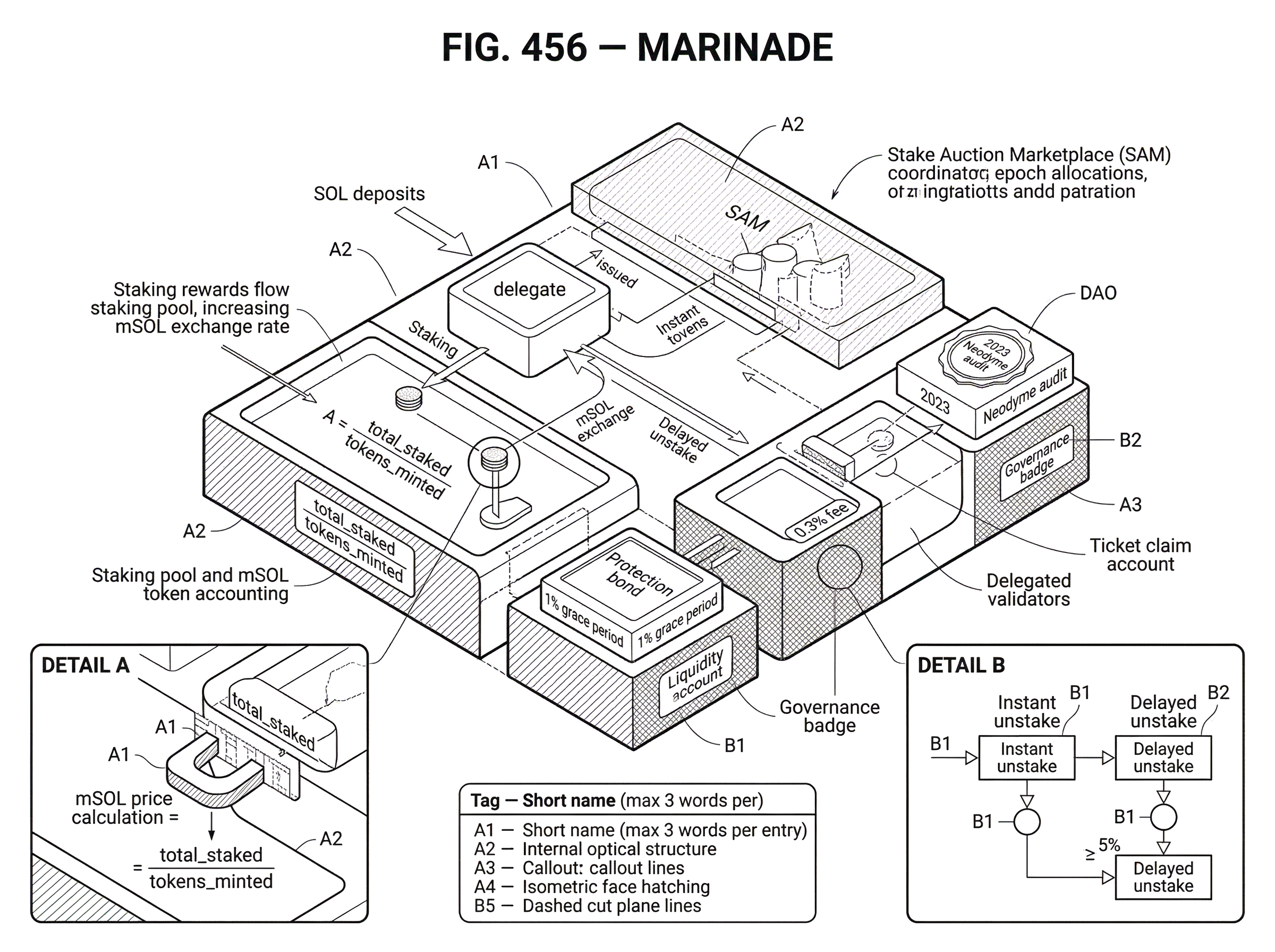
Marinade defines the on-chain price of mSOL as total_staked / tokens_minted, where total_staked is the total SOL value backing the pool and tokens_minted is the mSOL supply. When epoch rewards are added, total_staked goes up while the number of mSOL tokens you hold does not. So the claim represented by each unit of mSOL becomes worth more SOL. That is the central mechanism.
A concrete example makes this easier to see. Imagine you stake SOL through Marinade and receive mSOL. You still hold the same number of mSOL tokens a week later, but if the staking pool has earned rewards over that time, each mSOL now corresponds to slightly more SOL than before. Your gain shows up in the exchange rate, not in an increasing token count. This is elegant because it makes mSOL portable: the token itself can move through wallets and DeFi apps while still carrying the economics of a staking position.
If you use Marinade’s native staking option instead, you do not get a liquid token for composability, but you still benefit from the same validator delegation logic. In both cases, rewards are tied to Solana’s epoch cycle, which is approximately every two to three days, though timing and reward realization depend on validator performance.
What can I do with mSOL; common uses and limitations
Liquid staking only matters if the liquid token is actually usable. Marinade’s answer is mSOL. Because it is a tokenized representation of staked SOL, it can be held, transferred, and used in other Solana applications while the underlying stake position continues participating in staking rewards.
That makes Marinade especially useful for users who would otherwise face a trade-off between earning staking yield and keeping assets active. A long-term SOL holder might simply want passive staking exposure without picking validators. A more active on-chain user might want to post mSOL as collateral or move it through DeFi strategies while still maintaining staking economics. These are different users, but the same mechanism serves both: separate the staking position from the operational constraints of a traditional stake account.
There is, however, an important distinction between Marinade’s on-chain accounting price and the market price you may see on a DEX. Marinade publishes a canonical on-chain mSOL price, but mSOL can trade at a different market price when liquidity pools become unbalanced. In practice, arbitrage often narrows that gap, but it is still a real trade-off. The protocol can define what one mSOL is worth according to pool accounting; the market can temporarily price it differently.
How does Marinade decide which validators receive delegated SOL (SAM explained)?
Marinade is not just a token wrapper. Its real substance is the delegation system underneath. The protocol continuously monitors validators and distributes stake according to an open strategy. More recently, Marinade has described this through its Stake Auction Marketplace, or SAM, which delegates protocol TVL each epoch to validators competing on yield while operating within decentralization constraints.
The broad idea is straightforward. Validators do not simply receive Marinade stake because they are large or early. They compete for it. That competition is meant to improve staker returns while keeping allocation rules transparent. At the same time, Marinade imposes eligibility and concentration constraints so the protocol does not just chase headline yield into unsafe or overly concentrated outcomes.
This matters for understanding who Marinade is really for. It is useful for users who want staking exposure without becoming validator analysts. Marinade turns validator selection into a protocol-level market and policy problem instead of a user-level spreadsheet problem.
How do Marinade withdrawals and instant (liquid) unstake work?
| Path | Mechanism | Speed | Fee | Eligibility |
|---|---|---|---|---|
| Instant (liquid unstake) | mSOL → SOL via liquidity pool | Immediate | 0.3% fee | mSOL or eligible stake accounts |
| Delayed (ticket claim) | Ticket account then reserve withdrawal | Epoch-bound multi-day delay | No instant fee | Any delegated stake account |
Staking products become most interesting at the moment of exit. Marinade supports more than one withdrawal path, and that is not a cosmetic feature; it reflects the difference between instant liquidity and underlying stake settlement.
For liquid staking users, one path is effectively a swap: mSOL can be converted back into SOL through Marinade’s liquidity mechanisms. Marinade’s backend design describes liquid unstake as economically similar to swapping mSOL for SOL against the protocol’s liquidity pool. That is what allows a fast exit instead of waiting through the normal staking cool-down process.
Marinade has also extended this idea to existing stake accounts through Liquid Unstake. In that flow, Marinade can take a SOL stake account, convert it into mSOL, and then unwind it through its liquidity pool. The benefit is obvious: users can get out immediately instead of waiting for the next epoch boundary and withdrawal timeline. The trade-off is also clear: this convenience carries a fee, documented as 0.3% for instant unstake, and eligibility conditions apply, such as stake account age and minimum size.
For users who do not need instant liquidity, delayed unstake remains part of the protocol’s design. Marinade’s program architecture uses ticket-like claim accounts for delayed withdrawals, which reflects a simple fact about staking systems: if you want immediate finality, someone must provide liquidity up front; if you are willing to wait, the protocol can settle against underlying stake more directly.
How does Marinade protect stakers from validator downtime or misbehavior?
A staking protocol’s main promise is not only yield. It is that the machinery producing that yield is robust enough that users do not have to inspect every validator themselves. Marinade’s Protected Staking Rewards, or PSR, is part of that machinery.
PSR uses an on-chain bond system intended to protect stakers from certain validator underperformance events, especially prolonged downtime and commission changes. Validators in Marinade’s set fund bonds that can absorb performance-related shortfalls under defined rules. The structure matters because it changes incentives. A validator is not only competing for stake; it is also putting capital behind its reliability.
The protection is not absolute in the vague sense of “all risks disappear.” It is targeted. The documentation describes coverage rules, responsibility splits between validators and Marinade, and a 1% grace period for downtime or commission increases. That means Marinade is not claiming to abolish staking risk. It is narrowing a specific class of risk: the gap between expected staking performance and what users actually receive because delegated validators underperform.
This feature especially matters for users who care about passive staking exposure and do not want to monitor validator behavior epoch by epoch. It also matters for Solana itself, because requiring validator bonds can widen the validator set Marinade is willing to delegate to while maintaining performance safeguards.
What governance and trust trade-offs should I know about before using Marinade?
| Model | Who you trust | Main control | Primary risk | Best choice |
|---|---|---|---|---|
| Self-stake | Your wallet and validator keys | Validator selection and keys | Concentration and operational risk | Power users wanting full control |
| Marinade (protocol) | Marinade contracts and DAO | Delegation logic and upgrades | Smart-contract and governance risk | Users wanting liquidity and automation |
| Custodial staking | Custodian service provider | Custody and withdrawal access | Counterparty custody risk | Institutions or trust-preferring users |
Marinade is governed through Marinade DAO. MNDE holders can lock MNDE in Realms to receive veMNDE, which represents governance power. That governance layer matters because staking protocols are not static software. Parameters, delegation rules, fee policies, and operational priorities can change over time.
Still, governance does not remove trust assumptions; it relocates them. Users of Marinade are not only trusting Solana staking mechanics. They are also trusting the protocol’s smart contracts, upgrade processes, delegation logic, and governance structure. Marinade has published audits of its liquid staking program, and the 2023 Neodyme audit reported no issues above low severity, but audits reduce risk rather than eliminate it.
There are also ordinary product trade-offs. mSOL can diverge from its on-chain accounting price in the market. Instant unstake is convenient but fee-bearing and dependent on liquidity conditions. Reward timing follows epoch mechanics rather than a continuous payout stream. And users who want the simplicity of traditional self-directed staking to a chosen validator may not want protocol-layer delegation in the first place.
Conclusion
Marinade is best understood as staking infrastructure for Solana users who want less manual work and more flexibility. Its core idea is simple: pool stake management at the protocol level, spread delegation across validators, and let users choose between native staking and a liquid token, mSOL, that keeps staking exposure usable.
If you remember one thing, remember this: Marinade turns staking from a locked, validator-specific position into a managed and often liquid position.
Everything else follows from that idea.
- mSOL pricing
- auction-based delegation
- liquidity-based unstaking
- validator bonds
Frequently Asked Questions
mSOL accrues staking rewards by rising in SOL-denominated value rather than by increasing token count: Marinade defines mSOL price as total_staked / tokens_minted, so rewards raise total_staked and therefore the implied SOL value per mSOL token over epochs.
Yes - Marinade maintains an on-chain ‘true price’ for mSOL according to pool accounting, but mSOL can trade at a different market price on DEXs when liquidity pools are imbalanced; arbitrage often narrows the gap but temporary divergence is a recognized trade-off.
Instant (liquid) unstake converts stake into mSOL and then uses Marinade’s liquidity mechanisms; it carries a documented 0.3% instant-unstake fee and only applies to eligible stake accounts (e.g., stake accounts >1 SOL and older than two epochs), with actual slippage or limits depending on pool liquidity.
Marinade delegates via the Stake Auction Marketplace (SAM), where validators compete for stake each epoch and allocations are set within decentralization and eligibility constraints; the protocol redistributes TVL according to this open strategy rather than leaving validator choice to individual users.
Protected Staking Rewards (PSR) uses validator-funded bonds to cover specific underperformance events (notably prolonged downtime and commission increases) and includes a 1% grace threshold, so it narrows some validator-risk vectors but is not an absolute insurance against all losses; parts of PSR (audit/dry-run/rollout) were described as staged in the documentation/proposal.
Governance is handled by Marinade DAO via MNDE; MNDE can be locked to receive veMNDE for voting power, but veMNDE is non-fungible and unlocking locked MNDE begins a 30-day unlock period - so governance power is transferable only with delay and is not a freely tradable token.
Marinade’s code and programs have been audited (e.g., Neodyme and Sec3 reviews) with most critical issues addressed, but audits focus on specific builds and do not eliminate all risk; operational controls currently include an ecosystem multisig upgrade authority (not yet fully migrated to DAO control), which limits but does not remove upgrade-related trust assumptions.
The protocol notes that slashing or unexpected stake-account changes can make on-chain total_staked accounting inconsistent and may require admin-wallet funds to reconcile, meaning slashing is a recognized risk and operational reconciliation paths (and limits) exist but are not fully formalized in the overview.
Marinade mints a 1% protocol fee from staking rewards (taken into the protocol’s token/accounting) which reduces gross staking yield available to mSOL holders; other user-facing fees include the 0.3% instant-unstake fee and potential market slippage when swapping mSOL on DEXs.
Marinade’s documentation and design materials expose developer SDKs (TypeScript/JS and Rust) and APIs (Delegation Strategy, Stats, Snapshots), so integrations and programmatic access are supported and intended for third-party tooling and automation.
Related reading