What is Indodax?
Learn what Indodax is, how its rupiah-based crypto exchange works, and why Indonesian users use it to trade, fund accounts, and access crypto markets.
Introduction
Indodax is a centralized cryptocurrency exchange in Indonesia that lets users buy and sell crypto assets through a rupiah-based marketplace. That sounds simple, but it solves a specific problem: most people do not want to navigate blockchains directly just to get exposure to Bitcoin, Ether, or other crypto assets. They want a place where they can fund an account, see prices, place trades, and move between local currency and crypto without assembling that infrastructure themselves.
That is the basic role Indodax plays. It is not a blockchain, and it is not a self-custody wallet. It is a platform that sits between users and the underlying crypto networks, handling matching, custody, account access, and the practical details of trading. Indodax describes itself as Indonesia’s first and biggest crypto exchange, says it was established in 2014, and reports millions of members and hundreds of listed assets. Company materials also say it has regulatory permissions from Indonesian authorities, including BAPPEBTI, and that it later obtained a full PFAK license.
The useful way to understand Indodax is not as “a site where crypto is listed,” but as a machine for turning two very different systems into something that feels like one market. On one side is the banking and fiat world, especially Indonesian rupiah. On the other side are crypto networks with their own wallets, addresses, confirmation rules, and operational risks. Indodax makes those worlds tradable against each other.
How does Indodax’s rupiah-denominated order book work?
| Model | Liquidity | Price discovery | Custody | Ease of use | Best for |
|---|---|---|---|---|---|
| Order-book CEX (Indodax) | High (pooled) | Market-driven | Exchange custody | Account-based | Retail traders, beginners |
| Decentralized exchange (DEX) | Variable (pool-based) | On-chain AMM | User custody | Requires wallet | DeFi users, self-custody |
| Peer-to-peer (P2P) | Thin / fragmented | Negotiated prices | Peer custody | Manual process | Local OTC trades |
At the center of Indodax is an order-book exchange. That matters because the platform is not mainly quoting a fixed house price to every customer. Instead, it brings together buyers and sellers and shows the available bids and asks in the market. The price you see emerges from matching those orders.
This is the main idea that makes centralized exchanges click. A crypto exchange is useful because it concentrates liquidity. If every buyer had to find a seller privately, trading would be slow, opaque, and expensive. An order book solves that by collecting trading intentions in one place. Indodax’s materials describe the platform this way: a marketplace connecting buyers and sellers, with an order book visible to users and prices updated in real time.
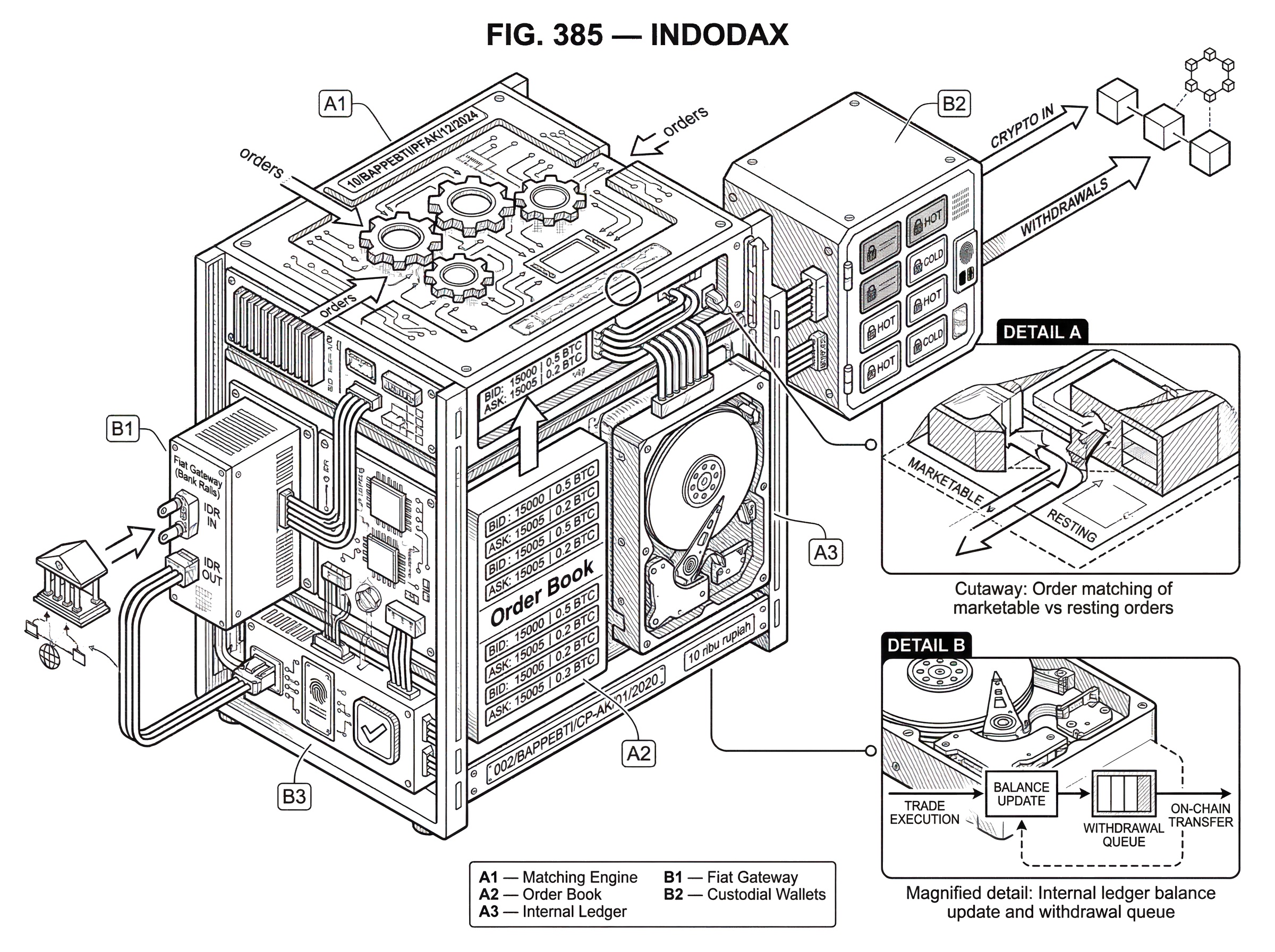
A simple example makes this concrete. Suppose a user in Indonesia wants to buy Bitcoin using rupiah, but does not want to negotiate peer-to-peer. They deposit IDR into their Indodax account, open the BTC/IDR market, and see existing sell orders from other users. If they place a marketable order, the exchange matches it against those sellers. If they prefer a specific price, they can wait in the order book until a seller accepts that level. What the user experiences as a clean trade is really the exchange doing several jobs at once: keeping internal balances, matching orders, updating the book, and later coordinating withdrawals if the user wants to move assets out.
That structure explains who Indodax is for. It is designed for people who want market access more than protocol-level control. A trader who wants to react to prices, a beginner who wants to start with a small amount of rupiah, or a user who wants a familiar account-based interface will usually prefer this model over interacting with decentralized exchanges directly.
Why is Indodax easier to use than self-custody wallets?
| Choice | Who holds keys | Responsibility | Convenience | Main risk | Best for |
|---|---|---|---|---|---|
| Self-custody | User | Manage keys and backups | Lower | Irreversible loss | Advanced users |
| Custodial (Indodax) | Exchange | Platform manages custody | Higher | Operator compromise | Beginners and active traders |
Using crypto natively means managing keys, choosing networks, understanding transaction fees, and accepting that mistakes can be irreversible. Centralized exchanges remove much of that complexity by replacing wallet-level responsibility with account-level responsibility. In practice, that means you log in to an account, pass verification, fund it, and trade from balances shown on the platform.
This convenience comes from a trade. The exchange holds the assets on your behalf while they remain on-platform. That is why centralized exchanges are easier to use, and it is also why they create custodial risk. If you self-custody, you bear the operational burden yourself. If you use an exchange, the platform bears much of that burden; but you must trust its systems, controls, and solvency.
Indodax leans into accessibility. Its fact sheet says transactions can begin from 10 ribu rupiah, which lowers the entry barrier for retail users. That design choice is not cosmetic. It changes the platform from something only active traders use into something broad enough for newcomers who are experimenting with very small amounts.
The same logic helps explain why Indodax also operates Indodax Academy, its educational platform. A marketplace for crypto in a local retail market does not work well if users do not understand the assets well enough to judge risk. The Academy’s role, as described by the company, is to provide articles, videos, glossaries, and other free learning materials so users can do their own research. That does not remove risk, but it does reduce one common failure mode: entering a volatile market without even a basic vocabulary.
How do I create an account, fund, and trade on Indodax?
From a user-facing perspective, the flow is straightforward. You create an account, complete the required verification steps, fund the account in rupiah, and then choose a market to trade. Once funds are credited, you can place orders against listed crypto assets. If you later want to leave the platform, you can withdraw IDR back through supported fiat rails or withdraw crypto to an external wallet, subject to the exchange’s operational availability and controls.
This sounds routine, but the mechanism underneath is worth noticing. Your trade on Indodax does not instantly become an on-chain transaction each time you click buy or sell. Inside the exchange, trades are generally reflected first as changes in internal account balances. Only when assets move into or out of the platform does the blockchain itself become directly involved. That internalization is what allows centralized exchanges to feel fast and responsive even when the underlying chains are slower or more expensive.
The consequence is important. When you are trading on Indodax, you are mostly interacting with Indodax’s internal ledger, not continuously with Bitcoin, Ethereum, or another blockchain. That is normal for centralized exchanges. It is also why the quality of the exchange’s custody, reconciliation, wallet management, and withdrawal controls matters so much.
Is Indodax regulated and what do its certifications mean for users?
| Signal | What it indicates | What it doesn't guarantee | User implication | Example |
|---|---|---|---|---|
| BAPPEBTI registration | Legal permission to operate | No absolute safety guarantee | Regulatory oversight and recourse | PFAK/BAPPEBTI registration claimed |
| ISO certifications | Formal processes and controls | Prevents all breaches | Process and security maturity signal | ISO 27001 / 27017 claimed |
| Third-party ranking | Scale and liquidity signal | Not a security audit | Useful liquidity/visibility cue | CoinMarketCap Top 50 claim |
Indodax’s public materials put real emphasis on regulatory status and certifications, which makes sense for a custodial financial platform. Company sources say it was officially registered with BAPPEBTI in January 2020 under registration number 002/BAPPEBTI/CP-AK/01/2020. Later company announcements say it received full approval as a Pedagang Fisik Aset Kripto (PFAK) from BAPPEBTI with certificate number 10/BAPPEBTI/PFAK/12/2024.
At a practical level, that matters because an exchange handling customer assets and fiat rails needs a recognized operating framework. For users, regulation is not just a badge. It shapes what kinds of products can be offered, how reporting works, and what operational standards the platform says it follows. Indodax also says it is a member of CFX, which it describes as Indonesia’s government-regulated crypto exchange infrastructure for oversight and reporting.
The company also claims several ISO certifications, including ISO 9001:2015, ISO 27001:2013, and later ISO/IEC 27017:2015. The right way to read certifications is carefully. They are useful signals that a company has adopted formal management or security practices within some scope. They are not guarantees that failures cannot happen. A certification says something about processes and controls; it does not eliminate operational risk.
What are the risks and benefits of using Indodax’s custodial model?
Indodax is useful because it compresses complexity. It takes banking access, market matching, custody, and customer support, and presents them as one product. That is exactly why so many people prefer centralized exchanges. The more of the hard parts the platform handles for you, the lower the friction.
But the same design creates concentration of risk. If custody, wallet operations, withdrawal systems, and user balances all depend on one operator, then that operator becomes a high-value target and a single point of operational failure. This is not unique to Indodax; it is a structural feature of centralized exchanges.
That trade-off became especially visible in September 2024, when multiple reports described a security incident involving Indodax and estimated losses of roughly $22 million from hot-wallet-related compromise, though public estimates varied. Indodax later announced that maintenance had been completed and that trading resumed, with some deposit and withdrawal functions restored gradually. Secondary reporting suggested the exact attack mechanism was still unclear at the time, with analysts discussing possibilities such as withdrawal-system compromise or access-control failures.
The lesson is not merely that “exchanges can be hacked.” The deeper point is that a centralized exchange works by pooling operational responsibility. That pooling makes the service easier to use and often more liquid, but it also means users are relying on the exchange’s internal controls rather than solely on blockchain consensus.
Why choose Indodax for rupiah trading and local support in Indonesia?
Indodax’s design makes the most sense when viewed as local market infrastructure rather than just a generic global trading app. Its emphasis on rupiah trading, low minimum transactions, local user support, and educational onboarding reflects the needs of an Indonesian retail audience.
Even claims about scale matter mainly because they suggest the exchange can serve as a liquid venue where local users meet each other.
- millions of users
- substantial traffic
- hundreds of listed assets
That local fit also explains why a user might choose Indodax over an offshore platform. For many people, the hardest part of entering crypto is not understanding Bitcoin in theory. It is finding a route from domestic currency into a live market with tools, support, and enough familiarity to reduce friction. Indodax is built around that transition.
For an advanced user who wants full self-custody, permissionless access, or sophisticated global derivatives, a local spot-focused exchange may not be the final destination. But for someone whose real problem is, “How do I move from rupiah into crypto and back in a way that feels operationally manageable?” Indodax is aimed squarely at that job.
Conclusion
Indodax is best understood as a rupiah-based centralized crypto marketplace: it connects buyers and sellers, holds assets in custody while they trade on-platform, and makes crypto markets accessible through a familiar account system. Its value comes from reducing the operational burden of using crypto directly.
That convenience is the central trade. Indodax makes access easier, faster, and more local for Indonesian users; but in return, users rely on the exchange’s custody, controls, and resilience. If you remember one thing, remember this: Indodax is useful because it turns crypto into a tradable local market, not because it removes the underlying risks.
What should you look for before choosing a crypto exchange?
Compare custody, execution, fees, and supported workflows before you pick an exchange. For a quick practical check, evaluate Indodax against Cube Exchange across those dimensions and use Cube’s deposit and market flows to verify differences in custody model, order types, and withdrawal options. Follow the steps below to turn research into concrete checks you can perform on both platforms.
- Open each platform’s custody and security documentation. On Cube, confirm the non-custodial MPC/threshold-signing model; on Indodax, note whether assets are held on-platform and any custody disclosures.
- Check funding paths and minimums. Verify Indodax’s IDR on-ramp (for example, minimums such as 10 ribu), then on Cube open the fiat on-ramp or crypto deposit flow and note fees and settlement times.
- Compare execution and order types in the relevant markets. Open the BTC/IDR (or equivalent) market on Indodax and the closest market on Cube; use a limit order on each to test book depth and typical fills.
- Inspect withdrawal and on-chain transfer details. Record withdrawal minimums, network choices, and on-chain fee estimates on both platforms; on Cube, choose the network before initiating a withdrawal to see the exact fee and minimum.
Frequently Asked Questions
Indodax is a custodial, centralized exchange that holds user assets on-platform and records trades on its internal ledger rather than immediately on-chain, which concentrates operational and custodial risk in the operator.
Most trades on Indodax are reflected first as changes to internal account balances inside the exchange and only touch the blockchain when funds are deposited to or withdrawn from the platform, which is why the exchange can appear fast even if underlying chains are slower.
Indodax states it is registered with Indonesia’s BAPPEBTI (registration number 002/BAPPEBTI/CP-AK/01/2020) and later received a Pedagang Fisik Aset Kripto (PFAK) certificate (10/BAPPEBTI/PFAK/12/2024); such regulation shapes permitted activities and reporting but does not eliminate operational or custodial risk.
In September 2024 Indodax experienced a security incident with public loss estimates in the roughly $14–$22 million range (commonly reported as about $22 million), but reporting showed differing figures and the exact technical exploit and full loss reconciliation remained unclear at the time.
Public sources and company notices did not provide a definitive, public confirmation of user reimbursement plans at the time; media and forensic reports raised the question but stopped short of a confirmed compensation timeline or scope.
Indodax reports holding ISO 9001:2015, ISO/IEC 27001:2013, and ISO/IEC 27017:2015 certifications; these indicate that formal management and security processes were adopted within the certification scope but are signals of practice rather than guarantees that failures cannot occur.
Company materials say trading can begin from as low as 10 ribu rupiah, a deliberate low-minimum design to lower the entry barrier for retail and first-time users.
After the incident Indodax announced maintenance was completed but noted that some crypto deposit and withdrawal functions remained closed and would be reopened gradually over a multi-day phased timeline; the company did not list which specific assets were immediately available versus still closed.
Related reading