What is CoinEx?
Learn what CoinEx is, how its centralized exchange works, how spot and futures trading function, and why its API and custody model matter.
Introduction
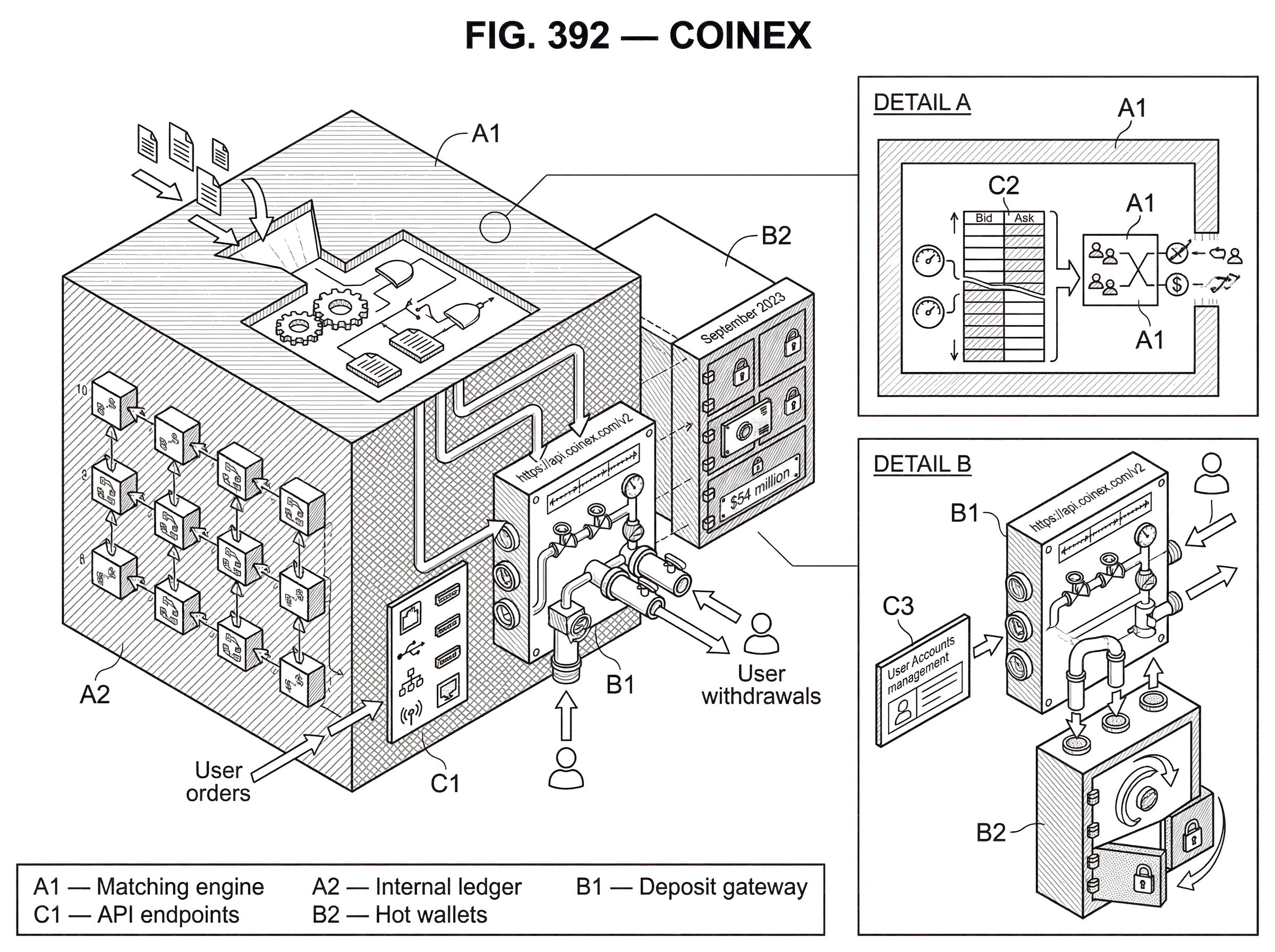
CoinEx is a centralized cryptocurrency exchange. That simple label hides the main trade-off that defines the product: it makes crypto trading faster and easier by moving most activity off-chain and into the exchange’s own systems, but in return users depend on CoinEx to custody assets, run the matching engine correctly, and secure the wallets that sit behind the platform.
That trade-off is the reason exchanges like CoinEx exist at all. Trading directly on blockchains can be slow, fragmented, and operationally awkward, especially for people who want to move quickly between many assets or use more advanced trading tools. A centralized exchange solves that by acting as the coordination layer. You deposit funds once, and from there the exchange updates balances internally as orders are matched, positions are opened, or transfers are requested.
For a reader coming to this fresh, the key idea is this: CoinEx is useful because it separates trading from settlement. Trading happens inside CoinEx’s ledger and matching infrastructure, while settlement to the blockchain happens mainly when users deposit or withdraw. Once that clicks, most of the product makes sense; the speed, the API design, the distinction between spot and futures, and also the risks.
What does CoinEx do and how does it make markets accessible?
| Venue | Custody | Settlement | Speed | Best for |
|---|---|---|---|---|
| Centralized exchange | Exchange controlled | On deposit and withdrawal | Immediate internal updates | Fast trading and APIs |
| On-chain trading | Self custody | Every trade on-chain | Block confirmation latency | Trust minimization and transparency |
| Decentralized exchange (DEX) | User or smart contract | On-chain per swap | Variable, often slower | Noncustodial token swaps |
CoinEx’s core job is to make markets accessible in a form ordinary users and automated systems can actually use. If you want to buy one cryptoasset with another, you need a venue where buyers and sellers can express prices, where those orders can be matched, and where balances can be updated reliably after the trade. CoinEx provides that venue through its website, mobile app, and developer API.
At the user-facing level, the experience is familiar: you create an account, deposit assets, choose a market, and place trades. But the mechanism underneath is more specific. When you deposit, the exchange credits your account after it recognizes the blockchain transfer. After that, if you trade, the exchange usually does not send a blockchain transaction for each fill. Instead, it changes internal account balances. That is what allows centralized exchanges to feel immediate compared with on-chain trading.
This also explains why CoinEx groups its systems the way it does. Its API documentation is organized into business modules such as Account, Assets, Spot, Futures, and Fees, which mirrors the product’s internal logic. Some functions are about identity and account structure, some are about moving assets in and out, some are about trading cash markets, and some are about leveraged derivatives. Those are not arbitrary menu categories; they correspond to different states in the lifecycle of a user’s funds.
How does trading on CoinEx work; spot vs. futures and internal settlement?
The simplest way to understand CoinEx is to imagine two ledgers connected by a gateway. On one side is the public blockchain world, where deposits arrive and withdrawals leave. On the other is CoinEx’s internal ledger, where your exchange balances live and where trading happens. The gateway is the deposit-and-withdrawal system.
Suppose you send BTC or ETH to an address provided by CoinEx. Once the exchange sees and accepts that deposit, your exchange account balance increases. From that point on, when you sell one asset for another on a spot market, CoinEx’s matching engine finds an opposing order or liquidity source and updates balances internally: your balance of the sold asset goes down, and your balance of the purchased asset goes up. The speed comes from the fact that this balance update is bookkeeping inside the exchange, not a separate blockchain settlement.
The same logic extends into futures, but with a different economic meaning. In spot trading, you are exchanging one asset for another. In futures trading, you are entering a contract whose value depends on an underlying asset. That is why CoinEx maintains separate WebSocket endpoints for spot and futures in its API: they are related businesses, but the data streams, positions, and risk calculations are not the same thing.
This structure is why CoinEx can support both casual traders and programmatic users. A manual user sees charts, order books, and balances. A developer sees HTTP endpoints for requests and WebSocket streams for real-time updates. Underneath, both are interacting with the same exchange machinery: market data, order routing, balance accounting, and risk controls.
Why use CoinEx’s API and which endpoints matter for automation?
| API Type | Latency | Typical use | Best for |
|---|---|---|---|
| HTTP | Moderate | Request‑response calls | Occasional requests and account ops |
| WebSocket | Low latency | Real‑time market streams | Market data and trading bots |
| API key management | Not applicable | Permissions and key lifecycle | Scoped automation and security |
For an exchange, the API is not a side feature. It is the programmable form of the product. CoinEx’s developer documentation exposes an HTTP API at https://api.coinex.com/v2, along with separate WebSocket base URLs for spot at wss://socket.coinex.com/v2/spot and futures at wss://socket.coinex.com/v2/futures.
That tells you something important about who CoinEx is built for. It is not only for someone tapping buy and sell in an app. It is also for traders running bots, portfolio tools syncing balances, and market participants who need live data feeds and automated execution. Real-time WebSocket streams matter because market data changes too quickly for repeated page refreshes or naive polling. HTTP is useful for requests like fetching balances, placing orders, or managing account functions; WebSockets are useful for a live view of order books, trades, and account events.
Authentication follows the standard centralized-exchange pattern: account-specific API use requires an API secret key created in the account and associated with permissions. That matters because automation without scoped credentials would be unsafe. The exchange also provides an API management console for generating and managing keys, plus sample code in a public GitHub repository, which lowers the setup cost for developers who want to integrate rather than trade manually.
There is a broader lesson here. An exchange with a structured API is really offering two products at once: a trading venue for humans and an execution platform for software.
If you are building anything that depends on exchange connectivity the quality and organization of the API become part of the product itself.
- a bot
- a dashboard
- a treasury tool
- a trading system
Who should use CoinEx; beginners, active traders, or programmatic users?
CoinEx makes the most sense for users who value convenience, speed, and market access more than direct self-custody during the trading process. That includes ordinary traders who want a simpler workflow than on-chain swaps, but it also includes more active users who care about futures, account management, and automation.
A beginner may experience CoinEx mainly as a place to convert one token into another without learning the mechanics of decentralized exchanges, liquidity pools, gas fees, and wallet signing for every action. An advanced trader sees something else: a venue where execution is centralized, latency is lower, and APIs allow systematic strategies. The same platform serves both because the central mechanism is shared. Once funds are inside the exchange, many kinds of market interaction become easier to coordinate.
That ease comes with a boundary. CoinEx is not primarily for users whose highest priority is eliminating platform trust. If your main goal is to keep assets under your own keys at all times and settle every trade transparently on-chain, a centralized exchange is solving the wrong problem. CoinEx is for users who accept custodial intermediation because they want the operational benefits it creates.
What are the main risks of using CoinEx?
| Risk | Primary cause | Typical impact | Practical mitigation |
|---|---|---|---|
| Hot wallet compromise | Exposed private keys or breach | Large user fund losses | Rotate addresses and use multisig |
| Custody concentration | Centralized control of wallets | Single point of failure | Withdraw or diversify custody |
| Regulatory restrictions | Noncompliance by jurisdiction | Geoblocking and account limits | Check local availability, withdraw |
| Operational errors | Wallet rebuilds or process bugs | Service delays and lost deposits | Transparent notices and audits |
The fundamental risk of any centralized exchange is that custody and execution are concentrated. Users do not control the exchange’s hot wallets, internal ledger, or operational security. That means the exchange can offer speed and simplicity, but it also becomes a high-value target.
This is not an abstract concern for CoinEx. In September 2023, CoinEx disclosed anomalous withdrawals from hot wallets, and outside reporting and on-chain analysis tied the incident to a major theft. Some secondary sources estimated losses around $54 million, while early reports produced different figures as investigators identified affected addresses. The exact total evolved, which is common in fast-moving incidents, but the mechanism is the important part: if exchange-controlled wallets are compromised, users are exposed because the platform is the custodian.
CoinEx later resumed deposits and withdrawals in phases and warned users to use newly updated deposit addresses for certain assets, noting that old addresses would no longer work. That detail is operationally mundane, but conceptually important. It shows what recovery looks like after an exchange wallet incident: the platform rebuilds wallet infrastructure, rotates addresses, and carefully restores the gateway between its internal ledger and public blockchains.
There is also a different class of constraint: geographic availability and access restrictions. In 2023, the New York Attorney General announced action against CoinEx over operating without required registration in New York, and later announced a settlement that included refunds, geoblocking for New York IP addresses, and restrictions affecting U.S. customers. For most readers, the practical point is not the legal theory. It is that exchange availability depends on jurisdiction, so whether CoinEx is usable for a given customer is partly a function of where that customer is located.
CoinEx exchange vs. CoinEx Smart Chain: what’s the difference?
Some readers encounter CoinEx not through its trading interface but through developer artifacts or adjacent ecosystem projects. There is, for example, a GitHub organization for CoinEx Smart Chain, with repositories based on Ethereum tooling. That is useful context, but it should not be confused with the core product described here.
The main thing called CoinEx in everyday use is the centralized exchange; the trading platform where users hold balances, trade spot and futures markets, and access APIs. Related chain infrastructure may matter to developers or ecosystem participants, but it does not change the central mechanism of the exchange itself: custody on the platform, internal matching, and external settlement at deposit and withdrawal boundaries.
Conclusion
CoinEx is best understood as a machine for turning blockchain assets into a tradable, centralized market environment. You deposit on-chain, trade inside CoinEx’s own systems, and withdraw back to-chain when needed. That design is what makes it fast and practical for both retail users and API-driven traders; and it is also what creates the core trade-off: convenience in exchange for trust in the platform’s custody, operations, and security.
What should you look for before choosing a crypto exchange?
Before choosing an exchange, focus on four practical dimensions: custody model, execution quality, fees, and supported workflows (API, order types, and fiat/rail support). Compare those factors directly against Cube Exchange; Cube uses a non-custodial MPC custody approach and offers spot markets and API access so you can run the same checks below on its platform.
- Check custody and security docs: open the venue’s security or custody page and note whether it holds user keys (custodial) or uses MPC/non-custodial controls; confirm the same statements on Cube’s security page.
- Compare fees and order types: open the fee schedule for maker/taker, taker limits, and withdrawal fees; verify the exchange supports the order types you need (limit, market, stop/stop-limit) and compare those to Cube’s listings.
- Test execution with a small trade: fund a small amount (e.g., $50–$200 equivalent), place a limit order to measure fill behavior and slippage, then place a market order to compare immediate execution costs on both venues.
- Verify deposit/withdrawal flows and geoblocking: make a small on-chain deposit and a withdrawal to your personal wallet to confirm network, confirmation thresholds, address rotation behavior, and any regional restrictions.
Frequently Asked Questions
CoinEx is a custodial, centralized exchange: you deposit assets into exchange‑controlled accounts and trades are settled by updating internal balances rather than by on‑chain transactions, which delivers faster execution and richer tooling but requires trusting the platform’s custody, matching engine, and security.
Most trades on CoinEx are executed off‑chain: after you deposit on‑chain and the exchange credits your account, the matching engine updates internal account balances for fills; blockchains are normally involved only when you deposit to or withdraw from the exchange.
CoinEx publishes an HTTP API at https://api.coinex.com/v2 and provides separate WebSocket base URLs for live data - wss://socket.coinex.com/v2/spot for spot and wss://socket.coinex.com/v2/futures for futures - so HTTP is used for request/response actions and WebSockets for real‑time market and account streams.
In September 2023 CoinEx disclosed anomalous hot‑wallet withdrawals that external on‑chain analysis and reporting linked to a major theft (early loss estimates varied, with some sources citing around $54 million); the episode highlights the central custodial risk that exchange‑controlled wallets can be compromised and typically requires wallet rotation and phased service restoration.
CoinEx faced enforcement action by New York authorities alleging it operated without required registration, resulting in settlement terms that included refunds and geoblocking for New York IP addresses; availability therefore depends on jurisdiction and CoinEx has restricted or withdrawn certain U.S. services.
CoinEx has published a proof‑of‑reserve update page (URL available), but the specific page content could not be retrieved during evidence collection due to access blocks, so per‑asset balances, Merkle roots, or auditor statements referenced there could not be independently verified from the provided source.
API access requires creating account‑specific API keys via CoinEx’s API management console and the exchange provides sample code, but the detailed signing algorithm, exact header/signature construction, and concrete per‑endpoint rate limits are described in other authentication and rate‑limit documents and were not included on the summary page.
Following the wallet compromise CoinEx rotated its wallet infrastructure, warned users to use newly issued deposit addresses (stating old addresses would no longer work), and resumed deposits and withdrawals in phases while warning of higher withdrawal volumes and longer processing times during stabilization.
Related reading