What Is Implied Volatility Term Structure?
Learn what implied volatility term structure is, how it is built from option prices, what its shape means, and why traders use it across maturities.
Introduction
implied volatility term structureis the pattern of implied volatility across different option expirations. The reason traders care is simple: markets rarely expect the same amount of uncertainty next week, next month, and next year, so a single volatility number hides the part that often matters most;when the market expects risk to arrive.
That timing is not a cosmetic detail. A market can look calm in the very short run and worried over the next quarter, or panicked now but relatively relaxed six months out. Those two situations may produce similar average volatility over some window, yet they imply very different positioning, hedging demand, and likely price behavior. The term structure is the device that makes that timing visible.
A useful way to frame the topic is with a puzzle. If implied volatility is supposed to represent the market's expectation of future volatility, why isn't there just one implied volatility for an asset at a given moment? The answer is that options do not insure a timeless risk. A 7-day option and a 6-month option cover different intervals, and those intervals may contain different expected events, different uncertainty, and different compensation demanded by sellers of volatility. The term structure is the market's attempt to price that time dimension.
How does implied volatility vary by option maturity?
An option's price depends in part on how much the underlying asset is expected to move before expiration. Implied volatility is the volatility input that makes an option pricing model match the observed market price. But once you compute implied volatility for many expirations, you usually do not get the same answer repeated across maturities. You get a curve.
That curve is the implied volatility term structure. If implied volatility for 1-month options is lower than for 3-month options, the curve slopes upward. If short-dated implied volatility is higher than longer-dated implied volatility, the curve slopes downward. If it bulges around a particular horizon, the market may be attaching special importance to a known event in that part of the calendar.
The analogy to the yield curve is helpful, and Cboe explicitly makes this comparison for SPX volatility term structure data. Just as interest rates differ by maturity because lending money for one month is not the same as lending for ten years, volatility differs by maturity because insuring price movement over one week is not the same as insuring movement over one year. The analogy explains the shape-across-time idea. Where it fails is that interest rates are directly quoted borrowing costs, while implied volatility is inferred from option prices and therefore mixes expected movement with risk premia and market microstructure effects.
That last point matters. The term structure is not a pure forecast of realized volatility. It is a market price for volatility exposure across time. That price reflects expectations, but also fear, hedging demand, dealer balance-sheet constraints, event risk, and the compensation sellers require for bearing jump risk.
Why use an implied-volatility term structure instead of a single IV quote?
Suppose you want to answer a seemingly simple question: How much volatility is the market pricing? A single near-the-money 30-day implied volatility quote gives part of the answer, but it immediately leaves important ambiguities.
It does not tell you whether risk is concentrated in the next few days or spread evenly across months. It does not tell you whether a central bank meeting, earnings release, election, or macro data cycle is making one part of the curve unusually expensive. It also does not tell you whether a product that holds and rolls short-dated volatility exposure is likely to benefit from or suffer from the current shape of the curve.
The term structure solves this by decomposing volatility pricing by horizon. Instead of asking for the implied volatility, you ask: what is implied for 1 week, 2 weeks, 1 month, 3 months, 6 months, and 1 year? Once you do that, several things become visible at once. You can compare horizons, infer where the market sees concentrated uncertainty, estimate forward volatility between dates, and evaluate whether futures or volatility-linked ETPs are benefiting from carry or fighting it.
How is an implied-volatility term structure constructed from option prices?
| Method | Data used | Strength | Main weakness | Best for |
|---|---|---|---|---|
| ATM slice | single at-the-money IV | simple quick read | ignores wings and tails | fast quotes and screening |
| VIX-style aggregation | many out-of-the-money strikes | robust term variance | requires liquid strikes | index-level term points |
| Constant-maturity | blend of nearby expiries | stable horizon comparison | interpolation can smear events | time-series comparisons |
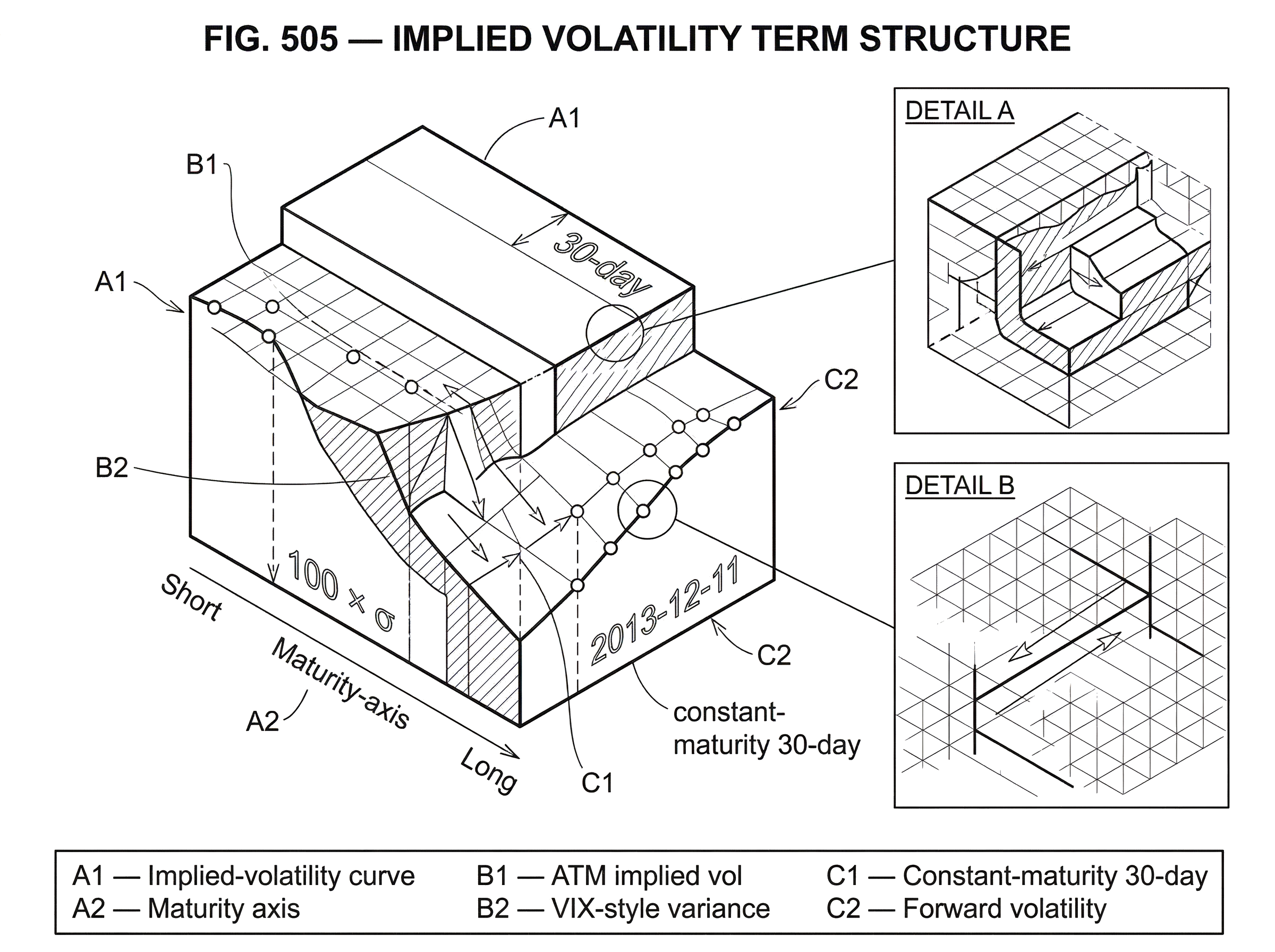
At a conceptual level, building an implied volatility term structure is straightforward. Take options at a sequence of maturities, extract a volatility measure from each maturity, and place those measures on a maturity axis. In practice, each of those steps contains choices.
The first choice is what volatility measure to use at each expiration. In many equity options contexts, traders often talk loosely about the implied volatility of the at-the-money option for each expiry. That produces a usable curve, but it is only one slice of the option surface. A broader and more robust approach is to aggregate information across many strikes to estimate an expiry-specific expected variance. That is the logic behind the VIX methodology and related Cboe volatility indices.
For SPX, Cboe states that its term structure information illustrates expected market volatility conveyed by S&P 500 option prices across standard maturities, and that it calculates those expectations by applying the VIX methodology to standard SPX option maturities. That is important because it means the curve is not just a string of single-strike IV quotes. It is a maturity-by-maturity estimate constructed from a wide range of out-of-the-money calls and puts.
Mechanically, the VIX-style calculation works by transforming option prices into a model-free estimate of variance for a given expiration. The key inputs include T, the time to expiration; R, the risk-free interest rate for that maturity; F, the option-implied forward level of the index; K0, the first strike at or below that forward level; and Q(K), the midpoint option price at strike K. Cboe's generalized formula then aggregates weighted out-of-the-money option prices across strikes to estimate variance σ^2, and the index level is reported as 100 × σ.
You do not need the full formula memorized to understand the mechanism. Here is the intuition. Deeply and moderately out-of-the-money options across many strikes contain information about the distribution of future outcomes, not just its center. By weighting those option prices appropriately and summing across strikes, you can estimate the market's risk-neutral expected variance for that expiry. Taking the square root turns variance into volatility, which is easier to quote and compare.
How do constant‑maturity 30‑day volatility indexes (e.g., VIXMO) get calculated?
Imagine it is midday and you want a 30-day reading of expected SPX volatility. There may not be an option expiration exactly 30 calendar days away. So instead of pretending otherwise, the constant-maturity method brackets the 30-day target using two nearby expirations; a nearer one and a later one.
Cboe's methodology for a constant-maturity 30-day volatility index, such as VIXMO, describes a four-step process. First, it selects the relevant near-term and next-term expirations, excluding series with too little time left. Second, it derives risk-free rates for those exact expiries from U.S. Treasury yield curve data using cubic spline interpolation. Third, it computes a variance for each selected term from option mid-quotes, using only options with non-zero bids. Finally, it combines those term variances to produce a constant-maturity 30-day index value.
Why does interpolation matter? Because the market lists discrete expirations, but the concept you usually want is a fixed horizon. If the nearest useful expiries are, say, 24 days and 38 days away, neither is itself the 30-day market expectation. The constant-maturity estimate is created by blending the two. This is the same general idea as inferring a 30-day point on an interest-rate curve from nearby traded maturities.
The result is a cleaner series for comparing today with yesterday or with last year. Without constant maturity, the observed quote would mechanically jump every time your reference option rolled from one listed expiry to another. With constant maturity, more of the movement reflects changes in volatility pricing rather than changes in what maturity you happened to be observing.
What causes the implied‑volatility term structure to change shape?
The term structure moves because the market is repricing future uncertainty, but that statement is still too vague. The more useful view is that the shape changes through a small number of mechanisms.
One mechanism is event concentration. If the market expects a specific event to matter a lot over the next two weeks but much less thereafter, short-dated implied volatility can rise relative to longer maturities. Earnings for a single stock often create this pattern very clearly. For an index, a major election, CPI release sequence, or central bank decision can create a hump centered around the relevant horizon.
Another mechanism is mean reversion in volatility. In equity index markets, short-run panic often does not get extrapolated indefinitely. When spot and near-dated implied volatility jump during stress, longer-dated volatility may rise too, but usually less. The curve can invert because the market expects current stress to ease before long. The same logic works in reverse during unusually calm periods: short-dated volatility may sit very low while longer maturities remain somewhat higher because the market does not believe extreme calm will last forever.
A third mechanism is volatility risk premium. Option sellers usually demand compensation for bearing convex, jumpy, hard-to-hedge risks. That compensation can vary by horizon. Long-dated options often embed different supply-demand balances than short-dated ones, and index options in particular can trade persistently rich to realized volatility because investors use them as protection.
A fourth mechanism is market structure and flow. This is where many smart readers underappreciate the difference between a clean theoretical curve and the traded one. Exchange-traded products, dealer hedging, and futures rolling can all affect the front of the volatility curve. Research from the BIS argues that ETF rebalancing demand in VIX-linked products can create a measurable non-fundamental gap in short-dated VIX futures, especially through leverage rebalancing. In other words, part of what you see in the short end may be mechanical demand, not a pure information signal about future realized volatility.
What do normal, inverted, and humped volatility curves indicate?
| Shape | Typical regime | Market signal | Trader implication |
|---|---|---|---|
| Normal (upward) | calm markets | longer-dated risk premium | sell longer-dated carry |
| Inverted (downward) | acute stress | near-term urgency | buy short-dated protection |
| Humped | scheduled event window | event concentration at horizon | target event-dated expiry |
In equity index volatility, the most common broad regime is an upward-sloping curve in relatively calm markets. Short-dated implied volatility is low, while medium-dated maturities are somewhat higher. In VIX futures language this is often associated with contango, though it is worth being precise: option-implied volatility term structure and VIX futures term structure are related but not identical objects.
Why is upward slope common in calm markets? Because low current volatility is often not expected to persist forever, and because short-dated protection may be relatively cheap when immediate demand for hedging is subdued. Longer horizons include more opportunities for shocks, and often embed a steadier risk premium.
A downward-sloping or inverted curve is more common in acute stress. When investors urgently want protection now, short-dated implied volatility can spike far above longer-dated implied volatility. The market is effectively saying: the next few weeks are dangerous, but this level of danger is not expected to continue indefinitely.
A humped curve usually means the market sees a specific interval as unusually important. In a single stock, earnings can make the one-month maturity expensive relative to both the very short end and longer expiries. In an index, a scheduled political or macro event can do something similar, though index humps are often less clean because many risks overlap.
The key reading principle is to ask not just what is high or low, butrelative to which horizon. Term structure is a comparative object.
How do spot term structure and forward volatility differ, and how are forwards extracted?
Once you have volatility across maturities, you can ask a deeper question: what volatility is the market implying between two future dates, not from today until each date? This is the volatility analogue of a forward rate.
Suppose 1-month implied volatility is modest but 3-month implied volatility is much higher. That does not necessarily mean the market expects volatility to be high throughout the full three months. It may mean the market expects relatively calm conditions in month one and much more uncertainty in months two and three. Forward volatility estimates try to isolate that later window.
This matters because many trades are really views on relative timing. A trader may not believe overall volatility is cheap or expensive in absolute terms, but may think the market is overpricing the next month relative to the following quarter, or vice versa. Calendar spreads in options and futures are attempts to express that relative view.
The term structure is therefore not only descriptive. It is the raw material for extracting forward-looking cross-maturity bets.
How do SPX options term structure, spot VIX, and VIX futures relate?
| Instrument | Represents | Investable? | Main cost or risk | Best use |
|---|---|---|---|---|
| Spot VIX | 30-day constant-maturity IV | no | not investable directly | benchmarking and signal |
| VIX futures | expected future VIX level | yes via futures | roll costs and contango | trading forward volatility |
| VIX-futures ETFs | rolled futures exposure | yes via ETF | daily roll decay and path risk | retail access to term exposures |
For equity index traders, the most widely observed volatility term structure is the SPX/VIX complex. Cboe publishes term structure data and charts showing expectations of S&P 500 volatility across standard maturities, and notes that traders use this information both to compare market expectations with their own and to trade forward-volatility products such as VIX futures and options.
Here an important distinction appears. Spot VIXis a constant-maturity 30-day measure derived from SPX option prices.VIX futures are tradable contracts that reflect the market's estimate of the value of the VIX Index on future expiration dates. So the first is an options-implied volatility index; the second is a futures curve on where that index is expected to be at future dates.
Because spot VIX is not directly investable, many tradable products use VIX futures instead. That creates a second term structure layered on top of the first. Products like the S&P 500 VIX Short-Term Futures Index hold a rolling portfolio of first- and second-month VIX futures, maintaining about one month to expiration by rolling a little each day. ProShares documentation for UVXY and SVXY describes exactly this basic construction.
This daily roll is not a side detail. It is the mechanism through which the shape of the VIX futures curve becomes a source of return or drag. When the curve is upward sloping, a long holder rolling from a cheaper near contract into a more expensive later contract tends to lose carry over time. ProShares explicitly states that VIX futures indexes have historically reflected significant costs associated with rolling futures daily, and that these costs can consistently reduce returns over time. That is why many investors learn the hard way that a long VIX-futures ETF is not a simple long-VIX position.
How do traders use implied‑volatility term structure for pricing, positioning, and risk management?
In practice, traders use implied volatility term structure for three broad kinds of judgment: pricing, positioning, and risk management.
On pricing, the term structure helps answer whether a maturity looks rich or cheap relative to its neighbors. An option may not look unusual in isolation, but may look extremely expensive compared with the expiries around it. This relative view often matters more than absolute IV level because volatility is a moving target across regimes.
On positioning, the curve helps traders choose where to place exposure. If you are buying protection, do you need the event-sensitive front end or the more stable back end? If you are selling volatility carry, do you want the fastest-decaying short-dated premium, or a longer maturity with less violent mark-to-market behavior? The right answer depends on what source of risk premium or hedge value you are seeking.
On risk management, the term structure tells you how a book may respond when the market's time profile of fear changes. A portfolio that is neutral to 3-month volatility but short 1-week volatility can be badly exposed to an event shock even if its headline vega looks modest. Term structure makes clear that not all vegas are the same. Vega at different points on the curve is exposure to different states of the world.
What common mistakes do people make when reading the volatility term structure?
A common mistake is to treat the term structure as a pure forecast of future realized volatility. It is better thought of as a price of volatility exposure by horizon. Forecasting is part of it, but only part. Risk aversion, hedging demand, and structural flows can make implied volatility systematically higher or lower than subsequently realized volatility.
A second mistake is to confuse options term structure with VIX futures term structure. They are linked, but not interchangeable. The SPX options curve describes the pricing of volatility embedded directly in options across expiries. The VIX futures curve prices future values of a 30-day volatility index. The latter depends not only on expected future volatility, but also on the dynamics of the VIX itself, volatility risk premia, and supply-demand conditions in futures markets.
A third mistake is to ignore data construction rules. Cboe's methodologies are explicit that spot volatility index values use bid-ask midpoints and include only options with non-zero bids. Once zero bids appear far enough into the wings, strikes are excluded. Filtering algorithms may also smooth anomalous quote behavior. These are sensible choices, but they remind you that any published term-structure point is the output of a methodology, not a raw law of nature.
There is also operational fallback behavior: when a valid volatility index cannot be calculated, Cboe republishes the last valid spot value until a new one can be computed. In fast or dislocated markets, that means a displayed point can temporarily be stale. For most educational purposes this is minor. For trading and replication, it matters.
When does the implied‑volatility term structure become unreliable?
The neat interpretation of term structure depends on assumptions that are often only approximately true. It helps to say those assumptions out loud.
If you assume options are liquid across many strikes and maturities, then the extracted curve is relatively informative. If liquidity disappears, bid-ask spreads widen, or zero-bid truncation cuts off the wings, the curve becomes noisier and more dependent on methodological filters.
If you assume option prices mostly reflect information about future volatility, the curve is a useful expectation map. If balance-sheet constraints, ETF rebalancing, or forced hedging dominate, parts of the curve may contain large non-fundamental premia. The BIS evidence on ETF-driven distortions in VIX futures is a reminder that markets can price who must tradeas much aswhat is expected.
If you assume volatility is a smooth function of maturity, interpolation between expiries is harmless. If a very specific event sits between listed maturities, interpolation can smear a localized risk into a broader curve point. Constant-maturity indices are extremely useful, but they are still summaries.
Why does implied‑volatility term structure matter for traders and risk managers?
The deepest reason implied volatility term structure exists is that uncertainty is not timeless. Markets need a way to price not justhow muchrisk there is, butwhen that risk matters. Options already do this contract by contract. The term structure is the compressed view that makes the timing dimension visible and tradable.
That is also why the concept extends naturally into neighboring ideas. Implied volatility itself is the single-expiry building block. Forward volatility is what you infer between maturities once the curve exists. VIX-style indices are one way to summarize maturity-specific expected variance more robustly than a single-strike quote. VIX futures and volatility ETPs then turn parts of that curve into directly tradable exposures; with all the carry, roll, and tail-risk consequences that follow.
Conclusion
Implied volatility term structure is the curve of option-implied volatility across maturities. Its importance comes from a simple fact: the market does not price uncertainty uniformly through time.
Read it as a map of timed volatility pricing, not as a single forecast. The front end tells you where urgency lives, the back end tells you what the market thinks persists, and the shape between them often reveals more than the headline IV number ever could.
Frequently Asked Questions
Because different option expirations cover different future intervals and therefore embed different expected events, risk premia, and supply-demand effects; extracting implied volatility at many maturities produces a curve (the term structure) rather than a single number.
Cboe-style (VIX) term-structure points are derived by aggregating option prices across many strikes for each expiration to produce a model-free estimate of variance using inputs like time to expiration (T), the risk-free rate (R), the option-implied forward (F), and midpoint option prices Q(K); the index level is then reported as 100 × the square root of that variance.
A constant-maturity index brackets the target horizon with the two nearest listed expirations, interpolates risk-free rates, computes variances for each term from option mid-quotes, and blends them to report a fixed-horizon value so the series reflects changes in volatility pricing rather than mechanical jumps from rolling expiries.
Shapes change because of event concentration (scheduled events that spike a particular horizon), mean reversion (short-run panic that is not expected to persist), volatility risk premia (different compensation by horizon), and market-structure flows such as ETF rebalancing and dealer hedging that can mechanically distort short-dated prices.
VIX futures and ETPs trade a futures curve on a 30-day volatility index rather than the spot index itself; because many ETFs roll short-dated futures daily, an upward‑sloping (contango) futures curve typically produces persistent roll costs that can erode returns and make ETF performance differ materially from spot VIX or a simple leveraged multiple.
No - the term structure is a market price for volatility exposure by horizon and mixes forecasts with risk premia, hedging demand, dealer constraints, and microstructure effects, so implied volatility often differs systematically from subsequently realized volatility.
Index calculations exclude options with zero bids and apply truncation rules and mid-quote filtering, and when a valid volatility index cannot be computed exchanges may republish the last valid spot value, so widening spreads, disappearing liquidity, or zero-bid truncation can materially bias or stale published term-structure points.
forward volatility between two future dates is inferred from the term structure much like a forward interest rate: by comparing variances (or volatilities) at different maturities one can isolate the market's implied volatility for the intervening window, a calculation traders implement via calendar spreads and algebraic forward‑volatility formulas.
ETFs and ETNs that target VIX‑futures exposure warn that they benchmark to a VIX‑futures index (not VIX itself), incur roll costs, use daily targets (so multi-day returns deviate due to compounding), and may issue K-1 tax forms - all of which can make them unsuitable as simple long‑VIX hedges and expose holders to persistent decay and operational risks.
The term structure becomes less reliable when option markets are illiquid, bid-ask spreads widen, zero-bid truncation removes wing information, or when large mechanical flows (e.g., leveraged ETF rebalancing) dominate pricing; empirical work (BIS and Cboe materials) documents that such flows can create non‑fundamental dislocations, especially in short-dated futures.
Related reading