What Are the Limitations of the Black-Scholes Model?
Learn the main limitations of the Black-Scholes model, including constant volatility, jump risk, discrete hedging, transaction costs, and skew.
Introduction
Black-Scholes model limitations are important because the model’s greatest strength is also its main weakness: it gives a clean price for an option by assuming a world that is far simpler than real markets. That tradeoff is not a flaw in the sense of “the model is useless.” It is the reason the model became foundational. By reducing option pricing to a small number of inputs and a replicating-hedge argument, Black-Scholes gave traders, investors, and risk managers a common language for thinking about convex payoffs, hedge ratios, and implied volatility.
The puzzle is this: if Black-Scholes is so influential, why do traders spend so much time talking about volatility smiles, skew, jumps, liquidity, and hedging error? The answer is that the model solves a very specific problem under very specific conditions. Once you understand that mechanism, its limitations stop looking like a random list of caveats. They all come from the same place: the model assumes that an option can be replicated smoothly and continuously in a market where the underlying follows a stable diffusion process and trading itself does not disturb the hedge. Real markets break each part of that picture in their own way.
That is the central idea to keep in mind. Black-Scholes is not “wrong” because markets are messy. It is a benchmark built on invariants that are only approximately true. The practical question is never whether the model is perfect. It is which assumptions are close enough for the task at hand, and which ones fail in ways that materially affect pricing, hedging, or risk.
How does Black‑Scholes use dynamic replication and delta hedging to price options?
To see where the limitations come from, it helps to start with what Black-Scholes is trying to do. A European option has a payoff at expiration that depends on the future price of an underlying asset. The pricing problem is difficult because that future price is uncertain. Black-Scholes solves the problem by shifting attention away from forecasting the most likely future price and toward constructing a hedge.
The core move is replication. If you can combine the underlying asset and cash in such a way that the combined portfolio exactly matches the option payoff in every future state, then the option and the replicating portfolio must have the same price today, otherwise there would be an arbitrage. This is the deep idea behind the model. The price is pinned down not by an investor’s personal view about expected returns, but by the cost of building an equivalent payoff.
That argument becomes analytically tractable only because the model assumes the underlying price evolves continuously, with returns driven by Brownian motion and a constant volatility parameter. In ordinary language, price moves are random but smooth enough that a trader can keep adjusting the hedge in tiny increments. If that can be done continuously and without friction, the option’s risk can be neutralized locally at every instant. The resulting no-arbitrage condition yields the famous closed-form formula for European calls and puts.
This is why Black-Scholes remains so important even now. It is not just a formula. It is a theory of how dynamic hedging links derivative prices to the underlying. The Greeks, especially delta, come directly from this replication logic. In practice, even when traders know the assumptions are violated, they still often use Black-Scholes as a quoting convention or as a first approximation because the model gives a common baseline.
But that same mechanism tells you exactly where the model is fragile. If the underlying does not move continuously, if volatility is not constant, if markets are not frictionless, or if hedging cannot be done continuously, then the replication argument stops being exact. Once replication is imperfect, pricing is no longer uniquely determined by the original logic alone.
Why does the Black‑Scholes constant‑volatility assumption fail in real markets?
| Model | Volatility treatment | Fits smile? | Captures dynamics? | Complexity |
|---|---|---|---|---|
| Black-Scholes | Single constant volatility | No | No | Low |
| Local volatility | Price and time dependent | Yes (static) | No | Medium |
| Stochastic volatility | Random evolving volatility | Partially | Yes | High |
| Jump-diffusion | Discrete jumps plus diffusion | Explains tails and skew | No for vol dynamics | High |
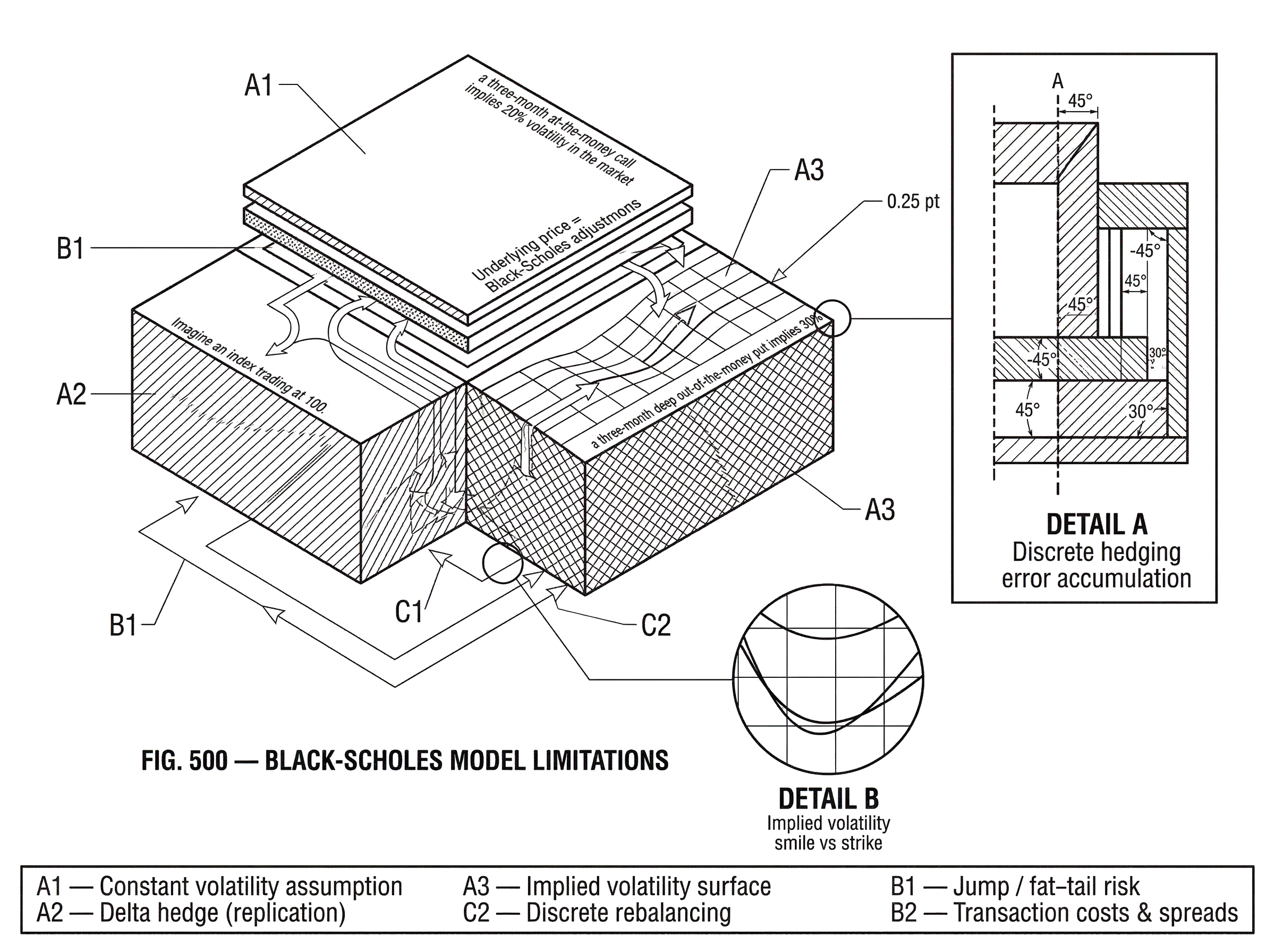
Among the model’s assumptions, the one markets contradict most openly is the idea of a single constant volatility. In Black-Scholes, volatility is a fixed input. For a given underlying and maturity, the model implies that options across strikes should all be consistent with the same volatility number. If that were true, the implied volatility backed out from market prices would be flat across strikes.
In real markets, that is not what traders observe. Implied volatility varies with strike and maturity, producing what market participants call the volatility smileor, more commonly in equity markets, thevolatility skew. The evidence discussed in later literature is straightforward: lower-strike equity index puts often imply much higher volatility than at-the-money or higher-strike calls. The shape is not an incidental detail. It means the market is systematically assigning different values to downside and upside tail risk than the Black-Scholes world would.
This matters mechanically, not cosmetically. If you use a single volatility input to price all options, you cannot fit the full cross-section of observed market prices. The model can match one option exactly, or perhaps a narrow region reasonably well, but then it will misprice others. That is why practitioners often speak of Black-Scholes implied volatility rather than “the true volatility.” The formula is inverted option by option to produce the volatility that would make the model fit that one market price. The result is not one number but a surface over strike and expiration.
A simple example makes the issue concrete. Imagine an index trading at 100. Suppose a three-month at-the-money call implies 20% volatility in the market, while a three-month deep out-of-the-money put implies 30%. In the Black-Scholes framework, those two prices should be generated by the same underlying volatility assumption. If they are not, something in the Black-Scholes description of the return distribution is too simple. The market is signaling that downside moves are either more likely, more severe, or more valuable to insure against than the lognormal constant-volatility picture suggests.
This is why later models such as local volatility and stochastic volatility were developed. Local volatility lets volatility vary with price and time and can be calibrated to fit the observed smile at a point in time. But even that has limits: as the supplied material notes, local volatility is static and does not capture how the volatility surface itself changes over time. Stochastic-volatility models go further by making volatility random, which better reflects the fact that volatility is not just unknown but evolving.
So the limitation here is not simply “volatility is not constant.” The deeper point is that volatility is itself an object with structure and dynamics, while Black-Scholes treats it as a single scalar input. That simplification is what gives the model elegance, and it is also what prevents it from describing the market’s full option surface.
How do fat tails and asymmetric returns break Black‑Scholes pricing?
Why does the volatility smile appear in the first place? One major reason is that actual return distributions are not well described by the normal-style diffusion behind Black-Scholes. Empirical returns often show fat tails and asymmetry. Large moves happen more often than the basic diffusion model suggests, and in many markets downside crashes are more salient than upside jumps.
This is not a minor statistical refinement. The option market is especially sensitive to tail behavior because options are nonlinear contracts. A small change in the probability of extreme outcomes can have a large effect on option values, particularly for out-of-the-money options. If a model understates the frequency or severity of large price moves, it will tend to misprice tail insurance.
Primary and secondary materials in the evidence point to this directly. Kou’s jump-diffusion work frames two empirical puzzles for the Black-Scholes setting: returns display asymmetric leptokurtosis, and implied volatilities form smiles rather than staying constant across strike. His proposed alternative adds jumps to the return process to capture those heavier tails while preserving some analytical tractability.
That development reveals something fundamental about Black-Scholes. Its diffusion assumption is not just a mathematical convenience; it implies a particular geometry of hedging. If prices move continuously, a delta hedge can in principle be adjusted as the underlying moves. But if prices jump discontinuously, the hedge cannot be updated during the jump. The portfolio experiences gap risk. In that world, continuous replication is not merely impractical; it is conceptually incomplete.
This creates a sharp boundary between the Black-Scholes world and jump models. In a pure diffusion setting, the option can be replicated exactly in theory. In a jump setting, markets become incomplete: there may be risks that cannot be hedged away using the underlying alone. Once that happens, there is no single no-arbitrage price derived from the original replication logic without additional assumptions about preferences, additional traded instruments, or pricing kernels.
You can think of Black-Scholes as describing a world where risk arrives like very fine sand pouring steadily through an hourglass. Jump models say that sometimes risk arrives like pebbles or rocks. The analogy helps explain why delta hedging works differently. Where it fails is that markets contain both continuous variation and discrete events, and the distinction is statistical rather than visually obvious at every moment.
What hedging errors arise when you can only rebalance discretely?
| Hedging approach | Implementation cost | Typical hedging error | Best when |
|---|---|---|---|
| Continuous theory | Theoretical only | Zero in model | Idealized markets |
| High-frequency rebalancing | Very high cost | Low in calm markets | Liquid quiet markets |
| Threshold rebalancing | Moderate cost | Controlled spikes | Costly volatile markets |
| Static hedge | Low cost | Large over time | Illiquid or long-dated |
Black-Scholes assumes that hedging can be done continuously. This assumption is easy to overlook because it sounds like a technical detail, but it is the operational backbone of the model. The option price comes from maintaining a hedge that is constantly rebalanced as the underlying price changes. If that rebalancing can only happen at discrete times, the hedge is approximate rather than exact.
In real markets, traders hedge at intervals: every few seconds, minutes, hours, or according to risk thresholds. Between those adjustments, the option’s sensitivity changes while the hedge remains stale. The resulting mismatch is hedging error. When markets are calm and rehedging is frequent, the error may be small enough that Black-Scholes remains a good approximation. When markets move quickly, the error can become substantial.
The problem compounds because discrete hedging is tied to market volatility itself. In quiet conditions, you can hedge less often without losing much accuracy. In turbulent conditions, you need to hedge more often precisely when trading is harder, spreads widen, and prices can jump. So the assumption that makes the model work best is most strained in the periods that matter most for risk.
A trader short an at-the-money call can illustrate the mechanism. As the stock rises, the option’s delta increases, meaning the trader needs to buy more stock to stay hedged. If the stock drifts upward smoothly, that adjustment can be made gradually. But if the stock gaps up sharply after news, delta rises suddenly and the trader must buy stock at a worse price after the move has already happened. The theoretical hedge assumed by Black-Scholes would have adjusted through the move; the actual hedge adjusts only after it. The difference is real P&L.
This is one reason the Greeks should be treated as local sensitivities, not guarantees of full risk control. Delta, gamma, vega, and the rest are extremely useful, but they inherit the model’s local and instantaneous view of risk. A hedge based on them is best understood as a controlled approximation, not a promise of exact replication.
How do transaction costs, spreads, and market impact change option hedging?
Black-Scholes also assumes frictionless trading: no transaction costs, no bid-ask spreads, no funding complications, no market impact, and unrestricted shorting. That assumption is not there because the original authors thought costs were unimportant. It is there because exact replication becomes much harder to formalize once every rebalance incurs a cost.
This matters especially for options because option hedging can require frequent trading in the underlying. A position with high gamma needs more active rebalancing, which means more turnover. In a frictionless model, that extra turnover is free. In an actual market, each hedge adjustment consumes spread, commissions, financing capacity, and sometimes liquidity.
Once transaction costs enter, a basic feature of the original theory breaks. The value of the hedge depends on how often you rebalance, but the optimal rebalance frequency now involves a tradeoff. Hedge too rarely and you incur larger hedging error. Hedge too often and the cumulative trading cost becomes large. There is no longer an exact replication at zero residual risk. Instead there is an optimization problem.
The literature built around transaction-cost extensions makes this explicit. Even the titles cited in the evidence tell the story: option pricing and replication with transaction costs, nonlinear Black-Scholes equations, discrete-time delta hedging with costs. The linear elegance of the original equation does not survive unchanged. Costs make the problem path-dependent and often nonlinear.
Illiquidity creates a related but deeper issue. Black-Scholes assumes that trades can be executed at quoted market prices without affecting those prices. That may be approximately true for small hedges in liquid instruments under normal conditions. It is much less true for large books, stressed markets, or less liquid underlyings. If a hedge trade moves the market, the act of replication changes the price of the thing being used for replication. The model treats the hedge as passive with respect to the market; reality does not always grant that privilege.
Why does Black‑Scholes fail most during market stress and crises?
The most important limitations rarely appear one by one. In market stress, they fail together. Volatility rises and becomes unstable. Correlations shift. Liquidity deteriorates. Gaps become more common. Margin calls force position changes at bad times. Models calibrated on quiet periods become least reliable when they are needed most.
The LTCM report in the supplied material is useful here even though it is not specifically a Black-Scholes critique. Its lesson is broader: risk models built on recent history and normal conditions can underestimate the size of shocks, the persistence of dislocations, and the tendency for correlations to rise in crises. That logic applies directly to any pricing or hedging framework that depends on stable diffusion-like assumptions.
Here is the mechanism. In normal times, a trader may delta-hedge an option book and monitor risks with model-based sensitivities. When a systemic shock hits, underlying prices gap, implied volatilities jump, and the volatility surface itself reshapes. At the same time, funding pressure rises because losses trigger collateral and variation margin calls. The trader is then forced to adjust hedges in a market where liquidity is thinner and execution is worse. The model did not merely make a small pricing error. The environment that justified its replication logic has changed.
This is why practitioners distinguish between model risk and market risk. Market risk is the risk that prices move. Model risk is the risk that the framework used to measure and hedge those movements is itself misspecified. Black-Scholes limitations become most costly when those two risks reinforce each other.
Which option types and payoffs fall outside the Black‑Scholes scope?
| Option type | Black-Scholes applicability | Primary extra risk | Modeling alternative |
|---|---|---|---|
| European vanilla | Directly applicable | Minimal path risk | Black-Scholes |
| American options | Limited (early exercise) | Exercise timing risk | Binomial or PDE |
| Barrier options | Not directly applicable | Path dependency | Monte Carlo or PDE |
| Volatility derivatives | Not applicable | Volatility process risk | Stochastic vol models |
| Single-name equity options | Depends on credit risk | Default and jump risk | Jump or credit models |
Another limitation is scope. The classic Black-Scholes formula applies directly to European options under its specific assumptions. Many real derivatives differ materially from that setup. American options can be exercised early. Barrier options depend on the path of the underlying, not just the terminal price. Volatility derivatives depend on realized or expected variance. Single-name equity options may reflect default risk in ways that a simple diffusion model does not capture.
This does not mean Black-Scholes is irrelevant for these products. Often it serves as a starting point, an intuition pump, or a local approximation. But the further a payoff moves away from simple European exercise and lognormal diffusion, the less likely it is that the original closed-form machinery will be enough.
This is also why the market evolved a whole ecosystem of extensions: local volatility to fit current smiles, stochastic volatility to model changing volatility, jump-diffusion to account for discontinuities and fat tails, and hybrid or calibration frameworks such as SVI to fit implied-volatility surfaces while respecting no-static-arbitrage constraints. The need for these models is itself evidence of the limits of the base case.
Notice the pattern. None of these alternatives abolishes Black-Scholes. They inherit its no-arbitrage spirit, its reliance on tradable hedges where possible, and its use of implied volatility as a practical language. Black-Scholes remains the baseline coordinate system even when the map has to be redrawn.
Why is Black‑Scholes still a central benchmark despite its limitations?
Given all these limitations, it is fair to ask why the model remains so central. The answer is that a useful model does not need to be universally true. It needs to organize thought, support communication, and work tolerably well within a domain.
Black-Scholes does all three. It gives a closed-form benchmark for vanilla European options. It provides Greeks that remain the standard local risk vocabulary. It gives the market a common quoting convention through implied volatility. And because the formula is simple and fast, it is practical for trading systems, scenario analysis, and first-pass valuation.
There is also a deeper reason. Even when traders use more sophisticated models, they often diagnose them relative to Black-Scholes intuition. If a stochastic-volatility model produces a certain skew, the trader still asks how that differs from the flat-volatility baseline. If an options surface is calibrated using SVI or another parameterization, it is still discussed in terms of Black-Scholes implied volatilities. The model survives because it defines the simplest coherent benchmark against which richer descriptions can be compared.
So the right stance is neither reverence nor dismissal. Black-Scholes is a benchmark for a world with continuous trading, frictionless markets, and stable diffusion dynamics. Real markets depart from that world in structured ways. Those departures create smiles, skews, jumps, liquidity effects, transaction-cost tradeoffs, and hedging error.
Conclusion
The limitations of the Black-Scholes model all trace back to one fact: exact option replication requires assumptions that real markets satisfy only imperfectly. Constant volatility, continuous price paths, continuous rebalancing, and frictionless trading are what make the model elegant. They are also what reality most often violates.
That is why Black-Scholes remains foundational but not final. It is best used as a baseline: a precise answer to a simplified problem, a common language for implied volatility and Greeks, and a starting point for models that try to recover the parts of market behavior it leaves out. If you remember one thing tomorrow, remember this: Black-Scholes is powerful not because it describes markets completely, but because it shows exactly which simplifications are doing the work.
Frequently Asked Questions
Because Black‑Scholes assumes one fixed volatility for a given underlying and maturity, it predicts the same implied volatility across all strikes; observed smiles/skews - where implied volatility varies with strike and term - mean a single volatility input cannot simultaneously match market prices at different strikes.
When returns include jumps, the hedge cannot be adjusted during the discontinuity and some risks cannot be eliminated using only the underlying, so the replication argument that pins a unique Black‑Scholes price fails and the market becomes incomplete.
Because continuous rebalancing is a theoretical ideal, real traders hedge at discrete times and so incur hedging error that grows when markets move fast or gap, meaning delta‑based hedges are only local approximations, not exact protections.
Transaction costs, bid–ask spreads, funding and market‑impact make frequent rebalancing costly, turning replication into an optimization tradeoff (hedge frequency versus trading cost) and often producing nonlinear pricing or utility/indifference formulations rather than the linear Black‑Scholes result.
The closed‑form Black‑Scholes formula applies cleanly only to European options under its assumptions; American features, path‑dependent payoffs (barriers), volatility derivatives, and credit/default exposure all require extensions or different models.
Local‑volatility models can be calibrated to fit a snapshot smile because they let volatility vary with price and time, but they are essentially static and do not capture how the volatility surface evolves; stochastic‑volatility models instead make volatility itself random and better reflect observed dynamics, though each approach has its own limits.
Black‑Scholes tends to break down most when markets are stressed because volatility and correlations shift, liquidity dries up, and margin/funding pressures force trades at bad prices - the same conditions that make replication assumptions least realistic and model risk largest.
Because it supplies a simple, fast benchmark and a common language (implied volatility and Greeks), practitioners use Black‑Scholes as a first approximation or quoting convention even when they rely on richer models for pricing and risk; it remains the baseline against which deviations are measured.
Related reading