What is Options Skew?
Learn what options skew is, why implied volatility differs across strikes, how SKEW and risk reversals work, and what skew says about tail risk.
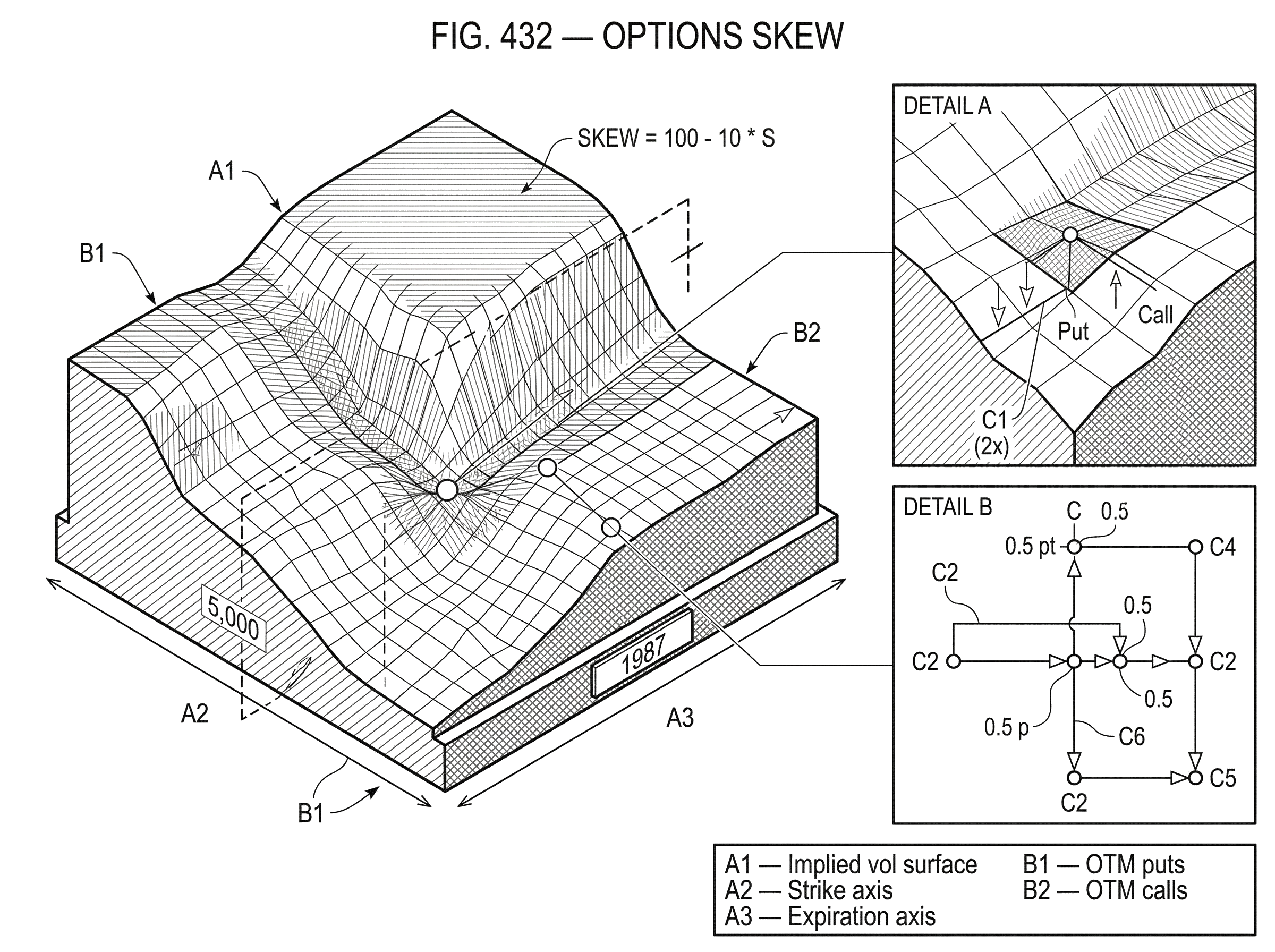
Introduction
Options skew is the pattern in which options on the same underlying asset and expiration trade at different implied volatilities across strikes. That sounds like a technical detail, but it reveals something central about markets: investors usually do not fear upside and downside equally, and option prices record that imbalance in real time.
If every future price move were treated symmetrically, the implied volatility surface would be flat across strikes. In practice it is not. Equity index options usually assign higher implied volatility to lower strikes, especially out-of-the-money puts, than to comparable out-of-the-money calls. Commodity markets can show the opposite. This is why skew matters: it is where option prices stop being a simple “volatility forecast” and start becoming a map of how the market prices which kind of move it fears most.
That makes skew useful far beyond pure options trading. It affects the cost of hedging, the behavior of structured products, the interpretation of indices like VIX and SKEW, the calibration of volatility surfaces, and the risk systems that clearinghouses use when markets become stressed. To understand skew well, the key is to stop thinking of implied volatility as a single number. It is a surface, and skew is one of the most important shapes on that surface.
Why implied volatility differs by strike; and why “one number” misleads
The Black-Scholes style habit of speaking about “the” implied volatility is convenient, but it compresses away the part traders care about most. In any option pricing model, you can back out the volatility input that would make the model match the market price of a specific option. That is the option’s implied volatility. But once you do this for many strikes, you find that the market is telling you different things at different points.
That discrepancy is not a small market imperfection. It is the market’s way of saying that the simple assumptions behind a flat-volatility world are wrong. Real return distributions are not perfectly symmetric. Large downside moves tend to be treated as more important than equally large upside moves in many asset classes, especially equity indexes. As a result, the options market assigns more premium to protection against those downside moves, and the implied volatility extracted from those options comes out higher.
So the right question is not “what is implied volatility?” but “implied volatility of which strike?” Once you ask that, skew appears naturally. It is the cross-strike pattern of implied volatilities, usually described by the slope or tilt of the volatility smile. In equities, that smile is often more like a smirk: lower strikes are richer than higher strikes.
This is also why skew should not be confused with realized volatility. Realized volatility is something you compute from past moves. Skew is a price today for asymmetric future risk. It contains expectations, hedging demand, dealer balance-sheet constraints, and risk premia all mixed together.
How supply, demand, and asymmetric fear create options skew
| Actor | Typical position | Primary concern | Market action | Price effect |
|---|---|---|---|---|
| Natural buyers | Long underlying (passive) | Crash/downside risk | Buy OTM puts for insurance | Raise put demand and put vols |
| Dealers / market makers | Provide liquidity/insurance | Limit concentrated tail losses | Sell and warehouse tail risk | Require higher premium on puts |
The simplest way to understand skew is to ask who naturally wants which option. In equity markets, many investors are structurally long the market through index funds, pensions, insurance portfolios, or long-only mandates. Their biggest concern is not missing extreme upside. It is being exposed to a sudden crash. That creates persistent demand for downside protection, especially out-of-the-money puts.
On the other side sit dealers and market makers who supply that protection, but only at a price that compensates them for the risks they absorb. A short out-of-the-money put is not just another option sale. It loads the seller into precisely the state of the world where liquidity worsens, hedging becomes harder, and losses arrive quickly. Because that risk is especially painful, sellers demand more premium. That extra premium appears as higher implied volatility at lower strikes.
This is the economic engine of skew. It is not primarily a mathematical curiosity. It is a persistent imbalance between natural buyers of insurance and the capital willing to warehouse tail risk. Cboe’s explanation of the S&P 500 option market makes this point directly: most market participants are effectively passive longs, so their risk is mainly to the downside, while dealers are the principal suppliers of that protection.
History matters here because this pattern was not always viewed as permanent. Cboe notes that the 1987 crash marked a structural break in index options, after which market participants became willing to pay materially more for downside protection than for equidistant upside exposure. The basic lesson was simple: a large left-tail event was not just a theoretical possibility. Once that lesson is embedded in market memory, skew tends to persist.
How skew appears on option quotes, risk reversals, and the surface
| Measure | Data used | Scope | Pros | Cons |
|---|---|---|---|---|
| Risk reversal | One call and one put | Two strikes only | Simple and tradable | Misses full-surface information |
| CVOL skew | Many strikes each side | Strip around ATM | Uses full-wing information | Requires broad strike liquidity |
| Cboe SKEW Index | SPX option strip | Strike-independent benchmark | Aggregates whole option strip | Model-dependent probability mapping |
Imagine an index trading at 5,000. Consider two one-month options: a 4,700 put and a 5,300 call. If the market treated upside and downside tails symmetrically, these two out-of-the-money options might imply similar volatilities once adjusted for interest rates and other details. In many equity index markets, the put instead implies a noticeably higher volatility than the call.
That difference means the put is expensive relative to a flat-volatility benchmark. But “expensive” needs care. It does not necessarily mean mispriced. It means the market attaches a larger premium to that downside state, either because it believes the probability is higher, because the state is more painful to hedge, or because investors are willing to pay extra for insurance even beyond expected loss. In practice, all three forces can matter.
Traders summarize this shape in several ways. The most common desk shorthand is a risk reversal, which compares the implied volatility of a call and a put with the same absolute delta or similar moneyness. CME describes this as a common practitioner measure of skew. It is useful because it is easy to quote, but it only uses two points on the curve. That means it can miss information contained in the rest of the surface.
A fuller approach uses many strikes rather than one call-put pair. CME’s CVOL skew framework, for example, aggregates option information from each side of at-the-money rather than relying on only a traditional 25-delta risk reversal. Cboe’s SKEW Index goes further still by constructing a strike-independent benchmark from a strip of SPX options. The general idea is the same in each case: skew is not best thought of as a property of a single option pair, but of the entire shape of option prices across strikes.
Skew vs. smile: reading the implied volatility surface across strikes and maturities
People often use smile and skew loosely, but the distinction helps. A smile is the overall curve of implied volatility across strikes for a fixed expiration. A skew usually refers to the slope or asymmetry of that curve. If both deep puts and deep calls trade at higher implied vol than at-the-money options, that is a more symmetric smile. If lower strikes are persistently richer than higher strikes, that is a negatively sloped skew, which is typical in equity indexes.
Once you include multiple expirations, the object becomes the implied volatility surface. Then skew is one dimension of shape across strike, and term structure is another dimension across time to expiration. These two dimensions interact. Short-dated options can have a very different skew from longer-dated options, especially when markets are stressed or when trading activity concentrates in very short maturities.
This interaction matters mechanically. A one-week downside hedge and a three-month downside hedge are not the same product. They do not respond to the same flows, the same dealer hedging pressures, or the same event risks. That is why talking about “the skew” without specifying maturity can be misleading. There is usually a whole term structure of skew.
The same point appears in clearing and margin models. Recent OCC rule filings on short-dated options note that assuming a flat short-end term structure can misestimate risk because implied volatility changes in short-dated options may be much larger than those in one-month options. That is not exactly a skew definition, but it reinforces the underlying idea: the shape of the surface near expiry matters, and simplifying it too aggressively can understate real exposure.
How skew changes hedge economics; a worked example
Consider a portfolio manager who is long an equity index and wants crash protection for the next month. In a flat-volatility world, the manager might compare puts and calls largely through symmetric moneyness. But in the real market, the relevant put is likely carrying a much higher implied volatility than a comparable call. That means insurance is costly in a very specific way: the market charges extra for protection against the downside state the manager actually fears.
Now suppose the manager tries to offset some of that cost by selling an out-of-the-money call. The trade is no longer just “buy protection, sell upside.” It is also a skew trade. The manager is buying a high-volatility option and selling a lower-volatility option. If the skew is steep, that relative pricing may help finance the hedge, but it also means the structure is sensitive not just to where the index moves, but to how the volatility surface deforms.
CME gives a commodity-market illustration of this logic through a silver risk-reversal example. The details there involve call skew rather than the classic equity put skew, which is useful because it shows that skew is not universally left-tailed in the same way across every asset. The broader lesson is the same: when one wing of the surface is much richer than the other, hedge performance and P&L can change materially even if the underlying move looks similar on first inspection.
That is why experienced options traders track not only delta and vega, but also where on the surface those exposures sit. Two hedges with similar headline cost can behave very differently if one is long rich downside vol and the other is long a flatter part of the surface.
What does the Cboe SKEW Index measure and how should you read it?
The Cboe SKEW Index is one of the best-known attempts to summarize downside skew into a single benchmark. Its purpose is not to measure the overall level of volatility. That is more like what VIX does. Instead, SKEW measures the slope of the S&P 500 implied volatility curve in a way intended to capture perceived left-tail risk.
Cboe’s white paper defines SKEW as a global, strike-independent benchmark derived from SPX option prices using a method analogous to VIX. The paper’s formal construction starts from a risk-neutral skewness price, S, and defines the index as SKEW = 100 - 10 * S. The sign convention matters: as the market-implied skewness becomes more negative, SKEW rises. So a higher SKEW reading means the option market is assigning more weight or more premium to left-tail outcomes.
The mechanism behind that formula is more interesting than the formula itself. Cboe constructs a tradable, delta-hedged replicating portfolio of out-of-the-money SPX options whose price corresponds to a skewness payoff. In other words, SKEW is not merely a descriptive statistic fitted to a curve. It is rooted in option prices through a replication methodology, much as VIX is rooted in a variance-replication idea.
This makes SKEW conceptually different from a simple risk reversal quote. A risk reversal asks, in effect, “how different are these two points?” SKEW asks something closer to “what does the entire relevant strip of option prices imply about the market price of asymmetry?” That broader construction is why Cboe describes it as strike-independent.
Interpretation still requires caution. The white paper translates SKEW levels into approximate risk-adjusted tail probabilities using a Gram-Charlier approximation and explicitly notes modeling choices, including omission of a risk-neutral kurtosis term. So the probability mapping is useful intuition, not a law of nature. Still, the intuition is clear: higher SKEW means the market is paying more for left-tail exposure than a normal-distribution world would imply.
SKEW vs VIX: why volatility level and volatility shape can diverge
| Index | Primary focus | What a high reading means | Typical stress behavior | Best used for |
|---|---|---|---|---|
| SKEW | Left-tail asymmetry | More premium on OTM puts | Can rise when VIX low; may fall during ATM vol spikes | Assess tail-premia and skew |
| VIX | Expected variance level | Higher near-term variance | Jumps on broad market sell-offs | Measure overall volatility level |
A common mistake is to think that high VIX automatically means high skew, or vice versa. They are related because both come from option prices, but they summarize different features of the risk-neutral distribution. VIX is essentially about the level of expected variance over a horizon. SKEW is about the asymmetry of that distribution, especially the left tail.
That distinction explains why Cboe emphasizes that SKEW and VIX have relatively low correlation and can move differently. A market can have low overall volatility but high concern about a crash tail. In that case VIX may remain subdued while SKEW rises. Conversely, during a sharp sell-off, at-the-money volatility often jumps dramatically, lifting VIX, while the relative richness of far-out-of-the-money puts may not increase proportionally. In that case the skew can flatten and SKEW may fall.
Cboe’s market commentary describes exactly this tendency: higher SKEW readings often appear in lower-VIX environments, while during sell-offs the volatility skew often flattens as at-the-money implied volatility rises more than tail vols. This can feel counterintuitive at first. If markets are scared, should not crash protection get even more expensive? Sometimes it does in absolute terms, but what matters for skew is the relative pricing across strikes. If the center of the surface rises faster than the wing, skew can flatten even in a fearful market.
That is the compression point many readers miss: volatility level and volatility shape are separate state variables. VIX mostly tracks the first. Skew metrics track the second.
Why quants and modelers must fit skew in volatility models
Skew is not only a trading signal. It is one of the hardest constraints any option model must satisfy. If your model cannot reproduce the observed slope and curvature of implied volatilities across strikes and maturities, it will misprice hedges, distort risk, and often create arbitrage inconsistencies.
This is why practical volatility-surface modeling often uses parameterizations such as SVI. The appeal of SVI is not that it gives a philosophical explanation for skew. It gives a tractable way to fit the observed implied volatility surface while respecting no-static-arbitrage constraints. Research on arbitrage-free SVI surfaces focuses exactly on this problem: how to represent the shape traders actually see without producing impossible price relations across strikes or maturities.
More advanced academic work goes further and asks what persistent skew implies about the underlying volatility process itself. Research on rough volatility, for example, argues that empirically observed power-law behavior in short-dated volatility skew is inconsistent with smoother volatility models. Whether a practitioner adopts that framework depends on purpose and taste, but the broader lesson is robust: skew is not a decorative feature. It is evidence about market dynamics that pushes directly on model choice.
When skew is misleading: interpretation limits and measurement caveats
Skew is informative, but it is not a clean probability forecast. This is the most important caveat. When you see downside puts trading rich, you cannot conclude only that the market thinks crashes are more likely. The option price also reflects the cost of warehousing tail risk, jump risk, dealer inventory, funding constraints, and demand for insurance from institutions that may be insensitive to price.
So skew mixes at least two things: the market’s risk-neutral distribution and the market’s risk premium for bad states. Those are not the same. A steep skew might mean traders assign high probability to a crash, or that they assign only moderate probability but demand large compensation for taking the other side if it happens.
There is also a measurement problem. A risk reversal uses only two strikes. A fuller-curve measure uses interpolation choices, strike filters, and liquidity screens. Cboe’s SKEW methodology depends on which SPX options have valid bids and on interpolation between expirations. Those implementation choices are sensible, but they mean the metric is still a model of market prices, not a raw fact independent of construction.
Finally, skew is asset-specific. Equity indexes often show downside put skew because investors are structurally long the asset and fear crashes. Commodity markets may show upside call richness during supply-shock episodes. Even within equities, single-stock skew can differ from index skew because earnings jumps, takeover optionality, and idiosyncratic shorting constraints matter.
How skew affects clearing, margining, and market infrastructure
When skew becomes concentrated in short-dated options, especially in very active expiries, it stops being only a pricing curiosity and starts affecting market infrastructure. Clearinghouses have had to update margin and stress methodologies because short-dated option books can change risk very quickly and because the implied volatility surface near expiry can move differently from longer-dated points.
OCC’s recent filings on short-dated options and intraday risk are relevant here. They do not define skew for traders, but they show its practical consequences. If risk systems assume the wrong short-end term structure, or if intraday option activity generates exposures not captured by end-of-day margining, market plumbing has to adapt. That is especially important in environments with large volumes of short-dated and zero-days-to-expiration options.
Stress episodes also reveal how volatility shape, margin, and liquidity interact. Research around the March 2020 turmoil found that sudden increases in margin requirements were associated with liquidity withdrawal. That does not mean skew caused the event, but it highlights a broader point: option-surface dynamics feed into dealer hedging, margin demands, and market depth. In stressed markets, these feedback loops matter.
Conclusion
Options skew is the market’s price of asymmetry. It appears because investors do not value upside and downside states equally, and because the capital supplying insurance demands extra compensation for the states that are hardest to bear.
If you remember one thing, remember this: implied volatility is not one number but a shape. Skew is the part of that shape that tells you which tail the market fears, what protection costs, and why volatility level alone never tells the whole story.
Frequently Asked Questions
Skew is the cross‑strike pattern of implied volatilities: it appears because markets price upside and downside risk asymmetrically, so options with the same expiration but different strikes imply different volatilities rather than a single flat number.
No - skew is not a clean crash‑probability forecast; it mixes the market’s risk‑neutral distribution with risk premia, dealer hedging costs, and demand for insurance, so a steep skew can reflect higher perceived crash probability, higher compensation sellers demand, or both.
They measure different things: VIX summarizes the overall expected variance (level of volatility) while SKEW summarizes the implied asymmetry of the distribution (left‑tail premium); they can move independently and often have low correlation.
Cboe constructs SKEW as a strike‑independent, VIX‑like replicating measure of option‑implied skewness, but its probability translations rely on a Gram–Charlier approximation and omit a risk‑neutral kurtosis term, so the numerical tail probabilities are model‑dependent approximations.
Because many institutional investors are structurally long stocks and seek downside protection, demand for OTM puts rises while dealers require extra premium to warehouse that tail risk; that persistent supply–demand imbalance is the main economic engine driving typical equity left‑tail skew.
Skew materially changes hedge economics: buying rich OTM puts and financing with lower‑vol calls creates exposure to how the volatility surface deforms (not just to the underlying move), so two hedges with similar upfront cost can behave very differently if one is long a richer wing of the surface.
Modelers must fit skew or they will misprice and mis‑risk options; practitioners commonly use parametric forms like SVI to produce arbitrage‑free surfaces, and recent research (e.g., on rough volatility) ties observed short‑dated skew behavior to choices about the underlying volatility process.
Skew measurement has implementation limits: simple risk reversals use only two strikes, fuller indices depend on strike selection, interpolation/extrapolation and available bids, and Cboe’s white paper explicitly warns that SKEW’s construction and probability mappings include modelling choices and approximations.
Skew matters for market plumbing because concentrated short‑dated skew and heavy SDO/0DTE activity can change intraday risk profiles and stress margin systems; clearinghouses (OCC, CME) have highlighted how short‑dated option concentrations and rapid surface moves can necessitate changes to margin and intraday risk charge frameworks.
Related reading