What is BingX?
Learn what BingX is, how its centralized exchange and copy-trading model work, and why its convenience comes with custodial trade-offs.
Introduction
BingX is a centralized cryptocurrency exchange designed for people who want to trade digital assets through a familiar exchange interface, but with extra help navigating fast-moving markets. That matters because crypto trading has two problems at once: the mechanics can be complex, and the decision-making can be even harder. Many users do not struggle with clicking the “buy” button; they struggle with choosing markets, understanding leverage, managing risk, and deciding what to do when prices move quickly. BingX’s product design is aimed at that gap.
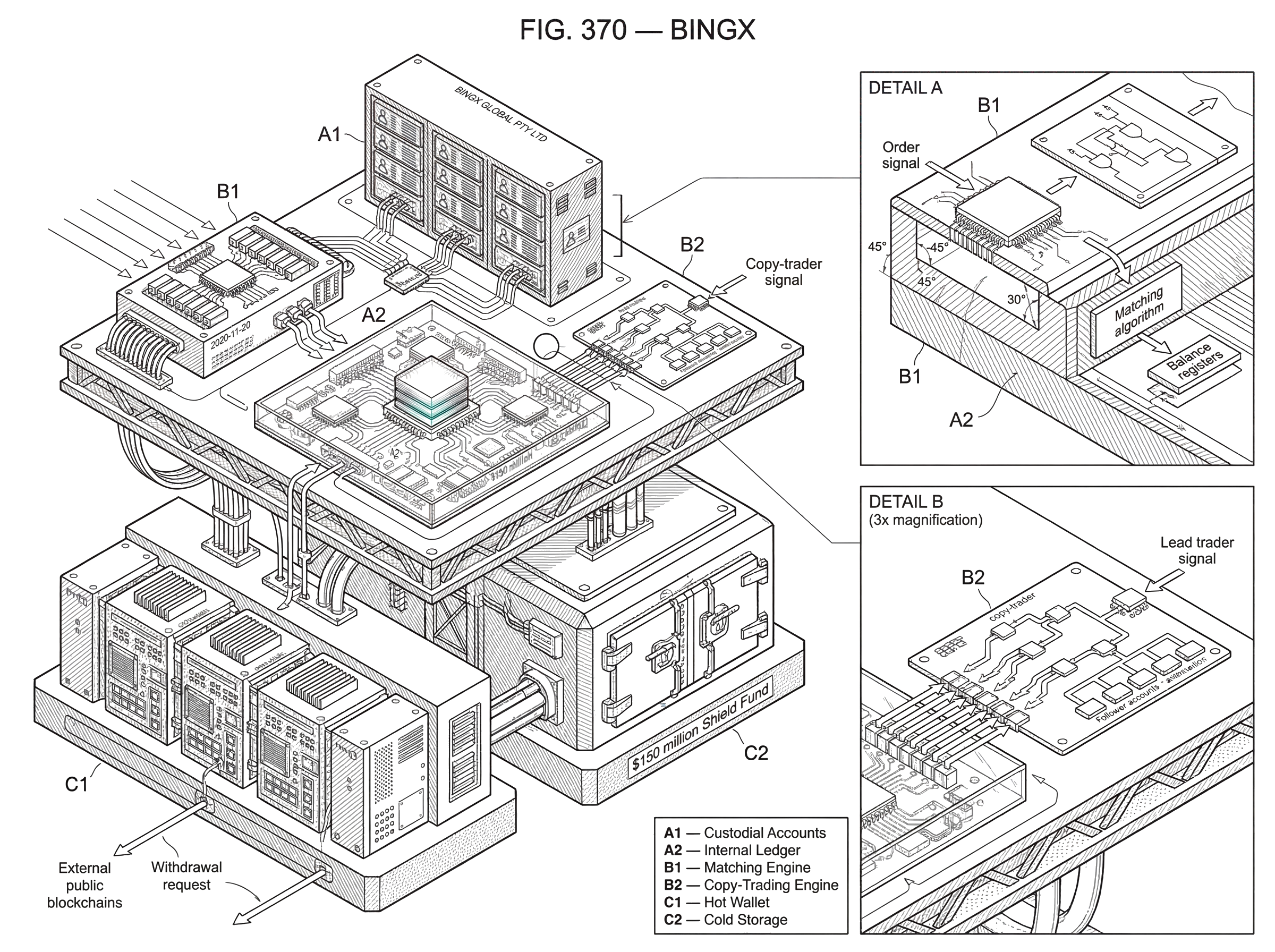
At a high level, BingX does what any centralized exchange does: it holds user assets in custodial accounts, matches buyers and sellers, and provides interfaces for spot and derivatives trading. But that description misses the feature that made the platform distinctive: it treats trading as something users can participate in directly or access indirectly by following other traders. In practice, that means BingX is not just an execution venue. It is also a platform for strategy discovery, especially for users who want exposure to crypto markets without building every trading decision from scratch.
That convenience comes with the core trade-off of any centralized exchange. Users gain a simpler, managed experience, but they also take on counterparty and custody risk because the platform controls the wallets, the trading engine, and the withdrawal process. Understanding BingX starts with that exchange between ease of use and trust.
How does BingX simplify crypto trading?
| Platform | Custody | Settlement | Speed & fees | Best for | Main trade-off |
|---|---|---|---|---|---|
| Centralized exchange (BingX) | Platform controls keys | Internal ledger; blockchain on withdraw | Fast; lower per-trade latency | Active traders; copy trading | Convenience vs counterparty risk |
| On-chain self-custody | User controls keys | On-chain settlement each trade | Slower; gas costs per txn | Sovereign users; long-term holders | Control vs operational complexity |
The simplest way to think about BingX is this: it reduces the distance between a user and a crypto market. If you trade directly on decentralized protocols, you often have to manage wallets, sign transactions, think about gas fees, and interact with separate applications for each activity. A centralized exchange compresses that complexity into an account system. You deposit funds, see balances in an app, and trade through an internal ledger rather than broadcasting every action to a blockchain.
Here is the mechanism. When a user deposits assets to BingX, the platform credits that user’s account internally. From then on, most trading happens inside BingX’s own books. If one user buys and another sells, the exchange updates database entries representing ownership and position changes. Only deposits and withdrawals necessarily touch public blockchains. That is why centralized exchanges can feel faster and cheaper than on-chain trading: they are not waiting for blockchain settlement on every trade.
This structure is especially useful for active traders. Spot trading lets users exchange one asset for another at current market prices or through limit orders. Derivatives trading goes further by letting users take positions on price movement without owning the underlying asset in the same way. That matters for people who want leverage, hedging, or short exposure, all of which are difficult or cumbersome in simpler retail apps.
How does copy trading on BingX work and what does it change?
| Approach | Effort | Control over trades | Risk visibility | Best user |
|---|---|---|---|---|
| Copy trading | Mirror lead traders | Limited per-allocation control | Depends on past performance metrics | Beginners; time-constrained users |
| Self-directed trading | Research and decide trades | Full customization and sizing | Direct, realtime risk management | Experienced traders; builders |
What makes BingX more than a generic exchange is its emphasis on copy trading. The key idea is simple: many users do not want to become full-time market analysts, but they do want to participate in active trading strategies. BingX tries to solve that by letting users allocate funds to mirror the trades of selected lead traders.
This changes the product from a pure market-access tool into a kind of market-access-plus-selection tool. On a standard exchange, the hard question is, “What should I trade?” On BingX, the platform partly reframes the problem as, “Whose strategy do I trust enough to follow?” That does not remove risk. It moves some of the user’s effort away from chart analysis and toward evaluating trader performance, behavior, and consistency.
A concrete example makes the mechanism clearer. Imagine a user who understands bitcoin and ether at a high level but does not know how to trade short-term volatility. On BingX, that user might browse lead traders, inspect their recent results, preferred markets, and risk profile, then choose to allocate part of a balance to copy that trader. When the lead trader opens or closes positions, the follower’s account mirrors those actions according to the allocated amount and platform settings. The follower is not buying a fund share in the traditional sense. The follower is using platform logic to replicate another trader’s moves in their own custodial sub-allocation.
That is useful for beginners and time-constrained users, but it also creates a subtle misunderstanding if you are not careful. Copy trading is not risk removal disguised as convenience. It is delegated decision-making inside a risky market. A skilled trader can go through losing periods, take tail risks that only become obvious later, or behave differently when market conditions change. Historical performance can help screen candidates, but it cannot guarantee future outcomes.
What is the trading workflow and user experience on BingX?
From a user-facing perspective, BingX is trying to combine three layers into one interface: account custody, market access, and strategy tooling. That matters because these layers usually live in different places. A novice might otherwise need one app to buy crypto, another to track markets, and a separate social feed or community to discover trade ideas. BingX brings those functions together so the user can move from observation to execution without switching environments.
The benefit is speed of decision and lower friction. A user can fund an account, browse markets, open a spot or derivatives position, or choose a trader to copy, all from the same dashboard. This is particularly attractive to users who care about responsiveness more than self-custody purity. Traders who operate frequently often value execution flow, chart access, order controls, and portfolio visibility over the extra operational burden of on-chain workflows.
The constraint is that all of this depends on trust in the platform’s internal systems. On-chain systems let users independently verify settlement at the protocol level. A centralized exchange instead asks users to trust that balances are recorded correctly, that withdrawals remain available, and that custody controls are strong enough to protect assets. That dependence becomes most visible not during ordinary trading, but during stress.
What custody and counterparty risks should I consider with BingX?
Because BingX is a centralized exchange, its most important invariant is not a blockchain rule enforced by distributed consensus. It is a business and operational promise: the exchange must remain able and willing to honor customer balances and withdrawals. If that promise fails, the convenience of the platform stops mattering.
This is why discussions around proof of reserves, insurance mechanisms, and operational transparency matter for a platform like BingX. In the supplied source material, BingX pages related to proof of reserves and insurance or shield-fund coverage were not retrievable because they were blocked behind a JavaScript and cookie challenge, so their substantive claims could not be verified here. There are indications that BingX maintains pages for these topics, and an official blog URL indicates a public announcement about a $150 million Shield Fund, but the detailed terms, coverage conditions, and verification methods were not accessible from the available primary materials. That uncertainty is worth stating plainly rather than glossing over.
A user should therefore think about BingX the same way they should think about any custodial exchange: not only in terms of trading features, but in terms of operational resilience. How are assets stored? How much remains in hot wallets versus colder storage? What happens during a withdrawal pause? What evidence is publicly available about reserves and liabilities? These are not peripheral questions. They are part of how a centralized exchange works.
What did the September 2024 hot‑wallet incident reveal about BingX?
| Visibility | Reversibility | Recovery options | Primary risk | Typical outcome |
|---|---|---|---|---|
| Centralized exchange | Limited external visibility | Possibly reversible via operator action | Insurance, treasury compensation, legal remedies | Custody/key compromise; service pauses; potential compensation |
| Decentralized protocol | Full on-chain transparency | Generally irreversible without consensus | Hard forks, governance fixes, no guaranteed payouts | Code/oracle bugs; permanent on-chain losses |
The clearest way to understand centralized-exchange risk is to look at what happens when custody systems are tested. Reputable secondary sources in the material describe a September 2024 hot-wallet incident at BingX, with estimates ranging from roughly $43 million to $52 million in losses. A Beosin security report classifies the event as a private-key compromise and describes abnormal multi-chain outflows from a hot wallet. CoinDesk reported that BingX said trading continued while withdrawals and deposits were temporarily delayed, and that the exchange stated it would compensate customer losses.
Why does this matter for understanding the product rather than just its history? Because a custodial exchange is only as strong as the systems surrounding its wallets, key management, incident response, and liquidity backstops. A decentralized protocol fails differently: the rules are transparent but often irreversible. A centralized exchange can sometimes absorb losses, resume operations, and make users whole; but only if its treasury, controls, and decision-making are strong enough.
So the incident does not merely say something about BingX. It illustrates the structural reality of the category. The same design that makes BingX easier to use than fully on-chain trading also concentrates operational responsibility inside the company. Users who want that convenience are usually accepting that trade knowingly or should be.
Which types of users are best served by BingX?
BingX makes the most sense for users who want crypto trading to feel more guided than raw market access. That includes newer traders who want to learn by observing others, intermediate users who want derivatives and more tactical exposure, and active traders who prefer a centralized dashboard over piecing together on-chain tools. The copy-trading layer is especially appealing to people who are interested in markets but do not want to generate every trade idea independently.
At the same time, BingX is less naturally aligned with users whose top priority is minimizing custodial dependence. If a person wants to hold their own keys, verify everything on-chain, and avoid reliance on an exchange operator, then the core appeal of BingX will not outweigh the model’s compromises. That is not a flaw unique to BingX. It is the basic dividing line between centralized convenience and self-custodied control.
The platform’s corporate footprint is also somewhat clearer from external registry material than from the inaccessible official about page. An authoritative LEI record identifies BINGX GLOBAL PTY LTD in Australia, with ASIC registration authority details and an entity creation date of 2020-11-20. But ownership visibility appears limited in that record because parent information is not provided, with non-disclosure reason listed as NATURAL_PERSONS. That does not by itself imply wrongdoing; it simply means corporate transparency from accessible public materials is incomplete.
Conclusion
BingX is best understood as a centralized crypto exchange built around easier active trading, with copy trading as its defining shortcut. It works by holding assets in custody, running an internal trading system, and letting users either place their own trades or mirror the trades of others.
That combination is useful because it lowers the skill and time required to participate in fast crypto markets. The cost is the usual centralized-exchange bargain: less operational burden for the user, but more trust placed in the platform. If you remember one thing, remember this: BingX is not just a place to trade crypto; it is a place to outsource part of the trading process; while still keeping the risks of a custodial exchange firmly in view.
What should you look for before choosing a crypto exchange?
Before picking an exchange, check custody, execution, fees, and supported workflows and then run a quick side‑by‑side test with Cube Exchange to compare results. Cube’s account and execution flows make it easy to test order types, fills, and withdrawals directly so you can evaluate tradeoffs objectively.
- Check custody and key management: read the exchange’s custody model (hot/cold split, MPC, custodial custody) and note whether it matches Cube’s MPC/non‑custodial signing approach.
- Compare execution and fees: review maker/taker fees, spreads, and available order types (limit, market, stop‑loss, derivatives/leverage limits) and record the numbers to compare against Cube.
- Fund a small test amount on Cube and the competitor using the same funding path (fiat on‑ramp or crypto transfer) and place the same limit order to observe fill speed and slippage.
- Withdraw a small amount from each venue, note on‑chain confirmation times and withdrawal fees, and send a support query to test response time and clarity.
Frequently Asked Questions
When you opt to copy a lead trader on BingX, the platform uses your allocated amount and its internal settings to replicate the lead trader’s open/close actions inside your custodial sub-allocation; followers do not buy a traditional fund share but have their accounts mirror the lead trader’s moves via the exchange’s internal ledger.
Most trades on BingX are internal ledger updates between users on the platform; only deposits and withdrawals necessarily touch public blockchains, which is why the exchange can feel faster and cheaper than on‑chain trading.
No - copy trading delegates decision‑making but does not eliminate market or operational risk; historical performance and past results can help screening but cannot guarantee future outcomes and lead traders can experience drawdowns or change behavior.
Multiple reputable reports on the incident describe a September 2024 hot‑wallet compromise with on‑chain estimates between about $43M and $52M drained; a Beosin security report characterizes it as a private‑key compromise, and CoinDesk reported BingX said trading continued while withdrawals/deposits were temporarily delayed.
Public evidence indicates BingX has pages and a blog post referenced as a $150 million Shield Fund and proof‑of‑reserves materials, but the fetches were blocked by a JavaScript/cookie interstitial so the Merkle roots, attestation dates, auditor statements, and the Shield Fund’s precise terms (coverage, triggers, limits) could not be verified from the retrieved material.
CoinDesk reported that BingX said it would compensate customer losses from the incident, but the available sources do not provide verifiable details about the timetable, mechanism, or which fund(s) would be used, so the scope and enforceability of that commitment remain unclear in the retrieved material.
BingX is best suited to users who want guided, active centralized trading - beginners learning by following others, intermediate users who want derivatives and strategy access, and active traders who prefer a single dashboard; it is less appropriate for users whose top priority is holding their own keys and verifying settlement on‑chain.
Official registry material and LEI records identify BINGX GLOBAL PTY LTD with an entity creation date of 2020‑11‑20 in Australia, but publicly accessible records linked in the research omit parent/beneficial‑owner details (listed as NATURAL_PERSONS) and show some discrepancies (an LEI registration noted as lapsed while entity status is active), so public corporate‑ownership transparency is incomplete in the retrieved sources.
Related reading