What is Aerodrome?
Learn what Aerodrome is, how its Base DEX works, and how veAERO voting, gauges, pools, fees, and emissions direct liquidity onchain.
Introduction
Aerodrome is a decentralized exchange on Base that tries to solve a harder problem than swapping tokens. Any automated market maker can match buyers and sellers. The deeper question is how a chain keeps the right liquidity in the right places over time, without a central operator deciding which pools deserve incentives. Aerodrome’s answer is to combine a familiar AMM with a voting system that lets locked token holders direct emissions toward specific pools.
That design matters because liquidity is not static. New tokens launch, trading demand moves, stablecoin pairs need low slippage, and protocols compete for attention. If incentives are sprayed everywhere, capital gets wasted. If incentives are controlled by a small team, the exchange stops being meaningfully open. Aerodrome sits between those extremes: trading happens through liquidity pools, but the distribution of rewards is governed by onchain votes tied to locked AERO.
At a high level, Aerodrome is a Solidly-inspired AMM system rewritten around pools, gauges, and vote-escrowed NFTs. For a trader, that mostly means routes and prices. For a liquidity provider, it means deciding whether to simply provide liquidity or also stake LP tokens into a gauge to earn emissions. For a protocol building on Base, it means Aerodrome can function as a marketplace for buying liquidity through fees and external incentives rather than through bespoke market-making deals.
How do Aerodrome pools and gauges work together to handle trades and distribute rewards?
| Type | Best for | Curve | Slippage | Complexity | Incentives |
|---|---|---|---|---|---|
| Volatile pool | Unrelated assets | Constant-product | Higher off‑parity | Low | Emissions via gauge |
| Stable pool | Pegged or correlated assets | x^3y + y^3x | Low near parity | Higher rounding complexity | Emissions via gauge |
| Gauge | Directing emissions | N/A | N/A | Low operationally | Receives veAERO votes |
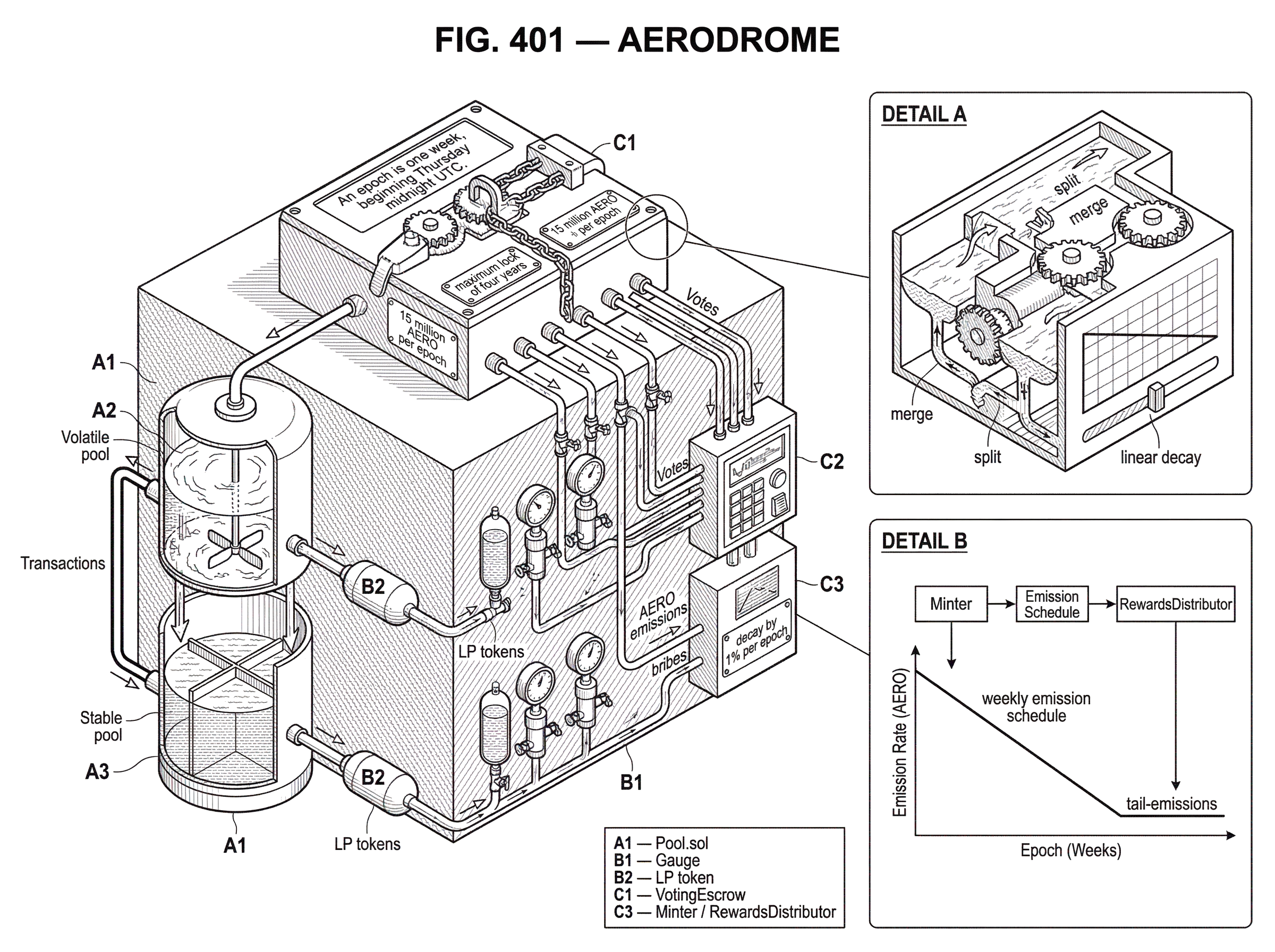
The core trading layer is straightforward. Aerodrome’s Pool.sol is an AMM in the Uniswap V2 style, meaning users trade against pooled reserves rather than against an order book. But Aerodrome does not stop at a single pool shape. It supports both volatile pools and stable pools. Volatile pools behave like the constant-product model traders already know from earlier DEXs. Stable pools use a specialized curve, x^3 y + y^3 x, designed for assets that should trade near parity, such as two dollar-pegged tokens or tightly correlated wrapped assets.
The reason for those two pool types is economic, not cosmetic. A constant-product curve is robust across many prices, which makes it a good default for unrelated assets. But when two assets are expected to stay close in value, that same curve wastes depth around the price users care about most. Aerodrome’s stable curve concentrates useful liquidity near parity, which can reduce slippage for those pairs. The trade-off is that the stable-pool invariant has more rounding complexity than plain constant product, and the specification explicitly notes that integrators should not assume K / totalSupply behaves monotonically in the same clean way it often does in simpler AMMs.
That warning is a good example of how Aerodrome is designed. The user experience can look familiar, but under the hood the protocol is opinionated about where liquidity should be efficient and how incentives should flow. The pool is only the first half of the system. The second half is the gauge attached to a pool.
A gauge is where liquidity provision becomes incentive-bearing. LPs receive LP tokens when they add liquidity to a pool. If they deposit those LP tokens into the pool’s gauge, they become eligible for AERO emissions allocated to that gauge. Those emissions are not fixed by the team. They depend on how much voting weight the gauge receives from locked-token holders. In other words, Aerodrome separates where trading occurs from where new token incentives are sent, then reconnects them through voting.
Why lock AERO into veAERO and how does locking direct liquidity?
| Token form | Voting rights | Fee & bribe share | Transferability | Best for |
|---|---|---|---|---|
| Liquid AERO | No voting | No fees or bribes | Fully transferable | Traders and passive holders |
| veAERO (locked) | Weekly voting power | Earns fees and bribes | ERC‑721 NFT (lock semantics) | Governance and incentive allocators |
The key idea that makes Aerodrome click is this: liquidity incentives are scarce, so the protocol makes them allocatable by vote. That is the reason AERO exists in both liquid and locked forms.
AERO itself is the protocol’s ERC-20 token. It can be traded and held like any other fungible token. But liquid AERO does not directly give governance rights or fee rights. To participate in directing the system, users lock AERO in the VotingEscrow contract and receive veAERO, represented as an ERC-721 NFT. This NFT carries voting power that depends on how much AERO is locked and, in the normal case, how long it remains locked. The specification describes the voting power as linearly decaying over time, with a maximum lock of four years.
This NFT-based design is not just branding. It makes positions more expressive. Aerodrome’s voting escrow supports features like merge, split, managed NFTs, and permanent locks. That means voting power is not merely a wallet balance snapshot; it is an explicit onchain position with its own history and state transitions. For sophisticated users, protocols, and DAO operators, that matters because governance and reward rights can be bundled, reorganized, delegated, or managed with more flexibility than a plain staking balance would allow.
Once users hold veAERO, they can vote on pools each epoch. An epoch is one week, beginning Thursday midnight UTC. The Voter contract handles those votes, the creation of gauges, and the distribution of emissions. Aerodrome’s specification notes that voting is only allowed during a defined window within each epoch, with voting disabled in the first and last hour. That timing discipline exists so the protocol can cleanly roll emissions and accounting forward at epoch boundaries.
The practical consequence is that Aerodrome creates a three-sided market. LPs want emissions. veAERO holders decide where emissions go. Protocols that want deep liquidity for their token pair can try to attract veAERO votes by offering bribes and by making their pools economically attractive. The result is not just “a DEX with rewards.” It is a system where liquidity is continuously repriced through voting.
How does a new token attract and keep liquidity on Aerodrome?
Imagine a new protocol on Base wants strong liquidity for its token against USDC. If it launches on a simple AMM, it can seed a pool, but that does not guarantee durable depth. Traders may appear for a few days and then leave. market makers may demand offchain deals. The protocol has no native way to compete for ongoing liquidity except by improvising incentives.
On Aerodrome, the protocol can create the pool and, if the token is whitelisted and no gauge already exists, a gauge can be created for it. Liquidity providers add assets to the pool and receive LP tokens. Those LPs can then stake their LP tokens into the gauge. At that point, whether the gauge earns meaningful AERO emissions depends on veAERO votes in the coming epoch.
Now the protocol has a lever. It can deposit external incentives into the voting system as bribes, giving veAERO holders a reason to vote for its pool. veAERO holders compare that opportunity against others: which pools generate strong trading fees, which offer attractive bribes, which fit a longer-term view of the ecosystem. They vote accordingly. If enough votes flow to the pool, the gauge receives a larger share of AERO emissions, LPs earn more, and liquidity becomes more attractive to maintain.
Notice what happened. No central operator chose winners. No single incentive schedule was hardcoded forever. Instead, Aerodrome turned liquidity acquisition into an open competition where cost is visible and allocation is updated weekly.
How do Aerodrome emissions and rebases work over time?
| Phase | Weekly emissions | Governance control | Purpose | Trigger |
|---|---|---|---|---|
| Bootstrap | 15M per epoch initially | Team-defined schedule | Aggressive liquidity bootstrap | Early epochs |
| Decay phase | Decays 1% per epoch | Protocol schedule | Gradual incentive tapering | Ongoing decay |
| Tail emissions | Percentage of circulating supply | EpochGovernor adjustable | Sustain long‑term rewards | Emissions < 6M/week |
This voting market only works if there is something valuable to allocate. That is the job of the Minter. In Aerodrome’s specification, emissions begin at 15 million AERO per epoch and decay by 1% per epoch. Once emissions fall below 6 million, the system shifts to a tail-emissions regime where weekly emissions become a percentage of circulating supply, initially 0.003, and that rate can be adjusted within bounded increments by EpochGovernor votes.
You do not need to memorize those numbers to understand the design. The point is that Aerodrome starts with strong bootstrap incentives, then gradually transitions toward a more governed long-run monetary policy. Early on, the protocol can pay aggressively to attract liquidity. Later, it relies more on a steady-state balance among trading fees, bribes, governance value, and controlled inflation.
The Minter does not simply spray tokens at users directly. It distributes emissions to the Voter for gauges and sends rebases to the RewardsDistributor. That matters because Aerodrome is trying to reward two different kinds of contribution at once. LPs provide execution quality for traders. veAERO holders provide capital commitment and governance over where incentives should go. Rebases and fee rights help keep those two constituencies aligned instead of letting one extract value from the other without responsibility.
The permissions documentation makes this concrete: veNFT holders can vote weekly on pools and, by doing so, earn trading fees, bribes, and AERO rebases. That is why many participants are not merely “governance users” in the abstract. They are active allocators of incentive flow, and the protocol pays them for making those allocation decisions.
Who should use Aerodrome: traders, liquidity providers, protocols, or long‑term holders?
For traders, Aerodrome is primarily a venue for swapping assets on Base through volatile and stable pools. The details of gauges and voting mostly matter indirectly, because good incentive allocation tends to produce deeper liquidity and better execution.
For liquidity providers, Aerodrome is more than a passive AMM. The important choice is whether to stay as an unstaked LP or deposit LP tokens into a gauge to earn emissions tied to veAERO voting. That can improve returns, but it also means those returns depend on the ongoing politics and economics of weekly vote allocation.
For protocols and token issuers on Base, Aerodrome is especially useful because it offers a native way to compete for liquidity onchain. Instead of negotiating everything offchain, a project can direct incentives toward its pool and let voters decide whether the offer is attractive enough. That is why DEXs in this family often become a chain’s liquidity hub: they are not only places to trade, but also places to buy market depth in a transparent way.
For long-term token holders, the protocol is designed around locking rather than pure passivity. If someone wants exposure to AERO alone, they can hold the ERC-20. But the system’s strongest rights go to those willing to lock and actively vote. Aerodrome is therefore built more for users who want to participate in liquidity allocation than for users who only want a passive governance badge.
What are Aerodrome’s upgrade paths and centralization or trust risks?
Aerodrome’s specification says the protocol is immutable, while the factories are upgradable. That distinction is subtle but important. Existing deployed core contracts are not meant to be endlessly rewritten in place. Instead, improvements can be introduced by releasing new factory versions for pools, gauges, bribes, or managed rewards, and then users can choose whether to migrate.
This gives the protocol a middle-ground upgrade path. It avoids the strongest form of mutability at the pool level, where users might worry that logic changes beneath them without consent. But it still allows the system’s entry points for new markets to evolve. The trade-off is fragmentation risk: if a better factory version appears, liquidity and activity may need to migrate over time rather than instantly inheriting improvements.
The permissions documentation also shows that Aerodrome has explicit administrative roles, including a protocol team multisig and an emergency council multisig. That does not mean ordinary actions are centrally controlled; core user actions like swapping, providing liquidity, creating normal veNFTs, bribing pools, and triggering epoch emissions are documented as permissionless. But it does mean the protocol should be understood as an onchain system with defined governance and emergency powers, not as a structure with zero human control anywhere.
Conclusion
Aerodrome is best understood as a DEX that turns liquidity into a governed marketplace. Its pools handle swaps in the familiar AMM sense, but its real distinguishing feature is that AERO lockers vote on which pools receive emissions, while collecting fees, bribes, and rebases in return. If you remember one thing, remember this: Aerodrome is not just trying to make trading possible on Base; it is trying to make the allocation of liquidity itself an onchain market.
How do you trade through a DEX or DeFi market more effectively?
Trade through a DEX more effectively by focusing on liquidity depth, pool type, and order execution. On Cube Exchange, fund your account, compare execution options for the pair, and place the trade using the swap/trade flow so you control slippage and order behavior.
- Deposit USDC or the token you plan to trade into your Cube account via the fiat on‑ramp or a direct crypto transfer.
- Open the swap/trade flow for your pair and check which pool type is being routed: prefer a stable pool for dollar‑pegged pairs to reduce slippage and a volatile (constant‑product) pool for unrelated assets.
- Choose an order type and protections: use a limit order for price control or a market order for immediate execution, and set a slippage tolerance (e.g., 0.1% for stable pools, 0.5–1% for volatile pairs).
- Review the estimated fill, fees, and final receive amount, then submit the trade and confirm the on‑chain settlement before using the new balance.
Frequently Asked Questions
Locked AERO holders receive veAERO (an ERC-721 NFT) and vote each epoch via the Voter contract; gauges attached to pools earn AERO emissions in proportion to the votes they receive, and LPs must stake LP tokens into a gauge to become eligible for those emissions.
Volatile pools use a Uniswap V2 style constant-product curve suited for unrelated assets, while stable pools use the x^3 y + y^3 x curve to concentrate liquidity near parity and reduce slippage for tightly correlated or dollar‑pegged pairs; the stable curve trades off extra rounding and invariant complexity, so integrators should not assume simple monotonic relationships like K/totalSupply.
veAERO is an ERC-721 NFT issued by the VotingEscrow when users lock AERO; it encodes voting power that typically decays linearly with remaining lock time (up to a four‑year max) and supports position-level operations like merge, split, managed NFTs, and permanent locks to make governance positions more expressive and composable.
Aerodrome operates on one‑week epochs (starting Thursday midnight UTC) and restricts voting to a defined window within each epoch (voting is disabled during the first and last hour) so the Voter contract can cleanly roll emissions and accounting at epoch boundaries.
Projects can fund external incentives (bribes) that are visible to veAERO holders; veAERO voters weigh trading fees, bribes, and long‑term fundamentals each week, so protocols can use bribes to attract votes and thereby increase the gauge's share of AERO emissions and the pool's liquidity attractiveness.
The Minter initially issues 15 million AERO per epoch and decays emissions by 1% per epoch until weekly emissions fall below 6 million, at which point the system switches to a tail‑emissions regime based on a percentage of circulating supply (initially 0.003) that can be adjusted within bounded increments by EpochGovernor votes.
Core protocol contracts are described as immutable while factories (pool/gauge/bribe factories) are upgradable, creating a migration‑style upgrade path rather than changing deployed core contracts in place; the permissions documentation also lists administrative roles (team multisig, emergency council multisig) and notes some roles will be renounced or transitioned later, but the exact on‑chain owners and upgrade authority details are not fully specified in the repo excerpts.
Integrators should note several implementation caveats: the stable‑pool invariant has rounding/behavioral differences that can break assumptions like monotonic K/totalSupply, multiple writes to voting checkpoints in a single block may overwrite earlier writes, and FactoryRegistry approvals can allow different factory code to be used for new markets - these differences increase integration complexity and migration risk.
The Minter routes new emissions to the Voter for gauge allocation while sending rebases to the RewardsDistributor; veNFT holders who vote can earn trading fees, bribes, and AERO rebases, aligning rewards between LPs (who provide execution quality) and veAERO holders (who allocate incentives).
Related reading