What is Contango?
Learn what contango is, why futures can trade above spot, how cost of carry and convenience yield shape the curve, and why roll yield matters.
Introduction
Contango is the market condition in which futures prices for later delivery are higher than the current spot price, or more generally higher than nearer-dated futures prices. That sounds like a narrow definition, but it matters because it changes what it costs to hold exposure through time. A trader who keeps rolling a futures position forward in contango is usually paying to maintain that exposure, while a hedger or inventory holder is reading something about storage, financing, and the value of having the physical good now rather than later.
The puzzle is that many people first meet futures through a simple intuition: if the market expects prices to rise, futures should be above spot. Sometimes that is directionally useful, but it is not the core mechanism. In many markets, especially physically delivered commodity markets, futures can sit above spot not because the market is broadly bullish, but because carrying the commodity across time is costly. Storage costs money. Insurance costs money. Financing inventory ties up capital. Those costs have to show up somewhere, and one place they appear is the futures curve.
That is the idea that makes contango click: contango is often the price of time and carry, not merely the market's optimism. Once you see that, several consequences follow. You can understand why some commodities are often in contango, why low inventory can flip the curve into backwardation, why futures and spot must converge as expiry approaches, and why a fund that holds futures can lose money from rolling even if the spot commodity does not collapse.
What does an upward‑sloping futures curve (contango) look like?
| State | Curve shape | Price relation | Signals | Who benefits |
|---|---|---|---|---|
| Contango | Upward sloping | Later above near | Carry costs dominate | Inventory holders, storers |
| Backwardation | Downward sloping | Later below near | High convenience yield | Users needing immediate supply |
At the simplest level, a market is in contango when later delivery months trade above the nearby month or above spot. The CFTC glossary gives the canonical market definition: prices in succeeding delivery months are progressively higher than the nearest delivery month. CME's educational material states the same idea in spot-versus-futures language: the forward price of the futures contract is higher than the spot price. In picture form, that means an upward-sloping forward curve.
The curve matters because futures are promises about when delivery or settlement happens. A June crude oil contract and a September crude oil contract are not the same claim. The September contract gives you exposure to oil at a later date, and that later date changes the economics. If holding physical oil until September costs money, then September futures can rationally trade above the current cash price.
This is why the term structure of futures prices is more informative than a single quoted futures price. Contango is not just "futures above spot" in isolation. It is a statement about prices across maturities. When each successive maturity is more expensive than the one before it, the market is pricing a positive cost to carry exposure forward.
That also explains why contango is the opposite of backwardation. In backwardation, later futures are below spot or below the nearby contract. The difference is not cosmetic. It means the economics of time have reversed: instead of paying to defer ownership, the market is assigning extra value to having the commodity available now.
Why are futures prices sometimes higher than spot? (cost of carry explained)
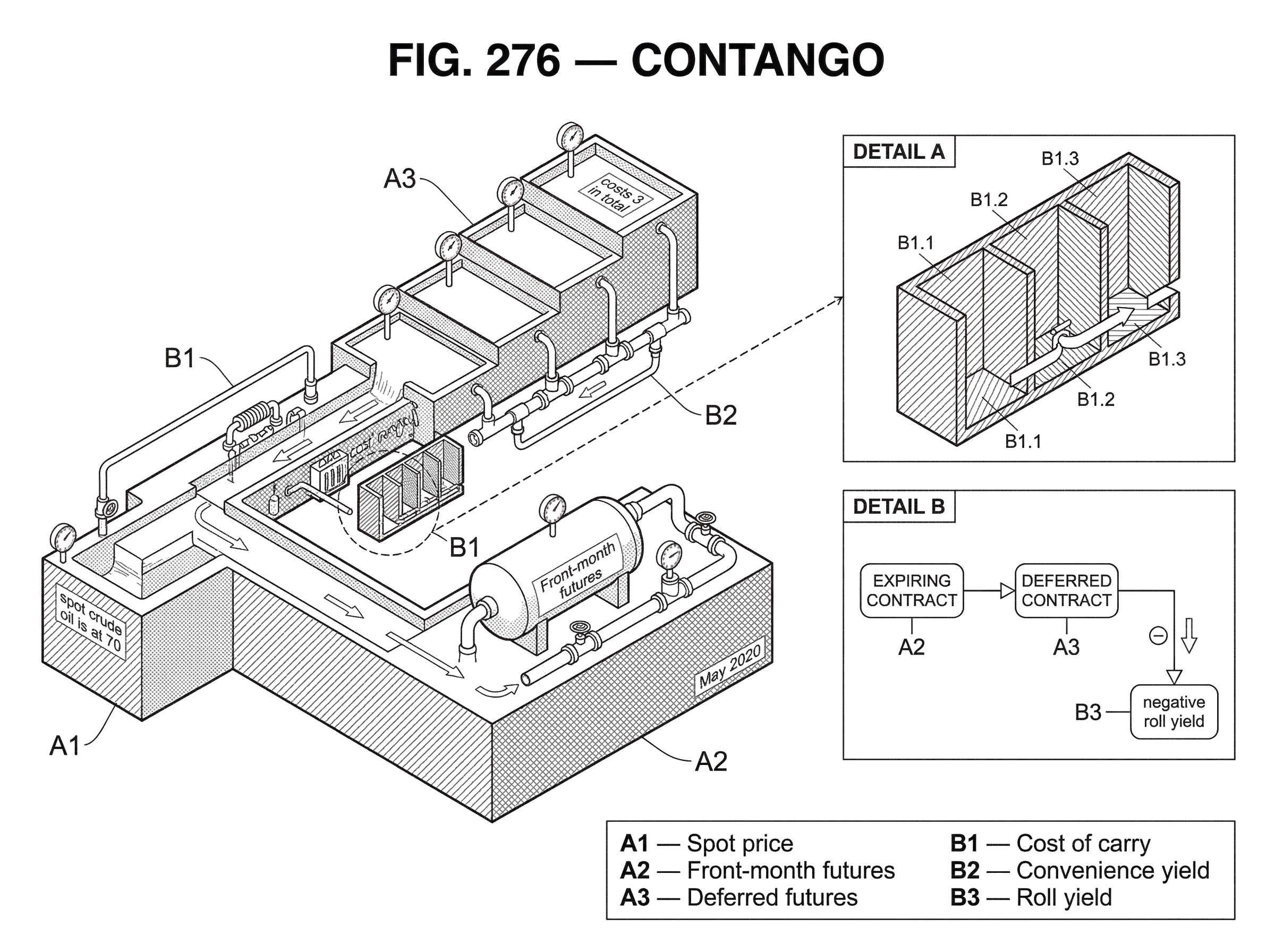
The most grounded explanation for contango in physically delivered markets is the cost of carry. If you buy a physical commodity today and plan to hold it for later use or delivery, you usually incur several costs along the way. CME's explainer highlights storage, financing, and insurance. The CFTC glossary uses similar language under carrying charges, describing insurance, storage, interest, and other incidental costs.
Here is the mechanism. Suppose you buy copper, crude oil, or grain today in the spot market. You now need somewhere to keep it. You may need to insure it. And because you had to pay cash for the inventory, you either gave up the use of that cash or borrowed funds to finance the position. If the market is functioning normally, a later-dated futures contract should reflect those carrying costs. Otherwise there would be an opening for arbitrage.
A concrete example makes this less abstract. Imagine spot crude oil is at 70. If storing, insuring, and financing one barrel for several months costs 3 in total, then a later futures price around 73 is not mysterious. It is the market's way of saying: owning oil for future delivery is more expensive than owning it today and immediately consuming or selling it. If the futures price were far below that carry-adjusted level, a trader with storage access could buy spot oil, store it, and sell the futures contract against it. If the futures price were far above it, the reverse set of trades would attract capital where possible. The curve is therefore constrained by the economics of storage and funding, not set by opinion alone.
This is why contango often appears in markets where physical storage is feasible and meaningful. The farther out the contract, the more time there is to pay those carrying costs. So an upward slope can emerge naturally even when nobody has a dramatic view about rising spot prices.
When and why can contango flip into backwardation?
If carry costs were the whole story, many commodity curves would always slope upward. They do not. Markets can move from contango into backwardation, sometimes quickly. CME explicitly notes that the forward curve can move between the two states as participants change their views of the future spot price.
The reason is that carrying costs are only one side of the balance. The other side is the value of having the physical commodity in hand right now. In commodity theory this is called the convenience yield: an implied return on inventory. It is not a cash coupon you literally receive. It is the operational and strategic benefit of physical possession.
That benefit can be very real. A steel producer may value ore inventory because it keeps the mill running. A refiner may value crude because it protects throughput. A grain processor may value nearby inventory because supply disruptions are costly. When inventories are abundant, that benefit is usually small; if one warehouse lot is unavailable, another may be easy to find. But when inventories are tight, the benefit of immediate access rises sharply.
CME's explainer states a particularly useful rule: convenience yield is inversely related to inventory levels. High stocks imply a low convenience yield. Low stocks imply a high convenience yield. This gives you a practical way to think about curve shape. High inventories tend to favor contango because physical ownership is not especially precious and carry costs dominate. Low inventories tend to favor backwardation because immediate ownership becomes valuable enough to outweigh some or all of those carrying costs.
So the shape of the curve is really a balance between two forces. On one side are storage, financing, and insurance; the costs of carrying inventory. On the other side is convenience yield; the benefit of having inventory available now. Contango appears when carrying costs dominate. Backwardation appears when the benefit of immediate ownership dominates.
Why must futures prices converge to spot as expiry approaches?
A futures curve can be upward sloping for months, but it cannot stay detached from spot all the way to expiry. As the contract approaches maturity, the futures price must converge to the spot price. CME states this directly: otherwise an arbitrage opportunity would exist.
This convergence is one of the most important invariants in futures markets. A futures contract nearing expiration is no longer a vague promise about a distant date. It is becoming a claim on very near settlement or delivery. The time component that justified carry costs is shrinking. There is less storage time left, less financing time left, less uncertainty about what "future delivery" means. As that time value disappears, so does the wedge between futures and spot.
You can think of contango as partly a price for waiting. If there is almost no waiting left, there is almost no reason for that part of the premium to remain. The futures price therefore gets pulled toward spot as expiry nears.
This is also why rolling matters so much. If you hold a futures position and do not want delivery or final settlement, you sell the near contract and buy a later one before expiry. In contango, that usually means selling the cheaper near contract and buying the more expensive deferred contract. Repeating that process month after month can generate a persistent drag on returns, because each new contract you buy starts above the level toward which it will eventually converge.
How does contango create negative roll yield for long futures investors?
| Curve state | Roll yield (long) | Investor effect | Common cause | Practical outcome |
|---|---|---|---|---|
| Contango | Negative | Ongoing drag on returns | Deferred contracts pricier | Headwind to long rollers |
| Backwardation | Positive | Roll adds to returns | High convenience yield | Tailwind to long rollers |
For many traders and investors, the most important consequence of contango is not the definition but the return impact from rolling. A curve shape becomes economically significant when you have to replace expiring exposure with later-dated exposure.
CFTC staff research formalizes this through roll yield. In plain language, roll yield reflects the price difference between the contract you are exiting and the one you are entering. When the maturing contract trades below the deferred one, the market is in contango and roll yield is negative for a long investor who must roll forward. When the maturing contract trades above the deferred one, the market is in backwardation and roll yield is positive.
The intuition is straightforward. Suppose you are long the front-month futures contract because you want ongoing exposure to oil prices. As the contract nears expiry, you must sell it and buy the next month. If the next month is more expensive, you are paying up just to keep the same directional exposure. Nothing dramatic had to happen to spot prices for that to hurt. The loss comes from the structure of the curve.
This is why futures-based products can behave very differently from spot. Bloomberg's commodity index methodology warns explicitly that contango can create negative roll yields that materially reduce index value even if spot prices are stable or rising. That warning is not a technicality. It is the mechanical consequence of repeatedly buying higher-priced deferred contracts in an upward-sloping market.
A practical example is the United States Oil Fund, or USO. Its disclosures explain that contango and backwardation can materially affect returns relative to a hypothetical direct investment in crude oil, and that the fund rolls from the near-month contract into the next month over a scheduled roll period. The key point is not fund-specific. Any strategy that keeps renewing front-end futures exposure inherits the economics of the curve. In contango, that often means a headwind.
Example: How a long futures position loses money even when spot is flat
| Holder type | Exposure mechanics | If spot flat + contango | Main cost |
|---|---|---|---|
| Spot holder | Owns physical now | Roughly break-even (ignores storage) | Storage and financing |
| Long futures roller | Sell front, buy deferred each roll | Loses from negative roll yield | Paying premium on each roll |
Consider a simplified market where spot oil stays around 70 for several months. At first glance, you might think a long oil futures investor should roughly break even if the spot commodity goes nowhere. But if the market is in contango, that intuition fails.
Suppose the front-month futures contract is 70 as it nears settlement, while the next-month contract is 72. A fund that wants to maintain exposure sells the 70 contract and buys the 72 contract. Time passes. As the new contract moves toward expiry, it tends to converge toward spot, which is still around 70. Absent some offsetting rise in the underlying market, the 72 contract drifts down toward 70. Then the fund rolls again, selling near 70 and buying the next deferred contract at 72.
Notice what is happening. The investor is not primarily losing because oil spot is crashing. The investor is losing because each month they buy a contract that starts above the level toward which it is pulled by convergence. The curve itself is extracting value from the rolling strategy.
This is the cleanest way to understand why "commodity went sideways" and "commodity ETF lost money" can both be true. The missing variable is not hidden leverage or fraud. It is negative roll yield from contango.
How storage and delivery bottlenecks can trigger extreme contango (WTI 2020 case)
In normal conditions, contango can be modest and economically intuitive. In stressed conditions, it can become extreme because storage and delivery are not abstract textbook ideas; they are physical constraints.
The WTI crude oil market provides the clearest example. CME's discussion of the Cushing delivery hub explains that WTI futures reflect physical crude fundamentals and tend to increase in contango when global supply outstrips demand. The mechanism is concrete: excess barrels get redirected into storage, inventories build, and the economics of nearby delivery weaken relative to later delivery. Because WTI is physically deliverable, the futures market is directly linked to whether oil can actually be stored and moved through the relevant logistics network.
The 2020 negative WTI episode showed this in an extreme form. Research from MIT Sloan analyzing the event argues that speculators exiting positions alone could not explain negative prices; storage and delivery constraints were necessary. The May 2020 WTI contract was approaching expiry, Cushing inventories were high, and market participants without the ability to take delivery had to get out. In that environment, near-term oil was not simply a cheap asset. It could become a liability if taking delivery meant obtaining barrels you had nowhere practical to put.
That episode is often remembered for the headline of negative prices, but the deeper lesson for contango is about capacity. If storage becomes scarce or operationally difficult, the cost of carrying excess supply through time can explode. The front of the curve can collapse relative to later months because the market is trying to price the burden of immediate physical ownership. Extreme contango is what happens when the ordinary economics of carry meet hard logistical limits.
Does contango appear outside commodities (for example, in volatility futures)?
Contango is most intuitive in physical commodities, but the basic idea extends beyond them: later-dated futures can trade above near-dated ones in many markets. The mechanism, however, may differ.
In volatility markets, for example, there is no warehouse full of VIX to store. Yet Cboe's term-structure materials show that VIX futures represent the market's estimate of the VIX index at future expiration dates, and traders watch that curve closely. Here contango still means deferred futures trading above near-term ones, but the reason is not storage cost. It is the term structure of expected future volatility implied by options markets.
That distinction matters because the label "contango" names a shape, not a single universal cause. In crude oil, storage and delivery logistics may dominate. In precious metals, financing and storage may matter a great deal over long periods. In volatility futures, expected mean reversion and the pricing of future uncertainty matter more than warehouse economics. The common thread is just this: prices for later dates are above prices for earlier dates. The causal story depends on the asset.
How do index roll schedules and big traders amplify contango's impact?
There is another layer that matters in practice: even if contango begins with economic fundamentals, market structure can amplify its effects for investors.
CFTC staff research on commodity index rolling shows how a fixed, predictable roll schedule can create temporary price pressure. The study examines the well-known monthly roll in commodity indices and finds that mechanically selling the maturing contract and buying the deferred contract can depress the former and elevate the latter during the roll window. That reduces roll yield for investors following the index and can create opportunities for more nimble traders.
The mechanism is not mysterious. If everyone knows a large benchmark will need to move size from one contract to the next on specific days, other traders can anticipate that demand. The roll then becomes not just a passive maintenance operation but a tradable event. In a contango market, this can make an already negative roll experience even worse for benchmarked long investors.
This is one reason commodity indices and exchange-traded products often devote so much design effort to roll methodology. A fixed front-month roll is simple and transparent, but it also makes the investor highly exposed to the front-end curve and to the impact of crowded rolling activity. Different methodologies try to spread rolls over time or choose different maturities, but none of them repeal the underlying economics. If the curve is upward sloping enough, contango still imposes a cost.
Common misconceptions about contango and what actually matters
A common misunderstanding is to treat contango as a pure forecast that spot prices will rise. Expectations do matter, and CME notes that curve shape can change as market participants revise views of future spot prices. But in many physically delivered markets, contango is better understood first as a carry relationship. It often says more about storage, financing, inventory, and delivery conditions than about a simple directional bet on rising prices.
Another misunderstanding is to think contango is automatically bad or automatically bearish. It is neither. For a physical holder with inventory and storage capacity, contango can reflect compensation for carrying stocks. For a hedger, it may be part of a normal commercial environment. For a long-only rolling investor, it is often a drag. The same curve can be costly for one participant and economically rational for another.
A third mistake is to forget convergence. People sometimes look at a high deferred futures price and assume it can remain permanently disconnected from spot. It cannot if the contract is approaching settlement under an arbitrageable market structure. The entire futures market depends on the fact that, at maturity, futures and spot are tied together.
Conclusion
Contango is the condition where later-dated futures trade above spot or above nearer-dated futures. The durable way to understand it is not as a market mood but as the economics of carrying exposure through time. Storage, insurance, and financing push futures upward; the convenience of having the physical commodity now pushes the other way; and the balance between those forces shapes the curve.
The practical consequence is easy to remember: in contango, time usually costs the long roller money. Futures still converge to spot as expiry approaches, but if you keep replacing cheap near contracts with more expensive deferred ones, the curve itself can become a source of loss. That is why contango matters so much in commodities, in futures-based funds, and in any strategy that lives not just on price direction, but on the structure of time.
How do you start trading crypto derivatives more carefully?
Trade crypto derivatives cautiously by sizing positions, choosing an appropriate margin mode, and using explicit stop/liquidation controls. On Cube Exchange you can fund your account, pick the market and margin mode, and place orders with leverage while configuring stops and reduce-only flags to limit forced liquidations.
- Fund your Cube account with stablecoin or crypto and move the amount you intend to risk into the derivatives margin balance.
- Select the contract and set margin mode (isolated for size-limited positions or cross for portfolio margin). Pick conservative leverage (for example ≤3x) before opening a trade.
- Choose an order type that fits execution: use a limit or post-only order to control entry price and reduce slippage, or a market order if you must enter immediately.
- Set explicit risk controls: add a stop-loss and a take-profit, enable reduce-only on entries, and check the displayed liquidation price and maintenance margin before confirming.
Frequently Asked Questions
Contango commonly arises from positive carrying costs: storage, insurance and the financing cost of tying up capital make holding the physical good until a later date more expensive, so later-dated futures trade above spot to reflect those costs.
If you continuously roll a long futures position forward in an upward‑sloping curve you typically sell the cheaper near contract and buy a more expensive deferred contract, producing a negative roll yield that can make a long futures strategy lose money even when spot is flat.
Convenience yield is the non‑cash benefit of having the physical commodity now (operational reliability, avoiding shortages), and when convenience yield rises (usually because inventories are low) it can outweigh carrying costs and flip the curve from contango into backwardation.
Contango can become extreme when physical storage or delivery capacity is strained: if taking delivery is hard or costly (or storage is near full) the price to defer ownership can spike, as illustrated by Cushing storage dynamics and the May 2020 WTI episode where delivery constraints played a central role.
No - as a futures contract approaches expiry its price must converge to the spot price because the time remaining to carry inventory or pay financing costs disappears, and persistent divergence would create arbitrage opportunities.
Large, predictable index rolls can amplify contango’s effect by concentrating selling of the front contract and buying of the deferred contract during roll windows, which depresses the front month and elevates the deferred month and further erodes roll yield for passive investors.
Yes - when futures appear mispriced relative to the cost of carry a trader with storage and financing access can buy spot and sell futures (or reverse the trade if futures are very high), but practical limits like storage capacity, transaction costs and delivery logistics often constrain or delay such arbitrage.
The term 'contango' names a forward‑curve shape (later > near) and applies outside commodities too - for example VIX futures can trade in contango, but the causal drivers differ (storage costs in commodities versus expected future volatility and option pricing mechanics in volatility futures).
Common mitigations include using longer-dated contracts or staggered/continuous roll schedules instead of fixed monthly front‑month rolls, and designing index rules that spread roll pressure over time, but these measures can reduce (not eliminate) roll costs and may shift exposures or liquidity risks.
Contango neither guarantees a bearish outlook nor is it uniformly "bad": it often compensates physical holders for carrying inventory and can be rational for hedgers, while it represents a cost mainly to rolling long-only investors who lack storage or commercial use for the commodity.
Related reading