What Is Backwardation?
Learn what backwardation is, why futures curves invert, how convenience yield and inventory drive it, and what it means for roll yield and trading.
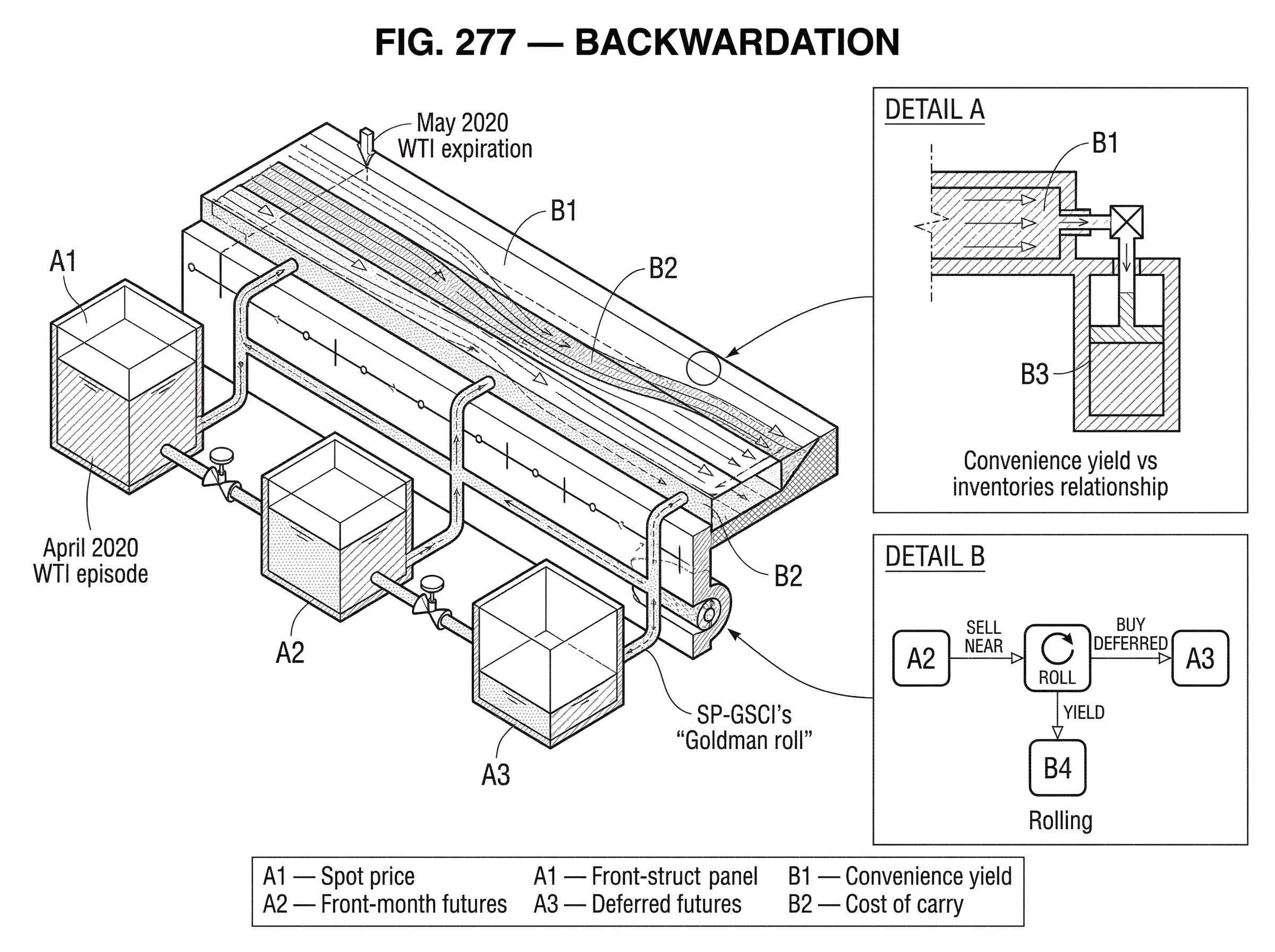
Introduction
Backwardation is a condition in futures markets where nearer prices are higher than later ones, or where a futures price sits below the current spot price. That sounds like a small geometric fact about a price curve, but it changes the economics of trading, hedging, storage, and rolling positions. A market in backwardation is not just “sloping down.” It is usually telling you that time itself has become expensive: having the commodity now, or soon, is worth more than having it later.
That is why backwardation shows up so often in discussions of oil squeezes, low inventories, and commodity index returns. The same futures contract can feel cheap or expensive depending on where it sits on the curve and how that curve is expected to move as expiration approaches. If you do not understand backwardation, it is easy to confuse spot scarcity with bullishness, or to mistake roll yield for a free return. The important question is not just what shape the curve has, but what mechanism could make that shape rational.
What does backwardation say about the price of time in futures markets?
| Feature | Backwardation | Contango |
|---|---|---|
| Curve shape | Near > Deferred | Near < Deferred |
| Spot relation | Futures < Spot | Futures > Spot |
| Inventory signal | Low inventories | High inventories |
| Dominant force | Convenience yield | Cost of carry |
| Roll yield | Typically positive | Typically negative |
A futures market quotes prices for delivery at different dates. If the May contract trades above June, and June above July, the curve slopes downward through time. CME’s glossary describes backwardation as a market situation in which futures prices are lower in succeeding delivery months; in market commentary this is also called an inverted market. CME’s educational material gives the spot comparison directly: a market is in backwardation when the forward or futures price is lower than spot.
Those are closely related but not identical ways of speaking. Traders often move between them without saying so. One way compares a given futures contract with today’s spot price. The other compares one futures month with another. In many practical commodity settings, both descriptions line up: the nearby contract is rich relative to deferred contracts, and the front of the curve may also sit below spot in a way that reflects the value of immediate physical ownership.
The compression point is this: backwardation appears when the benefit of having the asset sooner outweighs the normal costs of waiting. Under ordinary conditions, carrying a physical commodity forward costs money. You may have to finance inventory, insure it, and store it. Those are real costs. If all that mattered were carrying cost, later delivery would often be more expensive than immediate delivery, which is the contango case. Backwardation means something is strong enough to offset or exceed those costs.
Why can a futures contract trade below the current spot price?
At first glance, backwardation looks strange. Why should a promise to deliver later be cheaper than owning the thing today? Shouldn’t delay usually add cost rather than subtract it?
For many physical commodities, the answer is that ownership provides a non-cash operational benefit. CME’s educational explanation calls this the convenience yield: the implied return or benefit from holding physical inventory. If you are a refiner, manufacturer, or merchant and inventory keeps your process running, the value of that inventory is not just its resale price. It is the avoided shutdown, the ability to meet customer orders, the flexibility to respond to disruptions, and the simple fact that a production line with feedstock is worth more than a production line waiting for a truck.
That is why backwardation is easiest to understand in physically delivered commodities. Storage and financing push later prices upward; convenience yield pulls nearby ownership upward relative to later delivery. When inventories are ample, the convenience of an extra unit is small, and carry costs dominate. When inventories are tight, the convenience of immediate ownership becomes large, and the front of the curve can rise relative to the back. CME explicitly notes that convenience yield is inversely related to inventories: high stocks imply low convenience yield, while low stocks imply high convenience yield.
This is the mechanism. Not sentiment first, not chart shape first, but a competition between two forces: cost of carry versus benefit of possession. Backwardation is what you see when the second force wins.
How can storage constraints make the oil futures curve invert?
Imagine a crude oil market in which refiners need barrels now and storage at the delivery hub is becoming scarce. A trader who owns physical crude in the right place has something more useful than a paper claim on oil months from now. That oil can keep refinery operations supplied, satisfy immediate contractual obligations, or prevent costly disruptions. In that environment, the nearby barrel acquires extra value precisely because it solves an urgent coordination problem.
Now compare that physical barrel with a futures contract for delivery several months later. The deferred contract may still reflect expectations that supply will normalize, or simply the fact that later delivery does not solve today’s bottleneck. So the nearby contract can trade above the later one. The curve is backwardated because the market is putting a premium on immediacy.
The logic became especially vivid in U.S. crude markets during periods of extreme stress. CME describes NYMEX WTI as a physically settled contract closely connected to the spot market. That physical linkage matters. If delivery logistics, storage constraints, or local inventories become binding, the front-month contract can behave very differently from later months. The famous April 2020 WTI episode is often remembered for negative prices, but it also illustrated a deeper point: futures curves are not abstract lines. They are shaped by actual delivery obligations, actual storage, and actual time pressure.
The CFTC’s interim staff report on the May 2020 WTI expiration describes a market hit by an unprecedented demand shock, oversupply, and growing concern about storage availability at Cushing. By the time the expiring contract collapsed, most volume had already moved to later months. That is useful for understanding backwardation more generally. The front month is where physical urgency is most concentrated. Later months can trade on a different balance of expectations, financing conditions, and storage assumptions. When those balances diverge, the term structure bends sharply.
What is convergence and why must futures meet spot at expiration?
A key fact anchors all of this: futures prices converge to spot as the contract approaches maturity. CME states this directly. If convergence did not happen, there would be an arbitrage opportunity. This is one of the most important invariants in the entire topic.
Why does convergence matter so much? Because backwardation is not only a shape at a single moment. It is also a statement about how prices are expected to evolve as time passes. If a futures contract is below today’s spot price and must meet spot at expiry, then part of the contract’s path may involve rising toward spot, all else equal. If a later contract is below a nearby one and you keep rolling a long position from the expensive nearby month into the cheaper deferred month, you may pick up what traders call positive roll yield.
That idea needs care. A CFTC study on commodity index rolling defines roll yield in terms of the price difference between the maturing contract and the deferred contract. In backwardation, the maturing contract is more expensive than the deferred one, so roll yield is positive. Mechanically, if you sell the richer near contract and buy the cheaper next contract as part of a roll, that relative price structure works in your favor.
But this does not mean backwardation is a free lunch. The curve can change. The nearby premium can disappear before you roll. Spot can fall sharply. What you observe today is a pricing relationship, not a guaranteed profit stream. The convergence principle explains why roll yield exists as a concept; it does not eliminate market risk.
How does backwardation affect roll yield and commodity index performance?
| Participant | Typical action | Effect in backwardation | Main risk |
|---|---|---|---|
| Hedger | Lock in futures | Pays higher near-term | Spot falls before expiry |
| Speculator | Trade calendar spreads | Capture roll yield | Curve flips to contango |
| Index investor | Mechanically roll | Benefit from positive roll | Market impact reduces yield |
Backwardation matters in practice because many futures investors do not take delivery. They hold exposure by repeatedly moving from an expiring contract into a later one. That process is called rolling. In a backwardated market, the investor typically sells the near contract at a higher price and buys the next contract at a lower price. That is the opposite of the drag investors experience in contango.
This is why commodity commentary often speaks of backwardation as favorable for long-only futures exposure. Research cited in the evidence base makes the point empirically. The CFTC study of commodity-index rolling notes that historically roll yield has often been a major component of commodity futures excess returns, and that backwardation corresponds to positive roll yield. Gorton and Rouwenhorst likewise emphasize that the basis contains information about expected returns, while also warning that the basis itself is not some magical source of return independent of risk.
Here is the mechanism in ordinary language. Suppose an index is long the front-month contract and must roll before expiration. If the market is backwardated, the contract it sells is richer than the contract it buys next. That improves the economics of maintaining exposure. If instead the market is in contango, the index sells the cheaper contract and buys the more expensive one, which creates a headwind.
This becomes especially important when rolling is mechanical and predictable. The CFTC study on the SP-GSCI’s “Goldman roll” shows that large, scheduled rolling activity can itself move spreads. Heavy selling in the maturing contract and buying in the deferred contract can compress the spread and reduce the roll yield available to index investors. The broader lesson is subtle but important: backwardation creates the possibility of positive roll yield, but realized roll outcomes depend on market impact, liquidity, and timing.
What’s the difference between market backwardation and 'normal backwardation' theory?
| Aspect | Market practice | Normal backwardation |
|---|---|---|
| Definition | Spot > Futures (basis) | Futures < E[future spot] |
| Comparison base | Today’s spot | Expected future spot |
| Return implication | Positive roll possible | Longs earn risk premium (theory) |
| Primary use | Describes curve shape | Explains expected returns |
A smart reader can easily trip over terminology here. In market practice, backwardation usually refers to the observable price relationship: spot above futures, or nearby futures above deferred futures. But in older theory, especially in Keynes and Hicks, normal backwardation means something more specific: futures prices lie below the expected future spot price, so long futures positions earn a risk premium on average.
That distinction matters because the two ideas can point in different directions. Gorton and Rouwenhorst stress this clearly. The ordinary basis is about today’s spot versus today’s futures price. Normal backwardation is about today’s futures price versus the market’s expectation of future spot. Those are not the same comparison.
Why was the theoretical idea introduced? Because producers often want to hedge by selling futures. Speculators take the other side by buying. If speculators are providing insurance, they may require compensation for bearing price risk. In that theory, futures are set below expected future spot so that long speculators earn a premium on average.
This can help explain average returns in some markets, but it should not be confused with the visual shape of the curve. A market can look backwardated in the trading sense without telling you everything about expected returns. And a market can offer a risk premium for reasons that are not fully visible from a simple nearby-versus-deferred comparison. The fundamental lesson is that observable curve shape and expected return are related, but not identical.
How do inventory levels drive backwardation and convenience yield?
If there is one variable that repeatedly governs backwardation in commodities, it is inventory. Not inventory in the abstract, but inventory in the right form, right place, and right time.
CME’s educational material makes the inventory link explicit: convenience yield is inversely related to inventory levels. This is intuitive once you stop thinking of inventory as a stockpile and start thinking of it as a buffer against operational failure. If warehouses are full, the next unit adds little flexibility. If stocks are low, the next unit can be crucial. The value of possession rises nonlinearly when the system is close to constraint.
That is why backwardation often intensifies during supply disruptions, seasonal tightness, transportation bottlenecks, or sudden demand surges. The curve is not merely forecasting higher or lower prices. It is allocating scarcity across time. A steeply backwardated curve says, in effect, that the market places a high value on near-term supply relative to future supply.
The analogy to think of is a hospital’s supply room. If there is a large surplus of routine materials, one additional unit is not especially valuable. If supplies are almost exhausted, the next unit has outsized importance because it prevents failure of the whole process. That analogy helps explain convenience yield. Where it fails is that commodity markets also involve financing, arbitrage, transport, and tradable contracts, not just operational urgency. So it is a useful picture, not a complete model.
How should hedgers and traders adjust when a market is in backwardation?
For a hedger, backwardation changes the cost and timing of protection. A producer selling forward into a backwardated curve is locking in lower prices in later months than in the nearby market. A consumer hedging near-term needs may face a front month that is expensive relative to later delivery because immediate supply is scarce. The shape of the curve therefore affects not just directional views, but which maturity is economically sensible.
For speculative traders, backwardation matters because calendar spreads become central. A calendar spread is the price difference between two futures expirations in the same contract. If the market is backwardated, nearby-versus-deferred spreads are often positive in the sense that the front month trades above the next month. Traders may express views not on outright price, but on whether tightness will deepen or ease. If inventories rebuild, backwardation can flatten or flip into contango. If supply stress worsens, the inversion can become steeper.
For investors using futures as portfolio exposure, backwardation changes tracking behavior. CME’s WTI product materials even market the idea of avoiding “roll slippage” that affects some oil ETFs near the futures roll. The reason this language resonates is simple: the term structure directly affects what it costs to maintain exposure over time. In a backwardated market, rolling can help rather than hurt. In a contangoed market, the opposite is often true.
When does the backwardation explanation fail or need extra context?
The cleanest explanations of backwardation come from physically delivered commodities, but not every futures market works the same way. The evidence base here is strongest on commodity futures, especially those with physical delivery and clear storage economics. We should be careful not to pretend that convenience yield explains every case equally well across all contracts.
Even in commodities, backwardation does not automatically mean “bullish” in a simple directional sense. It can reflect present scarcity while the market still expects weaker conditions later. And because futures converge to spot at maturity, the return from holding a contract depends on how spot, spreads, and expectations change; not just on the curve shape you observe today.
It is also possible to overread roll yield. A positive roll yield is a mechanical implication of rolling through a backwardated curve, but actual investor experience depends on transaction costs, market impact, liquidity conditions, and whether the curve remains backwardated. The CFTC’s study of index rolling is a strong reminder that public, mechanical roll schedules can attract front-running and compress the very yield investors hope to capture.
Finally, backwardation is a description of relative prices, not a complete causal theory. Inventory tightness, convenience yield, hedging pressure, and expected future supply all matter, and their importance can vary by market and episode. The curve is evidence. It is not by itself the full explanation.
How do you read a backwardated market in three practical questions?
When you see backwardation, ask three questions.
First, what is scarce right now? In commodities, low inventory or delivery bottlenecks are often the starting point. If near-term physical access is unusually valuable, a nearby premium makes sense.
Second, what is the balance between carry cost and possession benefit? Storage, insurance, and financing push later prices up. Convenience yield pulls nearby prices up. Backwardation tells you the second force is dominating.
Third, who has to roll, hedge, or deliver? A curve is not just fundamentals; it is also market structure. Scheduled rolling, open interest migration, and expiry mechanics can all shape how backwardation appears and how profitable it is to trade.
That reading keeps you from collapsing several different ideas into one. Backwardation is not merely bearishness inverted, and not merely a signal that “futures are cheap.” It is the visible surface of a deeper time-allocation problem in markets.
Conclusion
Backwardation is the market’s way of saying that near-term access matters more than later access. In practical terms, it means futures prices decline across delivery months, or that futures sit below spot, because the value of immediate possession outweighs the usual costs of carrying inventory forward.
The durable intuition is simple: when supply is easy, time usually costs money and curves tend toward contango. When supply is tight, time itself becomes valuable, convenience yield rises, and the curve can invert into backwardation.
If you remember that backwardation is really a price on immediacy, the rest of the mechanics become much easier to understand.
- convergence
- roll yield
- storage
- spread trading
How do you start trading crypto derivatives more carefully?
Trade derivatives more carefully by sizing positions, choosing an appropriate margin mode, and using explicit order controls to limit liquidation risk.
On Cube, the same steps let you translate that caution into an execution workflow while keeping risk settings visible.
- funding
- selecting the market
- choosing margin/leverage
- placing controlled orders
- Fund your Cube account with a stable asset (USDC or equivalent) using the fiat on‑ramp or a crypto transfer.
- Open the desired perpetual or futures market and set margin mode (isolated for single‑position risk, cross for portfolio margin) before opening a position.
- Choose leverage deliberately (e.g., 2x–5x for tactical trades); enter a position size capped as a percent of your collateral (for example, max 2–5% of account equity).
- Place limit or reduce‑only orders and set an explicit stop‑loss and take‑profit to control downside; avoid market orders at high volatility.
- Monitor maintenance margin and set alerts; if margin nears the maintenance threshold, reduce size or add collateral to avoid forced liquidation.
Frequently Asked Questions
Convenience yield is the non‑cash benefit of holding the physical commodity (avoiding shutdowns, meeting orders, flexing through disruptions); when that benefit exceeds the usual cost of carry (storage, insurance, financing), nearby prices are bid above later delivery and the curve inverts into backwardation - CME materials state convenience yield rises when inventories are low and can outweigh carrying costs.
No - backwardation signals that immediacy is valued today, not a guaranteed future return; because futures must converge to spot at expiry, a backwardated front month can rise toward spot and produce positive roll yield, but the curve can flip, spot can move, and realized returns depend on those future changes and on market frictions.
Mechanically, rolling through a backwardated curve produces positive roll yield because you sell the richer near contract and buy the cheaper deferred one, but realized benefit depends on whether the inversion persists, plus liquidity, transaction costs, and market impact - the CFTC’s study of index rolling shows large, scheduled rolls can compress spreads and reduce available roll yield.
No - the market‑practice term ‘backwardation’ describes an observed price relationship (nearby above deferred or futures below spot), while Keynesian ‘normal backwardation’ refers to futures being below the market’s expected future spot so that longs earn a risk premium; the two concepts are related but distinct and can point in different directions.
Inventory is central: CME and the article explain convenience yield is inversely related to inventories, so low or poorly placed stocks (or binding storage/transport constraints) raise the value of immediate possession and tend to produce backwardation, while ample stocks reduce convenience yield and favor contango.
For hedgers, backwardation changes which maturities make economic sense: a producer selling forward may lock in lower later prices, while a consumer with near‑term needs may face an expensive front month - the curve shape therefore affects the timing and cost of hedging and which contract maturities are appropriate.
The April 2020 WTI episode illustrated how physical delivery linkages, storage capacity constraints at Cushing, and a sudden demand shock can cause extreme front‑month behavior and term‑structure distortion; the CFTC report documents storage scarcity and oversupply as material factors but does not assign a single root cause for the price moves.
You generally cannot read a single cause directly off the curve; the article and supporting studies stress multiple drivers - convenience yield/inventory, delivery mechanics, and hedging or index flows - so disentangling storage scarcity from hedging pressure requires looking at inventories, delivery and expiry mechanics, and who is positioned to roll or must deliver, and even then attribution can be uncertain.
Related reading