What is Bithumb?
Learn what Bithumb is, how this centralized crypto exchange works, how its trading and API systems operate, and who the platform is built for.
Introduction
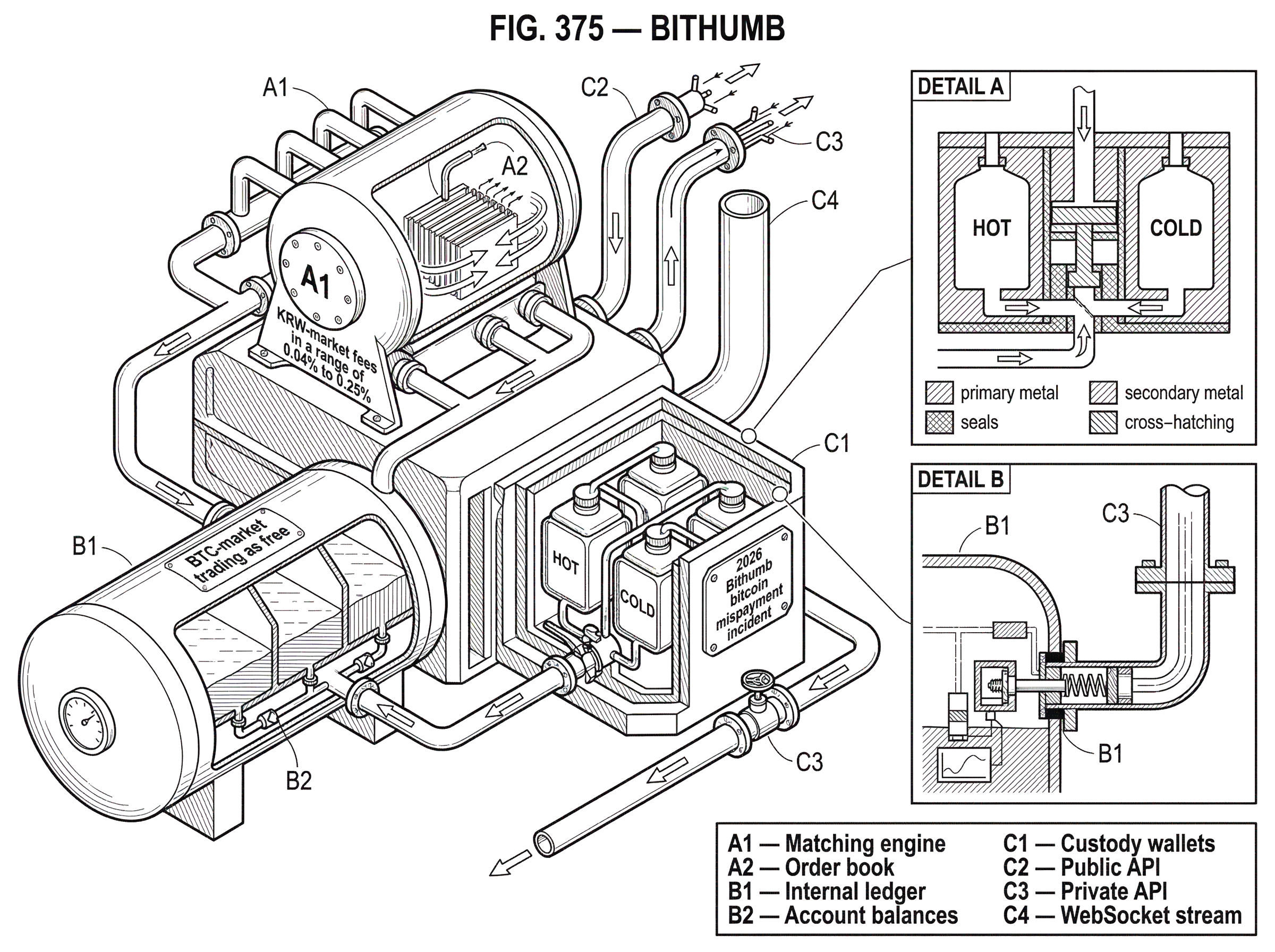
Bithumb is a centralized digital asset exchange platform: a service where users deposit funds, trade crypto assets through the platform’s order system, and withdraw assets later. That sounds straightforward, but the important part is what centralization changes. On Bithumb, you are not trading directly from your own wallet against a blockchain-native protocol. You are using a company-run system that keeps internal account records, operates matching and settlement logic, and exposes those functions through a web interface and APIs.
That model solves a real problem. Blockchains are good at final ownership records, but they are not, by themselves, a complete retail trading experience. Most users want faster order entry, consolidated balances, customer support, and market interfaces that feel more like a brokerage than a command line. Bithumb presents itself as a major “virtual asset platform” and, on its English-facing entry point, brands itself as “No.1” in that category. The useful question is not whether that slogan is literally true in every sense, but what kind of platform it is trying to be: a large, general-purpose venue for buying, selling, holding, and moving digital assets.
What is Bithumb’s primary function as a centralized exchange?
| Layer | Speed | Cost | Finality | Main use |
|---|---|---|---|---|
| Internal ledger | Instant | Low per trade | Reversible by operator | Active trading / matching |
| External blockchain | Minutes to hours | Higher per transfer | On-chain final | Deposits and withdrawals |
At first principles, an exchange like Bithumb exists to reduce coordination costs between many users who want to trade. If Alice wants to buy bitcoin and Bob wants to sell it, the hard part is not only finding each other. They also need price discovery, order timing, custody during the trade, and a reliable record of who owns what after the trade. Bithumb solves that by becoming the operating environment where those actions happen.
This is why a centralized exchange has two layers at once. There is the external asset layer, where actual crypto assets move on blockchains when deposits and withdrawals occur. Then there is the internal ledger layer, where user balances are tracked inside the exchange’s own systems. Most of the time, active trading happens on the internal layer. When a user places a buy or sell order, the exchange can update internal balances much faster than waiting for a blockchain transaction each time. That is the mechanism that makes a custodial exchange feel responsive.
The trade-off is equally fundamental. Because Bithumb manages customer balances and order execution internally, users gain convenience but take on platform risk. The exchange’s recordkeeping, controls, and operations matter a great deal. That is not an abstract concern. Official and secondary sources around Bithumb’s history show why internal controls, ledger integrity, and custody practices are central to understanding the product, not side issues.
How do deposits, trading, and withdrawals work on Bithumb?
From a user-facing perspective, the flow is familiar. A customer opens an account, completes whatever verification the platform requires for access to withdrawals and services, deposits funds, trades on the exchange, and later withdraws assets if desired. Bithumb’s support materials make clear that account verification is operationally important: accounts without customer verification may be restricted from withdrawals and product use, and rejected due-diligence requests can lead to further account blocking if not corrected.
Once funded, the user interacts with markets rather than directly with blockchain transactions. Bithumb publishes trading-fee guidance showing KRW-market fees in a range of 0.04% to 0.25% and lists BTC-market trading as free on the cited guide page. That tells you something about the product’s design. The exchange is not merely charging a flat infrastructure toll; it is shaping behavior by market type and, according to the same guide, by coupon-based discount programs tied to trading patterns. In practice, that means Bithumb is built not only for occasional buyers but also for repeat traders who care about execution costs.
Deposits and withdrawals reveal the boundary between the exchange’s internal system and the outside world. Bithumb states that deposits are generally free, though deposits below minimum amounts for some assets can incur fees. It also lists minimum deposit amounts for some coins and notes that withdrawal fees vary by asset. The mechanism here is simple: the exchange can credit and debit internal balances cheaply, but moving assets across networks has operational costs and edge cases. Minimum thresholds and asset-specific withdrawal charges are ways of handling that reality.
Imagine a user who deposits bitcoin, sells it into a KRW market, and later withdraws a different asset. The deposit begins as an on-chain transfer into addresses controlled by the exchange. Once Bithumb recognizes the deposit, the user’s account balance changes on the internal ledger. The trade itself then occurs internally when the order matches other users’ orders on the platform; no blockchain transaction is needed for that moment. Finally, when the user withdraws, Bithumb has to move from internal accounting back to an external blockchain transfer. That last step is where operational controls matter most, because a mistake is no longer just a number in a database once assets leave the platform.
How do Bithumb’s Public, Private, and WebSocket APIs differ and when should I use each?
| Interface | Purpose | Auth | Latency | Best for |
|---|---|---|---|---|
| Public API | Market data | No | Low | Price feeds, backtests |
| Private API | Account actions | API key required | Medium | Trading, withdrawals |
| WebSocket | Real-time streams | Auth for account updates | Very low | Execution and live dashboards |
Bithumb is not only a website or mobile trading venue. It also exposes itself as programmable infrastructure. Its developer documentation separates the platform into Public API, Private API, and WebSocket access, and that division reveals a lot about how the exchange works.
The Public API is for market data: tickers, candles, trades, current prices, and orderbook information. In other words, it exposes the observable state of the marketplace without requiring account authority. Bithumb’s public ticker endpoint returns a top-level status field and a data object containing per-asset market snapshots. Each asset entry includes fields such as opening_price, closing_price, min_price, max_price, units_traded, and 24-hour trading metrics. One practical detail matters for integrators: these numeric values are returned as strings, so trading systems have to parse them carefully rather than assuming native numeric JSON types.
The Private API is where the exchange stops being a market-data publisher and becomes an account operator. Bithumb’s docs describe private endpoints for assets, orders, deposits and withdrawals, and coin lending (Lending Plus). These are authenticated actions, so they require API keys. That design reflects the exchange’s internal structure: private endpoints are effectively controlled ways to alter or query the platform’s own ledger on behalf of a user.
The WebSocket interface exists because polling is too slow for many trading tasks. Bithumb documents real-time streams for current prices, trades, orderbook data, and even account or order information. If you are building a trading bot, market dashboard, or execution system, this is the difference between reacting after a change and seeing the change as it happens. The mechanism is not mysterious: instead of repeatedly asking “what is the latest state?”, the client subscribes and the exchange pushes updates.
This makes Bithumb relevant to two somewhat different audiences at once. Retail users need a place to trade. Technical users need a platform that can be integrated into software. The documentation index also includes guides, FAQ, changelog, support links, and API-key issuance instructions, which suggests Bithumb treats developer access as a meaningful part of the product rather than an afterthought.
What operational controls and risks should users watch for with centralized exchanges like Bithumb?
| Control | Primary purpose | Main limitation | When critical |
|---|---|---|---|
| Ledger reconciliation | Match ledger to assets | Requires frequent audits | Daily to weekly |
| Multi-confirmation withdrawals | Prevent premature sends | Slower withdrawals | High-value transfers |
| Multi-signature custody | Reduce single-key risk | Operational complexity | Cold storage vaults |
| Proof-of-reserves / audits | Public transparency | Snapshot limitations | Regulatory reporting |
The deepest thing to understand about Bithumb is that its usefulness depends on an invariant: the exchange’s internal ledger must remain consistent with the assets it actually controls and the actions it authorizes. If that invariant breaks, the product stops being trustworthy no matter how smooth the interface is.
Bithumb’s own corporate materials emphasize security certifications, compliance functions, audit practices, and custody-related capabilities. The company profile describes certifications including ISMS and ISO/IEC standards, mentions an AML center, and says external audits of KRW and digital assets held for the company and customers are conducted every six months. These claims are partly about trust signaling, but they also point to the real operational challenge: a custodial exchange has to show that user balances are not merely database entries disconnected from asset reality.
Bithumb’s research arm has also discussed proof-of-reserves mechanisms and their limits. That is notable because it shows an awareness that transparency is not a yes-or-no feature. A reserve snapshot can improve visibility, but a snapshot is still only a snapshot. The report highlights an important limitation: reserve proofs can show assets at a moment in time without fully solving questions about liabilities, leverage, or temporary fund movements around the audit window. That is a useful reminder that custody assurance is always partly a matter of system design and ongoing controls, not just a single published artifact.
Recent scrutiny around exchange operations makes the same point from a different angle. Regulatory material tied to a 2026 Bithumb bitcoin mispayment incident focused on whether exchanges maintain verification between ledgers and held assets, multi-confirmation procedures, and controls against human error. Those are not bureaucratic add-ons. They are the concrete mechanisms that keep a centralized exchange from turning an internal mistake into a real customer loss.
Who should use Bithumb and when is a custodial exchange appropriate?
Bithumb is most useful for users who want a managed trading venue rather than self-custodied, protocol-native trading. That includes people who want access to exchange order books, customers trading in markets tied to KRW or BTC, and developers building market-data tools or automated trading systems through API access. The fact that Bithumb is also supported by third-party trading infrastructure such as CCXT matters here: it means the platform is legible to the broader ecosystem of crypto software, not only to people using its own interface.
But that same design means Bithumb is less about self-sovereign asset control and more about delegated operation. Users hand the exchange a difficult job: custody assets, maintain correct balances, expose tradable markets, and process withdrawals accurately. In return, they get speed, convenience, and liquidity. Whether that trade is attractive depends on what the user values most.
Conclusion
Bithumb is a centralized crypto exchange and virtual asset platform that combines custody, internal account ledgers, market matching, and developer-facing APIs into one service. Its value comes from making crypto trading faster and more usable than direct on-chain coordination. The part worth remembering is simple: Bithumb works because it turns messy blockchain interactions into a managed trading system; and that same convenience makes internal controls, asset backing, and operational discipline the heart of the product.
What should you look for before choosing a crypto exchange?
Before choosing an exchange, check custody, fees, execution options, and operational controls and compare those items directly against Cube Exchange so you can judge tradeoffs in custody model and live execution. Cube’s product pages and API docs make it easy to compare custody (MPC threshold signing), fee schedules, and supported markets side-by-side with a competitor.
- Confirm custody and transparency: read the exchange’s custody model, proof-of-reserves cadence, and audit statements; then open Cube’s custody and audit pages to compare (MPC threshold-signing vs. custodial models).
- Compare fees and order types: get maker/taker rates, fee tiers, and any market-specific discounts (e.g., KRW vs BTC markets); on Cube, calculate fees for your typical order size and test limit vs market fills.
- Validate APIs and execution: review Public/Private/WebSocket docs, rate limits, and numeric data types (Bithumb returns some prices as strings); on Cube, check API docs and run a quick market-data/WebSocket subscription to measure latency and payload formats.
- Test deposit and withdrawal flows: check deposit minimums, withdrawal fees, confirmation counts, and required KYC steps; perform a small deposit and withdrawal on both platforms and compare confirmation time, total fees, and support responsiveness.
Frequently Asked Questions
Bithumb keeps an internal ledger for fast trading and updates user balances inside the platform when deposits are recognized; actual blockchain transfers happen only on deposits and withdrawals, so the on‑chain transfer must occur to move assets into or out of the exchange's custody.
No - ordinary trades are matched and settled on Bithumb’s internal ledger without broadcasting a blockchain transaction; only when you deposit to or withdraw from the exchange does a blockchain transfer occur.
The Public API provides market data (tickers, candles, orderbook snapshots), the Private API exposes authenticated account operations (assets, orders, deposits/withdrawals, lending), and the WebSocket streams real‑time price, trade, orderbook and account updates for low‑latency integrations.
Bithumb’s public ticker responses return numeric fields as strings (e.g., price fields are quoted), so integrators should parse those string values explicitly instead of assuming native JSON numeric types.
Bithumb publishes certifications and says it undergoes external audits (stated as every six months), and its research notes that Merkle‑tree proof‑of‑reserves snapshots increase visibility but are limited because they represent only a moment in time and do not by themselves resolve liabilities, leverage, or temporary fund movements.
The platform lists KRW‑market trading fees in a range of 0.04%–0.25% and notes BTC‑market trading as free on the cited guide, while deposits are generally free (subject to per‑asset minimums) and withdrawal fees vary by asset and are specified separately.
Public reporting around a 2026 bitcoin mispayment prompted regulatory scrutiny that emphasized whether exchanges maintain verification between internal ledgers and held assets, multi‑confirmation procedures, and controls to prevent human error, indicating those operational controls were central to the incident review.
The API/docs index delegates implementation details (authentication method, rate limits, exact request/response schemas) to linked pages and the support site, and the index itself does not publish concrete rate limits, full auth mechanics, or mention a sandbox/test environment in the materials summarized here.
Related reading