What Is the Variance Gamma Model?
Learn what the Variance Gamma model is, how its gamma time change creates skew and fat tails, and why traders use it to price options beyond Black–Scholes.
Introduction
The Variance Gamma model is an option-pricing model built for a simple reason: market returns are usually more skewed and more heavy-tailed than the Black–Scholes model allows. In Black–Scholes, log returns over a fixed horizon are normal and price paths move continuously. Real option surfaces keep telling us that this is too tidy. Deep out-of-the-money puts are often too expensive relative to that story, implied volatilities vary by strike, and return distributions show sharper peaks and fatter tails than a Gaussian law predicts.
The Variance Gamma, or VG, model changes the mechanism rather than patching the symptoms. Instead of assuming that uncertainty accumulates at a constant rate through calendar time, it assumes that the market runs on arandom clock. When that clock speeds up, many small moves can occur in what looks like a short calendar interval; when it slows down, little happens. That single change produces a process with jumps, asymmetry, and excess kurtosis while remaining mathematically tractable enough for option pricing.
That tractability is the real reason the model matters. A model can be realistic but unusable, or elegant but blind to the data. VG became important because it sits in the middle: rich enough to address the implied-volatility smile, yet structured enough that its characteristic function is known explicitly, which makes Fourier-based pricing practical. Here is the core idea to keep in mind throughout: VG does not add randomness by changing where Brownian motion goes; it changes how fast Brownian motion experiences time.
Why do traders move beyond Black–Scholes to models like Variance Gamma?
| Model | Mechanism | Skew/Kurtosis | Jump activity | Pricing tractability |
|---|---|---|---|---|
| Black–Scholes | continuous diffusion | None (normal) | None | Closed‑form BS formulas |
| Merton jump‑diffusion | diffusion + Poisson jumps | Skew via jump law | Finite activity | Semi‑analytic integrals |
| Variance Gamma | Brownian on gamma clock | Explicit skew & kurtosis | Infinite small jumps | Characteristic‑function FFT |
| Stochastic volatility | latent volatility state | Term‑structure of skew | No explicit jumps | Char func or PDEs |
The Black–Scholes model assumes that the stock price follows geometric Brownian motion. In that world, the continuously compounded return over any horizon is normal, variance grows linearly with time, and paths are continuous. If that were a good statistical description of markets, a single volatility parameter would explain option prices across strikes and maturities reasonably well.
But the market does not price options as though returns were normal. The implied volatility extracted from traded option prices usually depends on strike and maturity. This is not just a cosmetic nuisance. It is the market revealing that the risk-neutral distribution of future prices is not the lognormal distribution implied by Black–Scholes. In practice, there is usually more downside mass, fatter tails, and more short-horizon extreme-move probability than the Gaussian benchmark permits.
A natural response is to ask what structural feature is missing. One candidate is jumps. Another isstochastic volatility. The VG model takes the jump route, but in a particular way. It does not use a diffusion plus occasional large Poisson jumps, as in Merton’s jump-diffusion. Instead, it creates apure-jump Lévy process with stationary independent increments. That matters because it produces many small jumps rather than rare isolated ones, which can better mimic the persistent non-Gaussian shape seen in option prices.
The practical consequence is straightforward. With extra parameters beyond Black–Scholes, VG can control not just overall dispersion, but also skewnessandkurtosis. In the evidence base behind the model’s use, the parameter usually written θ controls asymmetry or skew, while ν controls kurtosis or tail heaviness, with σ retaining a volatility-like scale role. That extra flexibility is exactly what Black–Scholes lacks when it tries to fit a whole volatility smile with one number.
How does Variance Gamma use a gamma clock to create jumps?
The cleanest way to understand VG is to start from ordinary Brownian motion and then change the clock it uses.
Begin with an arithmetic Brownian motion with drift θ and volatility σ. If you ran it on ordinary calendar time t, the increment over a small interval would be a Gaussian move with mean linked to θ and variance linked to σ^2. That is the familiar diffusion world.
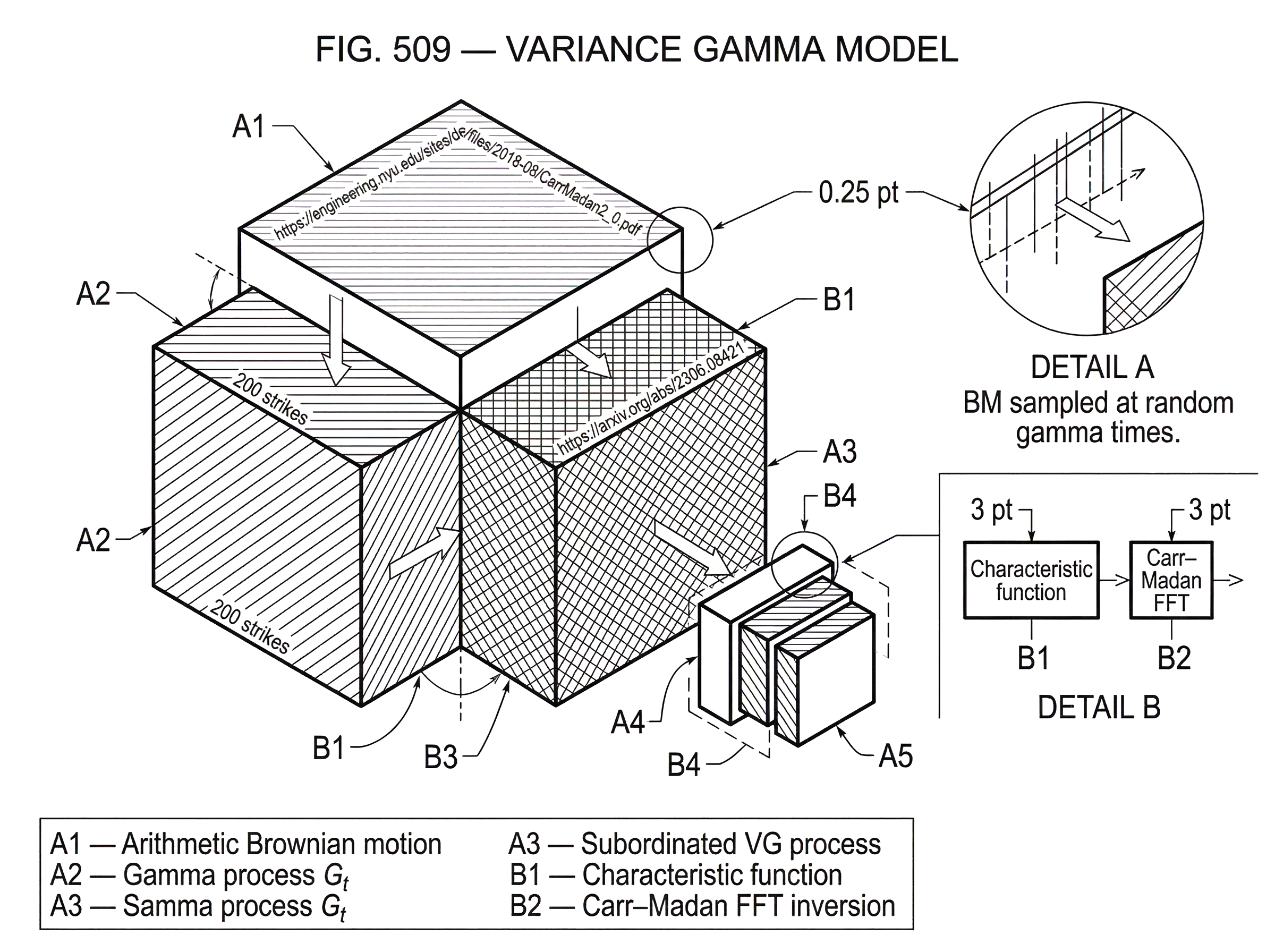
Now replace the deterministic time t with a random increasing process G_t, where G_t is a gamma process. The gamma process is nondecreasing, has independent increments, and is chosen so that its mean rate is 1 while its variance rate is ν. Instead of looking at the Brownian motion at time t, you look at it at the random time G_t. In words: over one calendar year, the market may experience more or less than one unit of “business time,” and the amount of business time itself is random.
This produces the VG process. In shorthand, the return component can be read as Brownian motion evaluated at gamma time. The resulting process is a pure-jump process. That phrase can sound surprising because Brownian motion is continuous. But once the clock is random and itself advances in jumps, the subordinated process no longer evolves continuously in calendar time. The randomness in the clock turns smooth motion in operational time into jumpy motion in observed time.
This is the compression point of the model. VG is what you get when Gaussian uncertainty is accumulated over a random amount of activity rather than a fixed amount of calendar time. Because the activity level varies randomly, the unconditional return distribution becomes heavier-tailed than normal. Because the Brownian motion itself can carry drift θ, the distribution can also be skewed.
A concrete picture helps. Imagine two trading days with the same open and close times. In calendar terms they are equal. But on one day, the market digests earnings, macro data, and a credit shock; on the other, almost nothing happens. Black–Scholes treats them as equal spans of variance accumulation. VG says they are not equal because the hidden activity clock moved further on the busy day. This analogy explains the mechanism well. Where it fails is that the actual gamma clock is a mathematical object with stationary independent increments, not a direct measurement of news flow or order count.
How do σ, θ and ν affect skew, kurtosis and scale in VG?
The standard VG construction uses three core shape parameters for the return process: σ, ν, and θ.
σ is the diffusion-scale parameter inherited from the Brownian motion being time-changed. If everything else were fixed, increasing σ broadens the distribution. It is the closest VG analogue to the volatility parameter in Black–Scholes, though in VG it does not by itself determine the whole shape.
θ tilts the distribution. A nonzero θ introduces asymmetry, which is why the model can produce risk-neutral distributions with left or right skew. For equity index options, where downside crash risk tends to matter more, the relevant fitted skew is often negative under common parameterizations. The point is not the sign convention by itself but the mechanism: drift in operational time becomes asymmetry in calendar-time returns after the random clock is applied.
ν governs how variable the gamma clock is. When ν is larger, the amount of operational time accumulated over a fixed calendar interval is more random. That increased variability makes the unconditional return distribution more heavy-tailed and more peaked relative to a normal law. In the source material, this is the parameter associated with kurtosis control.
These roles are best understood by asking what changes and what stays invariant. The invariant is that increments remain stationary and independent, because the model is a Lévy process. What changes is the one-period return law: it is no longer normal. That is the whole reason option prices across strikes can move away from the flat-volatility pattern of Black–Scholes.
There is also a limiting intuition worth remembering. If the randomness of the gamma clock shrinks appropriately, the process moves back toward a Gaussian benchmark. So VG should not be thought of as replacing Black–Scholes with a completely alien object. It is better seen as a controlled generalization that keeps enough structure to remain usable.
How is the VG process converted to a risk‑neutral stock price for option pricing?
For option pricing, one does not model returns under the historical probability measure alone. One needs a risk-neutral or pricing measure under which discounted asset prices are martingales. In practice, the stock price is written in exponential form, with log-price driven by a VG process plus a drift adjustment chosen so the discounted price has the right martingale property.
This adjustment matters because once returns are no longer Gaussian, you cannot simply carry over the Black–Scholes drift logic unchanged. The jump structure changes the exponential moments of the process, so the compensator must be chosen consistently. In implementations, this requirement usually appears through the characteristic function of the log price rather than through pathwise replication arguments.
That last point is important conceptually. In Black–Scholes, complete-market replication is central: continuous trading in the stock and bond pins down the option price uniquely. In pure-jump models like VG, that perfect replication logic does not survive in the same way. The market is generally incomplete, so pricing is tied to a chosen martingale measure and model specification rather than a unique replication argument.
This incompleteness is not a technical footnote. It changes how one should think about hedging. Under VG, delta hedging is no longer the exact frictionless replication strategy that continuous-diffusion intuition suggests. Evidence in the supplied material shows that for discretized VG dynamics, optimal hedging under a mean-square criterion can outperform plain delta hedging, and the hedging error does not vanish the way it does in the Black–Scholes limit. So the model is not just “Black–Scholes with better prices.” It also implies a different hedging problem.
Why are characteristic functions central to pricing under Variance Gamma?
| Method | Requires closed‑form? | Speed for many strikes | Greeks stability | Best for |
|---|---|---|---|---|
| Density integration | analytic density needed | Slow; per strike | Generally stable | single‑strike checks |
| Char function + FFT | closed‑form char func | Very fast many strikes | Can be unstable | vanilla strike grids |
| Monte Carlo | no analytic required | Slow for grid | Noisy but fixable | path‑dependent payoffs |
A probability density is one way to describe a distribution. A characteristic function is another. For a log terminal price s_T = ln(S_T), the characteristic function is defined as the expectation of exp(i u s_T) as a function of frequency variable u. In many Lévy models, including VG, this object is available in closed form even when the density itself is awkward.
That is a major practical advantage because option values can be recovered from transforms of the terminal distribution. Carr and Madan’s approach shows that if the characteristic function of the risk-neutral log price is known analytically, one can compute option prices efficiently using Fourier inversion, and even accelerate the computation with the fast Fourier transform, or FFT.
The reason this works is structural rather than magical. A European option price is an expectation of a payoff under the risk-neutral law. Expectations are integrals against the terminal distribution. Fourier methods turn difficult real-space integrals into frequency-space integrals, where convolution-like structure and explicit characteristic functions make the calculation easier. When the transform is well behaved, FFT lets you compute many strikes at once on a grid.
VG is especially suited to this because its characteristic function has a compact closed form. In the evidence provided, this is exactly why VG is used as the showcase model for FFT pricing. The model is rich enough to generate realistic smiles, yet explicit enough that transform methods remain fast enough for practical books of vanilla options.
How do FFT/Carr–Madan methods price VG vanilla options efficiently?
The implementation idea is simple once the transform viewpoint is in place. Instead of pricing each strike by direct numerical integration separately, you derive the Fourier transform of a modified option-price function in log-strike and invert it numerically across a whole strike grid.
There is, however, a subtle obstacle. The ordinary call-price function is not automatically square-integrable in log-strike, and direct transforms can have singular behavior near zero frequency. Carr and Madan address this by modifying the object being transformed. One method multiplies the call price by an exponential damping factor exp(α k), where k is log-strike and α > 0. Another works with the option’s time value and uses a sinh(α k) type regularization. These are not arbitrary tricks. They are ways of making the transformed function numerically well behaved so the inversion sampled by FFT remains stable.
A worked example in words makes the mechanism clearer. Suppose a desk wants prices for 200 strikes on the same maturity under a calibrated VG model. Because the model gives an analytic characteristic function for the log terminal price, the desk first plugs that function into the transform formula for a damped call-price or time-value function. That produces an integrand in frequency space. Rather than evaluating a separate integral for each strike, the desk samples the integrand on an evenly spaced frequency grid and applies FFT. The FFT returns option values across an evenly spaced log-strike grid in one batch. The speed gain comes from reusing the same transform evaluations across many strikes instead of rebuilding each price from scratch.
The numerical details matter. The evidence base notes that short maturities can make direct transforms highly oscillatory because call values are close to intrinsic value and become numerically awkward. That is why the time-value transform can be more stable. The same evidence also reports that FFT-based VG methods were substantially faster than direct inversion approaches in test cases, and that the time-value version produced smaller pricing errors.
This is a useful place to separate mechanism from limitation. The mechanism is robust: if you know the characteristic function analytically, transform methods can be very efficient. The limitation is equally real: efficiency does not guarantee stable Greeks or error-free numerics. Recent evidence cited in your source bundle reports that common Fourier techniques can fail badly for DeltaandGamma under some realistic parameter sets, leading to underestimated Delta–Gamma VaR. So FFT pricing is a strength of VG, but not a license to stop thinking about numerical diagnostics.
What type of Lévy process is the Variance Gamma model?
VG is not just “a jump model” in the broad sense. It has a more specific microstructure at the level of increments.
The process is a Lévy process, meaning increments over disjoint intervals are independent and identically distributed up to time length. This gives stationary independent increments and makes the model time-homogeneous. From a pricing perspective, that is what permits compact transform formulas.
It is also a pure-jumpprocess. There is no separate Brownian diffusion term once the model is written in its Lévy form. Instead, all movement comes through jumps. At the same time, the jump activity isinfinitebut offinite variation under the parameterizations discussed in the provided material. Infinite activity means that over any interval there are infinitely many tiny jumps in the mathematical idealization. Finite variation means the total accumulated absolute jump size remains finite over finite horizons.
This combination explains why VG can mimic rough, irregular price evolution without requiring isolated dramatic jumps as the dominant mechanism. Compared with a Poisson jump-diffusion, where jumps arrive at finite intensity, VG packs much of its non-Gaussianity into an ocean of small jumps. That often gives a smoother implied shape across strikes while still generating heavy tails.
When and how do traders use the Variance Gamma model in practice?
In practice, the VG model is mostly used where two requirements meet. First, one wants a better fit to vanilla option smiles or skews than Black–Scholes can provide. Second, one wants a model that remains computationally manageable for repeated pricing and calibration.
That is why VG is most naturally associated with European-style options, volatility-surface fitting, and transform-based pricing systems. The model’s explicit characteristic function makes calibration to cross-sections of option prices feasible, especially when many strikes for a given maturity must be evaluated quickly. Libraries such as QuantLib expose a VarianceGammaProcess, which reflects that the model is considered implementable rather than purely theoretical.
But this practicality has boundaries. For path-dependent claims, early exercise, and barrier features, one typically leaves the clean Fourier world and moves to integro-differential equations or other numerical schemes. The source material on VG numerical methods emphasizes that American and barrier options under VG require careful discretization of the jump integral terms. This is the pattern you should expect: the closer the payoff is to a terminal expectation of S_T, the more directly VG’s transform machinery helps.
The model has also inspired extensions when plain VG is not flexible enough. A notable neighboring idea is CGMY, which extends VG by adding an extra parameter to shape jump activity and variation more finely. The reason such extensions exist is revealing: VG captures skew and kurtosis well, but some markets still show term-structure effects or tail behavior that need either stochastic volatility, richer jump activity, or both.
What are the key assumptions and limitations of the Variance Gamma model?
| Assumption/issue | Effect on pricing/hedging | Practical sign | Mitigation |
|---|---|---|---|
| Stationary increments | misses volatility clustering | maturity bias in fit | add SV or time‑varying params |
| Fourier numerics | oscillation; unstable Greeks | wrong Delta/Gamma estimates | damp, refine grid, FDs |
| Incomplete markets | residual hedge risk | delta hedging residuals | optimal hedging / reserves |
| Calibration uncertainty | overfitting; parameter risk | unstable valuations | joint calibration–estimation |
The biggest misunderstanding about VG is to treat it as a final answer rather than a deliberate compromise. It fixes important Black–Scholes failures, but it does so by making new assumptions that can matter a great deal.
The first assumption is that stationary independent increments are a reasonable description over the horizon being priced. Real markets often show volatility clustering, regime shifts, and time-varying risk premia. A Lévy model with fixed parameters cannot fully absorb those features. This helps explain why empirical work can find that VG improves cross-strike fit yet still leaves maturity-related bias.
The second assumption is numerical rather than economic. Much of VG’s practical appeal comes from Fourier pricing, but transform methods depend on careful damping, truncation, grid design, and regularity conditions. These are not decorative implementation choices. Poor settings can create oscillation, aliasing, or unstable sensitivities. The recent evidence that Fourier-based Greek calculations may fail in realistic settings is a reminder that pricing and hedging accuracy are different numerical problems.
The third assumption concerns hedging. Incomplete markets mean there is not a single replication-based truth in the Black–Scholes sense. Once jumps are present, hedge ratios become model-dependent and residual risk remains even with frequent rebalancing. Evidence in the supplied sources shows this clearly for VG: as hedging frequency increases, hedging error in the Black–Scholes model tends toward zero, while in the VG setting it does not disappear in the same way.
Finally, calibration itself can be unstable. More parameters create more flexibility, but also more room for parameter uncertainty and overfitting. Work on model validation for mean-reverting VG variants in commodity markets highlights a practical tradeoff that generalizes beyond that setting: richer models can fit observed option prices better and raise estimated contract values, but they can also produce materially higher parameter-risk uncertainty. Better in-sample fit is not the same thing as better decision quality.
Variance Gamma vs Black–Scholes, Merton and Heston: when to choose each
It helps to place VG between two familiar alternatives.
Relative to Black–Scholes, VG keeps analytic tractability in transform space while replacing Gaussian log returns with a jump-driven, skewed, heavy-tailed law. If your main problem is that Black–Scholes cannot fit the smile at all, VG is a natural next step because it targets that failure directly.
Relative to Merton jump-diffusion, VG uses a different jump architecture. Merton combines continuous diffusion with occasional finite-activity jumps. VG removes the separate diffusion term and instead uses infinite-activity pure jumps generated by the random clock construction. So both models address non-Gaussian returns, but they encode jump risk differently.
Relative to Heston-type stochastic volatility models, VG often offers simpler transform-based pricing for vanilla options, but it does not model a separate evolving volatility state. If the market feature you most need is a realistic term structure of variance dynamics, a stochastic-volatility model may be better suited. If your main need is a flexible one-period distribution with efficient transform pricing, VG may be the cleaner tool.
Conclusion
The Variance Gamma model is best understood as Brownian motion run on a random gamma clock. That single structural change turns normal returns into a skewed, heavy-tailed pure-jump Lévy process, which is why the model can fit option smiles that Black–Scholes misses.
Its practical appeal comes from a rare combination: richer distributional shape and explicit characteristic functions, which make fast Fourier pricing possible. Its limits come from the same place: jumps make markets incomplete, hedging remains imperfect, and numerical methods that price well do not automatically produce reliable Greeks.
If you remember one thing tomorrow, remember this: VG exists because markets do not accumulate risk at a constant smooth rate, and the model captures that by randomizing the clock rather than by abandoning tractability.
Frequently Asked Questions
VG time-changes a Brownian motion with a gamma process (a random, nondecreasing "clock"); when the clock runs faster many small Brownian moves are packed into a short calendar interval and when it runs slower few moves occur, producing asymmetry and heavier tails without adding a continuous diffusion term.
Although VG starts from Brownian motion in operational time, the gamma clock advances randomly (with jumps), so the subordinated process observed in calendar time is a pure-jump Lévy process with infinite jump activity but finite variation.
In the standard parametrization σ sets the overall scale (a volatility-like parameter), θ tilts the distribution and controls skewness, and ν governs variability of the gamma clock and therefore the excess kurtosis (tail heaviness and peakiness) of unconditional returns.
VG admits an explicit characteristic function for the risk‑neutral log price, so one plugs that transform into Carr–Madan–style formulas and uses Fourier inversion (often accelerated with the FFT) to compute many European option prices quickly.
Fourier methods require careful damping, truncation and grid choices; short maturities make integrands highly oscillatory and can destabilize transforms, and recent numerical evidence shows some Fourier implementations can produce invalid Greeks or badly underestimate Delta–Gamma risk unless tuned or replaced by alternative solvers - practitioners therefore use damping/truncation rules and numerical diagnostics (the Carr–Madan paper even lists working defaults such as η=0.25, N=4096 and α≈1.1–1.5 as starting points).
No - markets with VG dynamics are incomplete, so continuous-time replication and Black–Scholes‑style perfect hedging do not hold; delta hedging is not exact, hedging error generally does not vanish with more frequent rebalancing, and numerical/optimal-hedging schemes can reduce but not eliminate residual risk.
VG improves cross‑strike fit but has limits: it assumes stationary independent increments (so it cannot capture volatility clustering or regime shifts), can leave maturity-dependent bias in calibration, and adds parameter uncertainty that can make calibration unstable or prone to overfitting.
VG sits between Black–Scholes and richer models: versus Black–Scholes it replaces Gaussian returns with a skewed, heavy‑tailed pure‑jump law; versus Merton jump‑diffusion it uses infinite‑activity many‑small jumps rather than finite‑intensity isolated jumps; compared with Heston it gives simpler transform‑based vanilla pricing but does not model a separate stochastic volatility state.
For path-dependent payoffs, early exercise and barriers you typically leave the clean transform world and solve PIDEs or use finite‑difference/integral schemes; discretizing the jump integral carefully is critical for stability and convergence in those implementations.
Yes - common quant libraries include VG implementations (for example QuantLib exposes a VarianceGammaProcess class and QuantLib‑Python documents its process API), but built‑in calibration routines are not always provided on the API pages and calibration remains a separate, model‑specific task.
Related reading