What Is Risk Reversal?
Learn what a risk reversal is in options trading, how it works, why traders use it to trade skew, and the risks behind long call/short put structures.
Introduction
Risk reversal is an options structure built from two legs on the same underlying: a long call and a short put, or the reverse. At first glance it can look like a complicated way to create something simple. A long call plus a short put often gives you directional exposure that resembles being long the underlying, so a reasonable reader might ask: why not just buy the stock or futures and skip the options?
That question is the right place to start, because it reveals what a risk reversal is really for. The point is usually not to get direction in the cheapest possible way. The point is to trade the differencebetween how the market prices upside and downside options. In other words, a risk reversal is one of the cleanest ways to express a view on skew; the market’s tendency to make one tail of the distribution more expensive than the other.
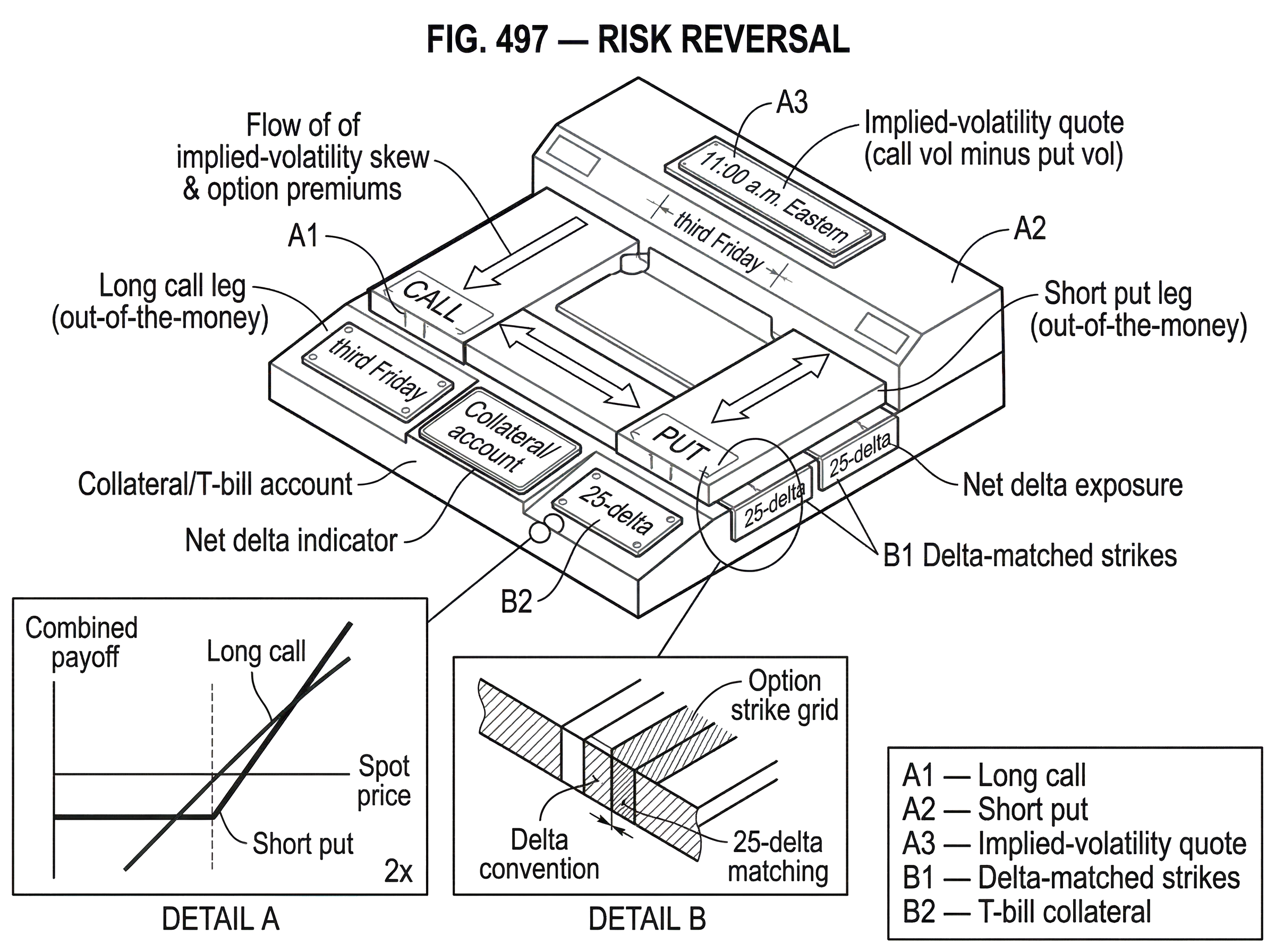
That is why the same phrase means two closely related things in practice. Traders use “risk reversal” to describe a position; for example, long a 25-delta call and short a 25-delta put. They also use it to describe amarket quote or metric; typically the implied volatility of an out-of-the-money call minus the implied volatility of an equally out-of-the-money put. The position and the metric are connected by the same underlying idea: markets often price upside and downside risk differently, and the risk reversal is a direct way to observe or trade that asymmetry.
Understanding risk reversal becomes much easier once you stop seeing it as a miscellaneous two-leg option trade and start seeing it as a claim about which side of the distribution is rich. Here is the mechanism: if puts are expensive relative to calls, selling the put and buying the call can monetize that asymmetry. If calls are expensive relative to puts, the opposite structure may make more sense. Everything else (directional exposure, premium paid or received, margin, tail risk, and practical implementation) follows from that core fact.
What is a risk reversal and how are the call and put legs paired?
| Orientation | Typical skew | Delta | Common use | Main risk |
|---|---|---|---|---|
| Buy call / sell put | Puts richer than calls | Net long delta | Capital-light bullish exposure | Asymmetric downside tail risk |
| Sell call / buy put | Calls richer than puts | Net short delta | Hedge upside or bearish overlay | Asymmetric upside tail risk |
A risk reversal combines opposite option positions at similar moneyness, usually with the same expiry. In equity-index usage, the standard example is to buy an out-of-the-money call and sell an out-of-the-money put. In FX and commodity markets, traders also discuss the opposite orientation (sell the call and buy the put) depending on which side of skew they want to own or hedge. The name does not identify the bullish or bearish direction by itself; it identifies the paired structure.
Why pair these two options at all? Because a single option mixes several things together: direction, convexity, time decay, and implied volatility. A risk reversal strips away some of that clutter by placing one option on each side of spot. If the strikes are chosen symmetrically in delta terms (25-delta call and 25-delta put is the common convention) the structure becomes a focused way to trade the relative richness of upside versus downside wings.
This is where market convention matters. In listed equity markets, people often speak of the tradeitself: buy the call, sell the put. In OTC FX, people often speak of thequote: “25-delta risk reversal” means call implied volatility minus put implied volatility at the 25-delta strikes. A positive or negative number then tells you which wing is richer. The BIS describes this convention directly for FX: the risk reversal quote is the volatility difference between the call and the put at a given delta, not a dollar option premium quote.
That difference in language can confuse beginners. The structure and the quote are not separate inventions. The quote exists because traders need a compact number that summarizes the relative price of the two wings that the structure trades.
Why do call and put wings trade at different implied volatilities?
If call and put wings were usually priced the same after adjusting for distance from the money, risk reversals would be less interesting. They matter because option markets are not symmetric in demand.
In equity indexes, downside puts are often persistently expensive relative to upside calls. The broad mechanism is simple. Investors frequently buy puts as insuranceagainst market drops, while covered-call programs and similar yield-seeking trades create steadysupply of calls. Those repeated flows push down put-call symmetry. The result isdownside skew: out-of-the-money puts trade at higher implied volatilities than comparable out-of-the-money calls.
That skew is not just a chart feature. It changes actual trade economics. If a 25-delta put is priced off a higher implied volatility than a 25-delta call, then selling the put and buying the call is not just “long upside, short downside.” It is also “sell the richer wing, buy the cheaper wing.” That relative pricing is the main economic reason the trade exists.
Other markets can look different. In some commodity episodes, upside calls become expensive because users fear supply shocks or momentum squeezes. CME’s silver example shows exactly this kind of case: call implied volatility ran above put implied volatility, so a short call / long put risk reversal made sense as a hedge overlay on a long futures position. The lesson is that the structure is not tied to one permanent sign of skew. It is a tool for trading whichever side the market currently fears more.
A useful analogy is insurance on two doors of the same house: front-door damage and back-door damage. If one door is insured at a much higher premium than the other, you learn something about what the insurer thinks is more likely or more painful. The analogy explains the relative-pricing logic well. It fails because options markets reflect not just expected outcomes but also supply-demand imbalances, risk premia, and hedging pressure. A rich put does not necessarily mean a crash is objectively likely in the real-world probability sense. It can also mean that investors strongly want protection.
How does a risk reversal's payoff compare to owning the underlying?
A long call plus a short put often behaves a lot like owning the underlying. This is not an accident. It comes from put-call parity, the pricing relationship linking calls, puts, strikes, and the forward or futures price at the same expiry.
At the same strike and expiry, the combination long call - short put is economically close to a synthetic forward. That is why a risk reversal often carrieslong delta. If the underlying rises, the long call helps and the short put becomes less dangerous. If the underlying falls, the call loses value and the short put loses more. The reverse orientation (short call plus long put) carries short delta.
This is also why “risk reversal” can be misunderstood. Someone sees the trade and says: “That is basically stock.” That is partly true, but it misses the crucial point. If plain delta were all you wanted, stock or futures is usually the simpler and cheaper instrument. Traders choose the options structure because the way that delta is packaged matters. They may want to own cheap upside and finance it by selling rich downside. Or they may want to hedge an underlying position by selling an expensive wing and buying a cheaper opposite wing. The structure matters because the market does not price both wings equally.
A worked example makes this concrete. Imagine an equity index where investors are paying heavily for crash protection, so the 25-delta put is expensive in implied-volatility terms while the 25-delta call is comparatively cheap. A trader who buys the call and sells the put is not merely saying “I am bullish.” The trader is saying something more specific: “I think the downside insurance premium embedded in the put is high enough that selling it helps fund upside exposure at attractive terms.” If the market drifts up, the position can do well because the call gains and the short put decays. If the market falls modestly, the premium earned from the rich put may offset part of the damage. But if the market falls sharply, the short put becomes the dominant risk, and the trade can lose heavily. The favorable relative pricing does not eliminate the tail exposure; it is the compensation for bearing it.
Why are risk reversals quoted by delta (e.g., 25‑delta) instead of strikes?
You will often hear “25-delta risk reversal” rather than a pair of strikes. That is not a stylistic preference. It is the cleanest way to compare options across time and across markets.
A strike tells you a fixed price level, but what counts as meaningfully out of the money changes with the underlying level, time to expiry, rates, and volatility. Delta is a more functional description because it tells you how sensitive the option is to the underlying and, roughly speaking, where the option sits on the distribution. A 25-delta call and a 25-delta put are not mirror images in every technical sense, but they are a standard way to define “comparable wings.”
This is why both Cboe’s RXM methodology and many FX conventions use 25-delta options. RXM, the Cboe S&P 500 Risk Reversal Index, is built from a monthly long 25-delta SPX callandshort minus-25-delta SPX put, plus a Treasury-bill account to collateralize the short put liability. In FX quoting, the risk reversal itself is often stated as the call implied volatility minus the put implied volatility at the 25-delta points. Same organizing idea, different market convention.
Delta conventions are not completely universal. In FX, quote conventions can depend on spot delta versus forward delta and other market details. So the number is only comparable if you know the convention behind it. But the purpose is the same: define a stable pair of wings so traders can discuss skew without arguing over arbitrary strikes.
How do risk reversal quotes signal skew and tail risk in the market?
| RR sign | Wing richer | Implied market view | Typical trader action |
|---|---|---|---|
| Positive | Call wing | Market prices upside more | Sell call, buy put |
| Negative | Put wing | Market fears downside or crash | Sell put, buy call |
| Near zero | Neither wing | No dominant tail concern | Use stock/futures or directional trades |
Because the structure isolates relative wing pricing, the risk reversal is also a useful diagnostic. It tells you which tail the market is paying up for.
In FX, this use is especially standard. BIS describes risk reversals as instruments that price the skewness of tail risk. A positive quote means the call wing is richer than the put wing; a negative quote means the put wing is richer. Interpreting the sign depends on the currency quotation convention, but the core message is stable: the market fears one direction more than the other.
This diagnostic use matters outside FX too. Equity-index traders look at 25-delta put-call skew for much the same reason: it summarizes demand for crash protection versus speculative upside. Commodity traders watch whether call skew or put skew dominates, especially when inventory fears or supply shocks make upside convexity valuable.
There is an important limitation here. A risk reversal quote is a risk-neutralmarket price signal, not a clean estimate of real-world probability. Research on currencies makes this explicit: the quote can reflect both expected skewness and askewness risk premium; the price investors are willing to pay for insurance. So when a risk reversal gets more extreme, that may mean the feared move is more likely, or that investors have become more eager to insure against it, or both.
How does Cboe’s RXM index implement a monthly risk‑reversal strategy?
The abstract idea becomes easier to grasp when you see a concrete benchmark. Cboe’s RXM tracks a hypothetical monthly S&P 500 risk-reversal strategy. Each month it buys an out-of-the-money SPX call with delta 0.25, sells an out-of-the-money SPX put with delta -0.25, and holds cash in one-month Treasury bills to cover the short-put liability.
That last part is not cosmetic. Once you sell a put, you have created downside obligation. A serious benchmark cannot pretend the short put is free capital. RXM addresses this by putting an amount of cash equal to the strike K of the newly written put into a T-bill account and accruing interest at the one-month T-bill rate. Mechanically, that means the benchmark is not just “long call minus short put”; it is “long call minus short put with cash collateral backing the short downside exposure.”
The roll process also matters. According to the methodology, the old options are held to maturity and typically settle on the third Friday using the SPX Special Opening Quotation, or SOQ. New options are then selected around 11:00 a.m. Eastern, and the premiums used for the new positions are based on a VWAP of trades from 11:30 a.m. to 12:00 p.m. Eastern, subject to specified trade-code exclusions and fallback rules if no trade occurs. These details may seem operational, but they matter for anyone trying to compare live trading to index returns. The strategy’s economics depend not only on the idea but on when and how the roll is priced.
RXM is useful because it makes two truths visible at once. First, the risk reversal is a coherent repeatable strategy, not just a trader’s shorthand. Second, the strategy is not simply a free lunch from “selling expensive puts and buying cheap calls.” It has roll timing, collateral needs, path dependence, and left-tail exposure.
How do traders use risk reversals for exposure, hedging, and financing?
The underlying purpose of a risk reversal is to reshape exposure using skew rather than paying full cash for the underlying or for one-sided optionality.
In a bullish equity-index setting, a long-call/short-put risk reversal can serve as a capital-light way to express upside participation while using put premium to help finance the call. That often appeals when calls seem cheap relative to puts. But the trade only looks capital-light if you ignore the short put’s risk. In reality, margin and collateral are central to the economics.
In hedging, the orientation can reverse. Suppose a commodity producer or futures holder wants downside protection but sees the opposite wing as unusually rich. Selling the rich wing and buying the protective wing can improve hedge economics. CME’s silver example showed how skew can materially change the outcome of such a hedge: when the skew was preserved, the theoretical loss was much smaller than in a no-skew version of the same trade. That is a good reminder that skew is not a cosmetic valuation detail. It can be a large part of the trade’s P&L.
Some traders also use delta-hedged versions of risk reversals to isolate the volatility component from the directional one. Cboe’s educational discussion points out that a delta-hedged monthly 25-delta SPX risk-reversal exposure historically produced a distinct return stream, suggesting that the skew premium can exist even after neutralizing outright market direction. This is an important distinction: the unhedged structure mixes skew and delta, while the delta-hedged version is closer to a pure relative-volatility trade.
What are the principal risks of trading risk reversals (short puts and skew exposure)?
The most important thing to understand about a risk reversal is that the attractive relative pricing usually comes with asymmetric tail risk. If you sell the downside put in an equity index, you are short the part of the distribution investors most fear. There is a reason that put often looks rich.
This is where casual explanations often fail. They say: sell expensive puts, buy cheap calls. True, but incomplete. The put is often expensive because large downside moves are painful, correlated with liquidity stress, and hard to hedge when they happen. During stressed market conditions, liquidity providers may pull back, spreads widen, and skew can move abruptly. The Flash Crash report is not about risk reversals specifically, but it is a reminder of the broader mechanism: in sharp dislocations, liquidity can evaporate quickly, and derivatives hedging assumptions that look comfortable in calm markets can fail when everyone wants to trade the same direction.
There is also model risk in how people read skew. A rich put does not guarantee profits from selling it. If realized downside moves exceed what was priced, or if skew becomes even more extreme, the short-put leg can overwhelm the gains from the long call. Likewise, a quoted risk reversal level does not tell the whole story unless you know expiry, delta convention, and the rest of the volatility surface.
Margin risk is another practical constraint. Short options consume capital because exchanges and brokers must assume adverse moves. Under portfolio margin systems such as OCC TIMS or CME SPAN, margin is calculated from stress scenarios across the portfolio, with offsets where appropriate. That can make a hedged book more capital-efficient than strategy-based formulas, but it does not make the short wing harmless. Scenario-based systems also include short-option minimums or equivalent floors precisely because deep out-of-the-money short options can look deceptively safe until the market jumps.
How do risk reversals differ between equities, FX, and commodities?
| Market | Common skew sign | Quote convention | Typical drivers | Typical use |
|---|---|---|---|---|
| Equities | Put-rich (downside skew) | Vol‑quoted, delta strikes common | Crash insurance demand, covered-call supply | Harvest rich puts |
| FX | Often negative for high-carry currencies | Call minus put vol at delta | Carry trades, funding liquidity | Gauge directional tail concern |
| Commodities | Variable, can be call-rich | Vol‑quoted, conventions vary | Supply shocks, inventory fears | Hedge supply or demand risk |
The concept is stable across equities, FX, and commodities, but the meaning of the quoteand thereason people care can differ.
In equity indexes, the common story is persistent downside skew from demand for protection. Here the long-call/short-put version is often discussed as a way to own upside while harvesting the richness of puts. In FX, the risk reversal quote is deeply embedded in market convention as a summary of directional tail concern, and traders often pair it with an at-the-money volatility quote and a strangle quote to reconstruct the two wing volatilities. In commodities, the sign of skew can flip depending on whether the market is more worried about supply squeezes or collapse in demand.
That cross-market variation is useful because it reveals what is fundamental and what is conventional. The fundamental part is the paired trade across two wings. The conventional part is how the market quotes it, which side is usually richer, and whether people talk first about the structure or first about the volatility difference.
What are common misunderstandings about risk reversals?
The first common mistake is to think risk reversal means only one orientation. It does not. The name refers to the paired call/put structure; the chosen direction depends on the exposure or skew view.
The second mistake is to think a risk reversal is mainly a cheaper substitute for stock. It can resemble stock or futures in directional terms, but traders usually care about the relative pricing of wings, not just raw delta.
The third mistake is to treat the risk reversal quote as a probability forecast. It is better understood as a market price of asymmetry. That price contains expectations, risk aversion, hedging demand, and supply imbalances all at once.
The fourth mistake is to ignore financing and margin. A long call financed by a short put can look inexpensive in premium terms while being very expensive in risk terms.
Conclusion
A risk reversal is best understood as a way to trade or read the market’s asymmetry. Mechanically, it pairs a call with an opposite put on the same underlying and expiry, often at matching deltas such as 25-delta. Economically, it matters because option markets usually do not price upside and downside tails the same way.
That is the memorable version: a risk reversal is not just a two-leg option trade; it is a statement about which wing is rich, which wing is cheap, and whether you are willing to bear the tail risk that comes with that pricing.
Frequently Asked Questions
Because the trade is usually not about cheapest directional exposure but about trading the relative price of upside vs downside options - it monetizes skew by selling the richer wing and buying the cheaper wing, something plain stock/futures cannot do, though stock is usually simpler if you only want raw delta.
Delta (e.g., 25-delta) standardizes how ‘out of the money’ the two legs are across different spot levels, expiries and vol regimes; quoting by delta makes the pair comparable through time and markets and is why conventions like a “25-delta risk reversal” are common.
The main hazards are asymmetric tail loss from the short wing (especially in crashes), liquidity and hedging breakdowns in stressed markets, model/mispricing risk if skew moves further against you, and margin/collateral demands that can be sizable despite low upfront premium.
Interpretation differs by market convention: in FX the standard risk‑reversal quote is call implied vol minus put implied vol at a given delta (so sign shows which wing is richer), while in equities practitioners often speak of the trade (buy call/sell put); you must also pay attention to delta/forward conventions to compare numbers across markets.
Cboe’s RXM builds a monthly long 25‑delta SPX call and short 25‑delta SPX put and places cash equal to the put strike into a one‑month T‑bill account to collateralize the short put; the cash collateral and scheduled roll/VWAP rules are explicit parts of the methodology, so implementation and roll timing materially affect returns.
Yes - traders often delta‑hedge risk reversals to reduce directional exposure and isolate the relative‑volatility (skew) return; empirical work and Cboe educational discussion show a distinct return stream can remain after neutralizing market direction, though practical implementation still faces costs and hedging error.
margin treatment depends on the clearing/exchange framework: portfolio‑margin systems (OCC TIMS) and exchange SPAN/SPA N frameworks compute scenario shocks and offsets rather than ignoring the short wing, so short options still draw capital and house requirements can be higher than exchange minimums - in short, margin is material and varies by venue and account type.
No - a risk‑reversal quote is a risk‑neutral market price of asymmetry that mixes expected moves, hedging demand and a skewness risk premium; it does not directly equal the real‑world probability of a crash without further assumption and adjustment.
Related reading