What Is Convexity? How Curvature Shapes Bonds, Options, and Hedging
Learn what convexity means in bonds and options, how it relates to gamma, and why changing sensitivities shape hedging, pricing, and volatility.
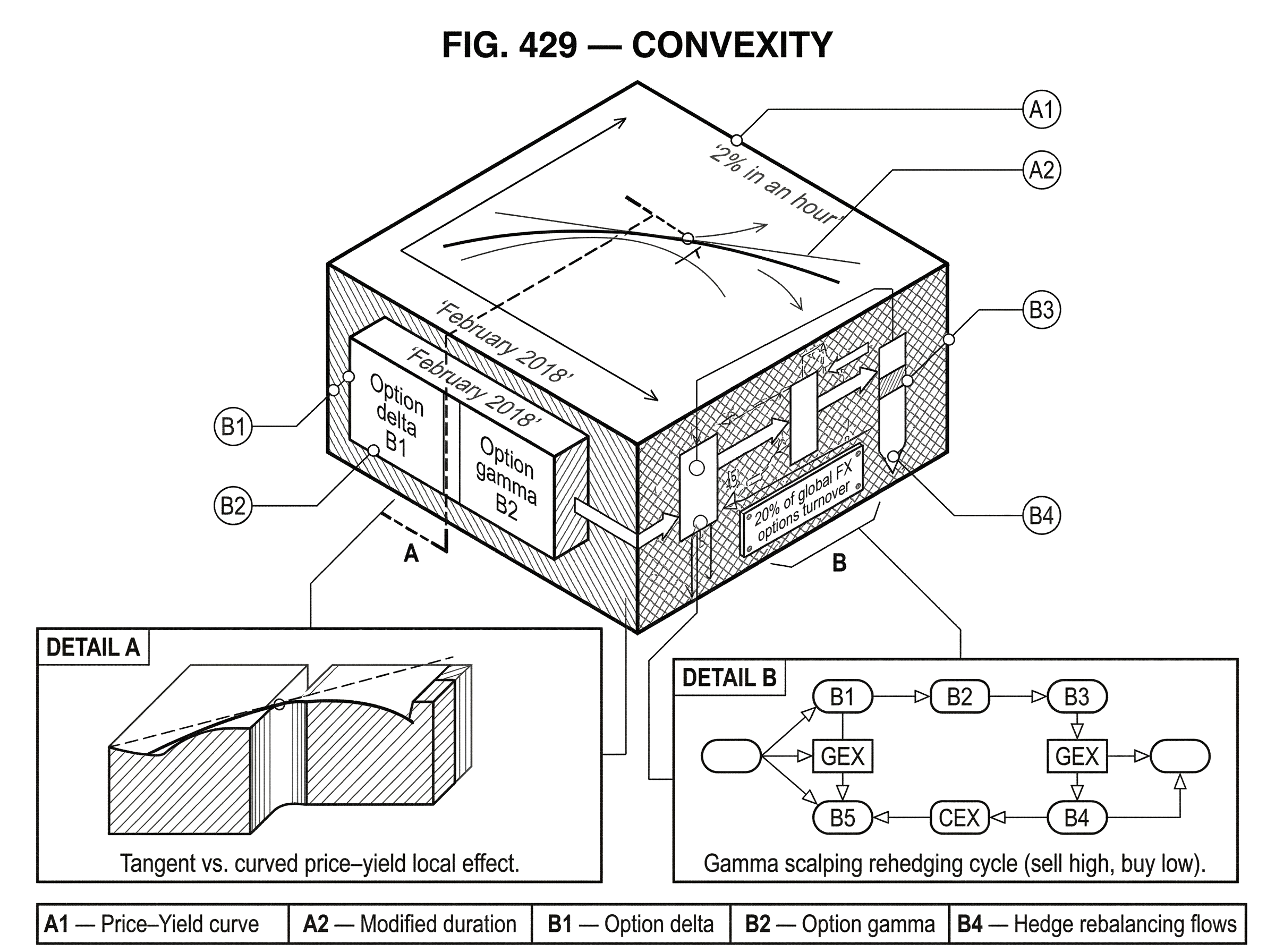
Introduction
Convexity is the part of market behavior that makes a position’s sensitivity change as the market moves. That sounds abstract, but it solves a very practical puzzle: why do some trades behave gently for small moves and then very differently once prices start running? If duration, delta, or some other first-order risk measure told the whole story, price changes would scale in straight lines. In real derivatives markets, they often do not.
The key idea is simple. A first-order measure tells you your current slope: how much price changes right now for a small move in the underlying variable. Convexity tells you how that slope itself changes. In bonds, the variable is usually yield. In options, the variable is usually the price of the underlying asset, and the closely related Greek is gamma, the rate of change of delta. Across both cases, the same structure appears: convexity is curvature.
That curvature matters because traders do not live in a world of infinitesimal moves. Rates can jump 25 or 50 basis points. An index can gap 2% in an hour. A market maker hedging options is forced to trade more or less aggressively as exposures change. Convexity is what connects those non-linear payoffs to actual trading flows, hedging demands, and sometimes to instability.
When do duration and delta stop being enough? How convexity changes the picture
Imagine an option-free bond and suppose yields rise a little. Modified duration gives a linear estimate of how much the bond price should fall. For a very small move, that estimate is useful. But the true bond price-yield relationship is curved, not straight. The linear approximation is a tangent line: accurate nearby, increasingly wrong as the move gets larger.
The same problem appears with options. Delta tells you how much the option price changes for a small move in the stock or index. But delta itself is not fixed. As the underlying moves, delta changes, sometimes quickly. A trader who hedges only to current delta and then assumes the hedge will stay right is implicitly pretending the payoff is linear. Options are not linear contracts, so that assumption breaks almost immediately.
This is the compression point for convexity: it is the correction for pretending a curved relationship is straight. Duration corrects a bond’s price for a small yield move, but convexity improves that estimate because the slope changes with yield. Delta corrects an option’s price for a small spot move, but gamma tells you delta will change as spot changes. Different markets, same geometry.
How does bond convexity change price behavior as yields move?
For a standard option-free fixed-rate bond, price and yield move in opposite directions. When yield falls, price rises; when yield rises, price falls. But the relationship is not symmetric in a linear way. According to CFA Institute’s fixed income refresher, convexity measures the second-order, non-linear effect of yield changes on bond price and complements modified duration.
The practical consequence is important. For an option-free fixed-rate bond, convexity is positive. That means if yields fall, the bond’s price rises by more than a duration-only estimate would suggest. If yields rise, the bond’s price falls by less than a duration-only estimate would suggest. Positive convexity benefits the holder because the curvature works in their favor on both sides relative to a straight-line estimate.
Here is the mechanism. Duration captures the local slope of the price-yield curve. Convexity captures how fast that slope changes as yield changes. When yields decline, the curve gets steeper in price terms, so gains accelerate relative to the linear estimate. When yields rise, the curve flattens enough that losses are smaller than the straight-line estimate. The asymmetry comes from the shape of the curve, not from a separate source of return.
A useful worked example is a long-maturity, low-coupon bond. Such a bond has cash flows pushed far into the future, so changes in discount rates affect those distant payments strongly. Duration is already high because the present value depends heavily on the discount rate. Convexity is also high because that dependence itself changes materially as the discount rate moves. If yields drop, those far-off cash flows reprice upward sharply. If yields rise, they still lose value, but the curvature means the loss is not just a mirror image of the gain.
CFA Institute also notes that convexity tends to increase with longer maturity, lower coupon, and lower yield. That mirrors duration’s dependence on those same bond features. The reason is structural: the more a bond’s value is concentrated in distant cash flows, the more exposed it is not just to the current discount rate but to changes in the sensitivity to that discount rate.
When traders or portfolio managers want to express this in position terms rather than as a pure ratio, they use money convexity. CFA Institute defines money convexity as annual convexity multiplied by the bond’s full price, which converts the concept into currency units or percent of par. That is useful because portfolios are managed in dollars, euros, or basis-point-value terms, not just abstract sensitivities.
Why portfolio convexity assumes parallel yield-curve shifts; and why that can mislead
| Method | Key assumption | Accuracy for non-parallel moves | Ease of use | Best for |
|---|---|---|---|---|
| Aggregate cash-flow | No parallel-shift assumption | High accuracy for twists | Harder to compute | Detailed hedging and valuation |
| Weighted-average | Assumes parallel yield shifts | Can mislead under curve twists | Easy and fast | Broad parallel-shock scenarios |
At the portfolio level, convexity sounds as if it should aggregate cleanly. In one sense it does: CFA Institute describes two ways to compute portfolio duration and convexity. The theoretically correct approach uses the weighted average timing of the portfolio’s aggregate cash flows. The more convenient practical approach uses the weighted average of the individual bonds’ durations and convexities.
The catch is not arithmetic but assumptions. The convenient weighted-average method implicitly assumes parallel shifts in the yield curve. In other words, it treats the whole curve as moving up or down together by the same amount. CFA Institute points out that such parallel moves are rare. That matters because a portfolio of bonds can have the same average duration and convexity under a parallel-shift assumption while behaving very differently if short rates rise and long rates barely move, or vice versa.
This is a good example of what is fundamental and what is convention. The fundamental object is the full mapping from the term structure to portfolio price. Duration and convexity are compressed summaries of that mapping. They are useful because humans need manageable risk measures, but they are summaries, not the thing itself. Once curve moves become non-parallel, summary measures can mislead.
That does not make convexity useless. It means convexity is most informative when the shock you care about resembles the shock built into the measure. For broad rate shocks and for rough scenario comparison, portfolio convexity is valuable. For detailed hedging of multi-maturity portfolios, traders often need a more granular framework because the curve can twist, steepen, or flatten rather than shift in parallel.
What is gamma and why is it the options-market form of convexity?
| Position | Gamma sign | Directional response | Main cost or benefit | Typical use |
|---|---|---|---|---|
| Long option | Positive gamma | Becomes more directional when underlying moves | Pays theta and volatility premium | Long-volatility strategies |
| Short option | Negative gamma | Exposure amplifies as moves accelerate | Collects theta but faces large losses | Income selling premium |
In options, the first-order sensitivity is delta: how much the option price changes for a small move in the underlying. Cboe’s educational material defines gamma as the rate of change of delta. That makes gamma the direct analog of convexity in options trading. If delta is the slope, gamma is how fast the slope changes.
A long call or long put usually has positive gamma. That means as the underlying rises, a long call’s delta tends to increase, and as the underlying falls, a long put’s delta tends to become more negative in the holder’s favor. More generally, a long option position tends to become more directionally responsive when the move helps it. This is the source of the classic statement that long optionality gives convex payoff exposure.
The simplest nontrivial example is a long straddle. Suppose a trader buys both a call and a put at the same strike. Near that strike, the position starts roughly delta-neutral, but it has positive gamma. If the stock rises, the call picks up delta faster than the put loses relevance, and the position becomes positively directional. If the stock falls, the put takes over and the position becomes negatively directional. Either way, the trader’s exposure leans into the move.
That sounds like free money until the missing cost appears: theta. Cboe describes theta as the change in option price as expiration approaches; the Alpaca gamma-scalping implementation explains the trade-off clearly. A long-gamma position benefits from movement, but every day that passes without enough movement costs option premium. Convexity is valuable, but it is not free. In listed options, you usually pay for it through time decay and often through implied volatility premia.
This is why options traders think in a bundle of sensitivities rather than one. Gamma captures convexity with respect to the underlying price. Vega captures sensitivity to implied volatility. Theta captures the cost of time passing. Rho matters more for longer-dated options. Convexity in practice sits inside that system of trade-offs.
How does gamma scalping monetize convexity and what are the practical limits?
A long-gamma trader can try to monetize convexity through gamma scalping. The idea is straightforward in principle and subtle in execution. You buy options, often a straddle, to obtain positive gamma. Then you trade the underlying asset against the changing delta of the options position in order to keep the overall book near delta-neutral.
Here is the mechanism in prose. Suppose the stock rises. Your long-gamma options position becomes net long delta, so to neutralize that exposure you sell some stock. Later the stock falls back. Your options delta shrinks, so you buy stock back at a lower price. If the market oscillates enough, this repeated “sell high, buy low” process converts realized volatility into trading profits. The option position supplies the curvature; the hedge trading tries to harvest it.
The Alpaca reference implementation describes gamma scalping as a market-neutral, long-volatility strategy and emphasizes the central trade-off: the strategy must make more from scalping fluctuations than it loses to theta and transaction costs. That is exactly the economic logic. Positive convexity is not intrinsically profitable; it is profitable when realized movement exceeds the movement implied in the option premium by enough to cover carry and execution costs.
The implementation also highlights a practical issue that many conceptual explanations leave vague: hedging frequency. If you rebalance too rarely, you fail to harvest the curvature and theta may dominate. If you rebalance too often, bid-ask spreads and trading costs eat the edge. There is no universal perfect threshold, because the answer depends on liquidity, spreads, underlying volatility, and the option structure itself.
This is where smart readers often misunderstand convexity. They see the curved payoff diagram and infer that convexity itself guarantees profit from volatility. It does not. The payoff shape creates potential to monetize movement, but the realized outcome depends on the path of prices, the cost of owning the option, the level of implied volatility you paid, and your rehedging discipline.
How does individual convexity scale into market-wide effects (GEX and dealer hedging)?
| Dealer gamma sign | Hedge flow direction | Market effect | Volatility tendency | Trader implication |
|---|---|---|---|---|
| Net long gamma | Buy into weakness sell into strength | Stabilizes intraday price moves | Damps realized volatility | Favors mean reversion trades |
| Net short gamma | Sell into weakness buy into strength | Amplifies directional moves | Increases realized volatility | Raises liquidity and crash risk |
Convexity does not stop at the portfolio boundary. In options markets, dealers who make markets often dynamically hedge the deltas created by the options they buy and sell. Because gamma changes delta, dealer hedging flows themselves can become a market force.
The core microstructure logic appears in both educational and research sources. SqueezeMetrics defines Gamma Exposure (GEX) by aggregating option gamma across strikes and expirations using open interest. SpotGamma similarly describes GEX as an estimate of how much dealer delta changes for a 1% move in the underlying and therefore how much dealers may need to buy or sell to stay hedged. The sign of that aggregate gamma matters because it changes whether dealer hedging is stabilizing or destabilizing.
When dealers are effectively long gamma, their delta hedge tends to move against the price move: they buy into weakness and sell into strength. That behavior damps volatility and can create mean-reverting conditions. When dealers are effectively short gamma, the hedge moves with the price move: they sell as the market falls and buy as it rises. That is pro-cyclical. It can amplify price swings and thin the market just when traders most want liquidity.
This is the bridge from convexity as a mathematical property to convexity as a trading regime. The convex shape of outstanding option positions determines how dealer deltas evolve. Delta changes force hedge rebalancing. Hedge rebalancing becomes order flow in the underlying. Order flow affects realized volatility and, in stressed cases, can feed back into price.
The idea is plausible in theory, but does it show up empirically? Evidence suggests it can. A Swiss National Bank working paper on FX options derives a closed-form relationship linking spot volatility to aggregate dealer gamma exposure under assumptions including linear permanent market impact and differential hedging intensity. Using reconstructed dealer positioning from DTCC data, the authors find that dealers were persistently net short gamma in their sample and that this short-gamma exposure was associated with higher realized spot volatility.
The same paper quantifies the effect for EURUSD and USDJPY, while also being clear about the limits: the repository covered only about 20% of global FX options turnover, aggressor side had to be inferred, and the model assumes a simplified impact structure. Those caveats matter. They do not erase the mechanism; they tell you not to treat any single GEX estimate as a law of nature.
This is also the right place to separate fact from convention. The fundamental fact is that dynamic hedging of non-linear option exposure can create predictable directional trading needs as prices move. The conventions are the various vendor-specific ways of estimating aggregate gamma from open interest, live volume, or inferred dealer positioning. Those estimates can be useful, but they are models of positioning, not direct observations of every hedge book.
When does convexity become dangerous? Real examples and failure modes
Convexity is often attractive in calm discussion because positive convexity sounds like owning insurance. But convexity can also be dangerous when you are short it, levered into it, or funding it with a structure that rebalances mechanically.
A vivid case comes from inverse volatility products. Nasdaq’s analysis of the February 2018 collapse describes how inverse VIX-linked products such as XIV and SVXY suffered catastrophic losses when VIX futures surged. The important point is not the product branding; it is the shape of the exposure. An inverse structure that benefits from falling volatility can be devastated by a very large one-day rise in the thing it is short. The losses are not merely large in a linear sense; they accelerate because the exposure is non-linear and path-dependent.
That episode is a reminder that convexity is not just an options-pricing abstraction. It is present whenever payoffs, hedges, or rebalancing rules make exposure change as the state changes. A product can look stable during ordinary days and still contain a convex mechanism that only becomes visible under stress. By the time it becomes visible, the repricing can be violent.
What convexity reveals about risk; and what it leaves out
Convexity tells you that the future sensitivity of a position depends on the path the market takes. That is why it is so central in derivatives. It explains why long options can accelerate into profitable moves, why bond gains and losses are not mirror images around duration estimates, and why hedgers can become forced buyers or sellers as markets move.
But convexity alone is not a complete risk framework. In bonds, the measure depends on assumptions about how yields move, and portfolio aggregation can hide non-parallel curve risk. In options, gamma has to be read alongside theta, vega, and liquidity. In market-wide positioning analysis, aggregate gamma metrics depend on open-interest data, trade classification rules, and assumptions about who is long or short the options and how tightly they hedge.
The simplest way to remember the idea is this: duration and delta tell you where your exposure is now; convexity and gamma tell you how that exposure will mutate if the market keeps moving. In trading, that mutation is often the difference between a manageable position and one that starts managing you.
Conclusion
Convexity is curvature in market exposure. In bonds, it improves on duration by capturing the second-order effect of yield changes on price. In options, it appears as gamma, the change in delta as the underlying moves. And in actual markets, that curvature does not stay on a payoff diagram: it turns into hedging flows, volatility regimes, and sometimes feedback loops.
A good practical test is to ask not only, “What happens if the market moves 1% or 25 basis points?” but also, “How will my sensitivity change after that move?” That second question is the one convexity was invented to answer.
Frequently Asked Questions
For a standard option-free fixed-rate bond, convexity is positive so price gains when yields fall are larger than a duration-only linear estimate would predict, and losses when yields rise are smaller than the linear estimate; CFA Institute explains this as the second-order curvature of the price–yield relationship that complements modified duration.
Portfolio convexity computed as a weighted average of individual bond convexities assumes parallel shifts of the yield curve, which the article warns is rare; when the curve twists or steepens, that aggregated summary can be misleading and managers need more granular tools (e.g., cash‑flow aggregation, key‑rate analysis, or scenario‑based methods) to capture non‑parallel risk.
gamma is the options-market analogue of convexity: delta is the first‑order slope and gamma is the rate at which that slope changes, so long‑gamma positions become more directionally responsive as moves occur but are costly to hold because theta (time decay) erodes option premium; Cboe and the article emphasize reading gamma alongside theta and vega rather than in isolation.
Gamma scalping monetizes convexity by rebalancing the underlying to remain roughly delta‑neutral: you sell stock after an up move and buy after a down move so oscillations generate scalping profits, but the strategy only wins when realized volatility and execution quality overcome option theta and transaction costs, and optimal hedge frequency depends on liquidity and spreads rather than a universal rule.
Aggregate Gamma Exposure (GEX) is an estimate of how much dealers’ net delta changes for a small move in the underlying and is used to infer whether dealer hedging will be stabilizing (dealers net long gamma buy into weakness and sell into strength) or destabilizing (dealers net short gamma sell into weakness and buy into strength); vendors like SpotGamma and research papers (SqueezeMetrics, SNB) describe this mechanism and its empirical associations with realized volatility while noting measurement caveats.
GEX and other aggregate gamma metrics rely on simplifying assumptions - for example, that market‑makers hedge to option delta, that trade sides and hedging intensity can be inferred from open interest and volume, and that hedging is point‑delta rather than banded - so these estimates are useful indicators but sensitive to assumption violations and should not be treated as exact observations of every hedge book.
Convexity can be dangerous when you are short it or levered into it: inverse‑volatility products and short‑gamma structures can experience accelerating, path‑dependent losses in sharp moves - the February 2018 inverse‑VIX ETN episode is cited as an example where a sudden spike in volatility caused catastrophic, nonlinear losses.
The article flags bonds with embedded options as a special case where convexity can be negative or path‑dependent and explicitly notes that it does not provide a single prescription for measuring convexity in those instruments; practitioners therefore use option‑adjusted models and more detailed scenario analysis to capture the embedded optionality’s effect on sensitivity.
Related reading