What Is the Exponential Moving Average (EMA)?
Learn what the Exponential Moving Average (EMA) is, how it works, why traders use it, and how it differs from a simple moving average.
Introduction
Exponential Moving Average (EMA) is a way to smooth price data while keeping more sensitivity to what the market has done most recently. That sounds like a small tweak to an ordinary moving average, but it changes the indicator’s behavior in an important way: the EMA is built to forget old information gradually instead of dropping it all at once.
That design solves a real problem. Raw price charts are noisy. A trader looking at every bar, tick, or candle can easily confuse random fluctuation with meaningful movement. A plain average helps, but a simple moving average has a hard cutoff: data inside the lookback window counts equally, and data just outside it counts not at all. Markets do not actually work that way. Yesterday usually matters more than fifty days ago, and fifty days ago usually matters more than a year ago. The EMA tries to reflect that reality.
The central idea is simple: each new price updates the average, but the update is only partial. Recent observations get more influence, older ones fade away exponentially, and the result is a line that follows price more closely than a simple moving average while still filtering noise. That is why EMAs appear everywhere in trading, from discretionary chart analysis to algorithmic systems and indicators like MACD.
What makes the EMA worth understanding is not just its popularity. It is that the indicator expresses a general tradeoff in markets: the faster you respond, the more noise you admit; the more you smooth, the more delay you accept. The EMA is one of the cleanest examples of that tradeoff in action.
Why use a weighted moving average (EMA) instead of a simple moving average (SMA)?
| Feature | Weighting | Reaction | Best for |
|---|---|---|---|
| Simple Moving Average (SMA) | Equal weight last N | Slower, abrupt cutoff | Stable average / support |
| Exponential Moving Average (EMA) | Recency-weighted decay | Faster, smoother turn | Timely trend detection |
A moving average exists because price is a mixture of signal and noise. The signal is whatever persistent structure you care about; trend, momentum, mean reversion pressure, regime shift. The noise is the part that can reverse immediately and may not tell you much about the next bar. If you use raw prices alone, you react quickly but unreliably. If you average prices, you reduce noise, but you necessarily become slower.
The question is not whether to smooth. The question is how to forget the past. A simple moving average, or SMA, answers by treating the last N observations equally. If the lookback is 20, every one of the last 20 bars gets weight 1/20, and the 21st bar back gets weight zero. That is easy to compute and easy to explain, but the weighting rule is mechanically awkward. A price from 20 bars ago has the same influence as the current bar, and then one bar later it disappears entirely.
The EMA uses a different rule. Instead of a rectangular window with equal weights, it uses a decay process. The newest price gets the largest weight. The previous EMA value carries the accumulated influence of older prices, but that influence is shrunk by a fixed factor each step. So old information does not vanish at a boundary; it fades continuously.
This is the idea that makes EMA click: it is not primarily an average over a fixed box of history; it is a running estimate that is repeatedly updated with partial trust in new information. Once you see it that way, many of its properties become obvious. A short EMA trusts new prices a lot, so it turns quickly. A long EMA trusts new prices less, so it moves more slowly. Neither one escapes lag, because both are still summaries of the past.
How does the EMA update work (the recursive formula explained)?
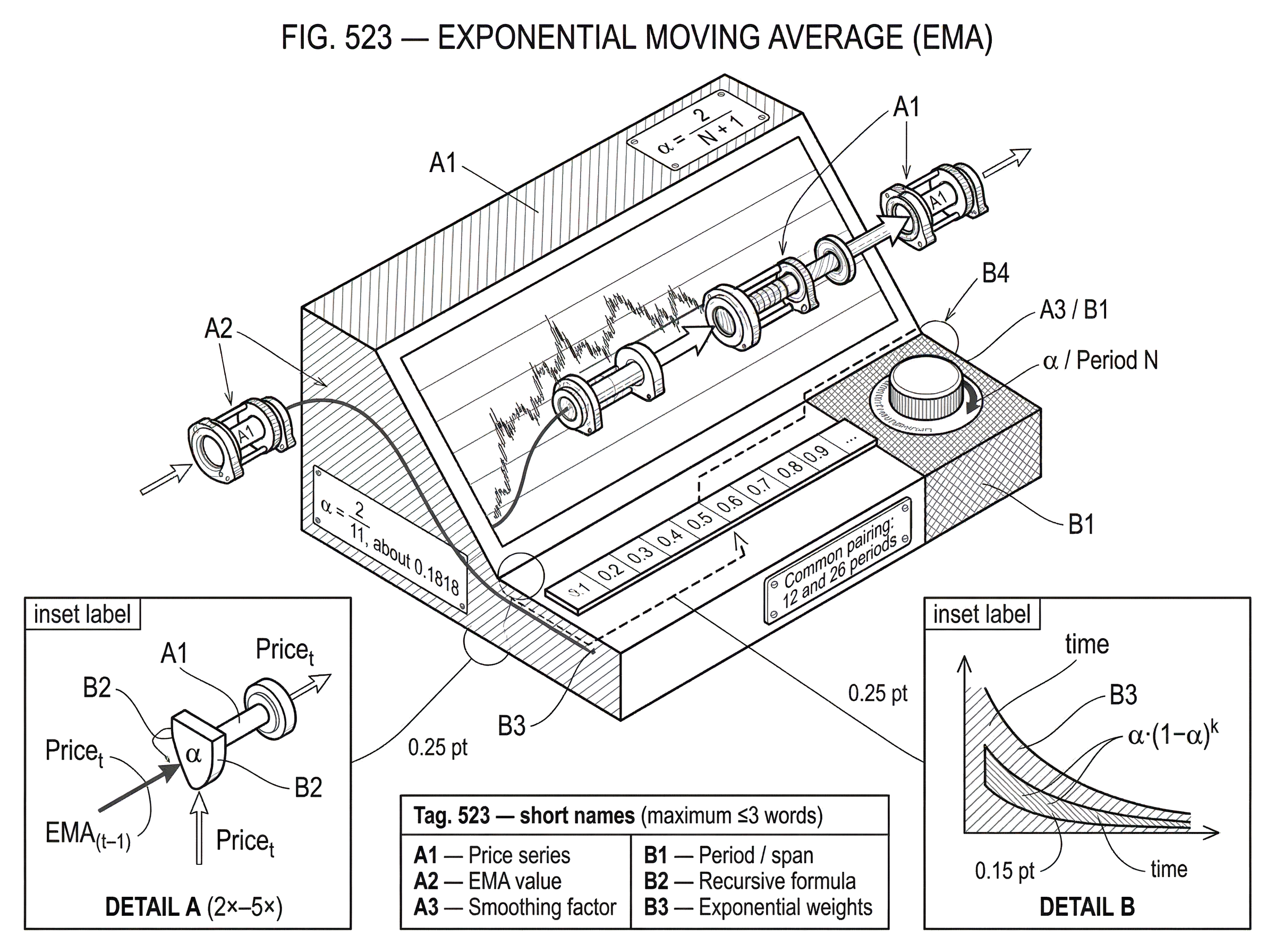
The recursive update is the heart of the indicator. If EMA_t is the current EMA value, Price_t is the current price, and α is the smoothing factor, then the update is:
EMA_t = α Price_t + (1 - α) EMA_(t-1)
This says the new EMA is a blend of two things: the latest price and the previous EMA. The parameter α, pronounced alpha, determines how aggressively the line responds. If α is large, the new price has a lot of influence and the EMA hugs price more tightly. If α is small, the previous EMA dominates and the line changes more gradually.
In trading platforms, traders often specify a length rather than α directly. A common conversion is:
α = 2 / (N + 1)
where N is the EMA period or span. So a 10-period EMA uses α = 2 / 11, about 0.1818, meaning the newest observation gets about 18.18% of the update weight. A 20-period EMA uses α = 2 / 21, about 0.0952, so it reacts more slowly. This is why increasing the period smooths the line: it lowers the update weight on the newest bar.
The recursive formula is compact, but it hides an important fact. If you expand it backward, you find that the EMA is equivalent to a weighted sum of past prices where the weights decay geometrically. Today’s price gets weight α, yesterday’s gets α * (1 - α), the day before gets α * (1 - α)^2, and so on. That is what people mean when they say the EMA uses exponentially decreasing weights. The decline is smooth and never truly reaches zero; older observations just become negligible.
That property explains both the appeal and the limitation of the EMA. Because recent prices matter more, the line reacts faster than an SMA of similar nominal length. But because older data still matter, the EMA cannot jump instantly to a new level unless price itself jumps and stays there. Smoothing always means memory, and memory always means lag.
Example: How does an EMA respond after a sudden price jump?
Imagine a market has been trading quietly around 100, and your EMA is also near 100. Then a strong new bar closes at 110. What happens?
If your EMA is short, say with α around 0.18, the new close does not drag the average all the way to 110. Instead, it pulls the EMA part of the way there. Starting from 100, the update becomes about 0.18 110 + 0.82 100 = 101.8. That may look surprisingly small at first, but it reveals the mechanism clearly. The EMA is saying: “I notice this move, but I do not yet believe the entire market level has changed by 10 points.”
Now suppose the next few bars also close near 110. The EMA will keep moving upward each period, because each new bar repeats the evidence that price has shifted. It might go from 101.8 to about 103.3, then 104.5, and so on. The key is that the gap closes faster when the discrepancy between price and EMA is large, then more slowly as the EMA approaches the new level. The update rule can also be written as:
EMA_t = EMA_(t-1) + α * (Price_t - EMA_(t-1))
This version makes the mechanism especially intuitive. The new EMA equals the old EMA plus a fraction α of the current error. So the EMA behaves like a smoothing process that corrects itself toward price a little bit at a time.
This is also where smart readers often misread the indicator. They may think a 10-period EMA “uses only 10 bars.” It does not. It uses the whole history in principle, but with exponentially fading influence. The period is best understood as a parameter that controls decay speed, not as a strict cutoff.
How is the EMA faster than an SMA; and what are its limits?
Traders often say the EMA is “faster” than the SMA. That is true in the specific sense that the EMA usually turns sooner when price changes direction, because it assigns more weight to the newest observations. StockCharts, for example, emphasizes that EMAs reduce lag relative to SMAs by weighting recent prices more heavily, and that they will typically turn before simple moving averages.
But “faster” can be misunderstood. The EMA does not predict price. It only updates its estimate more aggressively. If the market is choppy, that same aggressiveness can make the line react to moves that do not persist. So the gain in timeliness is paid for with greater vulnerability to false turns.
This is the fundamental tradeoff. A slower average suppresses more noise but enters trends late. A faster average catches more of the early move but is more easily whipsawed in sideways conditions. There is no parameter that removes this tradeoff. Changing the period only moves you along it.
This is why claims like “the 9 EMA is best” or “the 20 EMA works” are incomplete without context. Best for what asset, what timeframe, what holding period, what market regime, and what decision rule? An EMA is not a self-contained strategy. It is a smoothing operator embedded inside a larger process of interpretation.
How does EMA period length affect responsiveness and memory?
| Range | α (approx) | Behavior | Best use |
|---|---|---|---|
| Short (≈9–10) | α ≈ 0.18 (N=9–10) | Hugs price closely | Short-horizon momentum |
| Medium (≈20–50) | α ≈ 0.095–0.039 (N=20–50) | Balanced responsiveness | Tactical trend filter |
| Long (≈100–200) | α ≈ 0.019–0.01 (N=100–200) | Very smooth, slow turn | Broad trend / regime |
In charting software, EMA settings are usually expressed as a length such as 9, 12, 20, 50, or 200. Those numbers are conventions, not laws of nature. Their practical meaning comes from how much memory they imply.
A short EMA, such as 9 or 10 periods, gives substantial weight to the most recent bar. It tends to stay close to price and is useful when the trader cares about short-horizon momentum or wants signals to appear quickly. A medium EMA, such as 20 or 21 periods, smooths more and is often used as a compromise between responsiveness and stability. Long EMAs like 50, 100, or 200 periods change much more slowly and are often used as broad trend filters rather than tactical timing tools.
The period changes behavior because it changes α. With the common mapping α = 2 / (N + 1), doubling the length roughly halves the weight on the newest observation. As that weight falls, the line becomes less sensitive to single-bar shocks and more representative of persistent movement.
There is an important subtlety here. Two EMAs with different lengths are not merely “fast” and “slow” versions of the same truth. They are estimates of market direction at different time scales. A 10-period EMA may slope down during a pullback inside a much larger uptrend that a 200-period EMA still shows clearly. Neither is wrong. They answer different questions.
How do traders use EMAs in real trading setups?
Most practical EMA use flows from one of two ideas: using the EMA as a trend estimate, or using the relationship between price and EMAs as a signal about changing conditions.
When traders use a single EMA, they usually treat it as a dynamic reference line. If price is consistently above a rising EMA, that suggests upward pressure is dominating over the chosen horizon. If price is below a falling EMA, the opposite is true. The slope matters because an upward-sloping EMA means recent prices have, on average, been pulling the estimate higher. In that sense, the EMA translates a messy sequence of bars into a smoother statement about direction.
When traders use multiple EMAs together, the key mechanism is comparison across time scales. A short EMA responds quickly; a long EMA responds slowly. If the short EMA rises above the long EMA, recent price action is stronger than the longer-run baseline, which is why crossover systems interpret that event as bullish. If it falls below, the recent horizon has weakened relative to the longer horizon. TradingView and StockCharts both note that traders commonly combine multiple EMA lengths, and pairings such as 12 and 26 periods or 50 and 200 periods are especially common.
A familiar example is MACD. In its common form, MACD is the difference between a faster EMA and a slower EMA, often 12 and 26 periods, and then a signal line is formed by taking an EMA of that difference. This is a useful example because it shows EMA not just as a chart overlay but as a general building block. Once you have an operator that smooths a time series with recency weighting, you can apply it to price, to spreads, or even to another indicator.
Another common use is as a trend filter in a strategy that is not otherwise based on moving averages. A trader might only take long breakout setups when price is above a rising 50 EMA, or only short mean-reversion trades when price is below a 200 EMA and the broader regime is bearish. In these cases the EMA is not the trigger. It is a way to define market context.
Why do EMA crossover signals produce whipsaws in range-bound markets?
| Market regime | EMA behavior | Typical signals | Main risk |
|---|---|---|---|
| Trending | Follows sustained moves | Reliable crossovers | Late entries possible |
| Ranging | Oscillates around price | Many false crossovers | Frequent whipsaws |
| Choppy / low persistence | Erratic turns | Unstable signals | High false rate |
The most tempting use of EMA is to treat every cross as meaningful. Price crosses above the EMA, so buy. Price crosses below, so sell. Or use a fast EMA crossing a slow EMA. These ideas can work in persistent trends because the EMA is designed to follow sustained movement with a delay that is often acceptable relative to the size of the trend.
The trouble comes when the market lacks directional persistence. In a range, price oscillates around a relatively flat average. The EMA then keeps getting pulled first one way, then the other. Because it is always reacting to the latest bars, it can produce repeated entries and exits with little net progress. StockCharts explicitly warns that moving-average crossover systems produce many whipsaws when there is no strong trend.
This is not a flaw in the coding. It is a consequence of what the EMA is measuring. The indicator is best thought of as a smoothed estimate of level or direction under the assumption that recent data should matter more. If the process you are observing has no stable directional structure, the estimate will keep changing its mind. In that environment the problem is not that the EMA is inaccurate; it is that the market is not offering the sort of structure the EMA is meant to summarize.
That is why traders often combine EMA-based signals with additional conditions: slope filters, volatility filters, higher-timeframe alignment, breakout confirmation, or volume context. Those additions do not fix lag, but they can help distinguish trend continuation from noise.
Why do EMA values differ across platforms, and how should you warm up the indicator?
EMA looks simple enough that many traders assume two platforms must always show the same value if the period is the same. In practice, small differences are common, especially at the beginning of a series.
The reason is initialization. The recursive formula requires a starting value for the first EMA. But what should that be? A common choice is to seed the EMA with a simple moving average of the first N observations. Another is to use the first observed price directly. TA-Lib’s source code explicitly documents multiple seeding conventions, including a classic approach that uses an SMA of the first period and a MetaStock-style approach that uses the first price bar as the seed. These choices affect the early values, and the effect can propagate for a while before fading.
This is one source of chart mismatches. Another is whether a library computes the early EMA as a fully adjusted weighted average or as a pure recursive update from the start. In pandas, for example, exponentially weighted calculations support both an adjust=True mode, which computes explicit decaying weights and normalizes them, and an adjust=False mode, which uses the recursive formula directly. Both are reasonable, but they are not numerically identical in the early part of the series.
The good news is that these differences usually matter less as more data accumulates. Because old initialization effects decay exponentially, long histories tend to make implementations converge. The bad news is that if you are matching a broker, a charting platform, or a backtest engine, the exact startup convention can still matter, especially for shorter EMAs or strategies that trigger on early bars.
So if two EMA plots do not match exactly, the first question is often not “Which formula is wrong?” but “What seed, adjustment method, and warm-up history does each implementation use?”
How is the EMA related to exponential smoothing and forecasting methods?
The EMA belongs to the larger family of exponential smoothing methods. NIST describes exponential smoothing as a scheme that weights past observations using exponentially decreasing weights. In that broader forecasting context, the simplest form corresponds closely to the intuition behind EMA: estimate the current level by blending the newest observation with the previous estimate.
This connection matters because it clarifies what is fundamental and what is conventional. The fundamental idea is recency-weighted updating under exponential decay. The trading convention of calling something a 20-day EMA, plotting it over price, and using crosses as signals is a specific application of that broader mathematical idea.
It also helps explain neighboring indicators. Double and triple exponential smoothing methods exist because some time series contain structure beyond a changing level; for example, trend or seasonality. In trading, related constructions like DEMA and TEMA try to modify smoothing behavior and reduce lag, but they are best understood as variations on the same underlying problem: how to preserve useful smoothing while becoming more responsive.
What practical EMA implementation issues should traders check (sources, spacing, warm-up)?
An EMA is usually applied to closing price, but it does not have to be. Many platforms allow the source to be open, high, low, close, median price, or another derived series. MetaTrader’s iMA function, for example, lets users specify the applied price and moving-average method. Pine Script exposes ta.ema(series, length), which means the input can be any series, not just close. That matters because the EMA is an operator on a time series, not a special property of closing prices alone.
Spacing also matters. Most chart-based EMAs assume evenly spaced bars: daily, hourly, five-minute, and so on. If observations are irregular, the idea of “periods” becomes less natural. Some libraries, such as pandas through ewm, support time-based decay semantics in certain contexts, allowing the weight decay to depend on elapsed time rather than bar count. That is a reminder that the usual trading EMA is partly a modeling convention: it assumes each bar is one equal step of memory.
Warm-up depth is another overlooked issue. Since EMA depends on prior EMA values, you need enough history before trusting the line. If you start a 200-period EMA with only 200 bars, you can compute something, but the result may still carry noticeable startup bias depending on the seed method. Many production systems therefore load more history than the nominal period length before using the indicator operationally.
What information does an EMA provide; and what can’t it predict?
The EMA can tell you that recent prices, weighted by recency, imply a smoothed direction or level. It can show whether current price is above or below that smoothed baseline. It can compare short-horizon behavior to long-horizon behavior. Those are genuinely useful pieces of information.
What it cannot tell you is whether the next move will continue. It does not understand news, order flow, valuation, liquidity stress, or structural breaks except indirectly through price. TradingView notes that EMAs rely on historical price data and can misinterpret rapidly occurring events. That is exactly right. If a market gaps on unexpected news, the EMA responds only after the move appears in the data.
Nor can the EMA remove the need for regime awareness. In strong trends, lag can be tolerable because the move is large enough to survive delayed entry. In a range, that same lag can turn the indicator into a whipsaw machine. The EMA does not know which environment it is in unless you define that context elsewhere.
So the right way to think about the EMA is modestly but seriously. It is not a magical edge. It is a disciplined way to summarize recent price history with a specific forgetting rule. If that rule fits your trading horizon and the market’s structure, the EMA is useful. If not, it will still produce a line; just not one with much decision value.
Conclusion
The Exponential Moving Average is a moving average that gives more weight to recent prices and lets older information fade exponentially rather than disappear at a fixed cutoff. That single design choice is why it reacts faster than a simple moving average, why it still lags price, and why it works best when markets have some persistence to summarize.
If you remember one thing, remember this: an EMA is a running estimate that updates by taking a fraction of the gap between price and the previous estimate. Everything traders care about (responsiveness, smoothness, lag, whipsaw risk, and crossover behavior) follows from that mechanism.
Frequently Asked Questions
The EMA update is EMA_t = α Price_t + (1 − α) EMA_{t−1}; traders commonly convert a length N to α via α = 2/(N+1), so increasing N reduces α and makes the line smoother and slower to react.
Using a larger period lowers α (with α = 2/(N+1)), so the newest observation receives less weight and the EMA responds more slowly; conversely a shorter period raises α, making the EMA hug price more closely but admit more noise - there is no parameter that eliminates the tradeoff between responsiveness and whipsaw risk.
Different platforms and libraries can produce small early differences because they use different startup seeds and computation modes (for example seeding with an SMA of the first N bars versus using the first price, or using an explicit weighted calculation versus the pure recursive update), and numerical options like pandas' adjust=True/False further change early-period values.
You generally need more history than the nominal period because initialization choices bias early values; most production systems therefore load extra warm-up history and rely on the fact that initialization effects decay exponentially as more data accumulates.
EMAs reduce lag relative to simple moving averages because they weight recent prices more heavily, but they still lag because they are based on past data and older observations never drop to zero influence instantly.
In ranges the EMA flips with recent bars and produces many whipsaws; traders commonly add context (slope or volatility filters, higher-timeframe alignment, breakout confirmation, or volume conditions) to reduce false signals because those additions help screen for the persistent directional structure the EMA is meant to summarize.
The EMA is a special case of exponential smoothing (a recency-weighted running estimate); related constructions such as DEMA and TEMA or double/triple exponential smoothing exist to try to reduce lag or handle trend/seasonality, but they are variations on the same tradeoff between smoothing and responsiveness.
An EMA is an operator on any evenly spaced series and is commonly applied to close, but charting platforms and APIs let you use open/high/low/median or other derived series; for irregular timestamps some libraries (for example pandas' ewm with times/halflife options) support time-based decay so the effective weighting can depend on elapsed time rather than bar count.
Related reading