What is Simple Moving Average (SMA)?
Learn what the Simple Moving Average (SMA) is, how it works in trading, why it smooths price, where it lags, and how traders use SMA signals.
Introduction
Simple Moving Average (SMA) is one of the most widely used tools in trading because it does something both modest and useful: it replaces a noisy price series with a smoother estimate of direction. That sounds almost too simple to matter. Yet the reason SMA persists is exactly that it addresses a basic problem every trader faces; price moves on many time scales at once, and raw charts often hide the part you actually care about.
A market price is not just “the trend.” It is a mixture of long swings, short-term fluctuations, gaps, reversals, and random noise. If you look only at the latest bar, you get maximum freshness but minimum stability. If you average too much history, you get stability but lose responsiveness. The SMA sits directly on that tradeoff. It is not trying to predict the future. It is trying to summarize the recent past in a way that makes the current regime easier to see.
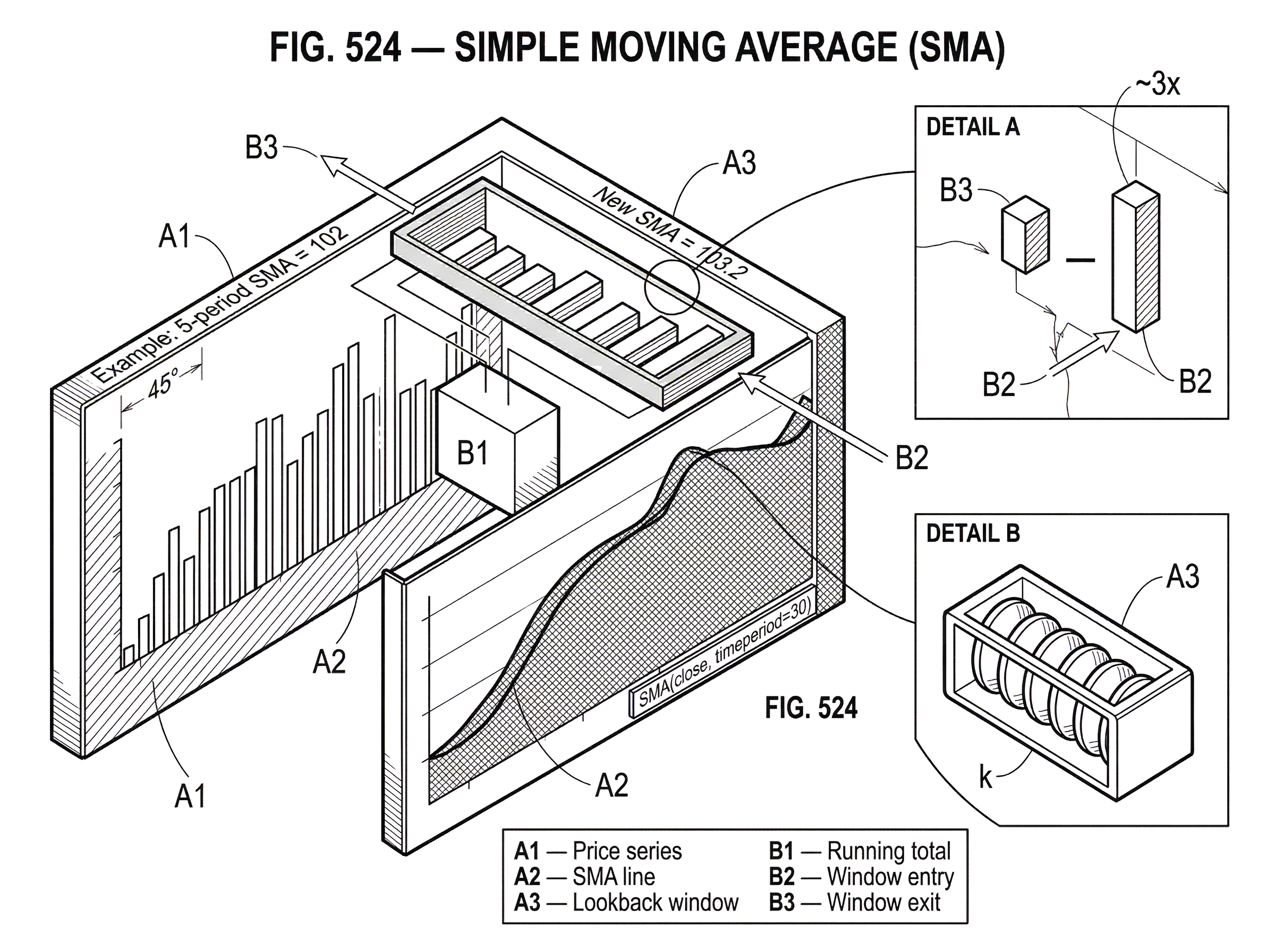
That is the key to understanding why traders use it. An SMA is not magic, and it is not a model of value. It is a filter. More specifically, it is an unweighted average of the previous k data points, where k is the lookback window. In charting practice those data points are often closing prices, though platforms may allow other sources such as open, high, low, or typical price. As new data arrives, the window moves forward: the newest point enters, the oldest point leaves, and the average updates. That rolling behavior is what makes the average “moving.”
How does an SMA weight recent prices and why does it give equal weight inside the window?
The most important thing about the SMA is not the arithmetic. It is the weighting rule. Inside the window, every observation gets equal weight. Outside the window, the weight is zero. That sounds innocent, but it fully determines how the indicator behaves.
Suppose a trader wants to know whether the last month of price action has been broadly rising or falling. Looking at each daily close separately is hard because day-to-day moves bounce around. The SMA answers by saying: forget the exact path for a moment; take the last k closes and compress them into a single number. If today’s close replaces a lower close from k days ago, the average tends to rise. If it replaces a higher one, the average tends to fall. The line moves only when the composition of the window changes.
This explains both the strength and weakness of the SMA. The strength is that brief fluctuations matter less because no single recent price dominates the average. The weakness is that the SMA is deliberately slow. By construction, it cannot fully reflect a sudden new move until enough old observations have rolled out of the window. In other words, it gains smoothness by giving up immediacy.
There is also a subtle consequence many beginners miss. Because all points inside the window are equally weighted, the most recent close does not receive special emphasis. Yesterday’s price counts exactly as much as the price from k - 1 bars ago. So if your real goal is “tell me quickly when the market changes,” the SMA may feel too inert. If your goal is “show me the broad direction and ignore a lot of noise,” that inertia is part of the point.
How do you calculate a simple moving average (SMA)? Formula and worked example
If P_t is the price at time t, and the lookback length is k, then the SMA at time t is the average of the last k prices:
SMA_t = (P_t + P_(t-1) + ... + P_(t-k+1)) / k
Every symbol here has a simple meaning. P_t is the latest price observation. k is the number of bars in the window. SMA_t is the rolling average attached to the current bar.
A concrete example makes the mechanism clearer. Imagine the last five closing prices are 100, 102, 101, 103, and 104. A 5-period SMA is (100 + 102 + 101 + 103 + 104) / 5 = 102. On the next day, suppose the new close is 106. The window is no longer 100 through 104; it becomes 102, 101, 103, 104, 106. The old 100 drops out, the new 106 enters, and the new SMA becomes 103.2. The average rises not just because price rose today, but because a relatively low old number left the sample and a higher new one entered.
That last point matters in practice. An SMA changes for two reasons at once: the newest value comes in, and the oldest value leaves. Traders often notice the first cause and forget the second. But the second is why SMA signals can sometimes change abruptly even when the newest price move seems modest. The average may shift because a large old observation just rolled off the edge of the window.
From an implementation standpoint, SMA is cheap to compute. You do not need to resum the entire window from scratch every bar. With a running total, the update is just: subtract the oldest value, add the newest value, divide by k. This low computational cost is one reason SMA became standard in charting platforms, trading libraries, and real-time systems.
Why does a simple moving average smooth price? (boxcar / low‑pass intuition)
The smoothing effect comes from cancellation. Short-term moves often alternate in sign: up one day, down the next, then up again. When you average several such observations together, part of that back-and-forth motion cancels out. What survives more clearly is the lower-frequency movement; the slower drift that pushes the average upward, sideways, or downward over time.
In signal-processing language, a moving average is a convolution with a boxcar kernel, which is why it behaves like a simple low-pass filter. You do not need that vocabulary to use the indicator, but it helps explain the mechanism precisely. “Low-pass” means slower-moving components are preserved more than faster oscillations. “Boxcar” means the weighting profile is flat inside the window and zero outside it.
This formal view is useful because it clarifies a common misconception. SMA does not “remove noise” in any absolute sense. It suppresses some high-frequency variation, but not perfectly. In fact, a major drawback of the SMA is that it still allows a meaningful amount of shorter-period signal to pass through. That is why the result can be less smooth than people expect, and why artifacts can appear in the smoothed line that were not obvious in the raw data.
So the right mental model is not “SMA reveals the true trend.” The better model is: SMA imposes a particular definition of trend by averaging over a fixed window with equal weights. If that definition matches the horizon you care about, the indicator is helpful. If it does not, the output can be misleading while still being mathematically correct.
SMA period tradeoff: how window length affects responsiveness and stability
| Window | Responsiveness | Smoothness | Lag | Best for | Typical periods |
|---|---|---|---|---|---|
| Short | High | Low | Low | Tactical timing | 5–20 |
| Medium | Medium | Medium | Medium | Intermediate trend | 21–100 |
| Long | Low | High | High | Long-term trend | 100+ |
Everything important about SMA period selection follows from one tension: a longer window reduces noise but increases lag. A shorter window tracks price more closely but reacts to many small fluctuations that may not matter.
Take a 5-bar SMA and a 50-bar SMA on the same chart. The 5-bar line will turn quickly because each new observation is 20% of the window. The 50-bar line will turn slowly because each new observation is only 2% of the window. The shorter SMA is more sensitive to recent conditions; the longer SMA is more committed to the broader past. Neither is inherently superior. They answer different questions.
This is why traders often speak of window length in terms of horizon. A 200-bar SMA is commonly used as a rough long-term trend proxy, while a 50-bar SMA is often used for an intermediate trend. Shorter SMAs can be used for tactical timing. The underlying logic is simple: choose k to match the movement you care about. If you are trying to assess a long swing, a 5-bar average is too twitchy. If you are trying to detect a fresh reversal, a 200-bar average will be too late.
There is no universally optimal k. The best choice depends on the asset, timeframe, trading costs, and what “useful” means in your strategy. That uncertainty is important. Many traders slide from “this parameter worked historically” to “this parameter captures a law of the market.” Usually it does not. It captures a compromise that happened to fit a given objective and sample.
Why does the SMA lag price, and how large is the lag typically?
Lag is not a bug added afterward. It is built into the averaging process. If your average includes many older values, the current output must reflect those older values too. A past-only SMA therefore trails the latest price information.
For a window using only historical observations, the indicator can lag the latest datum by roughly half the sample width. Intuitively, that makes sense: the center of mass of the window is not at the newest bar but somewhere around the middle of the last k bars. That is why the SMA often turns after price has already turned, and why breakouts can happen well before a long SMA visibly changes slope.
A worked example helps. Imagine price falls for weeks, then suddenly reverses upward with a sharp rally. A 20-day SMA does not ask only, “what happened today?” It asks, “what is the average of the last 20 days, most of which were still part of the old down move?” The answer will still look bearish for a while, even though the latest bars are improving. Only as more of the old downtrend leaves the window does the SMA bend upward decisively.
This is also why SMA-based trading signals are usually confirmatory rather than predictive. They tell you that enough of the recent path has changed to pull the average with it. That can be useful. But it means the move has often already begun by the time the signal arrives.
How do traders use SMA in practice? (trend direction, price‑vs‑SMA, crossovers)
| Use | Signal | Timing role | Horizon | Typical example |
|---|---|---|---|---|
| Trend direction | SMA slope | Confirmatory | Any | Long SMA proxy |
| Price vs SMA | Price crossing SMA | Trigger/confirmation | Short–intermediate | Price above SMA bullish |
| MA crossover | Short MA crosses long MA | Signal generator | Multi-horizon | Short/long cross |
| Timing rule | Price above long SMA | Asset allocation timing | Long | 10‑month rule |
The most straightforward use is trend direction. If the SMA is rising, traders often read that as evidence of an uptrend over the chosen window. If it is falling, they read that as a downtrend. The mechanism is direct: for the average to keep rising, new prices entering the window must on balance be stronger than the old prices leaving it.
Another common use is a price-versus-SMA rule. If price crosses above the SMA, some traders interpret that as a bullish signal; if price crosses below, as bearish. The reasoning is that price moving through its recent average may indicate a change in local balance. But the signal is more fragile than it first appears. In sideways markets, price can cross the SMA repeatedly without any durable trend emerging. Those repeated false starts are the classic “whipsaw” problem.
A second common use is the moving-average crossover. Here a short-period SMA and a long-period SMA are plotted together. When the short SMA crosses above the long SMA, traders often take it as a long signal; when it crosses below, as a short or exit signal. Mechanically, this is just a way of comparing two trend estimates at different horizons. If the short average is above the long average, recent prices are stronger than the broader baseline. If it falls below, recent prices have weakened relative to that baseline.
This type of rule appears in many trend-following systems because it converts a vague idea (“the short trend is stronger than the long trend”) into a precise condition. A related but simpler form is the monthly 10-month SMA timing rule studied in tactical asset allocation research: buy or remain invested when monthly price is above its 10-month SMA, and move to cash when below. In historical tests across multiple asset classes, such rules have often shown their main benefit not in making average returns dramatically larger, but in reducing large drawdowns. The mechanism is plausible: when markets fall below long moving averages, returns have often been weaker and volatility higher, so reducing exposure can cut participation in clustered declines.
Still, that does not make the rule universally reliable. Trend-following works best when trends persist. In choppy markets, the same logic can repeatedly enter late and exit after noise, giving up performance through a series of small losses.
When does an SMA fail or give false signals? (range markets, boundary effects)
The SMA fails most obviously when the market does not trend cleanly. In a range-bound environment, price oscillates around its recent average. That means crossover signals can occur over and over with little follow-through. The indicator is behaving exactly as defined; the market simply is not offering the type of structure the tool is designed to capture.
Another weakness comes from the window boundary itself. Since all included observations count equally and all excluded observations count not at all, the SMA has a hard cutoff. A price from k bars ago matters fully; one from k + 1 bars ago matters not at all. Real market relevance usually does not disappear that abruptly. This sharp edge is one reason the SMA can be disproportionately affected by an old value dropping out or a new value entering.
There is also a more technical limitation. Because the SMA’s filtering shape is a boxcar, its frequency response has sidelobes rather than a clean monotone fade. In practical terms, some shorter-period fluctuations leak through more than users expect, and the smoothed line can show peaks or troughs that are not a clean intuitive summary of the underlying move. You do not need to think in frequency space every day to feel this; traders encounter it as the frustration that “the moving average still looks messy” or “the signal changed on noise I thought the average would ignore.”
A further issue is that SMA says nothing about volatility, liquidity, or market microstructure. It is only an average of price. During highly unstable conditions, execution quality can matter more than the existence of a technical signal. A price-based rule may tell you to trade, but that does not ensure the market is deep, orderly, or cheap to transact in.
SMA vs EMA and other moving averages: how weighting changes responsiveness
| Method | Weighting | Recent emphasis | Outlier robustness | Best for |
|---|---|---|---|---|
| SMA | Equal inside window | Low | Poor | Transparent smoothing |
| EMA | Exponential decay | High | Poor | Earlier signals |
| WMA | Linear recent weights | High | Poor | Faster trend estimate |
| Moving median | Window median | Medium | Good | Robust to outliers |
| Cumulative avg | All past equal | Very low | Poor | Long-term average |
SMA makes the cleanest possible weighting choice: equal weight inside the window, zero outside. Other moving averages change the weighting rule to alter the tradeoff.
The most common comparison is EMA, the exponential moving average. EMA places more weight on recent observations and less on older ones, so it usually reacts faster to fresh price changes. This greater responsiveness is why many traders prefer EMA for earlier signals. But the cost is that EMA is less smooth and can respond more to short-term noise. The difference is not mystical. It is just a different answer to the question, “how quickly should old information fade?”
Weighted moving averages make that choice in other ways. A linearly weighted moving average gives progressively larger weight to newer observations. A cumulative average does something different again: it averages all data up to the present, which makes it increasingly stable but usually too slow for most trading applications. A moving median is another neighboring idea, useful when you want more robustness to occasional outliers rather than an ordinary arithmetic mean.
This is a good place to separate what is fundamental from what is conventional. The fundamental idea is smoothing a time series by aggregating neighboring observations. The convention is the exact weighting kernel. SMA is popular not because equal weights are always best, but because the rule is transparent, cheap, and easy to interpret.
How should I choose an SMA period (k) without overfitting or data‑snooping?
Traders often ask for the best SMA length as if there should be a universal answer. Usually there is not. There is only a choice about which time scale matters, how much lag you can tolerate, and how expensive false signals are.
If you shorten the window, you get earlier but noisier signals. If you lengthen it, you get cleaner but later signals. That part is unavoidable. What makes period selection tricky is that historical optimization can seduce you into overconfidence. If you test many lengths on the same market and keep the one that backtested best, you may just be selecting the luckiest fit to past noise rather than a durable edge.
This is the broader problem of data snooping or data mining. Reusing the same historical sample to search across many parameter choices can make a rule look better than it really is. Statistical work on the “reality check” problem exists precisely because naive inference after specification search can be misleading. For SMA strategies, the practical lesson is simple: do not mistake parameter tuning for discovery of a stable law. Favor robustness over precision. If neighboring parameter values behave similarly, that is usually more encouraging than one exact value looking spectacularly best.
In fact, some trend-following research finds broad stability across a range of moving-average lengths rather than dependence on a single magic number. That is the healthier pattern to look for. Markets change. A parameter that only works when set exactly right is often a warning sign, not a breakthrough.
SMA implementation pitfalls: source price, alignment, partial windows, and backtest effects
On charts, SMA is usually computed on the closing price, but that is a convention rather than a necessity. Some systems use open, high, low, median price, or custom bar values. Changing the source changes the meaning of the average.
Alignment also matters. A standard trading SMA uses only past data, because that is what could have been known at the time. A central moving average uses observations on both sides of the estimated point, which reduces time shift, but it requires future data and is therefore not suitable for real-time trading decisions. It can be useful for offline analysis, but using centered windows in a backtest without care can accidentally leak future information.
In data tools such as pandas, rolling-window functions also force choices about incomplete windows. If your window length is k, what should the first k - 1 outputs be? Many libraries return NaN until enough observations accumulate; others allow partial averages if min_periods is set lower. That choice affects signal timing and backtest alignment. The same indicator can appear to behave differently simply because one implementation emits early partial values and another waits for a full window.
Libraries make SMA easy to compute. TA-Lib exposes it directly as SMA(close, timeperiod=30). In pandas, an evenly weighted SMA is typically produced through a rolling mean, where the default equal weighting corresponds to the simple moving average case. The ease of implementation is convenient, but it also makes it easy to overlook boundary conditions, missing data, and alignment choices that matter in live use.
A short conclusion to remember
The simple moving average is just the average of the last k prices; but that simplicity hides a precise idea. It smooths price by giving equal weight to recent observations inside a fixed window and zero weight outside it. That makes trend easier to see, at the cost of lag.
If you remember one thing, remember this: SMA is not a prediction tool; it is a controlled way of forgetting detail. It works when that forgetting helps you see the time scale that matters, and it fails when the market’s structure does not match the horizon built into the window.
Frequently Asked Questions
SMA lags because it averages only past observations, so its “center of mass” sits inside the window rather than at the newest bar; a common rule of thumb from the article is that the lag is roughly half the window width.
EMA and linearly weighted MAs place more weight on recent observations (EMA exponentially so, WMA linearly), so they usually react faster than an equally weighted SMA at the cost of letting more short-term noise through; SMA’s equal-weight, hard-cutoff kernel is slower but simpler and often smoother.
SMA-based crossovers and price-vs-SMA rules generate many false signals in range-bound or choppy markets because price repeatedly crosses its recent average without durable follow-through, producing classic ‘whipsaw’ losses.
There is no universal best k; choose the window to match the time horizon you care about (short k for tactical responsiveness, long k for broad trend), and avoid overfitting by preferring parameter ranges that perform stably rather than a single optimised value - the article warns this is a data‑snooping risk and suggests favoring robustness.
Do not use a centered (two‑sided) moving average for live trading because it requires future data and thus leaks look‑ahead information; centered windows can be useful offline for analysis but are inappropriate for real‑time signals or honest backtests.
Implementation details matter: using partial windows (min_periods), different source prices (close vs. typical), or different alignment conventions will change signal timing and early outputs, so two libraries can show different SMA behaviour even with the same nominal k.
If your series contains occasional large outliers or you need more robustness, a moving median resists shocks better; if you want faster reaction but still smoothness, consider WMA or EMA which give greater weight to recent observations - each choice trades responsiveness against noise suppression.
No - SMA does not perfectly remove short‑period components because its boxcar (flat) weighting has a frequency response with sidelobes, so some shorter‑period fluctuations can leak through and create unexpected peaks or troughs in the smoothed line.
Related reading