What is a Derivatives Clearing Organization (DCO)?
Learn what a Derivatives Clearing Organization (DCO) is, why it exists, and how margin, default waterfalls, and regulation make cleared derivatives work.
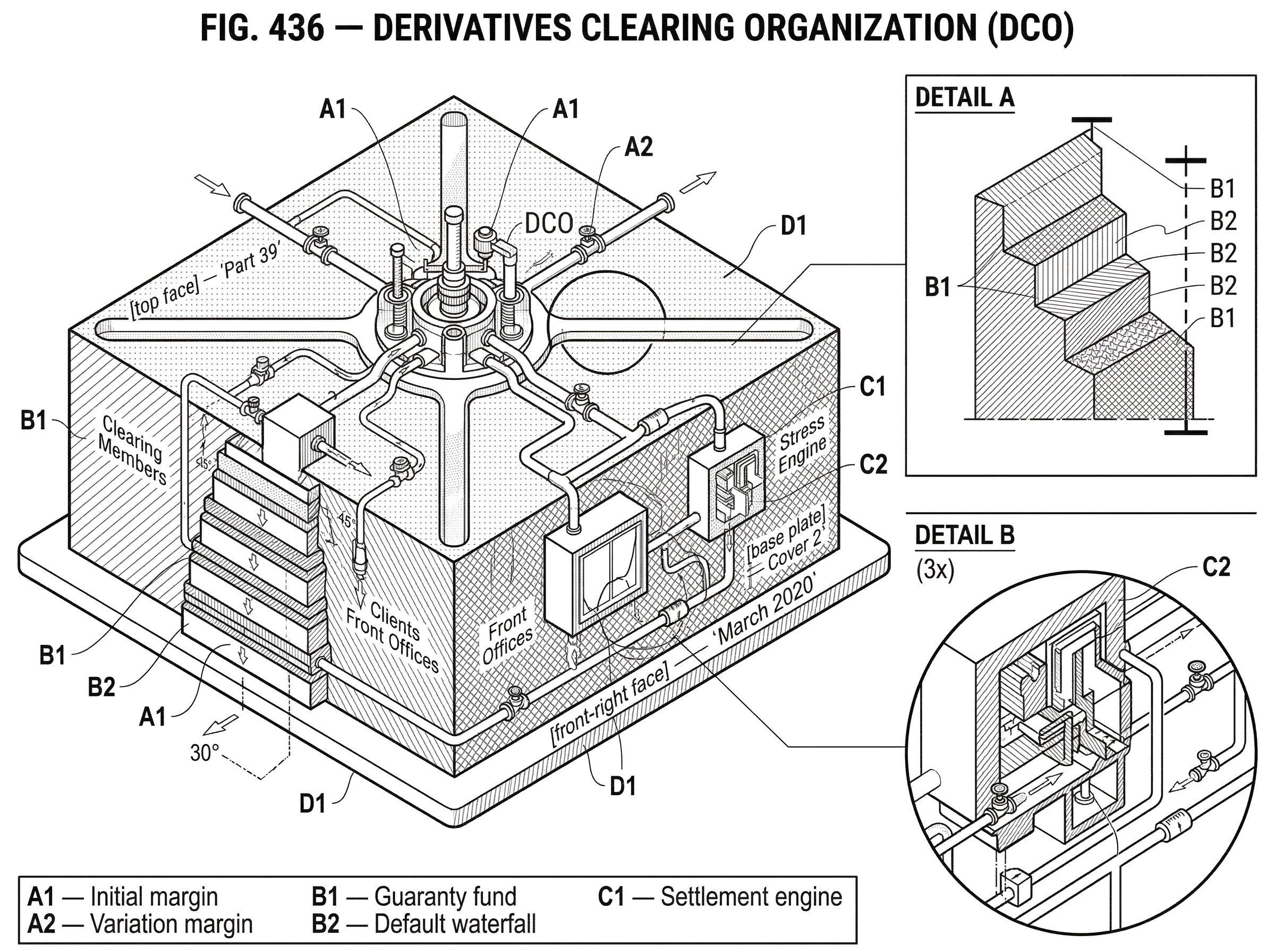
Introduction
A derivatives Clearing Organization (DCO) is the institution that stands in the middle of a cleared derivatives trade and makes sure the trade can still be honored even if one party fails. That sounds administrative, but it solves a very specific market problem: derivatives create obligations that can grow very large very quickly as prices move, so a market cannot rely on every participant to assess every other participant's creditworthiness in real time. If everyone had to worry constantly about whether every counterparty would pay tomorrow, liquidity would thin out exactly when markets were stressed.
A DCO changes that structure. Instead of Bank A depending directly on Bank B, both depend on the clearinghouse. In the language used internationally for a central counterparty, it becomes the buyer to every seller and the seller to every buyer. That single change is the organizing idea behind the rest of the machinery: margin, guaranty funds, stress testing, default waterfalls, participation standards, recovery planning, and heavy supervision all exist because the DCO has concentrated counterparty risk in one place in order to make the market safer overall.
In the United States, the Commodity Futures Trading Commission, or CFTC, regulates DCOs under Part 39 of its rules. Those rules do not merely define a legal category. They describe what a clearinghouse must be able to do in practice: admit members under objective risk-based standards, determine which products are suitable for clearing, collect enough financial resources to survive severe defaults, test its assumptions regularly, maintain a chief compliance officer, and submit certain new swaps for regulatory review before clearing them. Internationally, the same basic architecture appears in the Principles for Financial Market Infrastructures, or PFMI, which set the standard expectations for central counterparties.
The quickest way to understand a DCO is to see it not as a back-office utility but as a machine for transforming a web of bilateral promises into a centrally managed risk system. That system is powerful, but it is not magic. It works only if its assumptions about collateral, liquidity, legal enforceability, and member behavior hold when markets are under pressure.
Why do markets use a Derivatives Clearing Organization (DCO)?
| Model | Scalability | Counterparty view | Netting efficiency | Stress behavior | Main fragility |
|---|---|---|---|---|---|
| Bilateral | Does not scale well | Individual counterparty checks | Limited bilateral netting | Confidence can evaporate | Fragmented exposures |
| Central clearing | Scales via central rules | Clearinghouse-centric visibility | Multilateral portfolio netting | Risk concentrated at DCO | Single point of failure |
A derivative is a contract whose value changes with some underlying price, rate, spread, or event. Because that value moves over time, the contract creates counterparty credit risk: one side may owe money later, and the other side must trust that the payment will actually arrive. In a bilateral market, each firm manages that risk separately. It negotiates collateral terms, monitors exposures, and decides how much it trusts the other side. That works up to a point, but it has two weaknesses.
The first weakness is that bilateral credit assessment does not scale well in a dense market. If many firms trade with many other firms, the system becomes a mesh of exposures. Each participant must understand not just market risk, but the financial condition and operational readiness of many counterparties. The second weakness is that bilateral arrangements are often least reliable when they are most needed. During a sharp market move, exposures jump, collateral calls rise, and concerns about creditworthiness spread at the same time. The result can be a self-reinforcing loss of confidence.
Central clearing changes the geometry of that risk. Once a trade is accepted for clearing, the DCO interposes itself between the original counterparties. The firms no longer face each other for performance of the cleared contract; they face the clearinghouse. That allows the market to replace many bilateral risk-management arrangements with one centralized set of rules for collateral, settlement, default handling, and membership standards.
The key benefit is not that risk disappears. It does not. The key benefit is that risk becomes standardized, collateralized, netted, and managed under one rulebook. If a clearing member has offsetting positions with several counterparties, central clearing can net those exposures more efficiently than a bilateral network can. The DCO also sees the full cleared portfolio of each member within that clearing service, which allows it to calculate margin and monitor concentration risk in a systematic way.
That same centralization creates the central tension of clearing. A DCO reduces contagion through bilateral links, but in doing so it becomes a critical node itself. If its risk controls are weak, the market has concentrated fragility rather than reduced it. That is why DCO regulation focuses so heavily on conservative financial resources, legal certainty, and operational resilience.
How does a DCO change the legal and payment relationships of a cleared trade?
The core mechanism is often described in a single sentence: the clearinghouse steps in between the two original counterparties. But that sentence hides the real point. The important change is not physical intermediation; it is the replacement of one legal and financial relationship with another.
Suppose a Futures commission merchant clears a trade for a client that buys an interest rate futures contract, while another clearing member clears the corresponding sell side. Once that trade is accepted into clearing, the DCO treats the buyer's side and seller's side as separate obligations to the clearinghouse. From then on, if prices move in favor of the buyer, the DCO collects losses from the losing side and pays gains to the winning side through its settlement process. The winning side no longer has to chase the original loser directly.
This is why daily and intraday settlement matter so much. A DCO does not usually wait until the contract expires and then discover a massive unpaid bill. It continuously reduces the build-up of unpaid exposure by marking positions to market and collecting variation margin, meaning cash flows reflecting realized gains and losses since the last settlement cycle. CME, for example, describes settlement variation as the mechanism that prevents the accumulation of losses in the system. That is the causal chain: frequent valuation leads to frequent settlement, which keeps current exposure from compounding into something unmanageable.
Alongside variation margin, the DCO collects initial margin. Initial margin is not payment for an existing loss. It is collateral against the possibility that, if a member defaults, the market may move further while the DCO is trying to close out or auction the portfolio. Different clearinghouses use different models, but the principle is the same: estimate a severe but plausible short-horizon loss for the portfolio and require collateral sufficient to absorb it with high confidence.
This is also where portfolio effects matter. A DCO does not usually margin each contract in isolation. It margins the cleared portfolio, recognizing that some positions offset others while some create concentrated directional or liquidity risk. CME's SPAN framework, for example, is a market-simulation-based value-at-risk system used to assess portfolio risk. LCH's PAIRS model for certain rates and FX products uses filtered historical simulation and expected shortfall with volatility scaling. The details differ, but both are attempts to answer the same question: if this member fails now, how much could this portfolio lose before we can neutralize it?
How does a DCO's default waterfall allocate losses?
| Layer | Order | Source | Who bears losses | Prefunded? |
|---|---|---|---|---|
| Defaulter resources | First | Variation & initial margin | Defaulting member | Yes |
| DCO contribution | Second | Clearinghouse capital | DCO shareholders/capital | Yes |
| Guaranty fund | Third | Mutualized member fund | Non-defaulting members | Prefunded |
| Assessments / extraordinary tools | Fourth | Called assessments / tools | Non-defaulting members / public | Unfunded or contingent |
Margin is the first line of defense, but it is not the only one. A DCO must plan for the case where a defaulted member's own resources are not enough. The structure used to allocate losses beyond the defaulter's margin is commonly called the default waterfall.
The logic of the waterfall is simple: losses should first be borne by the party that caused them, then by resources explicitly committed to support the clearing service, and only after that by mutualized resources or extraordinary tools. The exact sequencing differs by clearinghouse and product set, but the broad pattern is stable across major CCPs and DCOs.
Start with the defaulting member's own collateral. The DCO can apply the defaulter's variation margin, initial margin, and guaranty-fund contribution according to its rules. If losses exceed those resources, the waterfall moves to the clearinghouse's own contribution and then to mutualized guaranty-fund resources contributed by non-defaulting members. CME describes its financial safeguards package in these terms, with the defaulter's resources first, then CME's own contribution, then the guaranty fund, then assessment powers. ICE Clear Europe discloses a similar structure, including the defaulter's margin, the defaulter's guaranty-fund contribution, the clearinghouse's capital contribution, mutualized guaranty-fund resources, and powers of assessment.
Why mutualize at all? Because clearing is a club good as well as a risk service. Members benefit from the stability and netting efficiency of the clearinghouse, so they are asked to support the system collectively if one member fails. That mutualization also creates incentives for members to care about the admission standards, risk limits, and governance of the clearinghouse. If weak members are admitted too easily, strong members may eventually bear part of the cost.
But mutualization has limits. Part 39 allows DCOs to count certain prospective assessments toward financial-resource requirements only with a haircut and a cap, which is a way of saying that unfunded promises are not equivalent to cash already in hand. This reflects a basic first-principles distinction: in a stress event, available now is much more valuable than collectible later. A resource that depends on calling surviving members during panic conditions is less reliable than prefunded collateral already under the DCO's control.
International standards push the same logic further for highly systemic CCPs. Under PFMI, a systemically important CCP with a more complex risk profile may be expected to hold resources sufficient to cover the default of the two participants and their affiliates that would create the largest aggregate exposure; the familiar Cover 2 standard. CME publicly states that its guaranty fund for each clearing service is sized to meet that standard. The number is not arbitrary. It is a recognition that in concentrated markets, the largest members are large enough that one-default assumptions may be too optimistic.
Why do regulators require strict margin, stress testing, and eligibility for DCOs?
The hardest part of running a DCO is not writing the rulebook. It is calibrating it well enough that the clearinghouse survives the world it will actually face, not the world its model assumes. That is why the regulatory framework spends so much time on methodology.
Under CFTC rules, a DCO must maintain financial resources sufficient, at a minimum, to meet its obligations to clearing members despite the default of the member creating the largest financial exposure in extreme but plausible conditions, and to cover operating costs for at least one year. It must perform monthly stress tests using historical and hypothetical scenarios and calculate what resources it needs from those tests. The DCO has some discretion in choosing the method, but the Commission can review the methodology and require changes. That combination matters. It acknowledges that risk models are design choices, not revealed truths.
The same idea appears in back testing. Part 39 defines a back test as a test comparing initial-margin requirements with historical price changes to determine how much actual coverage the margin would have provided. This is one of the most important reality checks in clearing. A model does not prove itself by looking mathematically elegant; it proves itself by asking whether yesterday's required collateral would really have covered yesterday's moves.
Participation standards matter for the same reason. A DCO is not just measuring market risk on positions; it is relying on members to meet margin calls, operationally process settlements, and participate in default-management actions such as auctions. So the CFTC requires admission and ongoing participation requirements that are objective, publicly disclosed, and risk-based. Product eligibility must also be considered carefully. Not every derivative is suitable for central clearing. A product with poor liquidity, hard-to-observe prices, or unusual risk characteristics may be difficult to margin and hard to liquidate in default. That is why Part 39 ties product eligibility to factors such as liquidity, pricing availability, and the DCO's ability to manage the risks.
This is also why a DCO cannot be understood as merely a vault for collateral. It is a decision-making institution that must continuously answer three linked questions: who can join, what can be cleared, and how much protection is enough? If it is too lax, it imports risk it cannot manage. If it is too strict, it may reduce the benefits of clearing and push activity into less transparent channels.
What happens step-by-step when a clearing member defaults?
Imagine a clearing member with a large cleared interest-rate portfolio suffers a sudden liquidity crisis after a major market move. During the day, the DCO's risk team sees unusual losses and changing positions. Because the clearinghouse is already marking positions to market and monitoring exposures intraday, the problem is not invisible; it appears first as a growing need for variation margin and possibly additional initial margin.
If the member fails to meet its call, the event changes from ordinary risk management into default management. At that point, the DCO uses the member's posted collateral first. Variation losses that have already been crystallized are covered through the settlement framework, and the initial margin becomes the buffer against further adverse moves while the DCO works to neutralize the portfolio. The DCO may hedge parts of the position immediately to stop risk from growing, then auction or transfer the remaining portfolio to surviving members.
If the portfolio can be closed out for less than the defaulter's posted resources, the system has done what it was designed to do: the loss stayed with the defaulter. If closeout costs exceed the defaulter's resources, the waterfall moves onward, potentially drawing on the clearinghouse's own capital contribution and then the mutualized guaranty fund. If losses go further still, assessment powers or recovery tools may be triggered depending on the rulebook and the jurisdiction.
What matters in this narrative is not any single step but the invariant behind all of them: the DCO is trying to convert a chaotic member failure into a pre-committed sequence of actions and resources. That sequence will never feel calm in the middle of a real crisis, but predictability is itself a form of resilience. Members know ex ante where losses should go, what their obligations may be, and how the clearinghouse intends to restore a matched book.
When and how can a DCO design fail or create systemic fragility?
A DCO exists to reduce systemic risk, but it can also transmit stress through different channels. The most discussed example is margin procyclicality. When volatility rises sharply, risk models often demand more initial margin. That is sensible from the DCO's perspective: if risk is higher, more collateral is needed. But systemically, large sudden margin increases can force clearing members and clients to find liquid assets at exactly the moment liquidity is scarce.
The March 2020 market shock made this tradeoff unusually visible. An FIA analysis of major CCPs found a sharp rise in aggregate initial margin and heavier use of ad hoc intraday margin calls, arguing that this behavior intensified liquidity pressure. The point is not that the clearinghouses were necessarily wrong to raise margin; if they had not, they might have undercollateralized themselves. The point is that there is a real tension between microprudential safety for the clearinghouse and macroprudential liquidity stress for the system.
This is why anti-procyclicality tools and governance matter, even though no calibration fully solves the problem. Margin floors, conservative lookback windows, add-ons, and discretion around intraday calls can all smooth the path somewhat, but any smoothing mechanism creates its own tradeoff: less responsiveness today may mean more undercoverage tomorrow. There is no model-free answer.
Another fragile point is legal certainty. Clearing works because novation, netting, collateral enforcement, and settlement finality are expected to hold in insolvency and across jurisdictions. PFMI therefore emphasizes that a CCP should have a well-founded, clear, transparent, and enforceable legal basis in all relevant jurisdictions. ICE Clear Europe, for example, highlights the role of English law, settlement-finality designation, and legal opinions across member jurisdictions. Without that legal substrate, the default waterfall is not really a waterfall at all; it is just an aspiration subject to litigation.
Operational resilience is the third major fault line. A DCO is useful only if it can keep valuing portfolios, collecting collateral, processing settlements, and managing defaults during periods of market and infrastructure stress. That is why DCO governance is not limited to financial risk. CFTC rules require a chief compliance officer and annual compliance reporting, while international standards and operator disclosures emphasize enterprise risk management, cyber resilience, model governance, and recovery planning.
What are recovery and resolution plans for a DCO and why do they matter?
For years, clearing policy was framed as if the key question were whether members fail. After the post-crisis expansion of central clearing, a harder question moved to the foreground: what if the clearinghouse itself suffers losses or liquidity needs beyond its ordinary resources?
That is the purpose of recovery and resolution planning. CPMI-IOSCO's recovery guidance focuses on how a financial market infrastructure would operationalize a recovery plan, replenish depleted resources, deal with non-default losses, and disclose the tools it may use. The Financial Stability Board's CCP resolution guidance, in turn, addresses what resolution authorities need in order to maintain continuity of critical clearing functions if recovery fails. These frameworks matter because a DCO is not replaceable overnight. If a major clearinghouse stops functioning abruptly, the disruption is not limited to its shareholders or members; it affects market continuity itself.
This is also where the boundary between private risk management and public stability becomes visible. A DCO is privately operated but systemically important. That means its rulebook must specify who bears losses in ordinary and extraordinary stress, while public authorities must decide what powers they would use if those private arrangements prove insufficient. Some details remain debated internationally, especially around the appropriate financial resources for resolution and how cross-border resolution should work in practice.
Why does cross-border recognition matter for clearinghouses and their users?
| Status | Legal enforceability | Supervision | Market access | Practical risk |
|---|---|---|---|---|
| Domestic DCO | Clear under local law | Home regulator oversight | Full domestic access | Lower legal friction |
| Recognized foreign DCO | Generally enforceable locally | Coordinated cross-border oversight | Allowed with recognition | Some legal coordination needed |
| Unrecognized foreign DCO | Uncertain across jurisdictions | Limited local oversight | Restricted or prohibited | Higher legal and access risk |
Modern derivatives markets are international, so a DCO often matters outside the jurisdiction where it is chartered. That creates a practical problem: if firms in one region want to clear through a clearinghouse based in another, local authorities need confidence that the foreign CCP is well supervised and legally reliable.
That is why cross-border recognition and alternative-compliance frameworks exist. The CFTC has a rule on registration with alternative compliance for certain non-U.S. DCOs, and Europe uses EMIR recognition for third-country CCPs. ESMA's handling of third-country CCP applications shows the mechanism clearly: recognition depends on legal conditions such as an equivalence decision for the home jurisdiction, supervisory cooperation through memoranda of understanding, and consultation with relevant authorities.
This is not bureaucratic duplication for its own sake. A DCO's default management, collateral rights, and settlement processes operate through local law. If a foreign clearinghouse serves domestic firms, domestic regulators need some way to assess whether those legal and supervisory arrangements are sufficiently robust. Cross-border clearing therefore depends not just on economics, but on mutual confidence between regulatory regimes.
Key takeaways: what to remember about Derivatives Clearing Organizations (DCOs)
A Derivatives Clearing Organization is a central counterparty for cleared derivatives: it steps between the original parties to a trade, collects margin, nets exposures, manages defaults, and uses prefunded and mutualized resources to keep contracts performing when a member fails. That is why it exists.
Its promise is powerful but conditional. A DCO makes markets more reliable only if its margin models are conservative enough, its legal rights are enforceable, its members are strong enough, its liquidity is available when needed, and its recovery plans are credible when ordinary safeguards run out.
The simplest durable picture is this: a DCO concentrates risk in order to control it.
Everything else follows from that choice.
- margin
- guaranty funds
- stress tests
- participation rules
- recovery planning
- regulation
Frequently Asked Questions
Variation margin is settled frequently to transfer realized gains and losses and prevent exposures from compounding, while initial margin is prefunded collateral sized to cover a severe but plausible loss while the DCO neutralizes a defaulted portfolio; both are required but serve distinct purposes in loss-absorption and exposure control.
The default waterfall sequences loss absorption from the defaulting member’s own resources (variation margin, initial margin, guaranty-fund contribution) to the clearinghouse’s own capital and then to mutualized guaranty‑fund resources and extraordinary tools, because losses should first fall on the party that caused them and only then be shared among members.
Cover 2 is a sizing objective - endorsed by PFMI and used publicly by major CCPs like CME - that aims to hold prefunded resources sufficient to withstand the simultaneous default of the two participants (and their affiliates) that would create the largest combined exposure, reflecting the concentration risk of large members.
Margin procyclicality occurs because risk models raise initial margin when volatility spikes, which protects the clearinghouse but can force members and clients to raise large amounts of liquidity exactly when markets are strained; empirical analysis from March 2020 showed large, rapid collateral demands that intensified liquidity pressure even while CCPs were managing their exposure.
Regulators and DCO rulebooks treat unfunded assessments as less reliable than prefunded collateral: Part 39 permits counting prospective assessments only with a significant haircut (e.g., 30%) and an overall cap (e.g., 20% of required resources), reflecting that "collectible later" resources are not equivalent to cash available immediately in stress.
A product is eligible for clearing only if the DCO can reliably value and margin it, liquidate or hedge positions in stress, and assess sufficient liquidity and market‑making depth; products lacking observable prices, liquidity, or manageable risk characteristics are often excluded from central clearing.
Recovery planning sets the DCO’s pre‑committed tools to replenish depleted resources or handle non‑default losses, while resolution planning prepares public authorities to preserve critical clearing functions if private recovery fails; both are necessary because a DCO can hit losses or liquidity needs beyond ordinary safeguards and cannot be replaced overnight.
Cross‑border recognition matters because a foreign DCO’s default-management and collateral rights operate through local law; domestic authorities therefore need assurance - via equivalence decisions, supervisory cooperation and recognition frameworks (e.g., ESMA/EMIR or CFTC alternative compliance) - that the foreign CCP’s legal and supervisory arrangements are sufficiently robust.
Operational resilience requirements focus on the DCO’s ability to value portfolios, collect collateral, process settlements, run default procedures, and maintain governance (including chief compliance functions); without those capabilities - plus legal certainty and disaster‑recovery infrastructure - the clearinghouse’s risk controls cannot be relied on under stress.
Related reading