What Is Order Flow Toxicity?
Learn what order flow toxicity is, why it matters to market makers, how VPIN tries to measure it, and where the concept is useful or limited.
Introduction
Order flow toxicity is the risk that liquidity providers are trading against counterparties who are better informed, and therefore losing money simply by being willing to quote. This matters because modern markets depend on intermediaries (market makers, dealers, and high-frequency liquidity providers) being willing to stand ready on both sides of the market. When they suspect the incoming flow is unusually informed or one-sided, they do not just lose on a few trades; they often respond by widening spreads, reducing displayed size, stepping back from quoting, or hedging aggressively. That reaction changes the market itself.
The basic puzzle is simple. Markets are supposed to become more liquid when trading activity increases, because more participants are present. Yet in stressed moments, the opposite often happens: volume surges while usable liquidity disappears. The reason is that not all volume is equally safe to trade against. A large amount of flow can be harmless inventory rebalancing, or it can be the footprint of traders who know that current prices are stale. From the perspective of a liquidity provider, those are very different environments even if the tape shows the same gross volume.
That is the central idea that makes order flow toxicity click: liquidity is not just about how much trading is happening, but about what the incoming trades imply about information. If buy and sell orders arrive in a way that suggests someone knows more than the quote setter, the quote setter is exposed to adverse selection. Order flow is then called toxic because it is dangerous to absorb. The word is metaphorical, but the mechanism is concrete.
Why do liquidity providers lose when they quote against informed order flow?
A market maker earns the spread by buying slightly below the current price and selling slightly above it. That business works only if incoming buyers and sellers are not systematically better informed than the market maker. If the market maker sells at 100.01 and the asset is really about to be worth 100.50, the sale was not profitable even though it captured the spread. The quote was picked off before it could adjust.
This is the core adverse-selection problem. A quote is an offer made under uncertainty about the asset's current fair value. Some uncertainty is unavoidable, and market makers can live with it. What they cannot live with is a flow of counterparties whose willingness to trade reveals that the true value has probably moved against the quoted price. In that case, a trade is not just a neutral exchange of inventory. It is evidence.
Seen from first principles, every market order asks a hidden question of the resting quote: why is this person so eager to trade now? Sometimes the answer is benign. A portfolio is being rebalanced, an index fund is crossing a benchmark flow, or a retail trader is simply impatient. But sometimes urgency itself is informative. If informed traders or faster traders buy aggressively before public prices fully adjust, the liquidity provider learns too late; after filling them.
That is why toxicity is a property of flow, not merely of prices. Price volatility can be high without severe toxicity if both sides of the market remain willing to trade and no one side appears systematically informed. Conversely, even before a large price move becomes visible, the composition of incoming orders can make liquidity providers suspicious. Their response (wider spreads, smaller size, less displayed depth) can then help produce the very instability that outside observers later describe as a liquidity event.
Trading example: how a stream of aggressive buys can force liquidity to retreat
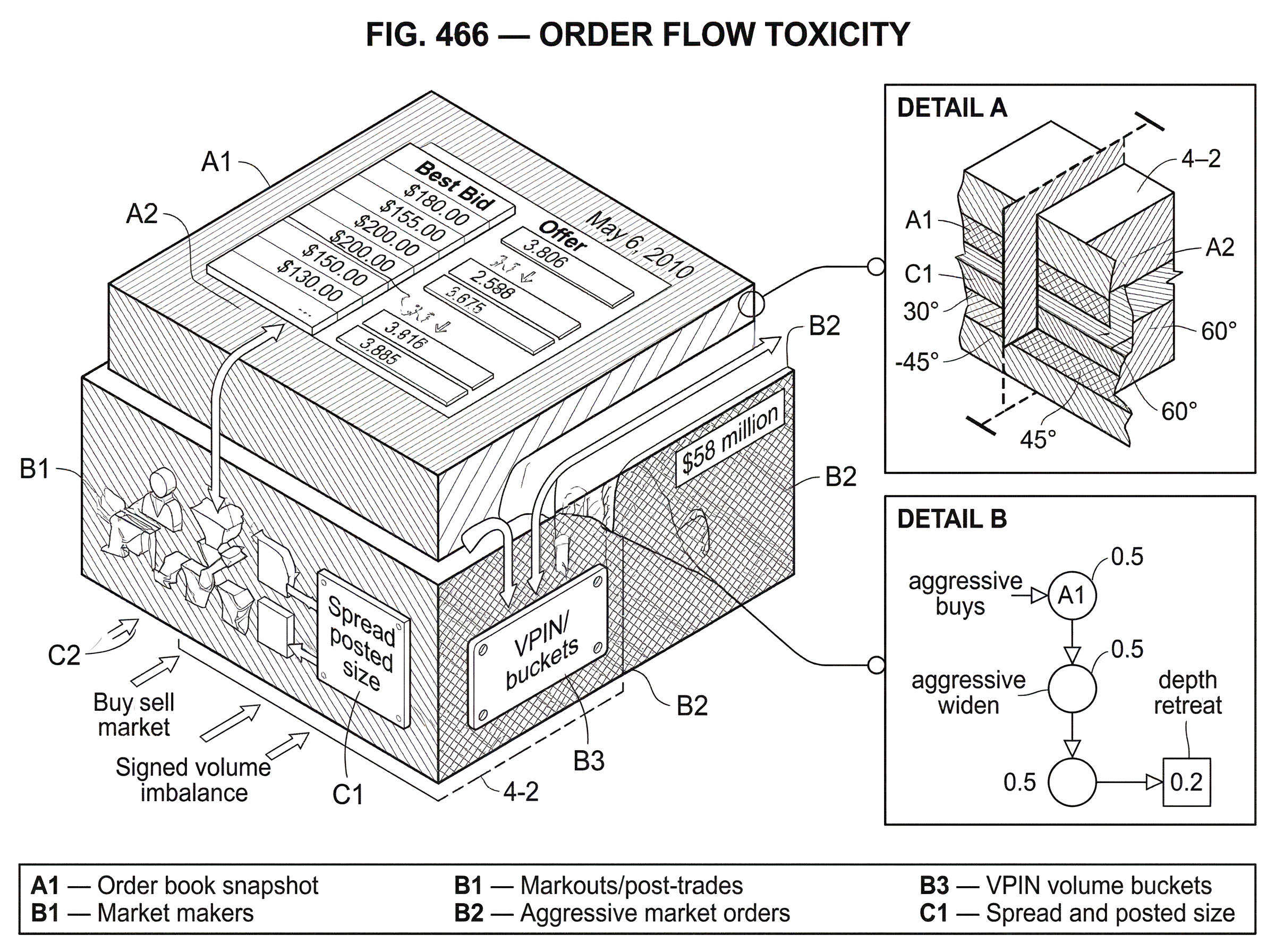
Imagine a futures market in a quiet period. A market maker is quoting bids and offers around the current midprice, expecting that over many trades some customers will buy, some will sell, and inventory can be managed without too much pain. Now suppose a stream of aggressive buy orders begins arriving. If those buys are balanced later by unrelated sells, the maker may just hedge inventory and continue quoting.
But suppose the buys keep arriving in a pattern that is hard to explain as noise: they are persistent, they cluster in a short period, and the price keeps nudging upward after each fill. The maker begins to infer that these buyers may not just be impatient; they may know the current ask is too low relative to where the market is heading. At that point, continuing to quote the old size at the old spread is equivalent to offering stale insurance to someone who knows a storm is coming.
So the maker reacts. The offer is moved higher. The posted size is cut. Hedging becomes more urgent. Other liquidity providers, seeing the same flow, may do the same. The immediate consequence is thinner depth and higher execution cost for later traders. The deeper consequence is feedback: as liquidity retreats, each new market order moves price more, which makes the flow look even more informed, which causes still more retreat.
This example explains both the meaning of toxicity and why the concept matters operationally. Toxic flow does not need to mean insider trading or perfect private information. It is enough that counterparties are, on average, better positioned (faster, more informed, or more directionally certain) than the passive side of the book.
What factors make order flow become 'toxic'?
The important structure is the asymmetry between the trader who initiates the trade and the trader who rests a quote. The initiator chooses when to trade. The quote provider commits in advance. That timing asymmetry creates an information problem because the initiator can condition on news, models, latency advantages, cross-market signals, or order-book information that the resting quote does not fully reflect.
Order flow becomes more toxic when three things line up. First, trades are persistently one-sided, so the imbalance is unlikely to be random inventory demand. Second, the side initiating those trades tends to be right in the short run, meaning prices move further in the same direction after execution. Third, liquidity providers cannot easily separate informed flow from uninformed flow quickly enough to protect themselves. If they could distinguish them perfectly, they would simply reject or reprice the dangerous trades.
This is why order-flow toxicity sits close to neighboring ideas such as market impact, adverse selection, and markouts, but it is not identical to any one of them. Market impact is what prices do after trading. Adverse selection is the loss to a passive liquidity provider from being traded against by a better-informed party. Markout measures the realized P&L of a quote after a trade, often over a short horizon. Toxicity is the broader state of the incoming flow that makes those outcomes likely.
The term also does not require that the aggressive side be "informed" in the old textbook sense of having secret fundamental news. In modern electronic markets, a trader can be informationally advantaged simply by processing public information faster, reacting to correlated instruments sooner, or recognizing predictable institutional flow before others do. From the quote setter's perspective, the source of the edge matters less than the fact that the edge exists.
Why volume can rise while liquidity falls
This is the part that many readers find unintuitive. If there is so much trading, why would liquidity providers leave? Shouldn't more trading create more opportunities to earn the spread?
Only if the extra trades are not disproportionately informed. A surge in volume can be exactly what alerts market makers that conditions have become dangerous. If order arrivals are highly directional and the short-horizon price response after trades is large, then each fill becomes less like collecting a fee and more like stepping in front of a moving vehicle.
The joint CFTC-SEC staff report on the May 6, 2010 market event is useful here because it documented this pattern in practice. A large sell program in the E-mini S&P 500 futures contract was executed by an automated algorithm targeting a share of market volume rather than price or time. As selling pressure intensified, buy-side depth in the E-mini collapsed to roughly $58 million, less than 1% of its morning level, even as trading activity was enormous. Cross-market arbitrage transmitted stress into SPY and underlying equities, while high-frequency traders initially absorbed flow and then rapidly turned over inventory in what the report described as hot-potato trading, before liquidity thinned further. The lesson is not that volume causes fragility by itself. It is that volume under informational stress can coexist with vanishing willingness to stand in the way.
That observation is central to why toxicity measures attracted attention after the Flash Crash. Practitioners wanted a way to distinguish ordinary high activity from the kind of one-sided, dangerous activity that causes passive liquidity to disappear.
How is order‑flow toxicity measured in practice?
| Method | Data needed | Signal | Main advantage | Main drawback |
|---|---|---|---|---|
| PIN-family models | trade counts and timestamps | probability of informed trades | structural inference | model fit complexity |
| VPIN / volume imbalance | signed trade volumes | recent bucket imbalance | real-time and intuitive | sensitive to implementation |
| Markouts (post-trade) | post-trade prices | realized passive P&L | direct economic test | lagging signal |
| Queue & depth analytics | order book snapshots | depth and refill speed | shows liquidity behavior | data intensive |
Because toxicity is about hidden information in incoming trades, it cannot be observed directly. What can be observed is the trade stream: prices, sizes, directions, and sometimes quote updates or venue identifiers. Measures of toxicity try to infer, from this stream, whether recent order arrivals look unusually informed or imbalanced.
At a broad level, there are two families of approach. The first uses structural models of informed trading, such as PIN models, which infer the likelihood that some portion of trading comes from informed traders. The second uses more direct microstructure proxies based on realized order imbalance and short-horizon consequences for prices and liquidity. VPIN, the volume-synchronized probability of informed trading, became the most famous example in the second camp.
The reason VPIN was compelling is intuitive. Clock time is a poor unit for measuring flow because one minute of trading at midday may contain almost no information, while one minute during stress can contain a huge amount. VPIN instead groups trades into equal-volume buckets. Each bucket represents the same amount of traded quantity, regardless of how much clock time it took to accumulate. That is an attempt to compare like with like.
Within each bucket, the method estimates buy volume and sell volume, computes the imbalance, and then smooths those imbalances across a rolling window of buckets. In practical descriptions, bucket imbalance is often written as the absolute difference between buy and sell volume divided by total bucket volume. If B is buy volume and S is sell volume in a bucket, the imbalance is |B - S| / (B + S). A VPIN-style estimate is then a rolling average of that imbalance across recent equal-volume buckets, often 50 buckets in canonical implementations.
The intuition is straightforward. If recent volume buckets are consistently dominated by one side, liquidity providers may infer that the aggressive side has an informational advantage, and the environment is becoming toxic. Some practical guides interpret values near 0 as balanced flow, mid-range values as moderate imbalance, and high values (often above about 0.7 in heuristic usage) as a danger zone for passive liquidity providers. Those thresholds are conventions, not laws of nature.
Why does volume bucketing (volume time) alter toxicity signals like VPIN?
| Bucket unit | What it normalizes | Pro | Con | Best when |
|---|---|---|---|---|
| Time buckets | clock time | smooths low activity | averages stress away | regular market tempo |
| Volume buckets | traded volume | compares like with like | sensitive to large trades | detecting directional surges |
Volume synchronization is not a cosmetic detail. It encodes a claim about what matters in market stress: information arrives through trades, and equal traded volume is a more relevant comparison unit than equal elapsed time. In a slow market, it may take a long time to fill one bucket; in a frantic market, buckets fill rapidly. A time-based metric would average over those very different states in a misleading way.
This does not mean volume time is always the correct lens. It means VPIN is trying to hold traded quantity constant so that the statistic reflects order imbalance rather than fluctuations in the clock. That is the useful analogy: measuring by volume instead of time is like measuring traffic by cars passed rather than minutes elapsed when trying to infer congestion from lane usage. The analogy helps explain why volume bars can normalize activity, but it fails if one assumes that equal volume always means equal information content. Different markets, venues, and regimes can produce very different informational meaning per unit of volume.
Implementation also matters mechanically. Real trade streams do not arrive in neat bucket-sized chunks. A large trade may overflow a bucket, so the remainder must be carried into the next one. Trade direction must often be inferred from prices and quotes rather than observed directly. The rolling-window length determines how reactive or smooth the metric is. Each of these choices can materially alter the output.
How do practitioners use VPIN and other toxicity metrics in risk management?
In practice, people use VPIN-like measures less as a universal truth detector and more as a risk-management signal. A market maker may monitor toxicity measures to decide when to widen spreads, cut size, shift inventory limits, or route flow differently across venues. A broker or venue analyst may compare toxicity by ECN or symbol to identify where informed or one-sided flow tends to cluster. Product documentation aimed at practitioners often recommends pairing VPIN with markout analysis: if a venue has high VPIN and poor post-trade markouts for passive fills, the case for toxic flow is stronger.
This use is sensible because the business problem is operational. A liquidity provider does not need a philosophically perfect estimate of informed trading; it needs an indicator that conditions are becoming dangerous. Even a noisy measure can be useful if it helps avoid being run over by one-sided, informed, or fast flow.
That said, the metric only earns trust if it adds information beyond simpler signals such as realized volatility, trading intensity, or recent price moves. This is where the debate becomes technical and important.
What are the main criticisms and limits of VPIN and toxicity estimators?
| Criticism | Why it matters | Evidence | Mitigation |
|---|---|---|---|
| Trade-classification error | mislabels buy vs sell | BVC vs tick-rule studies | use tick-rule or transaction tags |
| Correlation with volatility | tracks volume and volatility | controls remove forecasting power | control for volatility and volume |
| Parameter sensitivity | outputs change by choice | sensitivity to bucket/window | standardize parameters; robustness tests |
| False positives frequency | too many alarms | event-count disputes in literature | tune thresholds; pair with markouts |
The main criticism is not that order-flow toxicity is unreal. The concept is very real: liquidity providers can and do lose to better-informed counterparties, and they adjust behavior accordingly. The criticism is about whether VPIN, or a given implementation of it, really measures that concept rather than just repackaging volume and volatility.
Research by Andersen and Bondarenko is especially important here. Using best-bid-offer data from CME Group to obtain near-perfect trade classification for the E-mini S&P 500 futures contract, they argued that common VPIN implementations based on bulk volume classification were heavily affected by the model's trade-classification error. Their central finding was that the apparent predictive power of some BVC-based VPIN versions for short-term volatility arose because the classification errors themselves were correlated with trading volume and volatility. Once one controls for trading intensity and realized volatility, they found no incremental forecasting power from that implementation.
That critique matters for a simple reason. If a toxicity measure rises mainly because volatility and activity have already risen, then it may be a lagged reflection of market stress rather than a distinct warning about informed flow. In that case, calling it a measure of toxicity may be overstating what it knows.
The same work also stressed that VPIN is highly sensitive to implementation details: the starting point of the bucket sequence, the bucket size, whether time bars or volume bars are used upstream, and how trade direction is classified. This is not a minor engineering concern. If small design choices produce materially different signals, then two users can both claim to compute VPIN while in fact measuring somewhat different things.
There has been pushback to these criticisms. Other researchers and practitioners defended VPIN-style approaches, questioned how false positive rates were being assessed, and argued that event counts and practical usefulness looked better across large datasets than critics suggested. Software and tooling ecosystems have also continued to evolve, including improved VPIN variants such as iVPIN that use maximum-likelihood estimation and aim to produce more stable estimates, especially when buckets are small or informed trading is infrequent.
The right takeaway is not that one side "won" permanently. It is that the concept is stronger than any single estimator. Toxic flow exists. Measuring it in real time is hard. VPIN was influential because it offered a tractable proxy, but that proxy inherits all the usual problems of microstructure inference: hidden trade direction, fragmented venues, parameter sensitivity, and the difficulty of separating information from urgency.
Common misunderstandings about order‑flow toxicity
A common misunderstanding is to think that toxicity means illegality or insider trading. Usually it does not. The more general meaning is that the passive side of the market faces counterparties with superior information or speed.
Another is to treat toxicity as identical to volatility. Volatility can be a symptom, a correlate, or a consequence, but not the same object. A market can be volatile because of broad uncertainty while still supporting two-sided liquidity. Toxicity is more specifically about the expected loss from standing ready to trade against the arriving flow.
A third misunderstanding is to imagine that a high toxicity reading means price must crash. What it really means is that conditions are unfavorable for passive liquidity provision. The result may be wider spreads, less depth, greater impact, or more fragile price discovery. Sometimes that culminates in a sharp move. Sometimes it does not.
Finally, there is a temptation to think the concept belongs only to one market architecture. It does not. Futures, equities, ETFs, FX venues, and crypto exchanges all have versions of the same problem whenever passive quotes face potentially informed or fast-aggressive flow. The details differ (central limit order book versus dealer market, single venue versus fragmentation, visible versus hidden liquidity) but the adverse-selection logic travels well.
Why order‑flow toxicity is a useful concept even if metrics are imperfect
The enduring value of order-flow toxicity is that it names an otherwise slippery mechanism. It explains why liquidity providers care not just about how much flow arrives, but who seems to know what. It explains why spreads widen after bursts of directional aggression. It explains why market depth can disappear exactly when outsiders think the market is most active. And it explains why market structure design (circuit breakers, risk controls, quote obligations, venue routing logic) often tries to slow down or absorb feedback loops that start from adverse selection.
The Flash Crash evidence illustrates the broader point. The official report did not need VPIN to show that selling pressure, liquidity withdrawal, cross-market transmission, and rapid inventory turnover can interact to produce extreme dislocation. But the popularity of VPIN after that episode reflected a genuine need: firms and regulators wanted a way to see fragility building before the book went empty.
That need still exists. The exact measurement toolkit may vary (markouts, queue-position analytics, venue toxicity scorecards, PIN-family models, VPIN variants, or hidden-state models) but the underlying economic problem has not changed.
Conclusion
Order flow toxicity is the danger that passive liquidity providers are trading against better-informed or faster counterparties, and therefore losing when they quote. Once that danger rises, spreads widen, displayed depth shrinks, and markets can become fragile even as volume surges. VPIN became the best-known attempt to measure this state using volume-synchronized order imbalance, but its usefulness depends heavily on implementation and on whether it adds information beyond ordinary volume and volatility measures. The durable lesson is simpler than any formula: a market is liquid only so long as someone is willing to be the uninformed side of the next trade.
Frequently Asked Questions
Toxicity is about the expected loss to passive liquidity providers from trading against counterparties who are relatively better informed or faster; volatility is a measure of price variability. A market can be volatile without being toxic if both sides remain willing to trade, and toxicity can rise even before large price moves if incoming order composition looks one‑sided or informative.
Because toxicity depends on who is trading and how one‑sided that trading is, not just how many trades occur. The article and the SEC post‑Flash Crash analysis show that aggressive, directional selling can cause buy‑side depth to collapse (the report documented buy‑side depth falling to roughly $58 million, under 1% of morning levels) even as traded volume surged.
VPIN groups trades into equal‑volume buckets, estimates buy and sell volume per bucket, and smooths bucket imbalances across a rolling window so that activity is compared on traded quantity rather than clock time. The article explains this intuition and notes implementation choices (bucket size, overflow handling, trade‑direction inference) materially affect the output.
The strongest critiques focus on implementation and trade‑classification error: Andersen and Bondarenko (and followups) show bulk‑volume VPIN variants can be biased because misclassifying trade direction correlates with volume and volatility, and that many VPIN implementations are highly sensitive to parameter choices and starting points. Those findings call into question whether some VPIN signals add information beyond contemporaneous volume and volatility.
Liquidity providers typically respond to suspected toxic flow by widening spreads, reducing posted size and displayed depth, hedging more aggressively, or withdrawing quotes entirely; these reactions both protect the provider and can amplify price impact and feedback. The drafted article emphasizes these operational responses as the central channel by which toxicity changes market structure.
VPIN and related metrics can be useful as operational risk signals rather than definitive proofs of informed trading; practitioners pair them with markout analysis, venue scorecards, and volatility/intensity measures to decide whether to widen quotes or cut size. The article and practical guides recommend treating VPIN as one noisy input for risk management rather than a standalone oracle.
No - 'toxic' does not imply illegality or insider trading. The article stresses that toxicity simply means the passive side faces counterparties with superior speed or information (which can be from faster processing of public signals or cross‑market leads), not necessarily illicit private knowledge.
VPIN attracted attention after the Flash Crash because it aimed to give a real‑time signal of one‑sided, potentially informed flow, but its ability to predict extreme events is contested: the SEC report documented the mechanics of the crash without relying on VPIN, and subsequent academic work finds some VPIN implementations offer little incremental predictive power after controlling for volume and volatility. In short, VPIN highlighted a genuine need for early fragility signals, but whether any given implementation reliably predicts crashes remains an open, implementation‑dependent question.
Related reading