What Is a Futures Commission Merchant (FCM)?
Learn what a Futures Commission Merchant (FCM) is, why it exists, how it holds customer margin, and how it fits into clearing and market risk control.
Introduction
Futures Commission Merchant (FCM) is the name for the intermediary that accepts customer futures and related derivatives orders, holds customer collateral, and connects those customers to the clearing system. That may sound like a narrow back-office role, but it solves a central problem in derivatives markets: a futures contract creates obligations that change every day, sometimes every minute, and the market needs a firm that can collect margin, move money, report positions, and keep customer assets separate while the clearinghouse stands behind the trade.
If you strip the futures market down to first principles, the need for an FCM becomes obvious. A customer wants exposure to oil, rates, equity indexes, or another underlying market without negotiating directly with every counterparty. The exchange provides standardized contracts. The clearinghouse replaces bilateral credit risk with centralized clearing. But neither the exchange nor the clearinghouse wants to manage thousands of end-customer relationships one by one. The FCM sits in that gap. It is the customer-facing balance-sheet institution that turns many customer accounts into something the clearing system can safely process.
That position is why the role is powerful and why it is heavily constrained. Under U.S. law, an FCM is not just a broker in the everyday sense. The statutory core is that the firm solicits or accepts orders in futures and certain related products and also accepts money, securities, or other property to margin, guarantee, or secure those trades. That second part (accepting customer funds) is the real dividing line. It is also what distinguishes an FCM from an introducing broker, which may solicit or accept orders but does not hold customer funds.
Why do futures markets need a Futures Commission Merchant (FCM)?
| Role | Primary function | Customer interface | Risk handled | Main tool |
|---|---|---|---|---|
| Exchange | Standardize contracts | Direct or via brokers | Market integrity | Rulebook & matching |
| Clearinghouse | Novate and mutualize | Clearing members only | Counterparty mutualization | Margin & guaranty fund |
| FCM | Onboard customers; hold collateral | Direct customer-facing | Funding, operational, credit | Segregation, capital, margin |
A futures trade is not finished when the order is executed. In many ways, that is when the hard part begins. Once a position exists, the market must keep track of who owes what, whether enough collateral is posted, whether gains and losses have been settled, and whether a default by one participant can be contained without spilling into everyone else’s positions. The clearinghouse handles the mutualization and centralization of counterparty risk, but it needs financially responsible members to stand between it and end users.
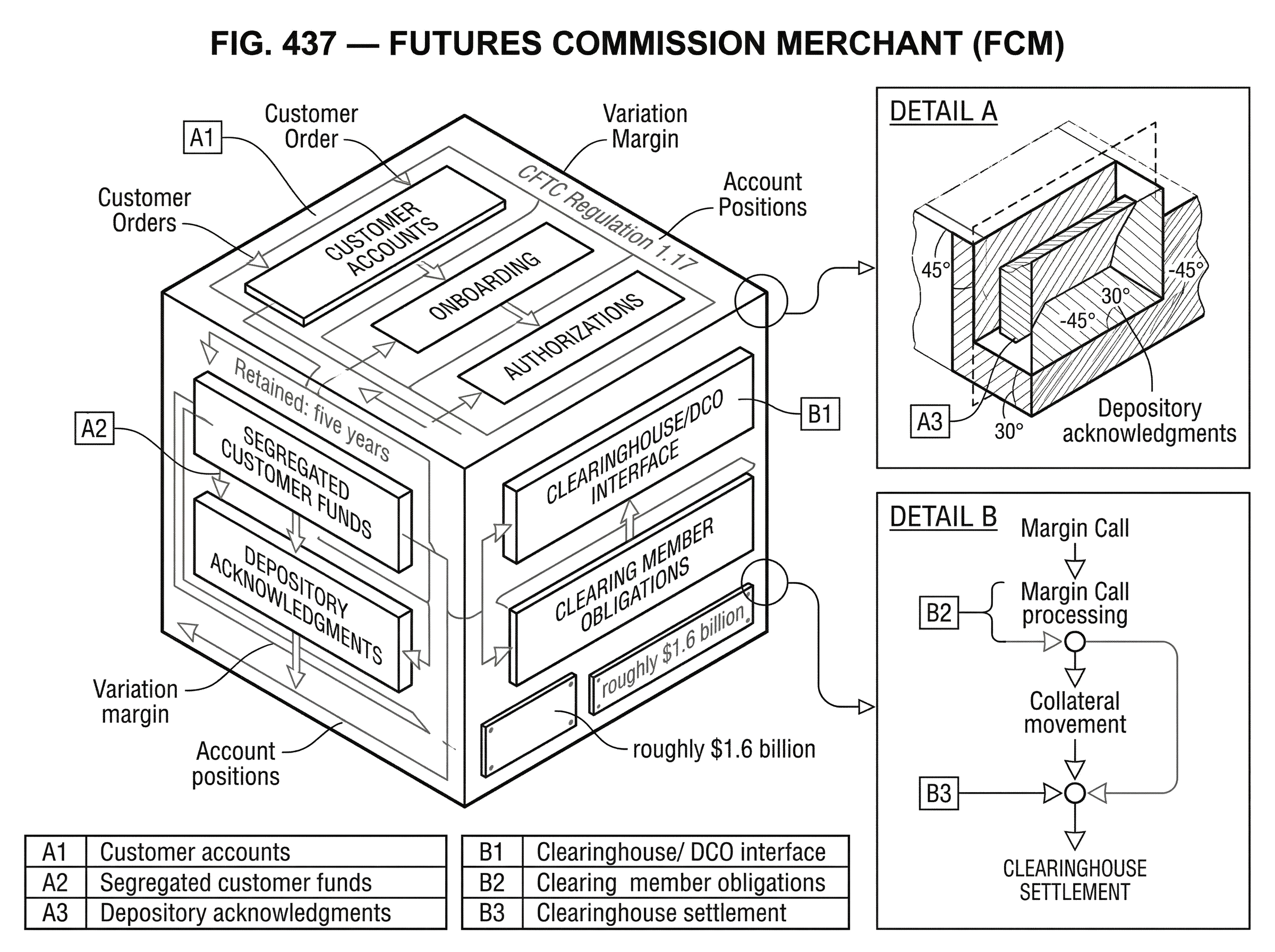
That is the basic function of the FCM. It translates customer trading activity into cleared obligations. Mechanically, this means the FCM opens and maintains customer accounts, collects initial margin, processes variation margin and other flows, sends trades for clearing, reports positions and cash movements to customers, and ensures that the customer funds supporting those obligations are protected under segregation rules. In effect, the FCM is both a service provider and a risk filter.
An analogy can help here. You can think of the clearinghouse as the heart of the system and the FCM as the circulatory interface through which collateral and obligations enter and leave. This explains why the FCM matters: the clearinghouse cannot function safely unless those flows are accurate, funded, and timely. But the analogy fails if taken too far, because FCMs are not passive pipes. They make decisions about onboarding, credit extension, operational controls, margin calls, and whether to continue carrying a customer at all.
What activities legally require a firm to register as an FCM?
In U.S. commodities law, the role is defined by activities, not branding. A firm is an FCM when it engages in soliciting or accepting orders for futures and certain related instruments and, in connection with those activities, accepts customer property to margin or secure the resulting positions. Registration with the Commodity Futures Trading Commission, or CFTC, is required unless a specific exemption applies.
That activity-based definition matters because it gets at the economic substance of the role. The market does not care whether a firm calls itself a broker, clearer, merchant, or platform. What triggers the FCM framework is that the firm is both taking customer orders and taking customer collateral. Once those two functions are combined, the firm becomes a point of concentrated operational, credit, and custody risk. The regulatory regime is built around containing exactly those risks.
There are limited exemptions. A firm handling transactions only for proprietary persons such as itself, affiliates, top officers, or directors need not register as an FCM. There is also a narrow cross-border exemption for a non-U.S. firm with only non-U.S. customers if it submits all trades for clearing to an FCM. These carve-outs show the underlying principle: the heaviest obligations attach when a firm is standing between outside customers and the U.S. cleared derivatives system.
All registered FCMs must be members of the National Futures Association, or NFA, and may also be members of one or more designated contract markets, meaning commodity exchanges. The NFA and exchanges act as self-regulatory organizations that enforce CFTC-approved financial and reporting requirements. So the FCM is not supervised by a single institution in isolation. It sits inside a layered oversight structure involving the CFTC, the NFA, and often clearinghouses and exchanges as well.
Why are customer funds segregated and central to FCM rules?
The most important fact about an FCM is not that it routes orders. It is that it holds customer money and collateral. Once you see that, much of the rest of the architecture makes sense.
Futures markets require margin because contracts are leveraged and are marked to market as prices move. If a customer goes long crude oil futures and the price falls, the account can require additional funds quickly. If the FCM has accepted collateral from many customers, it now sits on a pool of assets that are operationally convenient to manage but legally and economically belong to those customers. The core question becomes: how do you let the firm use those assets to support customer trades without allowing it to use them as its own financing source?
The answer is segregation. CFTC rules require an FCM to separately account for futures customer funds and segregate them as belonging to futures customers. The firm must maintain enough money, securities, and property in segregated accounts to cover its aggregate obligations to all futures customers. It may commingle customer funds from multiple customers for convenience, because running a separate bank account for every retail or institutional account would be unworkable. But it may not commingle customer funds with its own proprietary assets, except where a regulation expressly allows a narrow exception.
That distinction is subtle but essential. Customer-to-customer pooling is allowed; customer-to-firm pooling is not. The system tolerates omnibus handling for operational efficiency, but not reuse for proprietary support. Customer funds must be treated as belonging to the customer and may be used only for purposes tied to those customers’ positions, such as margining, settling, transferring, or paying lawful charges connected to those positions.
The depositories where those funds can be placed are also limited. An FCM may deposit futures customer funds only with a bank or trust company, a derivatives clearing organization, or another FCM. It must obtain written acknowledgments from depositories and provide them to regulators, which creates an auditable chain showing that the assets are being held in the required customer-protective form.
How does an FCM handle accounts, margin calls, and withdrawals in practice?
A simple example makes the role concrete. Imagine an asset manager wants to buy equity index futures for a portfolio hedge. It does not generally connect directly to the clearinghouse. Instead, it opens an account with an FCM. Before that account is opened for a retail customer, the customer must receive a written risk disclosure statement and return a signed acknowledgment. The FCM or introducing broker also needs proper trading authorization: either the customer specifically authorizes each transaction or gives written authority for the firm to effect transactions without transaction-by-transaction approval.
Once the account is open, the customer posts collateral to the FCM. The FCM records the account, monitors the required margin, and sends the trade into the clearing system. At the clearinghouse level, the trade is cleared through the FCM’s membership relationship or through a clearing arrangement. If the market moves against the customer, the required funds rise. If the market moves in the customer’s favor, variation gains may be credited. The FCM must keep those flows synchronized with the customer account and with its own obligations to the clearing system.
Now suppose the customer wants to withdraw cash. The issue is not simply whether cash is sitting in the account. The issue is whether, after the withdrawal, the account would still have enough funds to satisfy the applicable initial margin requirement. Recent CFTC rulemaking codified this as a Margin Adequacy Requirement for all FCMs: the FCM must ensure that a customer does not withdraw funds if the remaining balance would be insufficient to meet the customer’s initial margin requirements. This extends a logic long present in clearing rules: customer withdrawals cannot be allowed to create hidden undermargining.
That example shows why an FCM is more than a custody provider. It is continuously reconciling customer rights, margin requirements, exchange rules, clearinghouse calls, and its own capital limits. The visible trade may take milliseconds. The supporting financial control system runs all day.
What capital and liquidity requirements apply to FCMs and why do they matter?
| Risk source | Effect on FCM | Regulatory response | What capital covers |
|---|---|---|---|
| Customer default | May force FCM to fund losses | Minimum adjusted net capital | Absorb customer shortfalls |
| Timing / liquidity mismatch | Margin due before receipts | Liquidity tests; net capital rules | Bridge funding and timing gaps |
| Uncleared swaps exposure | Higher counterparty and margin risk | Higher floors for swap dealers | Cover initial margin for swaps |
An FCM is exposed not only to customer default risk but also to timing risk. Customers may owe margin before they pay it. Markets can move sharply between collection points. Operational errors can create shortfalls. A customer default can force the FCM to absorb losses or fund the position before liquidation is complete. That is why customer segregation alone is not enough. The firm itself must have capital.
CFTC Regulation 1.17 sets minimum financial requirements. For an FCM, adjusted net capital must be at least the greatest of several measures, including a baseline dollar floor, the firm’s risk-based capital requirement, the amount required by its registered futures association, and in some cases the amount required under SEC broker-dealer capital rules. The exact calculation is technical, but the principle is simple: the firm must have enough of its own financial resources to survive the risks created by carrying customer and noncustomer positions.
The risk-based part is especially revealing. It ties required capital to the risk margin associated with positions the firm carries. In other words, the more risk the FCM intermediates, the more capital it must hold. For firms that are also swap dealers, the requirements can be materially higher, reflecting the additional risks of uncleared swaps and related activities.
This is not just a prudential buffer in the abstract. If an FCM cannot demonstrate compliance with financial requirements or sufficient liquidity to continue operating, it may be required to transfer customer accounts and cease doing business other than liquidating positions. That response shows the underlying design choice: in derivatives markets, an intermediary that cannot reliably fund itself is too dangerous to keep in the chain.
How does an FCM interact with clearinghouses and exchanges?
The clearinghouse, or derivatives clearing organization, is the institution that novates trades and becomes the buyer to every seller and the seller to every buyer. But the clearinghouse generally deals with clearing members, not directly with dispersed end users. The FCM is often that clearing member or is tied to one.
This relationship matters because margin moves in both directions. The FCM collects collateral from customers and must satisfy obligations to the clearinghouse. If one customer account is weakly margined, the problem does not stay local for long. It can become an FCM funding problem, and from there a clearing-system problem. That is why clearinghouses and exchanges impose their own rules on members, including performance-bond systems, default-management obligations, and other liquidity and guaranty requirements.
CME and ICE rulebooks, for example, show the broader logic. Clearing members face margin frameworks, guaranty-fund contributions, default procedures, and operational obligations because the clearinghouse is trying to ensure that a member’s failure can be absorbed in a structured way. The FCM is therefore part of a nested system: customer protection at the account level, firm resilience at the FCM level, and loss mutualization at the clearinghouse level.
This nested structure also explains why the outbound relationship to a Derivatives Clearing Organization (DCO) is not incidental. The FCM exists in large part because the DCO needs a financially supervised interface to end customers. Without that interface, the DCO would need to internalize retail and institutional onboarding, account supervision, collateral custody, disclosures, and countless bilateral operational relationships.
What services and protections do customers get from an FCM?
From the customer’s perspective, the FCM provides market access, custody of posted collateral, account reporting, and the practical ability to maintain cleared futures and related positions. But beneath those services is a deeper reliance: the customer is trusting the FCM to make the legal distinction between customer assets and firm assets real in day-to-day operations.
That trust is supported by reporting and recordkeeping duties. FCMs must provide customers with monthly statements showing transactions, charges and credits, and account balances. They must also provide prompt confirmations and statements of gains or losses from offsetting positions. Records under the Commodity Exchange Act must be retained for five years, may be maintained electronically, and must be open to inspection by the CFTC, NFA, and Department of Justice.
The point of these requirements is not paperwork for its own sake. Derivatives markets create fast-changing obligations. If records are incomplete, late, or opaque, neither customers nor regulators can tell whether an account is margined correctly, whether funds are where they are supposed to be, or whether a shortfall is emerging. Good records are what make segregation and supervision enforceable rather than aspirational.
FCM vs. introducing broker; what is the difference?
| Entity | Holds customer funds? | Registration | Segregation duty | Best for |
|---|---|---|---|---|
| FCM | Yes | Register as FCM (CFTC/NFA) | Must segregate customer funds | Customers needing custody & clearing |
| Introducing broker | No | Register as IB (NFA) as required | No segregation obligation | Client acquisition and order execution |
A useful place where readers often get tripped up is the difference between an FCM and an introducing broker, or IB. Both may face customers. Both may solicit or accept orders. But only the FCM accepts customer funds or property to margin the trade.
That difference changes almost everything operationally. An IB can introduce the customer relationship and trading activity, but because it does not hold customer funds, it does not bear the same segregation and custody obligations. The FCM is the entity that actually carries the account in the sense that matters for collateral, reporting, and clearing exposure.
If you remember only one distinction, remember this one: the firm that holds the margin is the firm that sits closest to the system’s core financial risk controls. That is why the FCM role is more heavily capitalized and more tightly supervised than a pure introducing function.
What assumptions underpin the FCM model and how can it fail (MF Global lessons)?
The FCM framework works only if several assumptions hold at once. The first is that customer funds are truly segregated in practice, not just on paper. The second is that the firm’s capital and liquidity are sufficient to absorb timing mismatches, operational errors, and customer defaults. The third is that supervisors, exchanges, self-regulatory organizations, and clearinghouses can detect and respond to deterioration before it becomes unrecoverable.
The MF Global collapse is a vivid example of what breaks when those assumptions fail. According to the CFTC’s complaint, MF Global (a registered FCM) unlawfully used customer segregated funds for proprietary and affiliate purposes and became materially under-segregated. A House staff report later described a customer-fund shortfall that ultimately reached roughly $1.6 billion. The details of that episode are specific, but the structural lesson is general: if an FCM treats customer assets as a liquidity reserve for the firm, the whole protective design is being inverted.
That example also shows why the role cannot be understood as merely operational. FCM failure is not just the bankruptcy of a broker. Because the firm is embedded in customer funding flows and clearing obligations, failure can freeze positions, trap collateral, force transfers, and test the resilience of exchanges, clearinghouses, and peer FCMs. In other words, the FCM is a micro-level customer custodian and a macro-level stability node at the same time.
None of this means the system is guaranteed to prevent losses under all circumstances. Segregation, capital rules, disclosures, and reporting reduce risk; they do not repeal it. They rely on accurate books, timely supervision, good governance, and firms not overwhelming their controls with complexity or liquidity stress.
Do FCMs still matter in automated, high-speed futures markets?
It might seem that electronic trading and automated clearing should make FCMs less important. In one sense, they have made the visible brokerage function less distinctive. But they have made the control function more important, not less.
Automation increases trading speed and the volume of margin-sensitive activity. It does not eliminate the need for a legally responsible institution to face the customer, collect collateral, monitor withdrawals, maintain books and records, and stand behind obligations to the clearing system. If anything, as markets become faster and more interconnected, the cost of a weak intermediary rises.
That is also why recent regulation has focused on issues such as withdrawal-based undermargining and separate-account treatment. The market evolves, account structures get more complex, and firms want more tailored operational arrangements. But the underlying question does not change: after all elections, exceptions, and account structures are accounted for, is there enough margin, enough capital, and enough clarity about whose money is whose?
Conclusion
An FCM is the institution that makes cleared futures markets usable by customers and manageable for clearinghouses. Its defining feature is not simply that it handles orders, but that it accepts and safeguards the collateral that supports those orders.
That single fact explains almost everything else: registration, NFA membership, segregation rules, capital requirements, disclosures, recordkeeping, and the intense concern with margin sufficiency. The short version worth remembering is this: the FCM is where customer access to futures markets meets the market’s deepest risk controls.
Frequently Asked Questions
An FCM both accepts or solicits futures orders and holds customer money or property to margin those trades, whereas an introducing broker may solicit or accept orders but does not hold customer funds; that custody difference is what creates the FCM’s segregation, capital, reporting, and custody obligations.
CFTC rules require FCMs to keep futures customer funds in segregated accounts at banks, trust companies, DCOs, or other FCMs; firms may omnibus‑pool customer money for operational efficiency but may not commingle customer funds with the firm’s proprietary assets, and depositories must provide written acknowledgments and be subject to inspection to create an auditable chain of custody.
CFTC Regulation 1.17 obliges FCMs to maintain adjusted net capital at least equal to the largest of several measures, including a baseline floor and a risk‑based component tied to positions carried, so firms have their own resources to absorb timing mismatches, operational losses, or customer defaults; the precise calculation is technical and cross‑references other rules.
If an FCM cannot demonstrate compliance with required financial or liquidity thresholds, regulators can require the firm to transfer customer accounts and cease activities other than liquidating positions, because an intermediary that cannot reliably fund itself poses systemic risk to clearing and customers.
Under recent CFTC rulemaking and longstanding clearing logic, an FCM must prevent customer withdrawals that would leave an account below the applicable initial margin requirement; withdrawals are therefore vetted against margin adequacy before being allowed to ensure accounts are not left undermargined.
No; FCMs are prohibited from treating customer funds as the firm’s financing source and may use customer assets only for customer‑related purposes such as margining, settling, transferring, or paying lawful charges tied to those positions - misuse of segregated funds, as alleged in MF Global, can produce large customer shortfalls and enforcement actions.
Clearinghouses novate trades and mutualize counterparty risk but typically deal with clearing members rather than thousands of dispersed end users; FCMs supply the supervised operational interface - onboarding, custody, margining, reporting - that a DCO would otherwise have to perform for every customer.
Separate‑account treatment is an elective CFTC regime that lets certain accounts be treated distinctly for margining, but an FCM that elects it must compute risk margin and adjusted net capital as if each separate account were its own customer, which can raise capital and operational burdens for the firm.
A non‑U.S. firm that serves only non‑U.S. customers can be exempt from U.S. FCM registration if it submits all trades for clearing to a CFTC‑registered FCM, but that exemption is narrow and conditional and does not substitute for cross‑border supervisory or contractual arrangements.
MF Global illustrated that failures in segregation, weak internal controls, excessive reliance on manual adjustments, and improper transfers of customer funds can create large customer shortfalls and destabilize markets, showing that segregation and capital rules reduce but do not eliminate operational and governance risk.
Related reading