What is Put/Call Open Interest Ratio?
Learn what the put/call open interest ratio is, how it is calculated from outstanding options, and what it can and cannot say about market sentiment.
Introduction
Put/Call open interest Ratio is the ratio of outstanding put option contracts to outstanding call option contracts. At first glance it seems almost too simple to matter: add up the puts, add up the calls, divide one by the other. But that simplicity hides the real question the metric is trying to answer: are market participants more heavily positioned in downside protection or upside exposure, as measured by positions that still exist rather than trades that merely happened today?
That distinction is the key. Options traders often talk about a put/call ratio as if there were only one version, but there are at least two common families: ratios built from volume and ratios built from open interest. Volume tells you what changed hands during a period. Open interest tells you what remains open at the end of the period. If you want to understand positioning rather than flow, the open-interest version exists for that reason.
The metric is widely used as a sentiment gauge, a positioning indicator, and a rough way to summarize the shape of an options market. But it is easy to overread. A high ratio does not automatically mean traders are bearish in the straightforward directional sense, because puts can be bought, sold, spread, or held as hedges against long stock. A low ratio does not automatically mean unambiguous optimism either. The number is real; the interpretation is the part that requires care.
Why compare put open interest to call open interest?
A put and a call are not just two arbitrary contract labels. A put gives exposure that tends to benefit from downside in the underlying, while a call gives exposure that tends to benefit from upside. So if you aggregate all outstanding puts and all outstanding calls on the same underlying or market segment, you get a crude but often useful comparison between demand for downside-linked exposure and upside-linked exposure.
The reason this comparison became popular is structural. In many options markets, calls often outnumber puts in ordinary conditions, especially for individual equities where speculative upside participation is common. That means the ratio often spends a lot of time below 1.0. When it rises, traders infer that relative interest in puts has grown. When it falls, they infer that relative interest in calls has grown. The ratio is therefore not meaningful in isolation as a pure number; it is meaningful relative to its own baseline for the asset, market segment, and time period.
This is also why people use the ratio as a sentiment proxy. They are not claiming that each put is a bearish bet and each call is a bullish bet in a literal one-for-one sense. They are using the composition of the outstanding options market as a compressed summary of how market participants are choosing to express risk, speculation, and protection.
What does open interest measure for puts and calls?
To understand the put/call open interest ratio, you need to understand open interest precisely. Open interest is the total number of outstanding option contracts that have not been exercised and have not yet expired. CME’s settlement documentation expresses the same core idea in a slightly different way: it is the total number of contracts long or short for a contract, with only one side of each open transaction counted. That last clause matters because every open contract has both a buyer and a seller; open interest counts the contract once, not twice.
This is what makes open interest different from volume. If two traders open a new contract between them, open interest rises by one contract. If later a closing trade offsets an existing position, open interest can fall. But volume counts both events as trades that occurred on that day. So volume measures activity, while open interest measures inventory of still-open positions.
That difference is exactly why the open-interest put/call ratio is used. Suppose a stock has heavy call trading today because short-term traders chased an earnings move, but by the close many of those trades are closed or offset. Volume-based put/call ratios would show strong call activity. Open-interest-based ratios may barely move if little net positioning remains. If your question is “what did traders do today?”, volume is informative. If your question is “what is still sitting in the market?”, open interest is the better starting point.
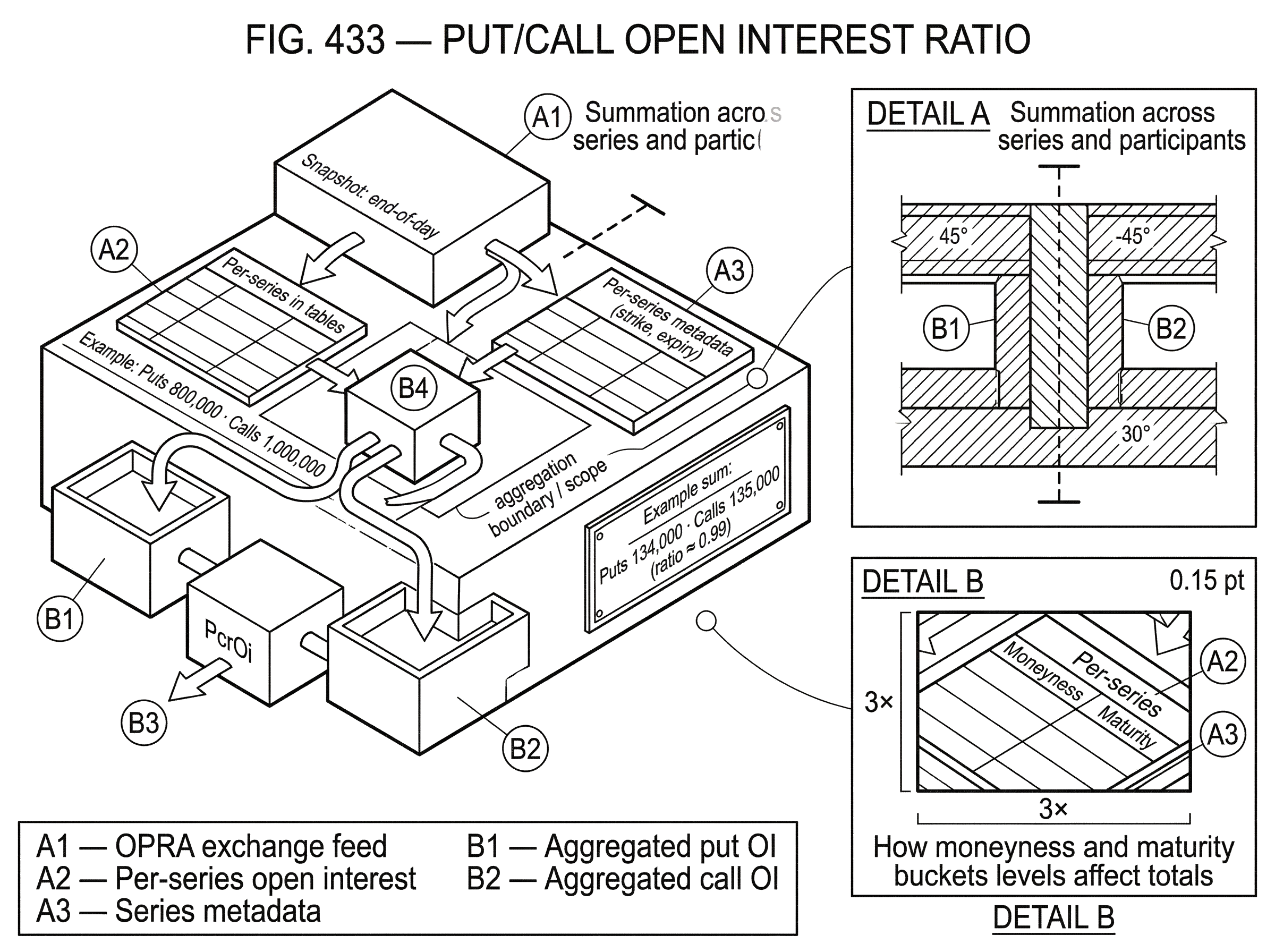
Quantcha’s methodology states the open-interest version directly: PcrOi is computed by dividing the sum of all puts outstanding at the end of the trading day by the sum of all calls outstanding at the end of the trading day. That is the clean conceptual definition most readers should keep in mind.
How is the put/call open interest ratio calculated and what counts toward it?
In its simplest form, the ratio is:
put/call open interest ratio = total put open interest / total call open interest
If total outstanding puts are 800,000 contracts and total outstanding calls are 1,000,000, the ratio is 0.8. If puts rise to 1,200,000 while calls remain 1,000,000, the ratio becomes 1.2.
The arithmetic is trivial. The difficult part is deciding what counts as “total.” That depends on the aggregation scope. Are you summing across all strikes and expirations for a single underlying? Across all equity options on an exchange? Across index options only? Across a whole market, including multiple exchanges? Different providers publish different variants, and those variants are not interchangeable.
This is where many misunderstandings begin. People often compare a ratio on one platform to a ratio on another as if both were the same object. But the result changes if you restrict to near-dated options, only include one exchange, include index options, exclude FLEX options, or use class-level vendor totals rather than raw per-series data. The formula is stable; the dataset boundary is not.
Where does option open-interest data come from (exchanges, OPRA, clearing)?
Mechanically, the ratio comes from per-series open interest data. In U.S. listed equity options, OPRA’s specification defines an Open Interest message that reports contract volume on current options that have not been exercised and have not yet expired. The message includes identifying fields such as security symbol, expiration block, strike price, and open interest volume. OPRA distributes these messages on behalf of participant exchanges, and each message carries the participant ID associated with that open-interest message.
That operational detail has an important consequence: if you want a market-wide put/call open interest ratio from OPRA-native data, you generally need to aggregate across option series and, where relevant, across participants. OPRA does not, in the message format described, hand you one magical precomputed market-wide put total and one call total. Instead, the data arrives at the series level, and a downstream system sums the pieces.
There is also routing complexity. OPRA publishes a Series Mapping Message that maps each option series to the multicast output line assigned for the current session. That mapping is published at the start of day and intraday for newly created series, and recent changes such as dynamic symbol rebalancing mean the operational placement of series can change over time. If you are building the ratio from raw feed data, you are not just doing arithmetic; you are maintaining an instrument map, ingesting the correct lines, and recovering missed blocks when necessary through OPRA’s retransmission facility.
Outside the U.S. equity-options context, the same basic pattern appears in different forms. CME publishes settlement files with an INT field for open interest at the contract level. Euronext’s Optiq interface publishes an Open Interest file sourced from the clearing system and calculated as of end of trading day, with some products reflecting overnight clearing netting. The transport and file formats differ, but the core mechanism is the same: the ratio is built downstream from instrument-level open-interest values, not conjured from a single universal market number.
Example: calculating a put/call open interest ratio from option series
Imagine a trader wants the put/call open interest ratio for a single stock at the close. They gather all listed option series for that stock: multiple expirations, many strikes, both puts and calls. For each series, they read the end-of-day open interest. Suppose the nearest monthly expiration has 20,000 call contracts spread across strikes and 14,000 put contracts. The next expiration adds 35,000 calls and 30,000 puts. LEAPS add another 80,000 calls and 90,000 puts.
Now the mechanism becomes clear. The trader is not asking how many contracts traded today. They are asking how many contracts remain open after all opening and closing activity, exercise, expiration, and clearing adjustments. Summing the puts gives 134,000; summing the calls gives 135,000. The ratio is therefore roughly 0.99.
Notice what this means and does not mean. It means that, across the option chain as defined, outstanding put positioning is about the same size as outstanding call positioning. It does not mean that traders are exactly balanced in directional conviction. Some of those puts may be protective hedges held against long stock. Some calls may be covered calls sold by long holders. Some open interest may sit inside spreads where the directional meaning of a single leg is incomplete without the other leg. The ratio is informative because it compresses the chain into a single number. It is limited for the same reason.
How do traders use the put/call open interest ratio?
Traders use the put/call open interest ratio because it says something different from price, volume, and implied volatility. Price tells you where the underlying ended up. Volume tells you how much traded. Implied volatility tells you something about option pricing and expected dispersion. The open-interest ratio says something about the stock of open option exposure split by put versus call.
That can matter in at least three practical ways.
First, it can act as a sentiment and positioning gauge. Quantcha’s materials note that many traders historically expected a ratio around 0.8 for many stocks, with lower readings often treated as more bullish and readings near 1.0 as more bearish. Those are heuristics, not laws, but they show how the metric is commonly used: not as a precise forecast model, but as a way to detect whether the option market’s standing inventory is skewed toward downside or upside exposure.
Second, it can help distinguish persistent positioning from temporary trading bursts. If volume-based put/call ratio spikes but open-interest ratio barely moves, the market may have seen large same-day activity without much net accumulation. If open interest also shifts, that suggests positions are being carried forward rather than merely traded and closed.
Third, it can help identify crowding or hedging pressure. A sustained increase in put open interest relative to calls may indicate growing demand for protection, structured downside trades, or bearish speculation. A sustained call-heavy open-interest structure may point to upside speculation, covered-call programs, or call overwriting depending on the underlying and investor base.
Why a high or low put/call open interest ratio can be misleading
The most common mistake is to treat the ratio as a direct vote count on market direction. That is too crude.
The reason is that option contracts are instruments, not opinions. A put can be bought because a trader is bearish, but it can also be bought to hedge a long stock position. A put can be sold as part of a bullish income strategy. A call can be bought for upside speculation, but it can also be sold against existing stock in a covered-call strategy. Open interest sees the existence of the contracts, not the intent or side that a casual reader wants to infer from them.
Quantcha explicitly warns that put/call ratios alone do not show whether options are predominantly bought or sold. That limitation is fundamental. Open interest is a net count of outstanding contracts by series, not a labeled database of trader beliefs. If you want to infer whether the market is aggressively buying puts, you usually need additional information such as trade direction, changes in implied volatility, or open/close classification.
This is why pairing the ratio with other indicators helps. If put/call volume rises sharply and implied volatility also rises, that is often more consistent with active put buying than with passive put selling. If put/call open interest rises over days while implied volatility stays elevated, that suggests downside-linked positioning is not merely intraday noise. The ratio becomes more useful when placed inside a broader mechanism rather than used alone.
Put/call open interest ratio vs put/call volume ratio; when should you use each?
| Metric | Measures | Speed | Best for | Interpretation tip |
|---|---|---|---|---|
| Volume-based PCR | Today's traded puts vs calls | Fast, noisy | Detect short-term flow | Pair with IV to infer buying |
| Open-interest-based PCR | End-of-day outstanding puts vs calls | Slow, accumulates | Assess carried positioning | Compare to its own history |
The cleanest way to separate the two is by asking what changes each metric can see.
A volume-based put/call ratio responds immediately to today’s trades. It is fast, noisy, and sensitive to event-driven bursts. It is often better at detecting short-term flow or sudden sentiment shifts. Quantcha defines the volume version by dividing the day’s total puts transacted by the day’s total calls transacted.
An open-interest-based put/call ratio responds to accumulated outstanding positions at the end of the day. It moves more slowly because many trades simply transfer risk or offset prior positions without changing the final open-interest stock by much. It is therefore better suited to understanding carried positioning and slower-moving market structure.
Research evidence supports the idea that the two capture different horizons. A study on Nifty index options found that put/call ratios based on volume were more informative at short horizons, while open-interest-based ratios had stronger longer-horizon predictive content. That does not mean the result is universal across all markets and eras, but it matches the intuition: flow moves faster than inventory.
What factors can distort the put/call open interest ratio?
| Distortion | Typical effect | Mitigation |
|---|---|---|
| Aggregation across maturities | Mixes hedging and speculation | Compute separate maturity buckets |
| Strike distribution | OTM hedges or lottery bets skew totals | Analyze moneyness bands |
| Exchange conventions | Timing shifts or discontinuities | Normalize publication timing |
| Low liquidity | Undefined or volatile readings | Treat sparse names cautiously |
| Vendor totals and scope | Different coverage changes values | Verify provider methodology |
Several mechanisms can make the ratio misleading if read naively.
Aggregation across maturities is the first. Near-dated options are often used for event speculation, while long-dated options may be used for hedging or structured exposure. If you combine them into one ratio, you are mixing markets with different purposes. A stock may show heavy long-dated put open interest because institutions hold protective hedges, while short-dated calls dominate speculative trading. The all-expiry ratio compresses both into one number and hides the distinction.
Strike distribution matters too. Deep out-of-the-money puts can build large open interest as crash hedges, but their directional meaning differs from at-the-money speculative positions. Likewise, far-out-of-the-money calls may represent lottery-ticket speculation rather than serious bullish conviction. A single total ratio ignores this geometry.
Market structure conventions can also matter. Cboe’s data documentation notes that historical open-interest conventions have differed across exchanges and dates, including periods where some values were shifted one day ahead. That means a time series can contain artificial discontinuities unless normalized. Euronext notes that for some commodity derivatives, overnight netting changes the timing of final open-interest publication. In other words, even before interpretation, you need to know when the snapshot was taken and what operational adjustments are baked into it.
Finally, low-liquidity instruments create edge cases. If there are no calls for a term or scope, a ratio can be undefined rather than large. Quantcha notes that when there are no calls, the value is null; if there are calls but no puts, the ratio is 0. These are not minor implementation details. They change how screens, backtests, and alerts should handle sparse option chains.
Is open interest reliable intraday or primarily an end-of-day metric?
A subtle but important point is that open interest is typically treated as an end-of-day or clearing-aligned measure, not a continuously pristine intraday state variable. OPRA provides open-interest messages and end-of-day summary information, but the publicly accessible vendor products and exchange documentation often make clear that open-interest fields are primarily available in EOD contexts or reflect clearing-system outputs. Cboe’s Open-Close Volume Summary, for example, includes open-interest fields in end-of-day files and explicitly excludes them from 10-minute interval files.
This makes sense from first principles. Open interest depends on whether trades open or close positions and on downstream post-trade processing. That is a more reconciliation-heavy quantity than simple trade count or last price. As a result, traders should be cautious with any supposed high-frequency intraday open-interest ratio unless they understand exactly how the provider estimates or updates it.
When does the put/call open interest ratio predict market behavior; and when does it fail?
The put/call open interest ratio persists because it often captures something real about positioning. Product documentation and practitioner usage treat it as a sentiment input, while empirical work suggests option-derived ratios can contain predictive information under some conditions. But the value is conditional, not automatic.
For example, open-interest-based ratios may be more useful over multi-day horizons than same-day horizons because the positions they summarize change more slowly. In calmer regimes, rising put open interest relative to calls can reflect meaningful defensive positioning. In stressed regimes, however, everyone may hedge at once, market makers may adjust inventories aggressively, and the ratio can become less discriminating. The Nifty study found periods, including crisis windows, in which these indicators lost significance.
That pattern is sensible. A signal derived from relative positioning works best when changes in positioning convey new information. When the whole market is under obvious stress, extreme put demand may say less about future direction than about current panic already visible in prices and volatility.
How should I use the put/call open interest ratio in practice?
| Decision | Action | Why it helps |
|---|---|---|
| Assess sentiment | Compare to historical baseline | Controls for asset-specific norms |
| Separate scopes | Split equity vs index ratios | Different use-cases and hedging behavior |
| Maturity buckets | Compare short vs long-dated ratios | Disentangles event trades from hedges |
| Combine indicators | Pair with IV and volume | Distinguishes buying flow vs carried positions |
| Handle edge cases | Treat nulls and zeros explicitly | Avoid divide-by-zero and sparse-chain traps |
The most robust use of the put/call open interest ratio is comparative, not absolute.
Compare it to its own history for the same underlying. Compare equity-option ratios separately from index-option ratios, because index options are used heavily for macro hedging. Compare short-dated and long-dated ratios rather than collapsing everything together if maturity structure matters to your question. And compare changes in the ratio with changes in implied volatility, skew, realized price movement, and volume.
Also be careful about scope. A ratio for a single stock means something different from a ratio for all listed equity options. A broad market ratio may be dominated by a small number of very active names or by index hedging flows. An underlying-specific ratio may reflect corporate-event positioning rather than general sentiment.
In practice, the ratio often works best as an input into a richer picture: positioning is growing more defensive, speculation is shifting toward upside, hedging demand is expanding, or the option market looks crowded in one direction. Used this way, it helps you ask better questions. Used as a standalone binary signal, it is easy to misuse.
Conclusion
The put/call open interest ratio is the number of outstanding puts divided by the number of outstanding calls over a chosen option universe. Its value comes from what open interest measures: not today’s trading burst, but the contracts that remain open after the market closes.
That makes it a useful lens on positioning, hedging, and sentiment; but only a lens. The ratio tells you how the option inventory is split between puts and calls. It does not, by itself, tell you who is right, who is hedged, or whether the crowd is buying or selling those contracts. The memorable version is simple: volume shows activity; open interest shows what is still there. The put/call open interest ratio is a way of asking which side of the options market is occupying more of that remaining space.
Frequently Asked Questions
Open-interest PCR measures the stock of outstanding contracts at the close (inventory) and therefore changes slowly and is better suited to multi-day positioning questions; volume PCR measures contracts traded during a period (flow), is fast and noisy, and is better for short-horizon or event-driven flow detection.
No - a high put/call open interest ratio only means more outstanding put contracts relative to calls; puts can be protective hedges, parts of spreads, or sold for income, so the ratio does not by itself prove net bearish conviction without additional evidence.
The computed ratio depends critically on what you include: which expirations, which strikes (OTM vs ATM), whether index options are mixed with single-stock options, and which exchanges or vendor aggregates are used; changing those boundaries can materially change the number and its interpretation.
Open interest is typically treated as an end-of-day or clearing-aligned snapshot rather than a continuously reliable intraday field; exchanges and vendors often publish OI in EOD files and some intraday products explicitly exclude open-interest fields or provide them only after reconciliation.
Feed providers like OPRA publish open interest at the option-series level (each message includes a participant ID), so market-wide put and call totals are generally computed downstream by summing series-level values rather than obtained as a single pre-aggregated consolidated total.
Several distortions can mislead the ratio: mixing long- and short-dated options, large OTM crash-hedge concentrations, exchange-level timing differences in historical OI conventions, and low-liquidity chains where no calls or puts exist (which can make the ratio undefined or zero).
The ratio is most informative when combined with other signals - for example, rising put open interest together with rising implied volatility and elevated put volume is more consistent with active put buying or growing downside hedging than the ratio alone would indicate.
Academic and market studies find horizon-dependent results: volume-based PCRs tend to have short-horizon predictive content while open-interest PCRs can show predictive signals at longer horizons, but those signals weaken or disappear during major crises or stressed regimes.
Implementations should handle sparsity explicitly: many providers treat 'no calls' as null and 'no puts' as a zero ratio; failing to code these cases can create spurious spikes or division-by-zero errors in screens and backtests.
Related reading