What Are Order Flow Imbalance Models?
Learn what order flow imbalance models are, how they link limit order book events to price moves, and where they work or fail in practice.
Introduction
Order flow imbalance models are models of short-horizon price formation that treat changes in buy-side and sell-side pressure as the immediate driver of price moves. The puzzle they address is familiar to anyone who has looked at a limit order book: price often moves before a large trade is obvious in the tape, and sometimes it moves even when traded volume looks ordinary. That happens because markets react not only to executed trades, but to the whole stream of order-book events (new limit orders, cancellations, executions, and auction interest) that alter how much liquidity is available on each side.
The core idea is simple enough to say in one sentence: if demand to buy becomes harder to satisfy than demand to sell, prices tend to rise; if supply becomes harder to absorb than demand, prices tend to fall. But turning that intuition into a usable model requires care, because “pressure” is not directly observed. What we see are messages from trading venues, and those messages reflect a particular market design: a continuous limit order book during the day, and often discrete auctions at the open and close. Order flow imbalance models exist to convert that event stream into a measure of directional pressure that can explain, and sometimes forecast, short-term price changes.
These models sit inside market microstructure rather than broad asset pricing. They are about how prices move, not mainly about what the fundamental value should be. That makes them useful for execution, intraday forecasting, market-making, auction trading, and post-trade analysis. It also makes them fragile if the data are incomplete, if hidden liquidity matters a lot, or if visible orders are strategically deceptive. The useful way to understand them is therefore not as a single formula, but as a family of attempts to infer the same underlying object: net pressure on available liquidity.
Why do prices move even when there are no obvious large trades?
A useful starting contrast is between two stories about price movement. In the coarse story, prices move because buyers and sellers trade. In the microstructure story, prices move because the conditions under which buyers and sellers can trade keep changing. A market order to buy matters because it consumes sell-side liquidity. A cancellation of ask-side orders can matter in almost the same way, because it removes liquidity that buyers would otherwise have hit. A new bid near the best price can stabilize price even without any immediate trade, because it increases the market’s ability to absorb selling pressure.
This is why raw trading volume is not enough. Volume tells you that transactions occurred; it does not tell you how hard the market had to work to absorb them. The SEC-CFTC report on the May 6, 2010 flash crash makes exactly this point in broader terms: high trading volume is not the same thing as abundant liquidity. In a stressed market, a great deal can trade while displayed depth evaporates. From the perspective of an order flow imbalance model, that distinction is central. The model is trying to measure not activity in the abstract, but the net depletion or replenishment of actionable liquidity.
That mechanism also explains why order flow can carry information. In Kyle’s classic sequential-auction model, market makers infer information from aggregate order flow because informed traders must hide inside the total stream of trading, using noise trading as camouflage. Real markets are far more complicated than Kyle’s setup, but the lasting intuition is that order flow is not merely mechanical. It can encode information, urgency, inventory needs, hedging demand, and strategic behavior. An imbalance measure is therefore a compressed summary of many motives acting through the book at once.
How does the limit order book act as a liquidity buffer and how does imbalance stress it?
A limit order book is best thought of as a buffer of resting liquidity. On the bid side, it buffers incoming sells; on the ask side, it buffers incoming buys. Price changes when that buffer is depleted enough that the best available trading terms worsen, or when fresh liquidity arrives and improves them.
Order flow imbalance models try to track how that buffer changes through time. If bid-side liquidity at the best prices is repeatedly removed (whether by executions against bids or by bid cancellations) then the market becomes less able to absorb additional selling. If ask-side liquidity is being removed faster than replenished, buyers face a thinner offer side and price pressure turns upward. The important point is that executions are only one way liquidity changes. Additions, deletions, modifications, and auction-specific order submissions all matter because they change the market’s local supply-demand geometry.
This is where order flow imbalance differs from the simpler notion of order book imbalance. Order book imbalance is typically a snapshot: how much volume is sitting on the bid side versus the ask side at some moment. Order flow imbalance is dynamic: how much the state of the book is changing in a buy-pressuring or sell-pressuring direction over an interval. A snapshot can be misleading if the displayed book is large but rapidly canceling, or small but being aggressively replenished. Flow matters because markets are processes, not still images.
How do you convert order-book events into an order flow imbalance metric?
| Event type | Signed direction | Buffer effect | Typical OFI entry | Visibility |
|---|---|---|---|---|
| Limit add at best | Buy-pressure (if bid) | Increases available depth | Positive small | High visible |
| Cancel at best | Sell-pressure (if bid) | Decreases available depth | Negative moderate | High visible |
| Market sell | Sell-pressure | Consumes bid liquidity | Negative large | Trade visible |
| Price-moving trade | Signed by aggressor | Shifts best quote | Large signed | High information |
| Deep add/cancel | Conditional direction | Alters book resilience | Small / conditional | Lower visibility |
To make the idea operational, a model needs a rule that assigns a signed contribution to each book event. The sign convention varies, but the usual logic is straightforward: events that strengthen the bid side or weaken the ask side are treated as buy-pressure contributions; events that weaken the bid side or strengthen the ask side are treated as sell-pressure contributions.
At the best quotes, the most common ingredients are these. A new limit order at the best bid adds buy-side support. A cancellation at the best bid removes that support. A market sell that executes against the best bid also removes buy-side support, because it consumes bids. On the ask side, a new limit order at the best ask adds sell-side supply, while a cancellation of asks or a market buy consuming asks removes that supply and therefore contributes to buy pressure.
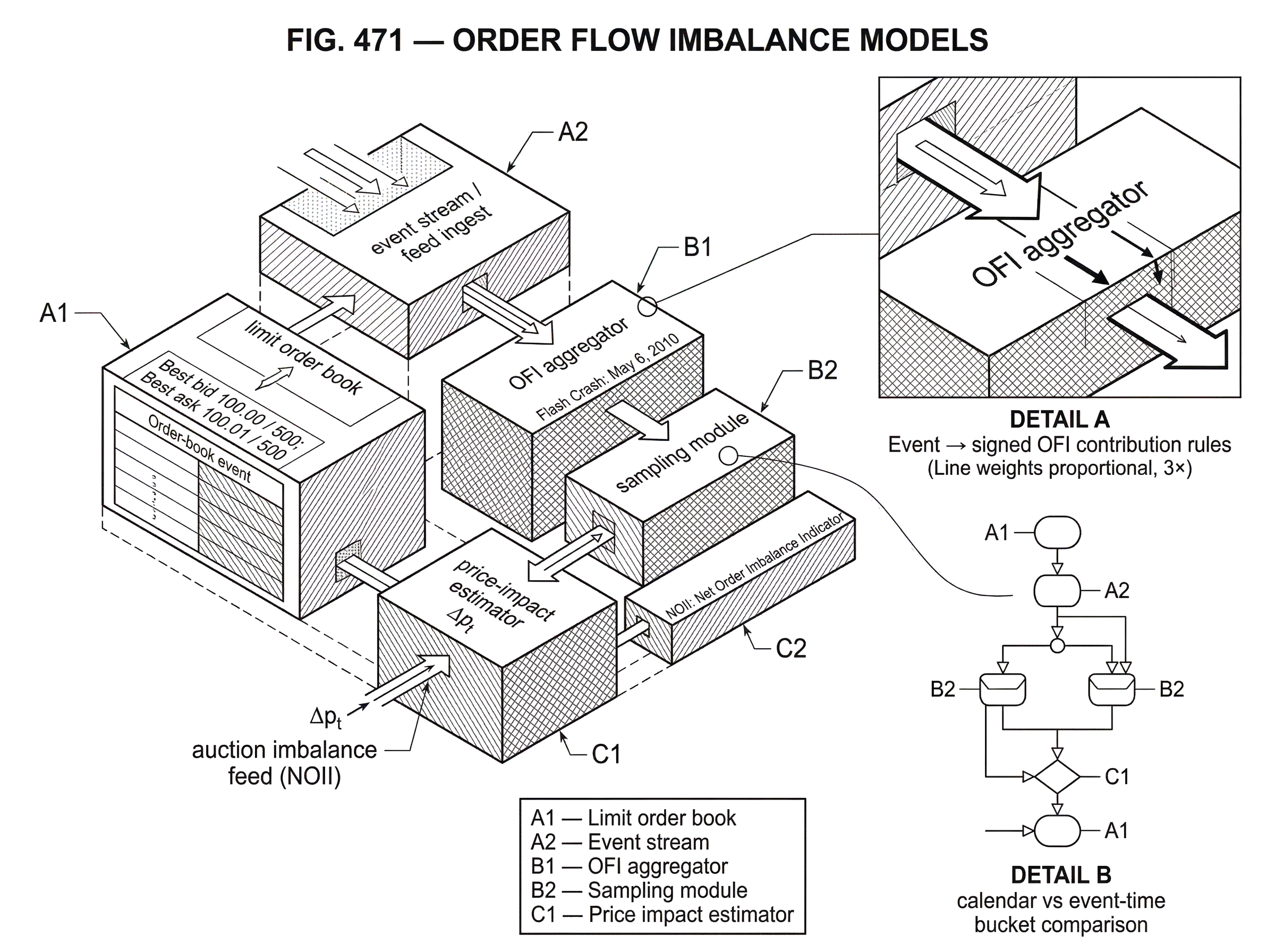
If we let OFI_t denote order flow imbalance over interval t, the model usually computes it as the signed sum of these event contributions over that interval. The exact encoding differs across papers and trading systems, but the spirit is consistent:
OFI_t = buy-side strengthening and ask-side weakening - bid-side weakening and ask-side strengthening
That is deliberately verbal rather than overly symbolic, because the main issue is not notation but event classification. The formula only becomes meaningful once you specify which levels of the book you observe, how you handle price changes, whether you net additions and deletions at the best quote only or across several levels, and how you bucket events into time.
A simple worked example makes the mechanism clearer. Imagine the best bid is 100.00 for 500 shares and the best ask is 100.01 for 500 shares. A trader posts 300 more shares at the best bid. The market is now slightly more able to absorb selling, so the event contributes positively to buy-side pressure. Next, 400 shares are canceled from the best ask. No trade occurred, but buyers now face less displayed supply, so this also contributes to buy-side pressure. Then a market buy executes 500 shares at the ask and clears the level, moving the best ask up. Again, the ask-side buffer has been depleted. Across these three events, the tape might show only one aggressive trade, but the book has become much more imbalanced in a buy-pressuring direction. That is what the model is trying to capture.
Why simple linear models often work surprisingly well
A striking empirical regularity in microstructure is that short-horizon price changes are often related roughly linearly to imbalance measures, at least over limited regimes and sampling choices. In reduced form, people often write something like:
Δp_t = β * OFI_t + ε_t
Here Δp_t is the price change over interval t, β is the sensitivity of price to imbalance, and ε_t collects whatever the model does not explain. The parameter β is closely connected to liquidity: when the market is deep and resilient, a given imbalance produces a smaller price move, so β is lower; when the book is thin, the same imbalance moves price more, so β is higher.
Why should linearity appear at all? Not because the market is truly linear in any deep sense. Rather, over short intervals and moderate state changes, a first-order approximation often captures the local response of price to net pressure on depth. If price is the market’s way of rationing scarce liquidity, then a small extra unit of imbalance can often be summarized as a roughly proportional move in the clearing price. This is a local approximation, not a universal law.
That point matters because readers often overgeneralize the model. A linear OFI regression is not claiming that every extra share has the same impact in all states of the world. It is claiming something narrower: conditional on a chosen sampling scheme and market regime, imbalance is a useful sufficient summary of immediate pressure. Once depth, volatility, tick size, queue position dynamics, hidden liquidity, and strategic adaptation change enough, the approximation can degrade quickly.
Event‑time vs clock‑time sampling: which OFI bucket should you use?
| Scheme | Primary use | Statistical property | Execution alignment | Main drawback |
|---|---|---|---|---|
| Calendar time | Real-time monitoring | Heteroskedastic event counts | High wall-clock alignment | Mixed information per bucket |
| Event time | Stationarity and inference | More stationary statistics | Low wall-clock alignment | Harder operational mapping |
| Volume buckets | Normalize traded volume | Controls volume variance | Moderate alignment | Sensitive to metaorders |
| Auction cadence | Auction-specific signals | Venue-aggregated imbalance | Direct for opens/closes | Venue-local signals |
One of the easiest ways to misunderstand order flow imbalance models is to think the model exists independently of the clock. It does not. The measured imbalance depends on how you aggregate events.
In a quiet market, a one-second bucket may contain almost nothing. In a highly active market, the same bucket may contain hundreds of adds, cancels, and trades. If you use calendar time, you get a direct operational view useful for execution and real-time systems, but you also mix together different levels of information arrival. If you use event time (say, every 100 book events) you normalize activity, but you make the model less immediately aligned with wall-clock execution decisions.
The choice changes the model’s meaning. A one-second OFI_t answers: what net pressure accumulated in the last second? An event-time OFI_t answers: what pressure accumulated over the last fixed number of microstructure updates? Neither is universally right. The first is closer to trading operations; the second is often closer to statistical stationarity.
This is also why data-feed cadence matters for auction imbalance indicators. Nasdaq’s Net Order Imbalance Indicator, or NOII, is disseminated at scheduled intervals before the open and close, then more frequently near the cross. NYSE disseminates its opening and closing imbalance messages on a different schedule, with frequency increasing as the auction approaches. Those publication rules are not incidental details. They define the temporal granularity available to any auction-focused imbalance model.
How do OFI models for continuous trading differ from auction imbalance indicators?
| Model | Data source | What 'imbalance' means | Strength | Limitation |
|---|---|---|---|---|
| Continuous book | Live order-book events | Net liquidity change over interval | High temporal resolution | Noisy; needs deep feeds |
| Auction cross | NOII / venue imbalance feed | Aggregate auctionable interest | Includes hidden/non-displayable orders | Venue-specific; discrete timing |
In continuous trading, imbalance models infer pressure from the event stream of the live order book. Auctions are different because the market is explicitly trying to find a single clearing price that maximizes matchable volume subject to venue rules. That changes both what “imbalance” means and how it should be modeled.
Nasdaq’s opening and closing crosses make this concrete. The venue disseminates NOII fields including the current reference price, paired shares, imbalance shares, imbalance direction, and indicative prices. Nasdaq states that the NOII includes both displayable and non-displayable order types and describes it as the best public predictor of the opening and closing prices. Mechanically, that matters because auction imbalance is not a guess based only on visible top-of-book changes. It is a venue-computed indicator derived from auction-eligible interest, including hidden components that outside book reconstruction would miss.
The auction price itself is not arbitrary. Nasdaq states that the cross price is chosen by prioritizing three objectives: maximize executed shares, then minimize imbalance, then minimize distance from the inside midpoint. NYSE publishes analogous imbalance and clearing-price information for its own auctions, again with venue-specific fields and cadence. So an auction imbalance model is usually much closer to modeling a constrained clearing problem than a continuous-time impact process.
A worked example helps. Suppose the Nasdaq closing cross shows many more buy shares than sell shares at the current reference price. The NOII message reports positive imbalance shares and a buy imbalance direction. If additional sell interest arrives, paired shares can increase and imbalance shares can shrink without any continuous trade having occurred. The indicative clearing price may move as the venue searches for the price that executes the most volume while leaving the least residual imbalance. In this setting, imbalance is not just a directional signal about future midprice; it is a state variable of a specific clearing algorithm.
This is why auction imbalance indicators are often more directly tradable than continuous-book OFI signals. They come from the venue’s own aggregation of eligible orders. But they are also venue-local. Nasdaq itself notes that only interest resting on the Nasdaq book is eligible to participate in its crosses. So even a high-quality auction imbalance signal is not a market-wide measure of supply and demand; it is a measure of that venue’s auction state.
How do hidden liquidity and feed design limit the reliability of OFI?
An order flow imbalance model is only as good as the book state it thinks it observes. In practice, that is a major limitation.
Some feeds contain rich order-level event data, such as TotalView-ITCH-style messages or full depth MBO feeds. These are what modelers use to reconstruct the book and compute OFI. But even with high-quality feeds, not everything is observable. Hidden and non-displayed liquidity may interact with the market without being visible in the displayed queue. Nasdaq’s own auction documentation explicitly says NOII includes non-displayable as well as displayable order types; that is useful for auctions, but it also reveals a general truth: visible book data alone can miss a meaningful part of executable interest.
Feed design creates additional friction. Some execution messages do not preserve enough information to map every trade back to the originating resting order. Public sample ITCH PCAPs may require specialized parsing because they are packaged in Nasdaq’s BinaryFILE format rather than standard packet captures. Production systems need lossless ingestion, careful sequencing, and synchronized timestamps because missing or misordered messages can manufacture false imbalances.
This is not an implementation footnote. It changes the economics of the model. If cancellations are undercounted, the book looks more stable than it is. If hidden replenishment is invisible, apparent ask depletion may overstate buy pressure. If timestamps drift across venues, cross-asset or cross-venue imbalance models can infer causality in the wrong direction. In other words, a poor data pipeline does not merely add noise; it can change the sign of the inferred mechanism.
How are OFI models related to price‑impact and propagator models?
Order flow imbalance models are often introduced as empirical regressions, but they are closely related to a broader class of price impact models. The connection is easiest to see from first principles. If order flow imbalance summarizes net pressure on liquidity, then a price impact model specifies how that pressure is transmitted into returns through time.
The simplest impact formulations use signed market order flow: past buy-initiated and sell-initiated trades are weighted by a kernel that describes how impact decays or persists. Research on transient impact and history-dependent impact models pushes this idea further. In the Transient Impact Model, price is written as a linear combination of past signed trades weighted by a propagator function. In the History Dependent Impact Model, price changes depend on the surprise component of order flow relative to what the recent history would predict.
These models are not identical to OFI models, because OFI typically includes more than executed trades. But the shared principle is the same: prices respond to net order pressure filtered through liquidity. The difference is about measurement. Trade-sign models use executed market orders as the signal. OFI models try to use a broader and often better signal by counting the whole set of liquidity-changing book events.
That is also why richer event typing improves results in some markets. Research comparing impact models finds that distinguishing price-changing from non-price-changing events can materially improve fit, especially in large-tick stocks where quote changes are relatively rare and informative. The lesson for OFI is that not all imbalance events are equivalent. A cancellation that empties the best ask carries different information from a small addition deeper in the book. Good models respect that asymmetry rather than pretending all signed messages are interchangeable.
When do OFI models fail? Spoofing, liquidity stress, and regime shifts
The most important caution about order flow imbalance models is that they can confuse displayed intention with real executable pressure.
Spoofing and layering are the clearest example. The CFTC’s enforcement action against Navinder Sarao described an alleged layering algorithm that placed multiple large visible sell orders away from the best ask, adjusted them as price moved, and canceled most of them before execution. A naïve imbalance model looking only at visible displayed depth could interpret that as genuine sell pressure. But economically, the orders were not meant to trade; they were signals designed to alter others’ behavior.
This is not a corner case in theory only. It exposes a general vulnerability: OFI assumes that changes in displayed liquidity are at least somewhat informative about the market’s willingness to trade. Strategic order placement weakens that assumption. Even honest liquidity provision can become highly state dependent under stress. During the flash crash, the problem was not simply “more selling.” It was that automated execution, feedback loops, and liquidity withdrawal changed the mapping from order flow to available depth. In such regimes, the historical β linking imbalance to price can jump abruptly.
There is a deeper lesson here. Order flow imbalance is not a primitive law of markets. It is a reduced-form summary that works when the market’s response function is stable enough. When participants withdraw, when auctions replace continuous trading, when a venue pause occurs, when short-sale constraints alter eligible interest, or when hidden liquidity dominates the visible book, the usual interpretation can fail.
How do traders and execution systems use OFI signals in practice?
In practice, people use order flow imbalance models wherever short-horizon liquidity pressure matters more than long-horizon valuation.
Execution algorithms use them to decide whether urgency should rise or fall. If buy-side imbalance is building and the book is thinning on the ask, a trader trying to buy may accelerate because waiting is becoming more expensive. Market makers use related signals to adjust spreads, skew quotes, and manage inventory because imbalance helps estimate the probability of adverse selection and near-term quote movement. Intraday directional models use OFI as a feature because lagged imbalance can carry predictive content, especially over very short horizons.
Auction traders use venue-specific imbalance feeds even more directly. Nasdaq NOII and NYSE imbalance messages reveal paired volume, residual imbalance, and indicative pricing information that can guide whether to enter offsetting interest or hedge expected auction outcomes. In cross-asset settings, researchers have also found that lagged OFI from related securities can help forecast short-term returns, though that predictive effect tends to decay quickly.
The practical pattern is consistent: the closer the task is to immediate trading mechanics, the more valuable imbalance tends to be. The farther the task moves toward medium-term investment forecasting, the more the signal competes with noise, adaptation, and changing regimes.
Key takeaway: what OFI measures and when it should be trusted
Order flow imbalance models exist because price changes are responses to changing liquidity, not just to completed trades. They try to measure the net pressure that order submissions, cancellations, executions, and auction interest impose on the book, then relate that pressure to short-term price movement.
Their power comes from focusing on mechanism. Their weakness comes from the same place: if the observed book is incomplete, strategically misleading, or governed by a different matching process than the model assumes, the signal can distort quickly. A good way to remember the idea is this: OFI is a proxy for how hard it has become to trade on each side of the market. When it gets harder to buy than to sell, price tends to rise; when it gets harder to sell than to buy, price tends to fall.
Frequently Asked Questions
Order book imbalance is a static snapshot of displayed volume on bids versus asks at a moment in time; order flow imbalance is a dynamic measure of how the book’s state changes over an interval by summing signed contributions from adds, cancels, and executions to infer net buy- or sell-pressure.
Because over short horizons and moderate state changes price often responds approximately proportionally to net pressure on liquidity, a first‑order linear regression Δp_t = β·OFI_t can work well; β then reflects market depth and resilience, being smaller in deep markets and larger in thin ones.
Sampling defines what an OFI bucket means: calendar-time buckets answer “what pressure accumulated in the last second,” while event-time buckets answer “what pressure accumulated over a fixed number of book updates,” and each choice changes stationarity, alignment with execution decisions, and the information content of OFI.
Auction imbalance indicators (like Nasdaq’s NOII) are venue-computed aggregates of auction-eligible interest - often including non-displayable orders - and represent the cross’s clearing state, whereas continuous-book OFI infers net pressure from the stream of adds/cancels/trades in live trading.
Missing or misordered feed messages, hidden/non‑displayable liquidity, and feed-format choices limit OFI: they can hide replenishment or cancellations, and Nasdaq documentation explicitly notes NOII includes non‑displayable orders while ITCH/TotalView feeds and PCAP quirks affect feasible reconstruction.
Yes - OFI can be misled by strategic order placement such as spoofing or layering because it treats visible changes in displayed liquidity as informative, and enforcement filings (e.g., the CFTC complaint discussed in the article’s sources) illustrate how large visible orders that are never intended to trade can create false imbalance signals.
OFI models are closely related to price‑impact or propagator models: both view price as the market’s response to net order pressure, but OFI broadens the signal beyond executed trades to include other liquidity‑changing book events while propagator models typically weight past signed trades by kernels describing impact decay.
Practitioners use OFI where immediate liquidity pressure matters most: execution algorithms to set urgency, market makers to skew quotes and manage inventory, auction traders who read venue imbalance feeds, and short‑horizon directional models as a proximal feature for intra‑day returns.
OFI breaks when the mapping from displayed book events to executable interest changes abruptly - for example during liquidity withdrawal, venue pauses, auctions replacing continuous trading, or regime shifts like the May 6, 2010 event where high volume coincided with evaporating displayed depth; in those regimes the historical β linking OFI to price can jump or reverse.
There is no single rule; the article stresses that you must specify which book levels you observe, how you classify price‑changing versus non‑price‑changing events, how you bucket time, and whether you include hidden/auction‑eligible interest - these modelling choices materially change OFI’s meaning and performance and must be tailored to the data and task.
Related reading