What Is Order Book Imbalance?
Learn what order book imbalance is, how it measures buy vs. sell liquidity, why it predicts short-term price moves, and where the signal breaks down.
Introduction
order book imbalance is the unevenness between buy-side and sell-side interest in a limit order book. It matters because modern prices are not set by some abstract consensus; they are set by matching actual resting orders against incoming demand. When one side of the book is thin and the other is thick, the next marketable orders do not meet equal resistance in both directions, and price becomes easier to move one way than the other.
That observation sounds almost too obvious to deserve a formal name. If there are more bids than asks, surely that is bullish; if there are more asks than bids, surely that is bearish. But that simple story is only partly right. The real question is not whether there are “more orders” in the book in some vague sense. The real question is where liquidity sits, how much of it is actually executable at relevant prices, how quickly it changes, and over what time horizon the displayed book tells you anything useful at all.
This is why order book imbalance sits at the center of market structure. It is a bridge between the static picture of the book and the dynamic process of price formation. It helps explain short-horizon price impact, auction mechanics at the open and close, execution risk, and even certain forms of manipulation such as spoofing and layering. Used carefully, it is one of the clearest ways to think about why a market feels stable in one moment and fragile in the next.
How does order book imbalance cause prices to move?
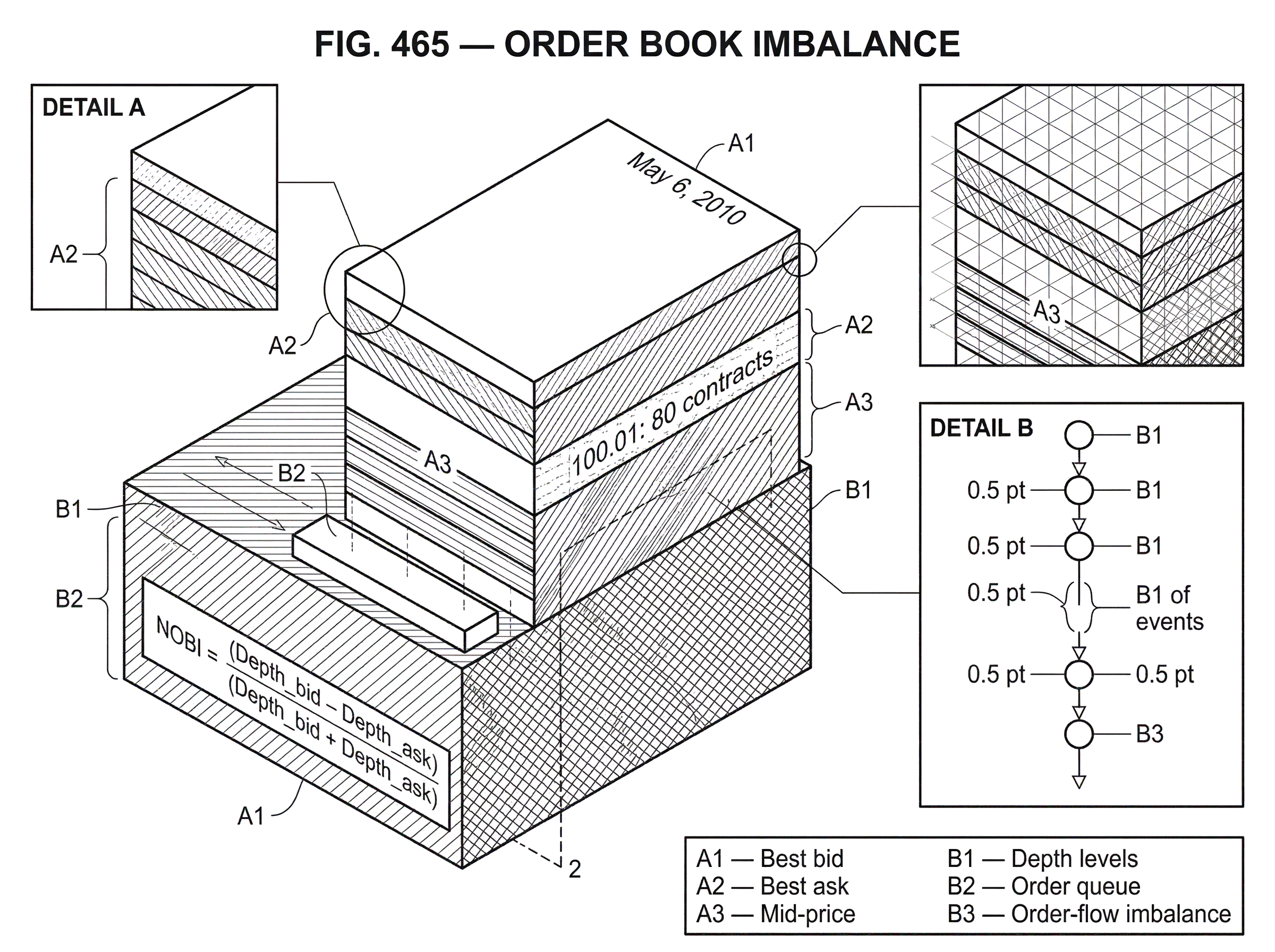
A limit order book is a queue of resting buy orders below the market and resting sell orders above it. The highest displayed buy price is the best bid. The lowest displayed sell price is the best ask. The midpoint between them is the mid-price. If an aggressive buyer sends a marketable buy order, it consumes sell-side liquidity at the ask. If an aggressive seller sends a marketable sell order, it consumes bid-side liquidity at the bid.
Here is the core idea that makes order book imbalance click: price is not moved directly by opinion; it is moved by the exhaustion of liquidity. If there is very little quantity resting on the ask and much more resting on the bid, then a relatively modest burst of buying can clear the best ask, then the next ask, and so on. The price rises not because the market “decided” the asset is worth more in the abstract, but because the available sell-side inventory near the current price was too small to absorb the incoming orders.
The same logic works in reverse. If the bid side is thin, a sell order does not have to be especially large to push the market down through multiple price levels. So order book imbalance is really a measure of asymmetric resistance. It asks whether the market is easier to push upward or downward, given the currently visible liquidity.
That is why imbalance matters more than raw trading volume for many short-horizon questions. A market can trade large volume and still be fragile if the replenishment of resting orders is weak. The joint SEC-CFTC analysis of the May 6, 2010 market events made exactly this broader point: high trading volume is not the same thing as deep liquidity. Under stress, volume can surge while usable depth evaporates.
How is order book imbalance measured and normalized?
| Measure | Depth | Normalized | Horizon | Strength |
|---|---|---|---|---|
| Top-of-book | 1 level | No | Sub-second | Very local immediate pressure |
| Normalized NOBI | 1–few levels | Yes | Seconds | Cross-asset comparable |
| Multi-level MLOFI | Multiple levels | Yes | Seconds to minutes | More stable explanatory power |
| Order-flow imbalance (OFI) | Event flow | Usually yes | Very short to short | Captures dynamic book events |
In the simplest form, order book imbalance compares bid depth and ask depth. Suppose Depth_bid is the total resting buy quantity at some chosen set of price levels, and Depth_ask is the analogous sell quantity. A raw imbalance can be written as OBI = Depth_ask - Depth_bid or the reverse convention, depending on the source. The sign convention is not fundamental; what matters is being consistent about which sign means buy-side dominance and which means sell-side dominance.
Because different assets and venues have very different absolute depth, practitioners often normalize the quantity. A common normalized form is NOBI = (Depth_bid - Depth_ask) / (Depth_bid + Depth_ask) or the sign-reversed equivalent. This scales the measure to the interval from -1 to 1. Values near 1 indicate strong bid-side dominance; values near -1 indicate strong ask-side dominance; values near 0 indicate a relatively balanced book.
The normalization matters for a simple reason: a 5,000-share imbalance means something very different in a highly liquid mega-cap equity than in a thin small-cap stock or a lightly traded token pair. Dividing by total depth turns the measure from an absolute quantity into a relative one.
But there is a deeper modeling choice hidden here: what counts as “the book”? Some studies use only the best bid and best ask. Others aggregate several levels on each side. That choice is not cosmetic. It changes the meaning of the signal.
If you measure only the top of book, you get a very local estimate of immediate pressure. This can be useful for very short horizons because the next trade interacts first with the inside quote. Research by Cont, Kukanov, and Stoikov emphasizes that over short intervals, price changes are strongly related to imbalance in supply and demand at the best bid and ask, and that the relationship is approximately linear with a slope inversely related to market depth.
If instead you include multiple levels, you are asking a broader question: not just whether the inside quote is thin, but whether there is meaningful support or resistance slightly farther away. Work on multi-level order-flow imbalance, or MLOFI, argues that deeper levels add explanatory power for contemporaneous mid-price changes. The intuition is straightforward. The top level may flicker rapidly and be noisy, while the shape of the book a few levels deep may better capture the market’s true short-run capacity to absorb order flow.
So when someone cites an imbalance number, the first smart question is: imbalance of what depth, at what levels, sampled how often, and with what sign convention? Without that, the number is less meaningful than it appears.
Why can the same trade size have different price impact?
Imagine a futures market with the best bid at 100.00 for 300 contracts and the best ask at 100.01 for 80 contracts. One level higher, 100.02 has another 70 contracts offered, and 100.03 has 50. On the bid side, below 100.00 there are 250 contracts at 99.99 and 240 at 99.98.
Now suppose an aggressive buyer submits a market order for 180 contracts. The first 80 contracts lift the entire best ask at 100.01. That price level disappears. The next 70 execute at 100.02. There are still 30 contracts left to buy, so the order continues into 100.03. By the time it is done, the lowest remaining ask is now 100.03 or higher, and the mid-price has moved up.
Why did the price move? Not because 180 contracts is inherently a “large” order. In another market state, 180 contracts might have had no visible impact at all. The move happened because the sell-side depth near the market was thin relative to the incoming order. The same order arriving against a thicker ask would have produced less or no price change.
Now reverse the shape of the book. Suppose the ask side had 300, 250, and 240 contracts across the first three levels, while the bid side had only 80, 70, and 50. The very same 180-contract aggressive buy would probably be absorbed near the top without much effect, while an aggressive sell of 180 would punch lower much more easily. Order book imbalance is the compact way to summarize that asymmetry.
This is also why imbalance is closely related to price impact. The impact of a given order depends not only on its size but on the local supply curve it meets. A one-sided book creates a steeper effective supply or demand schedule in one direction than the other.
Why does imbalance predict short‑term price changes?
| Horizon | Dominant mechanism | Predictive strength | Best measure |
|---|---|---|---|
| Sub-second | Static book depletion | High but fragile | Top-of-book OBI |
| Seconds | Order-flow imbalance | Moderate and usable | OFI or shallow MLOFI |
| Minutes | Replenishment failure | Low and conditional | Multi-level aggregated measures |
The empirical appeal of order book imbalance is that it often contains information about the next few seconds, or the next handful of book updates, better than coarser variables do. The mechanism is almost mechanical. If the bid side is much thicker than the ask side, then it takes less buy pressure than sell pressure to shift the best quotes upward. Even before any trade arrives, the market is already in an uneven state of readiness.
This does not mean imbalance predicts prices in a clean, deterministic way. It means that conditional on the current state of liquidity, the probability distribution of the next price move is tilted. Cont, Kukanov, and Stoikov report a roughly linear relation between order-flow imbalance and short-horizon price changes, with the slope inversely proportional to market depth. That inverse relation matters. In a deep market, a given imbalance is less consequential because there is more liquidity available to absorb shocks. In a shallow market, the same imbalance is more potent.
Other research adds an important nuance: the relevant mechanism depends on the time scale. On very short horizons, static depletion of one side of the visible book can signal fragility and produce a strongly nonlinear response. On somewhat longer intraday horizons, what matters more may be the failure of market orders and limit orders to offset each other as new liquidity arrives or fails to arrive. In other words, there is no single timeless “imbalance effect.” There is a family of related effects whose strength depends on how quickly the book refreshes.
A smart reader might object here: if imbalance predicts price, why doesn’t everyone just trade on it until it disappears? The answer is that many people do. But the signal is costly to use. It decays quickly, can reverse abruptly, depends on feed quality and latency, and is vulnerable to hidden liquidity and strategic cancellation. A signal can be real and still be hard to monetize.
Static imbalance vs order‑flow imbalance: what’s the difference and when to use each?
| Aspect | Static snapshot | Order-flow (OFI) |
|---|---|---|
| What it measures | Visible resting depth | Sequence of adds cancels trades |
| Signal horizon | Instant snapshot | Short to intraday tilt |
| Main advantage | Simple immediate read | Captures evolving pressure |
| Main drawback | Misses accelerating cancellations | Requires full event feed |
There is a useful distinction between the state of the book and the changes in the book. Static order book imbalance is a snapshot: how much depth is sitting on each side right now. Order-flow imbalance tracks events: new limit orders, cancellations, and market orders that change supply and demand over an interval.
This distinction matters because a market can look balanced in a snapshot while becoming unbalanced in flow. Suppose the visible book appears symmetric at this instant, but sell-side cancellations are accelerating while aggressive buyers continue to consume asks. The snapshot alone understates the directional pressure. Conversely, a book can look lopsided but remain stable if new liquidity quickly replenishes the thin side.
That is why the literature often moves from order book imbalance to order-flow imbalance models. These models treat the book not as a still image but as a process. The main empirical finding from that line of work is that short-term price formation is driven not just by executed trades, but by the full stream of book events at the best quotes: limit additions, cancellations, and marketable executions. This is a more complete description of how displayed supply and demand actually evolve.
So static imbalance tells you something like where the market stands now. Order-flow imbalance tells you which way the market is currently leaning as orders arrive and disappear. The two are related, but they are not interchangeable.
When should you use top‑of‑book imbalance vs multi‑level imbalance?
The best bid and ask are where execution begins, so they naturally attract attention. But they are also the noisiest part of the book. Orders at the inside can be small, fleeting, and strategic. They can appear and vanish on very short timescales. If you use only level 1 depth, you may be measuring the most reactive part of the book rather than the most informative part.
Multi-level approaches try to fix this by measuring imbalance across several price levels. The idea is not that distant liquidity matters equally to the inside quote. It is that the shape of near-book depth contains information about how the market will respond if the top level is depleted. If the ask is thin at the best price but thick just one or two ticks higher, upward moves may stall quickly. If the ask is thin all the way up several levels, the same initial pressure can cascade farther.
Empirical work on Nasdaq stocks found that adding deeper levels improved out-of-sample fit in a linear model of contemporaneous mid-price changes. Research on crypto exchange books similarly reports that deeper levels can be more informative than the best level alone, with imbalance measures stabilizing as more depth is incorporated. The common lesson is not that “more levels are always better.” It is that the best level alone may be too fragile a statistic, while a modestly deeper slice of the book can better approximate executable liquidity.
Where this breaks down is also important. Very deep levels may matter little for ultra-short horizons because the market may never reach them before the book changes entirely. So there is a matching problem between forecast horizon and depth horizon. A one-second strategy and a five-minute execution algorithm should not necessarily use the same imbalance definition.
How do auctions report imbalance (for example, Nasdaq’s NOII)?
Continuous trading is not the only place imbalance matters. Opening and closing auctions make the concept unusually visible because exchanges often publish dedicated imbalance indicators before the cross.
Nasdaq’s Net Order Imbalance Indicator, or NOII, is a good example. Before the opening and closing cross, Nasdaq disseminates data including the imbalance side, imbalance shares, paired shares, and indicative clearing prices. The purpose is practical: participants need to know whether the current auction book has excess buy interest or excess sell interest and at what price the cross is likely to clear if it ran now.
This is the same underlying idea as continuous-book imbalance, but with a different matching rule. In a call auction, price is chosen to maximize executable volume subject to the venue’s auction logic. The imbalance then measures the residual unmatched interest at that indicative price. If there are more buy orders than sell orders at the likely clearing price, there is a buy imbalance; if the reverse, there is a sell imbalance.
NYSE publishes a similar order imbalances feed during auction periods. Across venues, the exact message fields and timing differ, but the mechanism is shared: imbalance data helps participants decide whether to provide offsetting liquidity, revise orders, or accept likely execution prices.
This is useful for understanding what imbalance really is at a first-principles level. It is not just an “indicator” attached to a market. It is a direct expression of an unresolved matching problem: at the current candidate price, one side wants to trade more than the other side can absorb.
How does imbalance relate to liquidity crises and manipulation risks?
Because imbalance measures visible pressure in the book, it naturally becomes part of both risk monitoring and market surveillance. The same mechanism that makes imbalance informative in normal trading makes it dangerous under stress and exploitable under manipulation.
The Flash Crash episode illustrates the stress case. In the E-Mini, buy-side liquidity fell sharply during the event, and selling pressure met a market whose displayed depth could not comfortably absorb it. Cross-market arbitrage then transmitted pressure into related instruments such as SPY and baskets of equities. The lesson is not that imbalance alone explains every crisis. It does not. The lesson is that when one side of the book collapses, price discovery can turn into a liquidity vacuum.
Manipulation exploits that same reflex. In spoofing or layering, a trader places orders designed not to execute but to create the appearance of strong buy-side or sell-side interest. If others treat displayed depth as informative, the false imbalance can influence prices or induce responses from other algorithms. The U.S. case involving Navinder Sarao alleges exactly this kind of dynamic layering in the E-Mini: large sell orders placed above the market, repeatedly modified and canceled, increasing the apparent sell-side imbalance and exerting downward pressure while genuine trades were executed on the opposite side.
This is where a common misunderstanding needs correction. Order book imbalance is not the same thing as true supply and demand. It is displayed, venue-specific, and strategic. Some orders are genuine. Some are fleeting. Some liquidity is hidden and will not appear in the published book at all. So imbalance is useful precisely because many traders respond to displayed liquidity; but that also means displayed liquidity can be gamed.
FINRA’s surveillance definitions of layering and spoofing reflect this operational reality: manipulative orders can create the appearance of changing supply or demand, narrowing spreads or altering displayed interest, only to be canceled once they have influenced others. In that sense, imbalance is both a signal and an attack surface.
What are the main limitations of using order book imbalance?
The most important limitation is that the displayed book is not the whole market. Hidden orders, reserve quantity, midpoint books, dark venues, and off-exchange internalization can all provide liquidity that does not appear in a simple visible-depth measure. A market may look thin but contain hidden absorption. Or it may look thick but have displayed orders that disappear under pressure.
A second limitation is that imbalance is highly horizon-dependent. At a sub-second horizon, the current book state can matter a great deal. At a longer horizon, fundamentals, broader order flow, and cross-venue liquidity responses matter more. Even within intraday trading, the mechanism changes. Research on liquidity crises suggests that static depletion dominates at shorter horizons, while failures in the replenishment process matter more over longer ones.
A third limitation is that venues differ. Auction imbalance on Nasdaq is not defined the same way as continuous-book imbalance in a crypto spot market, nor the same way as imbalance in a futures book with a different tick size and participant mix. In crypto, for example, studies across Binance, Kraken, Huobi, and OKEx show that average imbalance patterns and depth structure differ by exchange and quote currency. That is not surprising. A metric built from visible depth inherits the microstructure of the venue that produces it.
A fourth limitation is that the mapping from imbalance to price is not always linear. Linear models are often useful approximations, especially over short intervals and moderate states. But in stressed conditions, once one side of the book becomes severely depleted, responses can become nonlinear. The market does not always move smoothly from “slightly imbalanced” to “very imbalanced.” Sometimes it crosses into fragility.
What are the practical uses of order book imbalance (forecasting, execution, monitoring)?
In practice, order book imbalance is used for three closely related purposes.
The first is short-horizon forecasting. Traders and market makers use imbalance to estimate the odds of the next quote move, the likely sign of short-term price pressure, or the risk that a passive order will be adversely selected.
The second is execution. If you need to buy, a book with strong bid-side support and weak ask-side depth may tell you that waiting could be costly because the market is easier to lift than to push down. If you need to sell into a thin bid, you may choose to slice orders more carefully or delay if possible.
The third is market monitoring. Exchanges, regulators, and risk managers watch imbalance because severe one-sidedness can signal auction stress, liquidity withdrawal, or potentially manipulative behavior.
These uses all stem from the same mechanism: imbalance is a compact summary of how hard it is, right now, to trade size without moving price.
Conclusion
Order book imbalance is the difference between buy-side and sell-side liquidity that matters at the current trading horizon. Its significance comes from a simple market fact: prices move when one side of the book runs out of nearby liquidity faster than the other.
The useful version of the concept is not just “more bids than asks.” It is a way of measuring short-run market fragility, expected price impact, and the unresolved pressure inside both continuous trading and auctions. It works best when you are precise about depth, time horizon, and venue; and when you remember that displayed liquidity is informative, but never the whole story.
Frequently Asked Questions
Practitioners typically compare total visible bid depth to ask depth and often normalize to make the measure comparable across assets; a common normalized form is NOBI = (Depth_bid - Depth_ask)/(Depth_bid + Depth_ask), which scales values between -1 and 1 so near-1 means strong bid dominance and near -1 means strong ask dominance.
Measuring only the best bid/ask gives a very local, high-frequency view that can be useful for the next few book updates, while aggregating several levels (MLOFI-style) captures the book’s shape and gives more stable information about how far a move might cascade; the right choice depends on your forecast horizon because very deep levels may never be reached before the book refreshes.
Order book imbalance often tilts the probability of the next short-horizon price move because price changes mechanically when one side’s nearby liquidity is exhausted; empirical work reports an approximately linear relation between order-flow imbalance and very-short-horizon price changes, with the slope inversely proportional to market depth, though this relation weakens with longer horizons and stressed conditions.
Static imbalance is a snapshot of visible depth at a moment, whereas order-flow imbalance sums the stream of events (new limits, cancellations, market orders) over an interval; snapshots tell you where the market stands now, flow describes which way the book is actively tilting, and flow models have stronger explanatory power for immediate price formation.
Displayed imbalance can be gamed - spoofing or layering places and cancels orders to create false buy/sell pressure - and regulators and exchanges use surveillance tools to detect such patterns because manipulative displayed depth can mislead other participants and distort prices, as alleged in enforcement filings about the 2010 flash‑crash period.
High trading volume does not guarantee deep, usable liquidity: the SEC/CFTC analysis of May 6, 2010 highlights that volume can surge while usable displayed depth collapses, so imbalance and depth dynamics are more informative about short‑run fragility than raw volume alone.
Imbalance is mainly used for three practical tasks: short-horizon forecasting of the next quote move, execution decisions (sizing and slicing to avoid adverse impact), and monitoring for liquidity stress or manipulative patterns, because it compactly summarizes how hard it is to trade size without moving price right now.
Limitations include that the visible book omits hidden and off‑exchange liquidity, venue microstructure differs so imbalance is not directly comparable across markets, and the mapping from imbalance to price can become nonlinear in stressed states - so imbalance is informative but never the whole story.
Auctions make imbalance explicit via feeds such as Nasdaq’s NOII or similar exchange messages: these publish imbalance side, shares, and indicative clearing prices in the pre‑open/pre‑close windows, and they differ from continuous-book imbalance because auctions compute an indicative price that maximizes executable volume rather than reflecting immediate best‑quote depth.
There is no single correct parameter set; choose the depth horizon to match your forecast horizon (top‑of‑book for sub‑second work, a few levels for seconds-to-minutes), be explicit about sign convention and sampling frequency, and validate out‑of‑sample because signal decay, latency, venue quirks, and transaction costs materially affect whether an imbalance-based rule is economically usable.
Related reading