What is Historical Data Replay?
Learn what historical data replay is, how market data is reconstructed point-in-time, what it is used for, and where replay accuracy breaks down.
Introduction
Historical data replay is the practice of taking recorded market data from the past and playing it back as if the market were unfolding again. That sounds simple until you ask the question that makes the whole topic matter: what exactly are you replaying? A market is not just a sequence of prices. It is a changing state made of quotes, orders, trades, routing decisions, venue-specific rules, timestamps, packet arrival order, and sometimes missing pieces that were never public to begin with.
That is why historical data replay exists. If you want to know whether an algorithm would have behaved sensibly, whether a broker achieved best execution, why a market event cascaded across venues, or how a matching engine outage propagated into prices, end-of-day prices are nowhere near enough. You need a point-in-time reconstruction of what participants could see, when they could see it, and how that view changed from moment to moment.
In practice, historical replay sits at the boundary between data storageandmarket reconstruction. The storage problem is straightforward in principle: capture and retain trades, quotes, order-book updates, or even raw network packets. The harder problem is preserving enough structure that a later user can recreate market state with the right sequencing and timing. That distinction explains why a replay built from top-of-book quotes answers different questions from a replay built from full order-by-order feeds or packet captures.
The central idea is this: historical replay is useful to the extent that it preserves the market invariants that mattered for the question you are asking. If you are studying broad execution quality, millisecond quote and trade data may be enough. If you are testing a low-latency strategy, you may need order-level feeds with nanosecond timestamps or raw .pcap packet captures. If you are reconstructing a cross-market failure, you may also need audit-trail data that follows orders through routing, modification, and execution across venues.
How does a market replay reconstruct state instead of just replaying prices?
| Dataset | Preserves | Typical precision | Best for |
|---|---|---|---|
| Last-trade only | Final trade price | Seconds to minutes | Long‑horizon research |
| Top‑of‑book quotes | Best bid and offer updates | Milliseconds | NBBO and price-series analysis |
| Order‑level feeds | Adds, cancels, executions | Micro/nanoseconds | Order‑book reconstruction |
| Packet captures | Raw packets and arrival order | Nanoseconds | Latency‑sensitive testing |
| Audit trails (CAT) | Order origin and routing | Event‑level with metadata | Cross‑market forensics |
People often picture replay as a chart moving forward in time. That is the wrong mental model. A true replay system is closer to a state machine: each incoming historical message changes the state of the market, and replay means re-applying those state changes in order.
Consider a limit order book. At any moment, the book contains resting buy and sell interest at different prices. Trades happen because incoming orders interact with that resting interest. If all you save is the last traded price, you lose the mechanism that produced the trade. If instead you save quote updates, you can reconstruct the best bid and offer over time. If you save order-level add, cancel, replace, and execute messages, you can rebuild much more of the book. If you save raw packets “as received on the wire,” you preserve not just the messages but also their original packetization and arrival order at the capture point.
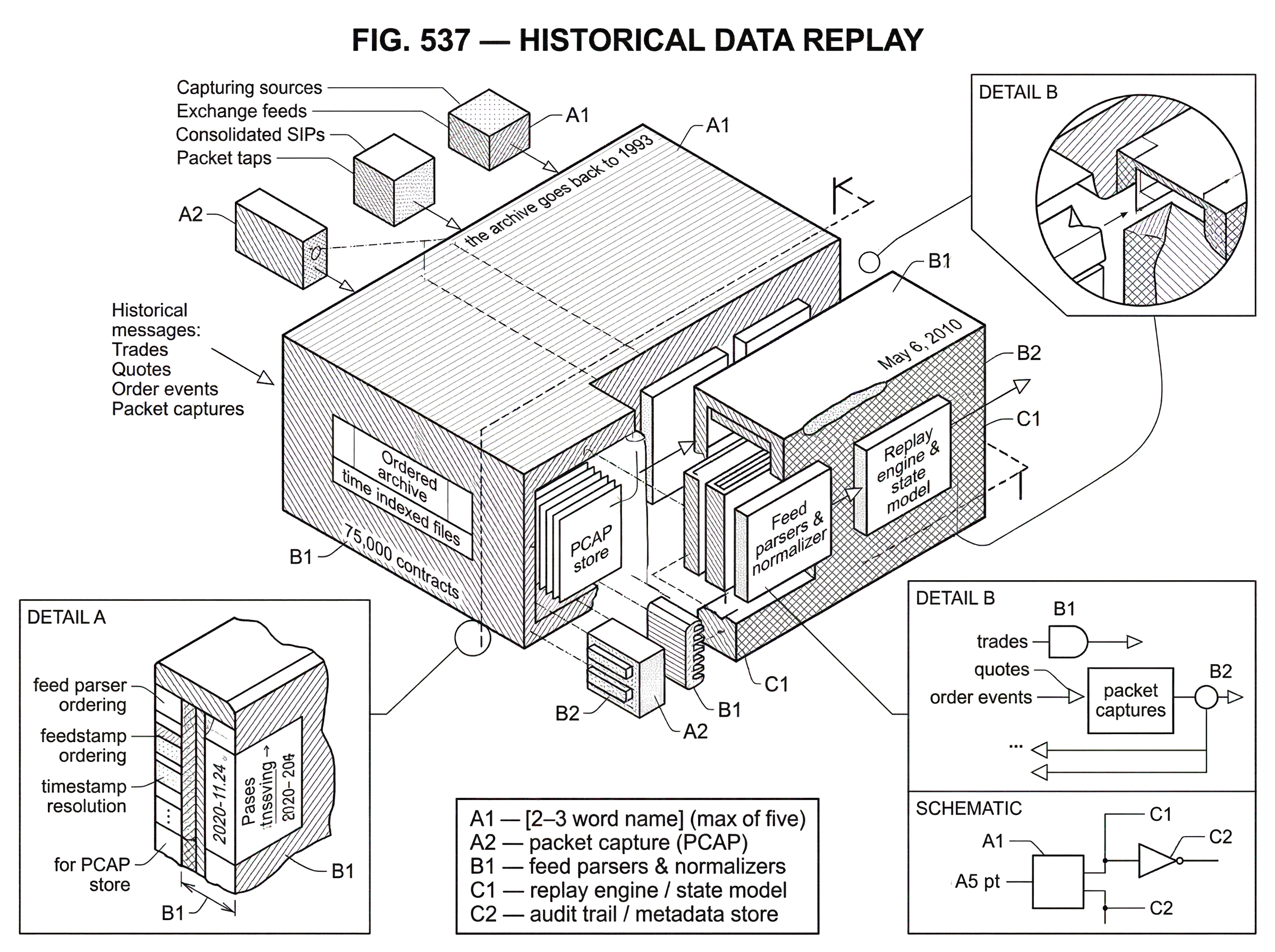
That progression matters because different users are trying to preserve different kinds of truth. NYSE’s Daily TAQ product, for example, is derived from CTA and UTP SIP outputs and provides daily files of trades and quotes for U.S. regulated exchanges. That is enough to replay consolidated quotes, trades, NBBO changes, and related indicators over long histories; the archive goes back to 1993. Nasdaq Market Replay, by contrast, is described as a cloud-based replay and analysis tool that lets users view consolidated order book and trade data for Nasdaq-, NYSE-, and regional exchange-listed securities at any point in time, with millisecond detail and simulated real-time order-book replay. Pico’s Redline offering goes further toward the wire itself, recording market data in compressed .pcap form “just as received,” with nanosecond packet timestamps and replay utilities that can merge multiple exchanges into a single time-accurate sequence.
These are all historical replay systems, but they are not equivalent. They preserve different state and therefore support different claims.
How do replay systems record events, preserve ordering, and rebuild market state?
A replay system usually has three layers. First, data must be captured from some source: a direct feed, a consolidated feed, an exchange archive, a regulatory repository, or raw network traffic. Second, the captured data must retain enough metadata to be ordered correctly later. Third, a replay engine must apply the messages back into a market model at whatever speed or representation the user needs.
The ordering problem is more subtle than it looks. In live markets, “what happened first?” is not always trivial, because multiple venues publish data independently, timestamp schemes differ, and the observer’s location matters. Nasdaq TotalView-ITCH v4.1, for example, separates timestamps into two pieces for bandwidth efficiency: a standalone seconds message and a per-message nanoseconds field. That design supports very fine event ordering, but only within the semantics of that feed. NYSE Daily TAQ also documents that timestamp precision improved over time, moving from lower precision to microseconds and then nanoseconds, with CTA and UTP improving on different schedules. So a replay of recent data can be more temporally exact than a replay of older data, even if both are called “historical replay.”
At the feed level, reconstruction means applying each message according to its meaning. An add-order message inserts liquidity. A cancel reduces displayed size. An execution removes liquidity and may or may not produce a printable trade report, depending on the feed and the execution type. Nasdaq’s ITCH specification explicitly notes that combining order-executed messages with trade messages is necessary to form a complete view of non-cross executions, and that non-printable executions should be ignored in time-and-sales and volume calculations to avoid double-counting. This is a good example of why replay is not just reading old rows from a file. The engine must understand the feed’s logic.
When the source is raw packets rather than normalized messages, another layer appears. Packet capture can preserve the original grouping of messages, network arrival order, and capture-point timing. Pico describes this as time-accurate replay: recorded packets can be replayed over the network, with multiple exchanges merged into a single time series so the replay sequence exactly matches arrival order at the network adapter when recorded. That is useful when the question depends on transport-level reality rather than exchange-declared event timestamps alone.
How can replay be used to analyze a disorderly market event (example: May 6, 2010)?
The value of replay becomes easiest to see when something goes wrong.
The joint SEC/CFTC report on the May 6, 2010 market event describes a market already under stress, with major equity indices down more than 4%, then falling another 5% to 6% within minutes before recovering nearly as quickly. In the E-Mini S&P 500 futures contract, a large mutual fund initiated a sell program of 75,000 contracts using an automated execution algorithm set to target 9% of the prior minute’s trading volume, without regard to price or time. Between 2:32 p.m. and 2:45 p.m., roughly 35,000 contracts were executed.
If you try to understand that event from end-of-minute bars, the explanation remains blurry. Volume was high, prices moved sharply, and then recovered. But replaying the order book reveals the mechanism. The report finds that buy-side market depth in the E-Mini fell to about $58 million, less than 1% of its morning level, while high-frequency traders initially absorbed sell flow, then traded heavily among themselves in “hot potato” fashion while keeping net positions small, and later reduced liquidity provision. Meanwhile, many individual securities and ETFs experienced severe dislocations, with thousands of trades executed at prices wildly far from prior values, including penny prints and prints as high as $100,000.
A replay lets an investigator watch that mechanism unfold in time. You can see liquidity thinning rather than merely infer it from volume. You can observe when pauses occur, such as the five-second CME Stop Logic pause in the E-Mini at 2:45:28 p.m., which the report says helped stabilize prices and allowed liquidity to replenish. You can compare what was happening in the futures book with what was visible in SPY and then in individual equities. You can also test counterfactuals: what if an execution algorithm had a price constraint, what if single-stock circuit breakers triggered earlier, what if limit-up/limit-down style bands had been in place? Those are not abstract policy questions; they are replay questions because they depend on event sequence.
This is one reason modern market structure built more explicit replay and audit capabilities after such events. The SEC’s Rule 613 required a consolidated audit trail to capture customer and order event information for NMS securities across markets from order inception through routing, modification, cancellation, and execution. CAT’s FAQ further states that CAT data must be kept online in an easily accessible format for six years, that raw data submitted by CAT reporters must be retained, and that regulators must have both targeted query access and data extractions using query language. That is not the same thing as a public replay product, but it reflects the same core need: after the fact, the system must support reconstruction.
Which data layer (TAQ, ITCH, PCAP, CAT) do I need for an accurate market replay?
There is a common mistake here: assuming that any historical market dataset can be “replayed” in the same sense. It cannot. The quality of replay is constrained by the data’s observational layer.
A consolidated feed such as CTA/UTP SIP output is excellent for many questions. It tells you what the national best bid and offer was, when trades printed, which quotes changed the NBBO, and how broad market conditions evolved. Daily TAQ, derived from those SIPs, is therefore useful for long-horizon research, execution analysis, and broad market reconstruction. But its own specification notes important limits. The NBBO file records quotes that cause the NBBO to change and identifies which exchanges are setting the NBBO, yet it does not itself let you determine total round-lot size across all exchanges at the best price; to compute that, you must join it with per-exchange quote records from the consolidated quote file.
A direct exchange feed exposes more internal market structure. Nasdaq TotalView-ITCH carries order-level data with attribution across a broad set of listed securities and supports detailed reconstruction of displayed book dynamics. CME markets sell historical trades, top-of-book, market depth, MBO, and PCAP data through DataMine, which means users can choose the depth and granularity appropriate to their use case. At this layer you can replay queue changes and depth depletion, not just trade prints.
A raw packet archive preserves yet another layer: the observer’s exact receipt of market data. This matters for latency-sensitive work because even if two messages have exchange timestamps, your system did not react to timestamps; it reacted to packets when they arrived. Packet replay is therefore especially valuable for testing feed handlers, plant infrastructure, and strategy software that depend on wire-level timing.
The organizing principle is simple: the closer the recording is to the original event source, the fewer assumptions a replay engine must add later. The tradeoff is operational cost. Raw packet capture is large, harder to manage, and sometimes restricted by licensing. Consolidated products are easier to work with and cover longer history, but they flatten venue-specific detail.
What practical problems does historical replay solve besides backtesting?
| Use case | Key question | Required data layer | Typical users |
|---|---|---|---|
| Backtesting | Would the strategy have worked? | Aggregated bars or ticks | Quant researchers |
| Execution review | Was execution reasonable? | Order‑level feeds | Brokers and clients |
| Surveillance & regulation | Was market abuse present? | Audit trails + feeds | Regulators and compliance |
| Engineering testing | Does software behave under load? | Packet captures | Engineers and ops |
| Research | What mechanism produced outcomes? | Order‑book replay | Academics and analysts |
Backtesting is the most familiar use, but it is not the deepest one. The reason replay survives as a distinct market-data practice is that it answers questions ordinary historical datasets cannot.
Execution review is one example. Nasdaq Market Replay explicitly markets the ability to analyze execution quality, monitor Reg NMS compliance, resolve customer trade inquiries, request a replay by issue, date, and time, and share a replay with clients to confirm best execution. The key point is not the user interface. It is that a broker or client dispute is about what liquidity was available at the timeandwhat route choices or fills were plausible given then-current market state. A replay provides that point-in-time context.
Surveillance and regulation are another example. CAT exists precisely because cross-market order lifecycles cannot be reconstructed reliably from fragmented public data alone. Rule 613’s order-tracking mandate and CAT’s retention of raw reporter submissions are mechanisms for replaying not only displayed market events but also order origin and routing histories. Regulation SCI operates at a different layer, requiring key market entities, including plan processors, to maintain systems with adequate capacity, integrity, resiliency, availability, and security, and to report and remediate system events. That matters for replay because reliable forensics depend on reliable source systems and preserved records.
Engineering is a third use. If you are building a feed handler, a smart order router, or a simulated exchange, you need to know whether your software behaves correctly under realistic historical message bursts and edge cases. A packet-level replay can reproduce message storms, gaps, malformed sequences, or the exact interleaving of venues. A normalized order-book replay can test whether your state model handles adds, cancels, executions, halts, and auction messages correctly.
Research is a fourth use, but even there the important distinction is between statistical historyandcausal history. A machine-learning model trained on bars is learning patterns in aggregated outcomes. A model trained or evaluated on replayable order-book events is exposed to the mechanism that produced those outcomes.
What are the limitations and blind spots of historical market replay?
| Limitation | Effect on replay | Mitigation |
|---|---|---|
| File coupling ambiguity | Trades and orders do not map cleanly | Use heuristic matching procedures |
| Depth truncation | Orders beyond reported levels vanish | Obtain deeper exchange feeds |
| Observer dependence | Arrival order differs by capture point | Capture multiple locations |
| Timestamp/version changes | Older data lower precision or fields | Use version‑aware parsers |
Historical replay has real limits, and most misunderstandings come from ignoring them.
The first limit is that public market data is not the market’s full internal state. Some liquidity is hidden, some order types are non-displayed, and some matching-engine decisions depend on state not fully represented in public feeds. Nasdaq’s NOII messages, for example, are informative precisely because they include non-displayable as well as displayable order types in indicative auction information. That tells you something important: the ordinary displayed book does not reveal everything that matters.
The second limit is that separate data files often need to be coupled heuristically. The Oberon note on order-book reconstruction makes this explicit: many datasets consist of loosely coupled trade and order files, so mapping book changes to specific trades requires a matching procedure and can remain ambiguous. The note also points out that not all exchanges publish all relevant events, and that self-trade prevention rules can cause matched orders to be canceled rather than executed. In such settings, replay is partly reconstruction and partly inference.
The third limit is truncation. Some venues or products publish only top-of-book or limited depth. Bitfinex’s raw book example in the note reports only the best 100 bids and asks, so an order dropping beyond visible depth may appear deleted and later re-created, leaving true state uncertain while it was out of view. The same general problem appears whenever a dataset preserves only a slice of market depth.
The fourth limit is observer dependence. A packet capture at one co-location point preserves what that observer received and when. Another observer elsewhere may have seen a different arrival order because of network path differences. So packet replay is exact relative to a capture point, not necessarily relative to every participant.
The fifth limit is historical inconsistency. Timestamp precision, symbology, field definitions, and feed versions change over time. Nasdaq’s ITCH revision history includes changes such as expanded symbol length and timestamp granularity evolution; NYSE Daily TAQ documents different timestamp regimes by era. Any serious replay system must be version-aware, or it will silently impose present-day assumptions on older data.
These are not reasons to distrust replay. They are reasons to define carefully what a replay is claiming to reconstruct.
What infrastructure and operational choices are required for high‑fidelity market replay?
Replay sounds analytical, but much of the work is infrastructural.
At the storage layer, providers need to retain large volumes of ordered events. CME’s DataMine offers historical datasets spanning settlements, trades, top-of-book, market depth, MBO, and PCAP. NYSE distributes Daily TAQ via SFTP and S3, with large compressed files and documented availability windows after market close. Tick Data provides “as-traded” daily files for U.S. equities and tools to transform them into mapped time series that incorporate ticker changes and corporate actions, while also documenting filtering choices such as condition-code filtering and proprietary bad-tick correction. Each of these choices affects replay fidelity.
At the access layer, replay systems need queryability. CAT explicitly requires both targeted online queries and extraction capabilities for regulators. Nasdaq Market Replay offers issue/date/time requests and export functions. Without this layer, stored history remains an archive rather than a usable replay tool.
At the control layer, the system has to stay trustworthy. Regulation SCI matters here not because it is a replay product, but because market-data processors and related systems are only useful for later reconstruction if they have capacity, resilience, incident reporting, and continuity controls. If a plan processor outage disrupts dissemination or a system fails without preserving usable logs, the later replay inherits that damage.
Conclusion
Historical data replay is the disciplined reconstruction of past market state from recorded market events. Its purpose is not merely to look backward, but to recover causality: what was visible, what changed, in what order, and with what consequences.
The idea to remember is simple: a replay is only as truthful as the layer of market reality it preserves. Quotes preserve one layer, order-level feeds preserve more, raw packets preserve still more, and audit trails preserve cross-market lifecycle context that public feeds alone cannot. Once you see replay this way, the topic stops being a data product category and becomes what it really is: a way of turning market records back into an explainable market.
Frequently Asked Questions
Pick the recording layer that preserves the market "invariants" relevant to your question: consolidated quotes and trades suffice for broad execution or long-horizon research, order-level feeds (e.g., TotalView-ITCH) are needed to replay queue dynamics for microstructure studies, raw packet captures are required for transport- and latency-sensitive testing, and audit-trail data (CAT/Rule 613) is necessary to reconstruct cross-market order lifecycles. The article explains this selection principle and gives product examples for each layer.
No - public feeds do not show all liquidity or internal matching decisions; hidden or non‑displayable orders and exchange-internal state can be missing, so replay from public data can only reconstruct the visible layer and may need audit-trail data or inference to fill gaps. The article gives NOII and other examples to show that displayed books omit some state.
Because timestamp formats and precision changed over time, replay accuracy varies: older datasets often have coarser time resolution (seconds→milliseconds→microseconds→nanoseconds) and feeds like ITCH split seconds and per‑message nanoseconds for fine ordering, so replay systems must be version-aware to avoid imposing modern timing assumptions on older data. The article and the ITCH/TAQ notes document these evolutions.
Packet-capture replay preserves the original packetization, network arrival order, and capture-point timing (useful when you care how your system actually saw messages), whereas exchange-feed replay re-applies normalized messages according to feed semantics and may not reproduce wire-level interleaving; the article contrasts these uses and Pico/Redline describe time-accurate packet replay utilities.
A consolidated product like Daily TAQ or SIP output is excellent for NBBO, trade prints, and long-history research, but it omits venue-level depth and can’t alone give total round‑lot size at the NBBO or order‑by‑order queue position; the article and Daily TAQ docs note these specific limits.
Many datasets require heuristic matching because trade and order files are loosely coupled; mapping book changes to particular trade executions can remain ambiguous when exchanges omit events or when depth is truncated (e.g., top‑100 only), so reconstruction is partly deterministic and partly inferential. The Oberon note and the article discuss these matching ambiguities explicitly.
Yes - replay lets you run counterfactuals (for example, testing an execution algorithm with a price constraint or simulating different circuit‑breaker behavior) because it replays the sequence of state changes so you can change policy or strategy parameters and observe different outcomes; the May 6, 2010 analysis in the article illustrates exactly this use.
High-fidelity replay is expensive and operationally heavier: packet captures and deep order books require far more storage and careful retention/ licensing, replay speed is bounded by storage read throughput, and some vendors ship bulk drives to deliver terabytes of PCAP. The article and vendor notes (TAQ file sizes, Pico Redline shipping, and storage-read limits) describe these infrastructure and cost trade-offs.
Regulatory-level sources are explicitly intended for cross‑market reconstruction: the Consolidated Audit Trail (CAT) and SEC Rule 613 were designed to capture order origin, routing, and lifecycle data and CAT requires reporters to keep raw submissions online in an easily accessible format for six years, although CAT excludes clearing data. These regulatory requirements are discussed in the article and the CAT/Rule 613 evidence.
Related reading