What Is Risk Parity?
Learn what risk parity is, how risk-parity portfolios are built, why leverage matters, and where the strategy helps or breaks down.
Introduction
Risk parityis a way of building portfolios that allocates byriskrather than bydollars. That sounds like a minor adjustment, but it changes the whole logic of asset allocation. A conventional portfolio might hold 60% in stocks and 40% in bonds and appear balanced on paper, yet most of its day-to-day and year-to-year movement is often driven by the stock portion because stocks are much more volatile than bonds. Risk parity begins with that mismatch and tries to fix it.
The core idea is simple: if one asset class is far more volatile than another, giving them similar dollar weights does not produce similar influence on the portfolio. A risk-parity portfolio instead seeks to spread the portfolio’s overall risk more evenly across its components. In practice, that usually means owning moreof lower-volatility assets such as government bonds andless of higher-volatility assets such as equities, and then often using leverage to scale the whole portfolio up to a desired risk or return target.
That last step is why risk parity attracts both interest and criticism. The idea promises more balanced diversification, especially across economic environments, but the implementation can depend heavily on volatility estimates, correlations, financing conditions, and the behavior of bonds during stress. To understand why investors use it, and why it sometimes fails, it helps to start with the basic problem it is solving.
Why a 60/40 portfolio can still be concentrated by risk
Most investors first learn diversification in capital terms: do not put all your money in one asset. That advice is directionally right, but it hides an important fact. Assets do not contribute to portfolio risk in proportion to their dollar weights unless they have the same volatility and the same correlation structure. In the real world, they do not.
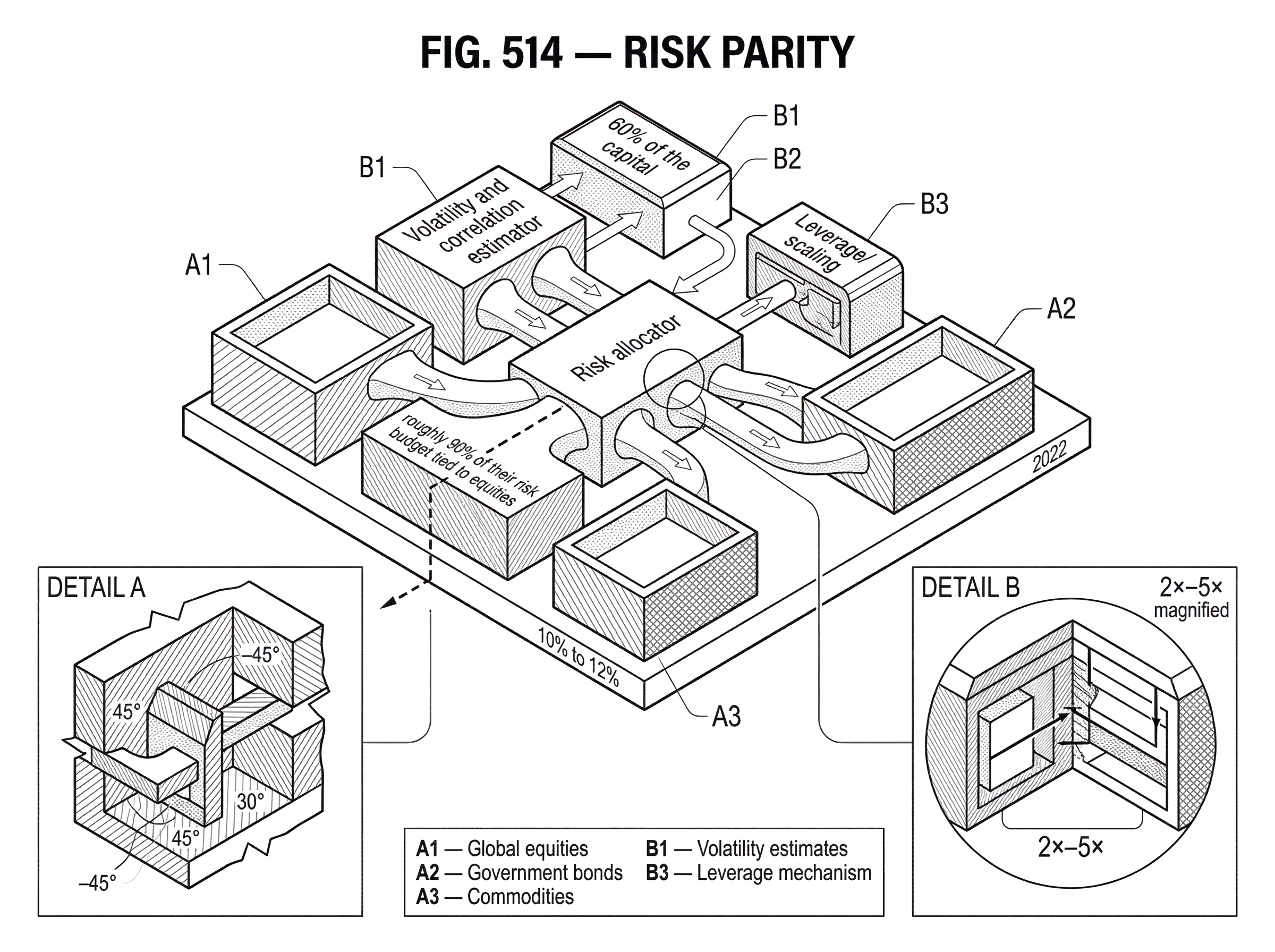
Take the familiar 60/40 stock-bond portfolio. Because equities are typically several times as volatile as high-quality bonds, a 60/40 mix often ends up with the large majority of its risk budget effectively coming from equities. AQR’s explanation of risk parity frames this starkly: typical traditional portfolios can have roughly 90% of their risk budget tied to equities even though equities are only 60% of the capital. The portfolio looks diversified by dollars but remains highly exposed to one dominant source of uncertainty.
That concentration matters because portfolio drawdowns are driven by risk exposures, not by how neat the capital weights look in a pie chart. If equities fall sharply and the rest of the portfolio is too small, too stable, or too correlated to offset them, then the portfolio still behaves like an equity-heavy bet. Risk parity is an attempt to align the appearance of diversification with its actual mechanics.
The essential question becomes: not “how much money sits in each sleeve?” but “how much does each sleeve matter to total portfolio variance?” Once you ask the second question, many familiar allocations look less balanced than they first seemed.
How does risk parity equalize each asset's contribution to portfolio risk?
The organizing principle of risk parity is that a diversified portfolio should not let a single asset class dominate total portfolio risk. The cleanest expression of that principle is equal risk contribution: each major component should contribute a similar share of total portfolio volatility.
Here intuition should come before formulas. Imagine a portfolio made of a very jumpy asset and a very stable asset. If you put half your money in each, the jumpy asset still does most of the moving. To make both matter equally, you would need a smaller position in the jumpy asset and a larger position in the stable one. Risk parity generalizes that logic across many assets.
A very simple implementation uses inverse volatility weights. If an asset has volatility σ_i, a rough risk-parity weight can be set proportional to 1 / σ_i, then normalized so all weights sum to 1. This is not the full equal-risk-contribution solution because it ignores correlations between assets, but it captures the first-order mechanism: high-volatility assets get lower weights, low-volatility assets get higher weights.
Once correlations matter, the problem becomes richer. An asset can be individually volatile but still diversify the portfolio if it tends to move differently from other holdings. That is why more complete risk-parity implementations estimate both volatilities and correlations, then solve for weights whose marginal contributions to total portfolio risk are similar. In practice, many managers use forecasts, constraints, and optimization methods rather than a single closed-form rule.
Still, the idea that makes risk parity click is this: capital is not risk. If you remember only one thing, remember that.
Example: Building a simple risk-parity portfolio with stocks, bonds, and commodities
Suppose an investor wants a portfolio using global equities, government bonds, and commodities. A traditional capital allocator might begin with a fixed split, perhaps giving equities the biggest weight because they are expected to earn the highest return over time. A risk-parity allocator starts differently. They first ask how volatile each asset class has been and how each has moved relative to the others.
Imagine equities have been much more volatile than bonds, while commodities sit somewhere in between. If the investor put one-third of the money into each, equities would likely dominate total portfolio risk. The risk-parity response is to cut the equity weight, raise the bond weight, and size commodities somewhere between the two. If bonds are very stable, they may require a surprisingly large capital allocation just to contribute as much risk as equities.
At this point the investor may notice an apparent problem: the portfolio now holds a lot of capital in lower-return assets such as bonds. Left unscaled, that portfolio may have lower expected return than an equity-heavy benchmark. This is the moment where leverage enters the picture. Rather than abandoning diversification, the investor can keep the more balanced risk structure and scale the whole portfolio upward, often with futures or other derivatives, until it reaches a target level of volatility.
This is the mechanical heart of many institutional risk-parity programs. First, build a portfolio whose risk is diversified across asset classes or macro exposures. Then scale it to the desired overall risk level. Bridgewater’s account of All Weather and AQR’s white papers both emphasize this logic: diversification is improved by balancing risk first, and leverage is then an implementation tool for restoring the overall risk target.
Why do risk-parity strategies use leverage?
| Position | Purpose | Typical leverage | Main benefit | Main risk |
|---|---|---|---|---|
| Unlevered RP | Balance risk only | None | Lower leverage exposure | May trail equity returns |
| Levered RP | Scale to target volatility | Modest to moderate | Equity-like returns with diversification | Financing and forced‑deleveraging risk |
| 60/40 (traditional) | Capital-weighted benchmark | None | Simplicity and equity exposure | Risk concentrated in equities |
Without leverage, risk parity often pushes large amounts of capital into lower-volatility assets. That improves diversification, but it may also leave the portfolio too conservative for investors seeking returns similar to equities or a traditional balanced benchmark. Leverage solves that specific problem by increasing total exposure without undoing the underlying risk balance.
This is where many misunderstandings arise. Critics often describe risk parity as “just levering bonds.” That misses the design. A well-constructed risk-parity portfolio is not trying to make a single bond bet larger. It is trying to hold a broader set of diversifying exposures in balanced risk proportions and then scale the portfolio to the desired volatility. AQR explicitly argues that risk parity is not simply leveraged bonds; the strategy’s behavior depends heavily on diversification across equities, bonds, commodities, and often global markets.
But leverage is not a cosmetic detail. It changes the risk profile in ways that matter. Financing costs reduce returns. Margin requirements and liquidity management become important. Forced deleveraging during stress can worsen losses if positions must be cut at bad times. These are not side issues; they are part of the mechanism. Any explanation of risk parity that presents leverage as harmless is incomplete.
The more honest way to say it is this: risk parity uses leverage because, once you diversify by risk instead of capital, the resulting unlevered portfolio is often not risky enough to meet investor goals. Leverage is the bridge between a better-balanced risk structure and a competitive return target. It is useful, but it introduces its own failure modes.
How Bridgewater's All Weather maps risk parity to macro environments
One influential version of risk parity, developed by Bridgewater in its All Weather strategy, frames the problem in terms of economic environments rather than just asset volatilities. The basic observation is that asset classes respond differently to changes in growth and inflation. Stocks tend to do best when growth is stronger than expected. Nominal government bonds tend to do well in disinflationary slowdowns. Inflation-linked bonds and some commodity exposures can help when inflation surprises to the upside.
From that perspective, the portfolio problem is not merely to hold many assets. It is to avoid having the portfolio implicitly rely on one narrow economic outcome. Bridgewater describes this as balancing assets according to their structural response to economic environments so that the portfolio is less vulnerable to surprises in discounted conditions. Their term environmental balance captures the aim: no major fundamental bias to any single growth or inflation regime.
This is a deeper idea than “equal weight the buckets.” Two portfolios can both be diversified across asset classes and still be biased toward the same macro outcome if the assets all rely on falling inflation, cheap money, or robust growth. Risk parity in the All Weather sense tries to map the portfolio to underlying macro drivers, then spread risk across them.
That is also why instruments such as Treasury Inflation-Protected Securities, or TIPS, became important in practice. Bridgewater’s account stresses that inflation-linked bonds filled a genuine gap in the ability to diversify inflation-up environments. If you want a portfolio that is not simply a growth-and-disinflation machine, you need assets whose cash flows or pricing behavior are structurally tied to different states of the world.
What are the economic arguments supporting risk parity?
There are two main layers to the case for risk parity. The first is straightforward diversification math. If a traditional portfolio has most of its risk concentrated in one asset class, then spreading risk more evenly should improve diversification and often reduce drawdowns relative to a concentrated benchmark.
The second layer is more ambitious. Some researchers argue that lower-risk assets may offer surprisingly attractive risk-adjusted returns over long periods. The paper by Asness, Frazzini, and Pedersen gives one influential explanation through leverage aversion. If many investors either cannot or will not use leverage, they may overpay for high-beta assets that promise high raw returns without borrowing. Safer assets then can end up offering better returns per unit of risk than standard theory would predict. If that is true, then a portfolio that owns more low-risk assets and scales them up with leverage can make economic sense, not just statistical sense.
This argument should be treated carefully. It is not a law of nature. It is an equilibrium story about market frictions and investor constraints. But it helps explain why risk parity is more than a mechanical preference for calm-looking assets. The claim is that markets may compensate low-risk assets more generously than classical models suggest, especially when many investors are constrained from levering them.
AQR’s historical simulations also support a milder version of the idea. Across long samples, equities, bonds, and commodities had broadly similar long-run risk-adjusted returns in their studies, even though raw returns and short-run performance differed. If that rough similarity holds, then allocating risk more evenly rather than concentrating it in equities becomes easier to justify.
How is a risk-parity portfolio implemented in practice?
| Method | Complexity | Considers correlations? | Typical instruments | Robustness |
|---|---|---|---|---|
| Inverse volatility | Low | No | Cash or futures | Sensitive to correlation shifts |
| Equal Risk Contribution (ERC) | Medium‑High | Yes | Futures, swaps, cash | Better balanced risk contributions |
| Hierarchical Risk Parity (HRP) | Medium | Indirectly via clustering | ETFs, futures | Robust to noisy covariances |
A simple classroom version of risk parity uses historical volatility and inverse-volatility weights, rebalanced on a regular schedule. For example, one AQR illustration sets each asset’s position weight each month based on a target annualized volatility divided by forecast volatility, using a rolling volatility estimate. QuantInsti’s practical example shows the same basic logic in smaller scale: estimate recent volatility, invert it, normalize the weights, and shift the estimate to avoid look-ahead bias.
Real implementations are usually more elaborate because the naive version leaves out three important mechanisms.
The first is correlation. Equalizing standalone volatilities is not the same as equalizing portfolio risk contributions. If two assets are highly correlated, holding both may add less diversification than their individual volatilities suggest. More advanced equal-risk-contribution approaches solve directly for weights that equalize each asset’s contribution to total portfolio volatility.
The second is risk forecasting. Historical volatility is a noisy estimate of future volatility, especially during regime changes. Managers therefore use different lookback windows, exponential weighting, regime models, stress tests, or broader statistical risk models. Since risk parity depends on those estimates, model choice materially affects the portfolio.
The third is portfolio scaling and execution. If a manager targets a constant portfolio volatility such as 10% to 12%, as some fund documents describe, they must adjust exposures as market volatility rises or falls. This can mean deleveraging after volatility spikes and releveraging after calm returns. The idea is to stabilize risk through time, but this process can interact badly with fast market reversals.
Instruments matter too. Futures are common because they allow low-cost, liquid exposure to equities, government bonds, commodities, and currencies while embedding financing into excess returns. Product documents for several risk-parity funds and ETFs also show widespread use of swaps, options, forwards, and collateral pools, with commodity exposure sometimes routed through Cayman subsidiaries for structural reasons. Those details are operational, but they are not peripheral. Implementation determines realized costs, liquidity, and tail behavior.
When and why investors use risk parity as a core portfolio
In practice, investors use risk parity as a strategic multi-asset allocation framework. The appeal is not that it predicts markets particularly well. In fact, one of its selling points is that it doesnot rely heavily on forecasting expected returns asset by asset. Instead, it tries to build a more robust baseline portfolio by balancing exposures across sources of risk.
Institutional investors have used it as a core portfolio, sometimes with active overlays on top. Bridgewater’s telling of All Weather places it clearly in the “beta” part of portfolio construction: fix the core market exposures first, then decide whether and how to add alpha-seeking strategies. AQR similarly describes core-satellite uses in which a leveraged risk-parity core can sit underneath active tilts.
This helps explain why risk parity is often discussed next to benchmark design rather than just fund selection. For some investors, it is not merely another product category; it is an alternative answer to the question “what should the default diversified portfolio be?” That is a more ambitious role than a tactical trade.
In which market environments does risk parity fail?
| Failure mode | Typical trigger | Impact on RP | Possible mitigation |
|---|---|---|---|
| Rapid rising rates | Fast yield spikes | Bonds and equities both fall | Lower leverage, duration hedges |
| Correlation breakdown | Crisis-driven correlations | Loss of diversification | Stress tests, tail hedges |
| Funding / margin stress | Liquidity squeeze, margin calls | Forced deleveraging | Liquidity buffers, kill-switches |
| Model estimation error | Regime change or noisy data | Mis-sized positions | Robust estimators, conservative targets |
Risk parity’s weaknesses are mostly the mirror image of its strengths. Because it relies on diversification across assets and regimes, it struggles when diversification fails. The most painful examples come when stocks and bonds both lose money together while the cash rate is rising. In those environments, the portfolio’s large fixed-income risk allocation offers less protection than expected, and the leverage used to scale the portfolio can magnify the drawdown.
This is not hypothetical. AQR’s analysis of rising-rate periods shows an important distinction between moderatelyrising rates andsharply rising rates. Over long stretches of gradually rising yields, bonds can still earn positive returns above cash because coupons and roll-down offset some capital losses. In abrupt rate shocks, however, all major asset-allocation strategies can struggle, and risk parity may be especially vulnerable. Their 1979–1981 example makes this clear.
Recent experience reinforced the point. Risk-parity products and indices saw significant stress in 2022, when inflation surged, central banks tightened aggressively, real yields rose, and both stocks and many bond exposures fell together. Product literature from risk-parity ETFs explicitly notes that such “cash is king” environments can be difficult, especially when long Treasuries and TIPS decline at the same time. HFR’s risk-parity index data likewise showed a severe 2022 drawdown before partial recovery in early 2023.
Another weakness is that “risk” is often proxied mainly by volatility. That is convenient and often useful, but it is not the same as economic loss, liquidity stress, gap risk, or forced-sale risk. A portfolio can look balanced in volatility terms and still be exposed to funding pressure, crowding, or sudden correlation shifts. This is one reason risk parity depends so heavily on sound risk models and liquid implementation.
There is also a subtler issue: risk parity does not escape the need for judgment. Someone must choose the asset universe, the volatility estimator, the correlation model, the rebalance frequency, the leverage target, the drawdown controls, and the treatment of inflation-sensitive assets. A global stock-bond-commodity implementation can behave very differently from a U.S.-only stocks-and-bonds version. AQR explicitly notes that meaningful commodity exposure and global diversification materially changed outcomes in some historical periods.
So the strategy is systematic, but it is not assumption-free.
Risk parity vs. equal-risk-contribution vs. hierarchical risk parity: what's the difference?
The phrase risk parityis often used broadly, but there are neighboring ideas worth separating. In the narrowest sense, risk parity usually means a portfolio where major asset classes are sized so their contributions to total risk are similar.Equal risk contribution, or ERC, is the more precise optimization concept: choose weights so each asset contributes equally to total portfolio volatility. In very simple cases, inverse-volatility weighting approximates this. In correlated portfolios, true ERC generally requires solving an optimization problem.
There are also variants such as Hierarchical Risk Parity, or HRP, which use clustering methods to organize assets by their relationships before allocating risk. The motivation is that covariance matrices are noisy, and classical optimizers can be unstable out of sample. HRP tries to build a more robust structure when there are many assets and correlation estimates are unreliable. That makes it a neighboring method rather than the same thing as standard asset-class risk parity.
The common thread is that all of these methods reject the idea that capital weights alone define diversification. They differ in how they estimate structure and how directly they solve for balanced risk contributions.
A short conclusion
Risk parity is best understood as a correction to a common illusion in portfolio construction: a portfolio can look balanced by dollars while being concentrated by risk. Its answer is to size holdings so no single asset class dominates total portfolio volatility, then, if necessary, scale the resulting diversified portfolio to the investor’s target risk level.
That makes risk parity powerful, but not magical. It works through risk estimates, correlations, leverage, and assumptions about how different assets behave across economic environments. When those assumptions hold reasonably well, it can produce a more resilient strategic allocation than a traditional equity-heavy mix. When diversification collapses or rates rise violently, its vulnerabilities become clear.
If you want the memorable version for tomorrow, it is this: risk parity does not ask where your money is. It asks where your risk is.
Frequently Asked Questions
Risk parity sizes positions so each major component contributes a similar share of total portfolio volatility (risk) rather than similar dollar amounts; by contrast a typical 60/40 capital-weighted portfolio often ends up with the large majority of its risk coming from equities (AQR illustrates cases where equities account for roughly 90% of the risk despite being 60% of capital).
Because equalizing risk tends to push large capital into lower‑volatility assets (e.g., bonds), managers typically apply leverage to the whole portfolio to reach a target volatility or return level while preserving the balanced risk structure.
Leverage brings explicit costs and operational risks: financing spreads reduce returns, margin and liquidity demands can force deleveraging in stress, and forced sales can amplify losses - problems highlighted by both historical shock episodes (e.g., 1979–81) and the 2022 inflation/ tightening episode.
Inverse‑volatility weights are a first‑order, easy approximation, but they ignore correlations; true equal‑risk‑contribution (ERC) requires solving for weights so each asset’s marginal contribution to portfolio volatility is equal, which typically needs a covariance‑aware optimizer.
Very sensitive: risk‑parity outcomes depend strongly on the volatility estimator, correlation model, lookback window and rebalance rules, so different forecasting choices and implementation details materially change realized performance and tail behaviour.
Risk parity tends to struggle when diversification breaks down - for example when stocks and bonds fall together amid sharply rising rates or concurrent inflation shocks - cases documented in historical episodes and stressed risk‑parity indices in 2022.
No: a well‑constructed risk‑parity portfolio seeks balanced exposures across equities, bonds, commodities and often global markets and then scales the mix; critics’ shorthand of 'levered bonds' misses that the strategy’s behaviour depends on cross‑asset diversification and implementation choices.
One theoretical justification (Asness, Frazzini, Pedersen) is 'leverage aversion': if many investors cannot or will not use leverage, high‑risk assets can become overpriced on a risk‑adjusted basis and low‑risk assets can offer attractive risk‑adjusted returns when levered; this is an equilibrium explanation, not a guaranteed law, and empirical/simulation caveats apply.
Related reading