What Are OHLC Candlesticks?
Learn what OHLC candlesticks are, how open, high, low, and close are built from market data, and what these charts reveal - and hide.
Introduction
OHLC candlesticksare a way to compress a stream of market activity into a single visual object that records four prices for a chosen time interval: theopen,high,low, andclose. That sounds almost trivial, but the reason candlesticks matter is that markets generate far more information than a human can look at directly. A liquid instrument can produce an enormous sequence of trades and quote changes in a single minute. A candlestick exists to turn that noisy sequence into a compact summary that preserves the parts of price movement people care about most.
That compression is both the power and the danger. A candle can show you, at a glance, whether price rose or fell during the interval, how far it traveled, and whether it was rejected from extremes. But it also hides the path taken inside the interval. Two candles can look identical even if one came from smooth buying and the other from violent back-and-forth trading. To understand candlesticks well, you have to hold both truths at once: they are useful because they discard detail, and they can mislead for exactly the same reason.
The practical question is not just what a candlestick looks like. It is what information survives the compression, what information is lost, and how the underlying market data determines the final shape. That means understanding both the chart itself and the feed mechanics underneath it.
How do OHLC candlesticks summarize a time interval?
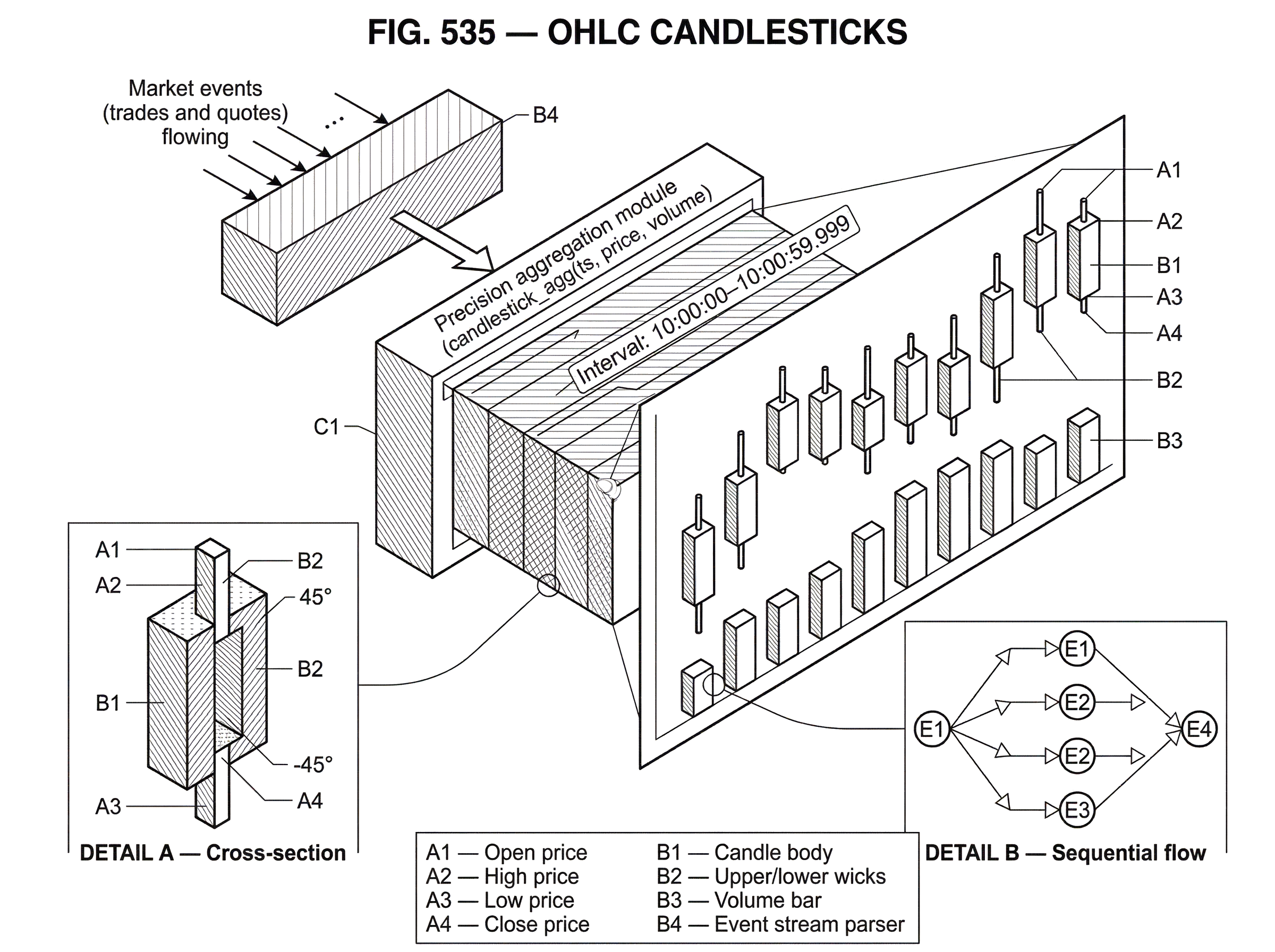
Imagine you watched every trade in a stock from 10:00:00 to 10:00:59.999. You could store the entire sequence tick by tick. Or you could summarize that minute using four numbers. The openis the first price observed in the interval. Thecloseis the last. Thehighis the maximum price reached, and thelow is the minimum. Those four values are enough to preserve the interval’s endpoints and its full vertical range, even though they throw away the exact route between them.
That is the basic invariant behind an OHLC candle. No matter how many trades occurred, the candle answers four simple questions: Where did the interval start? Where did it end? How high did it get? How low did it get? If you also attach volume, you know how much trading took place while that path unfolded. This is why candlesticks are so widely used across equities, futures, foreign exchange, and crypto markets: the representation is simple enough to scale, but rich enough to preserve more structure than a line chart that shows only closes.
A candlestick is therefore not a model of the market. It is a lossy encoding of a time bucket. The bucket might be one second, one minute, one hour, or one day. Change the bucket size and you change the candle, because you are changing the question being asked of the data. A one-minute candle asks what happened within that minute. A daily candle asks the same question across a full trading day. The underlying mechanism is the same; only the interval changes.
How does a candlestick's body and wicks show open, high, low, and close?
The visual grammar of candlesticks is designed so the most important comparison (open versus close) is visible before you read exact numbers. The thick central portion, called the body, spans the open and close. If the close is above the open, the candle is often colored green or white; if the close is below the open, it is often red or black. The thin lines above and below, usually calledwicksorshadows, extend to the high and low reached during the interval.
This design works because it separates two different facts. The body shows the net move from the start to the end of the bucket. The wicks show how far price explored beyond those endpoints. A long upper wick means price traded materially above the body before retreating. A long lower wick means it traded below the body before recovering. A very small body means the interval opened and closed near each other even if the path in between was wide.
That is why traders often talk about candles as showing momentum,rejection, orindecision. Those interpretations are not magic. They come directly from the geometry. A long bullish body says the close ended well above the open. A small body with long wicks says the interval covered a wide range but finished without much net progress. The picture is just a compact rendering of the four prices plus the relative location of the close inside the range.
The analogy to a sentence is useful here. A candlestick is like a compressed summary of a long conversation: it keeps the opening remark, the closing remark, the loudest moment, and the quietest moment. That explains why it is useful for quick reading. But the analogy fails in an important way, because the missing middle may contain the most important causal sequence. A candle cannot tell you whether the high happened early or late, whether the low came before the high, or whether the market traded smoothly or in bursts.
Where do open, high, low, and close values come from in market feeds?
| Source | Represents | Typical use | Main limitation | Best for |
|---|---|---|---|---|
| Trade-based | Executed prices | Execution analysis | Ignores displayed liquidity | Price-action from trades |
| Quote-based | Bid/ask or midpoint | Liquidity and spread view | May not reflect trades | Order-book signals |
| Direct venue feed | Venue-specific prints/quotes | Low-latency venue view | Differs across venues | Latency-sensitive strategies |
| Consolidated SIP/NBBO | Aggregated last-sale/NBBO | Broad market snapshot | Potential dislocations/latency | Cross-market analysis |
A charting platform makes candlesticks look native, as if the candle simply exists. It does not. Someone or something had to compute it from lower-level market data.
At the lowest level, markets emit events. In an exchange feed such as Nasdaq TotalView-ITCH, the raw data is not a ready-made candle but a stream of message-level updates: order additions, executions, cancellations, and other market events. Nasdaq’s specification represents timestamps asnanoseconds since midnight, and prices are encoded as integers with an implied decimal precision. In other words, before you can aggregate anything into OHLC values, you first need to parse the feed correctly, recover decimal prices, and order events by their timestamps.
That ordering matters because the openis defined by first observation in the interval and theclose by last observation. If your event order is wrong, your candle is wrong even if the high and low happen to remain correct. This becomes especially important in high-message-rate periods such as the open and close, when many executions cluster near bucket boundaries.
There is also an important distinction between trade-basedandquote-based candlesticks. Many retail charts use last-sale trades: each candle is built from transaction prices. But some analytics instead use quotes, such as best bid, best ask, or midpoint. That choice changes the meaning of the candle. A trade-based candle summarizes executed prices. A quote-based candle summarizes displayed pricing opportunities. Neither is universally “right”; they answer different questions.
In equities, this gets more subtle because market data can come from different sources. A direct venue feed may differ from the consolidated view. NYSE Daily TAQ, for example, provides consolidated trades and quotes across venues and includes fields such as trade price, volume, exchange, sale condition, timestamps, and identifiers used to track corrections and cancels. If you build candles from a venue-specific feed, you get a venue-specific picture. If you build from consolidated last-sale or NBBO-related data, you get a broader market view. The candle shape depends on which world you decided to summarize.
How to compute a one‑minute OHLC candle from trade ticks
Suppose a stock has the following printable trades during the 10:00 minute: first at 100.00, then 100.05, then 99.98, then 100.08, and finally 100.03 just before the minute ends. The one-minute candle is mechanically determined. The openis 100.00 because that was the first trade in the interval. Thehighis 100.08 because no trade exceeded it. Thelowis 99.98. Theclose is 100.03 because that was the last trade before the bucket ended.
Visually, this would be a bullish candle if the platform colors any close above the open as bullish, because 100.03 is above 100.00. But it would not be a strong bullish candle. The body would be small, because the net change from open to close is small. The upper wick would be noticeable, because price reached 100.08 and then fell back before the interval ended. The lower wick would also exist, because price traded below the open at 99.98 before recovering.
Now imagine a different sequence in the same minute: 100.00, then 99.98, then 100.08, then 100.03. The final OHLC values are identical. So is the candle. Yet the path is not identical. In the first sequence, the market moved up, then down, then up again, then down slightly. In the second, it first moved down, then strongly up, then slightly down. The candle preserves the envelope and endpoints, not the chronology inside the envelope.
This is the central lesson of candlesticks. They are incredibly effective at preserving range plus endpoint information. They are deliberately bad at preservingpath information. Many interpretation errors come from forgetting that distinction.
Why feed format, non‑printables, and timestamping change candlestick results
| Policy | When applied | Corrections handling | Volume effect | Use case |
|---|---|---|---|---|
| Real-time first-seen | At trade time | No retroactive revision | Reflects raw seen volume | Live trading and alerts |
| Post-corrected historical | After tape reconciliation | Apply corrections/cancels | Cleaner historical volumes | Backtesting and research |
| Hybrid (publish then revise) | Publish immediate, update later | Patch affected intervals | Adjusted after reconciliation | Operational transparency |
For a chart reader, a candle is a shape. For a data engineer, it is the output of a set of filtering and aggregation rules. Those rules matter more than many users realize.
Take Nasdaq ITCH. The specification notes that some executions are marked non-printable, and Nasdaq explicitly recommends ignoring non-printable executions for time-and-sales and volume calculations to avoid double counting. If you include those events anyway, your volume can be inflated and your OHLC series can be distorted, especially around bulk prints and cross events. Likewise, cross trades may represent opening, closing, or other auction-related bulk activity and require special handling if you want to avoid counting the same economic event twice.
Historical data adds another layer. NYSE Daily TAQ includes trade correction indicators and trade identifiers to track corrections and cancels. That means a trade you originally used to form a candle may later be corrected or marked as erroneous. There is no escaping a design choice here: do you publish candles as first-seen in real time, or do you later revise historical candles when the underlying tape is corrected? Both conventions exist, and they answer different questions. The first captures what a live trader saw at the time. The second captures a cleaner ex post record.
Even timestamps are less simple than they appear. TAQ documents that timestamp precision differs across feeds and historical periods; some records are nanosecond precision, others are microseconds with appended zeroes, and earlier periods had coarser precision. If you aggregate near bucket boundaries, precision and ordering choices can change which minute receives a trade. For low-frequency charting this may rarely matter. For short intervals and high-throughput symbols, it can matter a great deal.
What information do candlesticks reliably convey?
Candlesticks survive because they match a real cognitive task: humans need to scan many intervals quickly and notice changes in balance between buyers and sellers. The candle’s body tells you whether the interval ended higher or lower than it began. The wick structure tells you whether price tested and rejected levels away from the eventual close. A sequence of candles lets you see acceleration, hesitation, failed breakouts, and compressed ranges with much less effort than reading raw trades.
This is also why candlesticks are more expressive than a line chart of closes. A line chart throws away intraperiod range. If a market opens at 100, trades down to 95, rallies to 105, and closes at 100, a close-only chart shows almost nothing happened. A candlestick shows a broad range and a close back near the open. That is not the full truth, but it is much closer.
Patterns such as doji, hammer, engulfing, or marubozu are attempts to attach reusable language to recurring geometries. The sensible way to think about these patterns is not as mystical signals but as shorthand descriptions of order-flow outcomes. A hammer-like candle says price traded much lower during the interval but did not stay there into the close. A marubozu-like candle says the interval moved strongly in one direction with little visible retracement. Whether those shapes predict anything useful depends on context, market, timeframe, and your testing discipline. The geometry is real; the predictive claim is always more contingent.
What do candlesticks hide and why traders overinterpret them
The most common misunderstanding is to treat a candle as if it tells a complete story. It does not. It tells a bounded story.
A candle cannot reveal the sequence of high and low, the density of trading at different prices, the duration spent near any level, or whether the move came from one large print or many small ones. Two intervals with the same OHLC values may have radically different liquidity conditions and very different implications for execution risk. This is why OHLC charts are often paired with volume, order-book data, or lower-timeframe inspection.
There is a second misunderstanding: people often treat candles as if their construction were universal. In reality, candles depend on data source,asset type,session definition, andaggregation rule. In equities, the opening price may be heavily influenced by an auction. In continuous crypto markets, there is no natural exchange-wide market close in the same sense, so the day boundary is a convention. In fragmented markets, per-venue candles can differ from consolidated candles. If a platform uses trade prices, another uses midpoint quotes, and a third excludes certain sale conditions, the candles can all legitimately disagree.
The effect is strongest where microstructure is messy. Research comparing the SIP NBBO with a synthetic BBO built from direct feeds found large numbers of quote dislocations and a concentration near the market open and close. That does not mean candlesticks are invalid. It means that the candle inherits the strengths and weaknesses of the feed it summarizes. If your underlying quote view is stale or consolidated differently from another vendor’s, the resulting highs, lows, or even opens and closes can differ.
How should you implement OHLC aggregation in a market‑data pipeline?
| Approach | Compute cost | Storage needs | Rollup-friendly | Typical latency |
|---|---|---|---|---|
| Raw tick recompute | High compute | Lower aggregated storage | Hard to roll up | Higher query latency |
| Two-step aggregate | Moderate compute | Store intermediate objects | Designed for rollups | Low query latency |
| Precomputed continuous aggregates | Low query compute | Higher storage footprint | Native rollup support | Lowest query latency |
If you build market-data systems, OHLC candlesticks are an aggregation problem. The pipeline usually starts with raw ticks or messages, then applies parsing, normalization, filtering, bucketing, and storage.
A practical implementation often uses time-bucketed aggregation over a trade table with fields such as ts, price, and volume. Systems like TimescaleDB’s toolkit expose this explicitly. The function candlestick_agg(ts, price, volume) creates an intermediate candlestick aggregate from raw tick data, and accessors such as open, high, low, close, and volume read out the final values. This two-step design is useful because the intermediate object can later be rolled up: minute aggregates can become hourly or daily aggregates without rescanning all raw ticks.
That reflects an important principle. A candle is not only a visual object but also a hierarchical aggregate. If you already have correct 15-minute candlestick aggregates, you can combine them into larger periods using a rollup operation that preserves the right logic for open, high, low, close, and volume. Open comes from the earliest child bucket, close from the latest, high is the maximum across children, low the minimum, and volume sums. The mechanism is simple precisely because OHLC is designed to be composable.
The storage side matters too. Continuous aggregates precompute rollups so queries do not have to rescan raw rows every time. That is exactly the kind of workload OHLC generation creates. But even here the details matter: gapfilling missing buckets is usually a query-time concern rather than something done directly inside the continuous aggregate definition. That distinction exists because “no trades occurred” is not the same statement as “the bucket should be shown with copied-forward values.” Again, the chart you see depends on a modeling choice.
Which related market‑data concepts change how you should interpret candlesticks?
As soon as you rely on candles for anything beyond casual chart reading, you run into neighboring market-data concepts.
The first is tick data. Candles depend on it. Every open, high, low, and close must be derived from some sequence of lower-level observations. If you do not understand what counts as a tick in your system (trade, quote, midpoint, venue-specific execution, consolidated last sale) then you do not fully understand your candles.
The second is market structure. Equities are fragmented across venues and governed by rules around protected quotations and trade-through prevention. That does not force a particular candle design, but it does shape what executions and quotes exist in the first place. Opening and closing auctions, off-exchange reporting, and feed differences all affect the raw material.
The third is session definition. A daily candle for a U.S. stock usually means regular trading hours unless stated otherwise, but many systems also provide premarket and after-hours candles. In futures and crypto, the “day” boundary may be chosen administratively. Because the candle is bucket-relative, the session boundary is part of the definition, not an afterthought.
Key takeaway: when a candlestick reflects the market; and when it doesn't
OHLC candlesticks are a compact summary of market activity over a time interval. They work by preserving four anchor prices (open, high, low, and close) and discarding most of the path in between. That tradeoff is exactly why they are so useful and why they can be misleading.
If you remember one thing, remember this: a candlestick is only as meaningful as the data and rules used to build it. The shape on the chart is not the market itself. It is a carefully compressed view of trades or quotes, filtered through timestamping, venue choice, session boundaries, and aggregation logic. Once that clicks, candlesticks stop being mysterious pictures and become what they really are: disciplined summaries of time-bucketed price behavior.
Frequently Asked Questions
A trade-based candle aggregates executed transaction prices (it summarizes what actually traded). A quote-based candle aggregates displayed prices such as best bid/ask or midpoints (it summarizes available pricing opportunities rather than executions). Neither is universally “right”: they answer different questions and will produce different highs/lows/opens/closes for the same interval.
There are two common choices: publish real-time candles exactly as first seen, or retroactively revise historical candles when tapes later report corrections/cancels. The article notes both conventions exist and NYSE Daily TAQ provides fields (trade IDs and correction indicators) specifically intended to support post-hoc reconciliation if you choose to recompute history.
Because open is the first observed price and close the last, any reordering across the bucket boundary changes which bucket gets a trade - so timestamp precision and event ordering directly affect opens/closes. The article explains this intuitively, and TAQ/plan documentation documents that feeds and historical archives have varied timestamp precisions (milliseconds → microseconds → nanoseconds), which can alter bucket assignment for high-frequency intervals.
No - you cannot reliably recover the intraperiod execution path from a single OHLC candle. The candle preserves the interval’s endpoints and vertical range but discards chronology, trade sizes, and whether the range came from many small trades or a single block print; the article gives concrete sequences that produce identical OHLCs but different trading paths.
You should usually exclude non‑printable executions from time-and‑sales/volume to avoid double counting, per Nasdaq guidance, and treat cross/bulk prints with care because they can appear in multiple message types; the article highlights these as common sources of distortion and Nasdaq’s ITCH spec explicitly recommends ignoring non-printable prints for volume and time-and-sales.
OHLC is composable: to roll up child buckets into a larger candle, take the open from the earliest child, the close from the latest child, the high as the maximum of children, the low as the minimum, and sum volume. The article describes this principle and commercial toolkits (e.g., candlestick_agg and rollup in Timescale/TigerData toolkits) implement this exact hierarchical aggregation.
Different vendors can legitimately show different candles because candles inherit the data source and aggregation rules - venue-specific feeds, consolidated tapes, trade vs. quote choices, session definitions (regular hours vs extended), and filtering rules all change the input set used to compute OHLC. The article emphasizes that the plotted candle is a view derived from those upstream choices rather than a single objective ‘market’ picture.
Candlestick shapes are meaningful geometry but not guaranteed predictors: patterns (doji, hammer, engulfing, etc.) describe recurring order‑flow outcomes, yet their predictive value depends on context, timeframe, market, and proper statistical testing. The article frames patterns as useful shorthand but cautions their predictive claims are contingent, a stance echoed by reference pattern guides that treat them as educational tools rather than trading guarantees.
Related reading