What is the Markowitz Efficient Frontier?
Learn what the Markowitz efficient frontier is, how mean-variance optimization builds it, why diversification works, and where the model breaks down.
Introduction
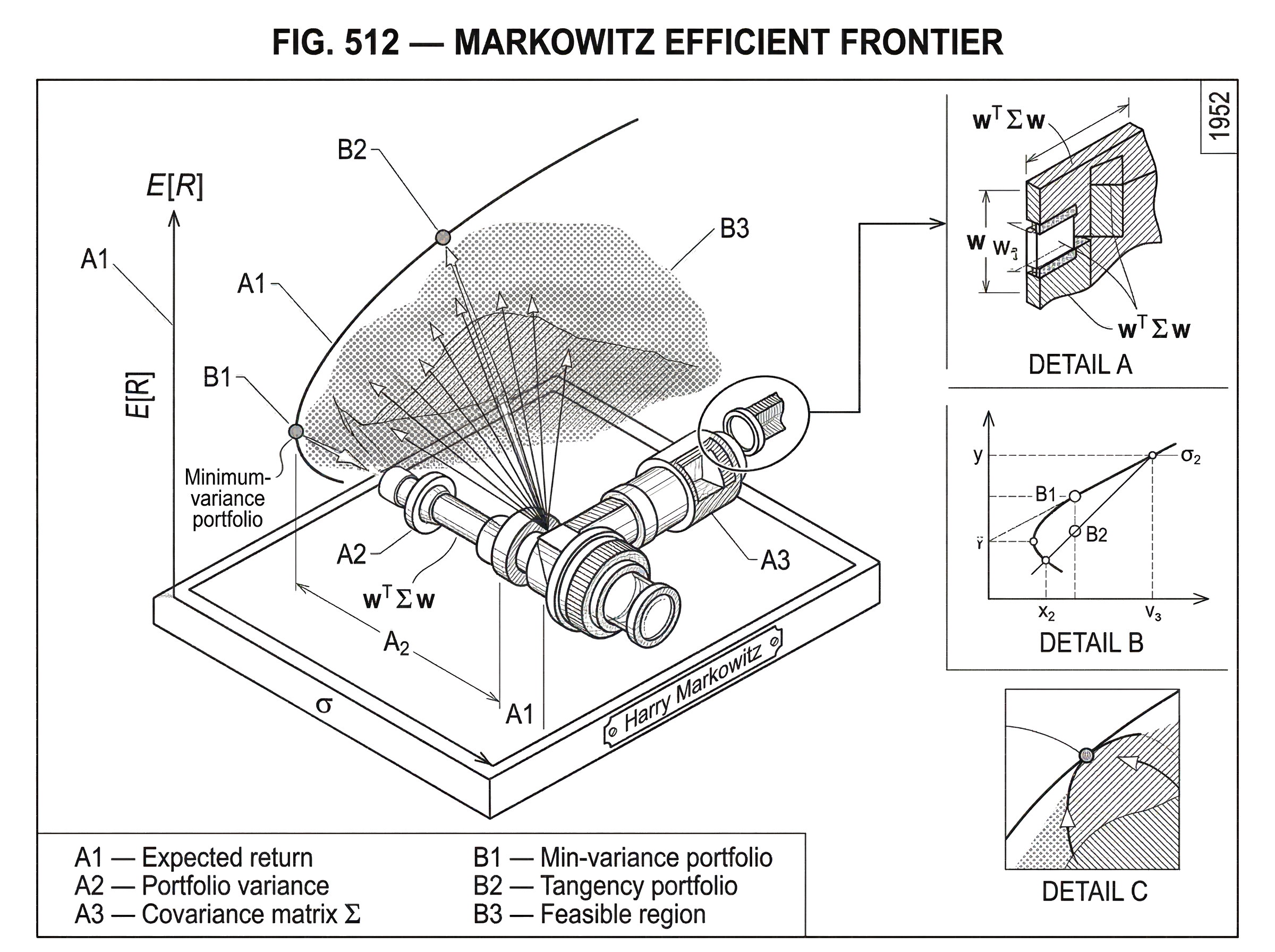
The Markowitz efficient frontieris the set of portfolios that give thehighest expected return for a given level of risk, or equivalently thelowest risk for a given expected return. That sounds straightforward, but it solved a real conceptual problem in investing: if investors only chased the highest expected return, they would often put everything into a single asset. In his 1952 paper, Harry Markowitz argued that this cannot explain rational diversification. The missing idea is that a portfolio is not just a bag of assets. It is a combination whose overall risk depends on how those assets movetogether.
That last phrase is the point on which the whole framework turns. A stock that is risky on its own can still improve a portfolio if its returns do not rise and fall in lockstep with the rest of the holdings. The efficient frontier is the geometric picture of that fact. It shows the boundary between portfolios that are merely possible and portfolios that are best available once both expected return and risk matter.
This idea became the foundation of modern portfolio theory because it gave investors a disciplined answer to three questions at once: what diversification really means, how to compare portfolios with different risk levels, and how to separate the problem of finding good trade-offs from the separate problem of choosing among them. The frontier does not tell every investor to hold the same portfolio. It tells them which portfolios are worth considering in the first place.
Why does portfolio choice need an efficient frontier?
Suppose you compare investments the way a beginner often does: by expected return alone. Markowitz's criticism was simple and devastating. If expected return were the only thing that mattered, the rule would usually say to put all your money into the single asset with the highest expected return. There would be no reason to diversify. Yet diversified portfolios are not just common in practice; they are often more sensible even before we bring in any institutional constraint.
The reason is that risk is not additive in the naive way. If you own two volatile assets, the portfolio does not automatically become twice as risky, or even as risky as their simple average. What matters is how the assets co-move. If they often offset each other, the portfolio can have a smoother return path than either asset alone. This is why diversification is a structural feature of portfolios, not a moral slogan about prudence.
Once you accept that investors care about both expected return and some measure of risk, portfolio choice becomes a trade-off problem. There is no single best portfolio in the abstract, because a portfolio with higher expected return usually comes with higher risk. What you can identify, however, is the set of portfolios that are not clearly inferior to any other feasible portfolio. That set is the efficient frontier.
A useful way to say this precisely is with the idea of dominance. Portfolio A dominates portfolio B if A has at least as much expected return and no more risk, with one of those comparisons being strictly better. If a portfolio is dominated, there is no reason to hold it. The efficient frontier is the set of portfolios that arenot dominated in this sense.
How do expected return, variance, and covariance create the efficient frontier?
To see where the frontier comes from, start with the two ingredients Markowitz used. The first is expected return, which for a portfolio is just the weighted average of the assets' expected returns. If the portfolio weights are w_i and the expected returns are μ_i, then portfolio expected return is the sum of w_i μ_i across assets. This part is simple.
The second ingredient is where the interesting structure appears. Markowitz used varianceof return, or equivalently standard deviation, as the measure of risk. Variance captures how spread out returns are around their mean. But for a portfolio, variance depends not only on each asset's own variance, but also on the covariances between every pair of assets.
Covariance measures whether two assets tend to move together. If they often rise and fall together, covariance is positive. If one tends to rise when the other falls, covariance can be negative. Markowitz emphasized that the variance of a weighted sum includes all these covariance terms, and that is exactly why diversification can lower portfolio risk.
Here is the mechanism in plain language. When assets are not perfectly positively correlated, their ups and downs partly cancel inside the portfolio. The portfolio still holds risk, but less of the assets' idiosyncratic fluctuation survives after aggregation. This is why diversification can improve the risk-return trade-off without lowering expected return in proportion.
An analogy helps here. Think of each asset as a noisy instrument in an ensemble. If every instrument plays the exact same note at the exact same time, the noise stacks directly. If they play different patterns, some fluctuations wash out when heard together. That explains why correlation matters. Where the analogy fails is that portfolio risk is not literal sound cancellation; it is a statistical property of returns, and investors care about capital outcomes, not acoustics.
How does the efficient frontier emerge from a two‑asset example?
Consider a simple investor choosing between two assets. Asset X has a relatively high expected return but large volatility. Asset Y has a lower expected return and also lower volatility. If these were the only facts, the choice would look like a familiar trade-off: more return means more risk.
Now add the crucial fact that X and Y do not move together perfectly. Some months X does poorly while Y holds up; other months the reverse happens. As the investor shifts weight from all-X toward a mix of X and Y, expected return changes linearly because it is just a weighted average. But risk does not change linearly. Because the assets are imperfectly correlated, the mixed portfolio's variance can fall faster than intuition based on simple averaging would suggest.
At first, this can produce a surprising result: a blend of the two assets may have lower risk than either asset alone. Keep changing the weights and you trace out a curve in risk-return space. Some points on that curve are clearly attractive; others are not. If one mixed portfolio offers the same expected return as another but with less risk, the riskier one is dominated and should be discarded.
With many assets, the same logic scales up. The feasible set of all portfolio combinations becomes a region in risk-return space. The efficient frontier is the upper-left boundary of that region if return is on the vertical axis and risk on the horizontal axis. “Upper” means more expected return. “Left” means less risk. Every portfolio below or to the right of that boundary is inefficient because some other feasible portfolio does better on at least one dimension without doing worse on the other.
Markowitz's original geometric treatment showed this with small numbers of securities and described the efficient set as a connected locus running from the minimum-variance portfolioat one end to the portfolio with themaximum attainable expected return at the other. In modern presentations, the efficient frontier is often drawn as a smooth curve, though in constrained settings or finite-sample implementations the exact geometry can be more irregular.
Which portfolios belong on the efficient frontier and which are dominated?
The easiest portfolio on the frontier to understand is the minimum-variance portfolio. This is the feasible portfolio with the lowest possible variance, regardless of expected return. It matters because it is the leftmost point in the opportunity set. Any portfolio with even lower expected return but higher variance would be obviously irrational to hold if variance is your risk measure.
From that point onward, moving along the frontier means accepting more variance only because it buys more expected return. That is the organizing principle. Portfolios below the minimum-variance point on the full curve are feasible, but they are not efficient: for the same level of variance, you could find a portfolio with higher expected return on the upper branch.
This distinction matters because people sometimes speak loosely as if every portfolio produced by mean-variance calculations belongs on the efficient frontier. It does not. The frontier is only the efficient part of the feasible set. The rest are possible portfolios, but they are dominated once the criterion is expected return versus variance.
Another common misunderstanding is that the frontier is a recipe for a single best portfolio. It is not. It is a menu of best trade-offs. Choosing one point on that menu requires an additional preference statement: how much extra expected return does the investor require to accept extra variance? Markowitz's framework separates the engineering problem from the preference problem. First find the efficient set. Then choose among efficient portfolios using investor preferences.
How is the efficient frontier computed in practice?
| Method | Objective | Constraints | Output | Best when |
|---|---|---|---|---|
| Minimize variance | Minimize portfolio variance | Target expected return | Single frontier point | You have a return target |
| Maximize return | Maximize portfolio expected return | Variance / risk cap | Single frontier point | You have a risk budget |
| Maximize Sharpe | Maximize excess return per unit risk | Include risk-free rate | Tangency (Sharpe) portfolio | You want risk‑adjusted optimum |
In modern notation, the inputs are an expected return vector μ, a covariance matrix Σ, and portfolio weights w. Expected portfolio return is w^T μ. Portfolio variance is w^T Σ w. The weights usually satisfy a budget constraint such as the sum of weights equaling 1, and often other constraints such as bounds on short selling or leverage.
There are two equivalent ways to generate the frontier. You can maximize expected return subject to portfolio variance staying below a chosen limit. Or you can minimize variance subject to achieving at least a chosen expected return. Vary the chosen risk cap or target return, and you trace out the efficient frontier. Modern convex optimization treatments use exactly these formulations.
This is where the efficient frontier connects directly to mean-variance optimization. Mean-variance optimization is the procedure; the efficient frontier is the geometric output. If you solve the optimization repeatedly for different targets, you are computing the frontier itself.
In practice, the computation can become demanding when the asset universe is large or the constraints are realistic. Markowitz later developed the critical line algorithm to trace the efficient frontier for many securities under constraints. Today, standard quadratic optimization methods, factor-model approximations, and specialized solvers make the problem tractable for large institutional portfolios.
But the hard part is usually not the solver. It is the inputs.
Why are expected‑return and covariance estimates the main challenge for the frontier?
| Method | Main effect | Reduces sensitivity to | Implementation cost |
|---|---|---|---|
| Weight constraints | Shrink extreme weights | Noisy mean estimates | Low |
| Shrinkage / factor models | Stabilize covariance estimates | Covariance noise | Moderate |
| Regularization / robust opt | Penalize extreme portfolios | Both means and covariances | Moderate–high |
| Black–Litterman / Bayesian | Blend views with market | Mean estimates | Moderate |
The frontier is only as good as the expected returns and covariances used to build it. Markowitz himself was explicit about this. To use the expected-return–variance rule in practice, investors need reasonable estimates of expected returns and covariances, and he recommended combining statistical techniques with experienced judgment.
That warning turned out to be central. Expected returns are especially difficult to estimate, and small errors in them can produce large swings in optimal portfolio weights. This is one reason naive implementations of mean-variance optimization often generate strange portfolios: huge positions, extreme long-short bets, and allocations that look precise in-sample but unstable out of sample.
The problem is structural. The optimizer is trying to find the best portfolio on a boundary. If you perturb the boundary by changing μ or Σ, the argmax can jump sharply. A tiny increase in one asset's estimated return can make the optimizer rush toward that asset, even if the estimate is mostly noise. This is not a minor bug in software. It is the consequence of optimizing aggressively on uncertain inputs.
Research and practice responded in several ways. One is to impose constraints such as no short sales, weight caps, turnover limits, or sector bounds. Another is to use shrinkage or factor models to stabilize covariance estimates. A third is to regularize the optimization directly so that the portfolio is less sensitive to noisy estimates. More recent convex formulations sometimes called “Markowitz++” keep the mean-variance structure but add transaction costs, holding costs, leverage controls, robustified inputs, and soft constraints so that the resulting portfolios are more stable and implementable.
Interestingly, constraints that look theoretically restrictive can help in practice. Work such as Jagannathan and Ma showed that no-short-sale constraints can act like an implicit shrinkage of the covariance matrix, often reducing realized risk. The deeper lesson is that the clean unconstrained frontier is a model object. Real investors usually need a constrained frontier that reflects estimation risk and implementation frictions.
Why does mean‑variance use variance as risk and when does that break down?
Variance is mathematically convenient and often practically useful, but it is still a modeling choice. It treats upside and downside deviations from the mean symmetrically. Many investors do not experience those symmetrically. Large gains are not usually felt as a form of risk.
Markowitz recognized this tension himself. In his 1959 book he discussed semi-variance, which focuses on adverse deviations, as a potentially more plausible risk measure. In his Nobel lecture he noted that mean-variance approximations often track expected utility very closely for many utility functions and diversified portfolios, but not for all. For some investor preferences and return distributions, using only mean and variance can be a poor approximation.
This is the boundary of the theory. The efficient frontier is compelling when the investor's choice can be well summarized by expected return and variance, or when mean-variance is a good approximation to a fuller expected-utility problem. It becomes less adequate when skewness, tail risk, path dependence, liquidity risk, or regime changes matter in ways variance cannot capture.
That does not make the frontier useless. It means its interpretation must be disciplined. The frontier is not a universal law of investing. It is the efficient set under a specific risk metric and a specific set of assumptions.
What key assumptions underlie the Markowitz efficient frontier?
Several assumptions matter more than readers sometimes realize. First, the framework is usually single-period: you choose a portfolio now based on beliefs about next-period return distributions. That is different from a genuinely multi-period problem in which trading opportunities, taxes, and changing opportunity sets matter over time.
Second, the standard exposition assumes coherent probability beliefs for returns. They may be subjective rather than objective, but the model still needs them. If your return forecasts are unstable or inconsistent, the resulting frontier is unstable too.
Third, constraints change the geometry. Markowitz's original presentation often excluded short sales, and modern implementations commonly add many more restrictions. These are not cosmetic. They alter which portfolios are feasible and therefore alter the frontier itself.
Fourth, the framework is frictionless unless you add costs and market impact explicitly. In real portfolios, turnover, liquidity, taxes, and trading constraints can matter as much as the static risk-return trade-off. A portfolio that looks efficient before costs may be inferior after you account for the cost of getting into and maintaining it.
These assumptions explain why the frontier is both powerful and fragile. Powerful, because it identifies a genuine optimization structure. Fragile, because the structure depends on estimated beliefs, chosen risk measures, and feasible-set definitions.
How do investors use the efficient frontier in practice?
| Point | When preferred | Requires µ estimates? | Robustness |
|---|---|---|---|
| Minimum-variance | Lowest possible volatility | No | High |
| Tangency / Max‑Sharpe | Maximize risk‑adjusted return | Yes | Sensitive to µ |
| Liability‑driven | Match liabilities or horizon | Sometimes | Depends on constraints |
| Constrained institutional | Respect turnover/limits | Often yes | Higher due to constraints |
In practice, investors rarely treat the frontier as a sacred curve to be obeyed mechanically. They use it as a decision framework. It helps compare candidate allocations, understand whether a proposed portfolio is dominated, and visualize the cost of demanding more expected return in terms of additional risk.
For some investors, the most useful frontier point is the minimum-variance portfolio because it does not require expected-return estimates and is often more robust. For others, the relevant point is a tangency or maximum-Sharpe portfolio once a risk-free rate is introduced. For institutions, the frontier often serves as a baseline from which additional realities are layered on: liabilities, benchmark-relative risk, turnover budgets, diversification rules, factor exposures, or stress constraints.
This is also why neighboring models emerged. Black-Litterman, for example, can be understood as a way to produce more stable expected-return inputs before running a frontier-style optimization. Robust optimization, shrinkage estimators, and factor covariance models all play a similar supporting role. They do not replace the basic frontier idea so much as try to make it survivable outside the classroom.
Episodes of market stress also remind us that portfolios that look distinct in normal times can become dangerously similar in a crisis. Quantitative equity strategies in August 2007, for example, suffered when deleveraging and liquidity withdrawal pushed many similar portfolios through the same narrow exit. That does not refute the Markowitz frontier directly, but it shows that a frictionless covariance-based view can miss crowding, liquidity spirals, and path-dependent market impact.
What's the single idea to remember about the Markowitz efficient frontier?
The Markowitz efficient frontier is the boundary of best feasible trade-offsbetween expected return and variance. Its enduring insight is not merely that risk and return trade off. Investors knew that already in some loose sense. The real insight is thatdiversification is governed by covariance, so the right unit of analysis is the portfolio as a whole, not each asset in isolation.
Once that clicks, the frontier becomes almost inevitable. Among all feasible portfolios, some will be plainly wasteful because another portfolio offers more return for the same risk, or less risk for the same return. The efficient frontier is the set that survives this elimination.
What remains true seventy years later is both modest and profound: if you are going to summarize portfolio choice with expected return and variance, then the efficient frontier is the map of rational possibilities. Everything important after that comes from asking how reliable your map really is.
Frequently Asked Questions
Covariance terms enter the portfolio variance calculation so assets that are not perfectly positively correlated can have offsetting movements, causing some idiosyncratic volatility to cancel in the aggregate; that is why adding an asset can reduce portfolio variance even without reducing its expected return.
Because the frontier lists all portfolios that are not dominated on both expected return and variance, it is a menu of best trade‑offs rather than a single prescription; selecting one point from the frontier requires an extra preference - how much extra expected return you demand to accept more variance.
Mean–variance optimization is highly sensitive because the optimizer is selecting on a boundary: small errors in the expected‑return vector or covariance matrix can shift that boundary and make the argmax jump, producing extreme, unstable weights.
Common practical remedies include imposing constraints (no‑short rules, weight caps, turnover limits), using shrinkage or factor models to stabilize covariance estimates, and regularizing the optimization (robust or penalized formulations, i.e., “Markowitz++”); these approaches reduce sensitivity and improve out‑of‑sample behavior.
Markowitz used variance because it is mathematically convenient and often approximates investor trade‑offs, but he and later authors note it treats upside and downside symmetrically; when skewness, tail risk, or downside sensitivity matter, alternatives such as semi‑variance, CVaR, or higher‑moment methods can be more appropriate.
Formally you use the expected‑return vector μ and covariance matrix Σ with weights w, computing return w^T μ and variance w^T Σ w; one traces the frontier by solving either ‘minimize variance for a target return’ or ‘maximize return for a variance cap’ repeatedly, and large problems are solved today with quadratic/convex solvers, factor approximations, or specialized algorithms like the critical‑line method.
Constraints change the feasible set and therefore reshape the frontier: banning short sales or adding sector/weight bounds can make the frontier less extreme and, in practice, act like implicit shrinkage of estimates (for example, no‑short constraints often reduce realized risk by tempering extreme weights).
The standard efficient‑frontier exposition is single‑period and assumes fixed probability beliefs; extending it to a true multi‑period, dynamic setting requires a different model because trading opportunities, taxes, path dependence, and changing distributions matter and can alter what is optimal.
To choose a point you must state preferences: risk‑averse investors may pick the minimum‑variance portfolio or a tangency/maximum-Sharpe portfolio once a risk‑free rate is included, while institutions often start from the frontier and layer on liabilities, turnover budgets, or benchmark constraints to reach a practical allocation.
No - the classic frontier is frictionless and ignores trading costs, liquidity, and market impact unless those costs are added explicitly; empirical episodes (e.g., 2007 deleveraging) show that liquidity, crowding, and market‑impact risks can make similar‑looking portfolios behave badly in crises, so such frictions should be incorporated for implementable decisions.
Related reading