What Are Locked and Crossed Markets?
Learn what locked and crossed markets are, why they occur in fragmented trading, and how Regulation NMS and related rules are designed to limit them.
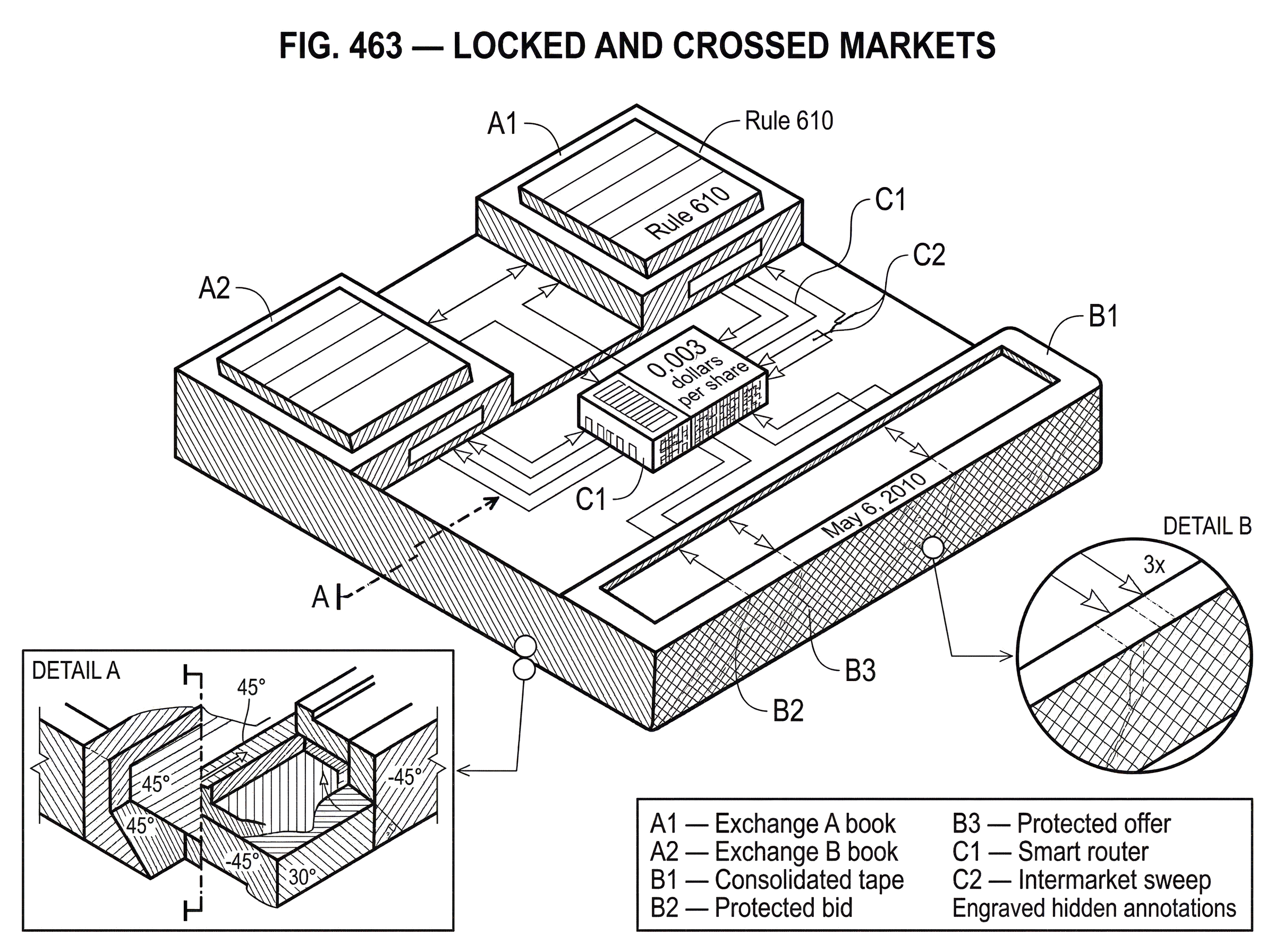
Introduction
Locked and crossed markets are situations where the best displayed bid and offer no longer line up in the normal way. In an ordinary market, the highest price someone is willing to pay sits below the lowest price someone is willing to accept. That gap is the spread. A locked market appears when the best bid equals the best offer. A crossed market appears when the best bid is actually higher than the best offer.
At first glance, that seems impossible. If someone is willing to buy at 100.00 and someone else is willing to sell at 100.00, why would they not simply trade? And if a buyer is willing to pay 100.01 while a seller is willing to accept 100.00, why would the trade not happen immediately at one of those prices? That puzzle is the right place to begin, because locked and crossed markets are not mainly about strange prices. They are about fragmented trading, timing, access, and the difference between seeing a quote and actually being able to execute against it.
In U.S. market structure, the concept matters because modern trading does not happen in one central book. Quotes are displayed by multiple exchanges and trading facilities, then consolidated into a national view. Once prices are spread across venues, the market can briefly display combinations that would never exist inside a single, perfectly synchronized order book. The rules around locked and crossed markets are an attempt to preserve a basic invariant: displayed prices should form an orderly market that rewards visible liquidity rather than punishing it.
How does a single order book behave compared with a multi‑venue market?
The simplest way to think about the issue is to start with a single order book. Suppose one trader posts a bid to buy at 99.99, and another posts an offer to sell at 100.01. The market is normal. The spread is 0.02. If a new buyer raises the bid to 100.01, the market becomes locked: best bid equals best offer. In a single venue, that state usually resolves immediately, because matching logic can execute the orders. If the buyer posts 100.02 while the offer remains 100.01, the book becomes crossed. Again, in a single venue, the matching engine should execute rather than display an inverted book.
That is why locked and crossed markets are fundamentally a multi-venue phenomenon. Across venues, Exchange A might display a bid of 100.00 while Exchange B displays an offer of 100.00. The national best bid and offer is then locked. Or Exchange A might display a bid of 100.01 while Exchange B displays an offer of 100.00. The national market is crossed. The key point is that the two prices live in different places, under different routing and timing conditions, even though market data makes them appear side by side.
This is also why the best bid and offer, or more precisely the protected top-of-book quotes that feed the consolidated market, sit at the center of the concept. A locked or crossed market is defined by the relationship between those best displayed prices. In equities under Regulation NMS, the protection framework focuses on the best bids and offers of exchanges and the ADF, but only when those quotations are automated and immediately accessible. In options, the comparable idea is the protected bid or protected offer disseminated under the OPRA framework.
What legally counts as a locked or crossed market?
The formal definitions are simple once the intuition is clear.
In listed U.S. equities, a locking quotation is generally a displayed bid priced equal to an existing displayed offer, or a displayed offer priced equal to an existing displayed bid, in an NMS stock during the applicable hours. A crossing quotation is a displayed bid above an existing displayed offer, or a displayed offer below an existing displayed bid. FINRA Rule 6240 states those definitions for NMS stocks, and FINRA Rule 6437 uses the same structure for OTC equity securities within the same inter-dealer quotation system.
In options, the national plan uses the same logic at the protected top of book. A Locked Market is a quoted market in which a protected bid equals a protected offer. A Crossed Market is a quoted market in which a protected bid is higher than a protected offer. The structure is the same because the underlying problem is the same: a market’s displayed prices are supposed to rank buying interest below selling interest, not on top of or through it.
The simplicity of the definition can be misleading. The hard part is not recognizing the state. The hard part is understanding why it happens in systems explicitly designed to avoid it.
Why do locked and crossed markets occur in fragmented trading?
The central mechanism is fragmentation plus imperfect synchronization. If all orders met in one place, a lock or cross would simply execute away. Once orders are posted in multiple venues, however, each venue sees only its own book directly and sees the rest of the market through feeds, routing links, and control logic. Those links are fast, but they are not instantaneous and they are not frictionless.
Suppose Exchange B is offering shares at 100.00. A participant on Exchange A wants to buy at that same price. In a frictionless world, the participant would route to B and execute the offer. But real systems face message delays, queueing, risk checks, access controls, and routing decisions. A quote can therefore be posted on A before the away offer on B is removed, creating a temporary lock. If the incoming quote is more aggressive than the away offer, the displayed market can become crossed.
Here is the deeper point: a locked or crossed market is often less a disagreement about value than a disagreement about state. Different venues and participants may be acting on slightly different information about what is still executable elsewhere. One venue may think an away quote is available; another may already be in the process of removing it; a router may have sent an order but not yet received confirmation. For a moment, the consolidated picture can show a price relationship that no single matching engine would willingly maintain.
That does not mean all locks and crosses are harmless timing artifacts. Some arise from poor routing logic, weak controls, or a deliberate strategy of posting first and reconciling later. Regulatory sources reflect this distinction by not treating every single occurrence as a violation. Instead, the rules generally require members to reasonably avoid displaying locks and crosses and prohibit a pattern or practice of doing so. That language recognizes that isolated events can occur in fast markets even with sound systems, while persistent behavior points to a structural problem.
Why do regulators prohibit a pattern of locked or crossed quotations?
The most important economic reason is that displayed liquidity needs protection to remain worth displaying. Imagine you post a visible sell order at 100.00. If others can freely post a buy order at 100.00 or 100.01 elsewhere without actually accessing your quotation, your displayed order loses priority in a practical sense. You took the risk of showing liquidity, but another venue or participant can step in front of you or trap the market in a non-executable state.
The SEC’s Regulation NMS release makes this logic explicit. The Access Rule, Rule 610, requires exchanges and associations to adopt rules prohibiting members from engaging in a pattern or practice of displaying quotations that lock or cross automated quotations. The policy aim is to reward displayed limit orders and support fairer executions. If visible quotes can be ignored, market participants have less reason to display them. That weakens the public price discovery process.
There is also a fairness problem for incoming marketable orders. A locked or crossed market makes the top of book less reliable as a guide to where a trade should execute. If the best displayed prices are inconsistent across venues, routing becomes more complex and the chance of inferior or delayed executions rises. In that sense, preventing locks and crosses is part of a broader project: preserving a coherent national market despite fragmentation.
A third reason is strategic behavior. In fast markets, stale quotes can be picked off before they are updated. If a venue or participant can create or exploit locks and crosses systematically, the result is a transfer from slower liquidity providers to faster traders. Some academic work on fragmented markets and high-frequency trading emphasizes that these situations emerge naturally when public information travels through a continuous-time, serial-processing system rather than a single synchronized auction. The analogy is useful up to a point: the market behaves less like one room with one auctioneer and more like several rooms connected by very fast but not perfect phone lines. The analogy fails if taken too literally, because modern routing and matching are algorithmic and rule-bound in ways human phone markets were not.
How do Regulation NMS Rules 610 and 611 limit locks, crosses, and trade‑throughs?
| Rule | Purpose | Scope | Protected quotes | Main effect |
|---|---|---|---|---|
| Rule 610 | Access and anti‑lock rules | Access fees; SRO rulemaking | Targets automated quotations | Limits fees and prohibits pattern locks |
| Rule 611 | Order protection / trade‑through prevention | Top‑of‑book best bids/offers | Only automated, protected BBOs | Requires routing to protected quotes |
| ISO exception | Execution exception for routed sweeps | Permits immediate local execution | May temporarily bypass protected quotes | Sender must route to better quotes |
In U.S. equities, the main regulatory architecture is built around Rule 610 and Rule 611 of Regulation NMS.
Rule 610, the Access Rule, does several things at once. It requires fair and non-discriminatory access to quotations, limits access fees, and requires each exchange and association to prohibit its members from engaging in a pattern or practice of displaying quotations that lock or cross automated quotations. These pieces belong together. A quote is not meaningfully part of a national best market if it is too expensive or too difficult to access. That is why the SEC also capped quotation access fees, generally at 0.003 dollars per share, to support the integrity of price protection.
Rule 611, the Order Protection Rule, addresses a neighboring problem: trade-throughs. A trade-through occurs when a trading center executes at a price worse than a protected quotation displayed elsewhere. To understand the connection, notice the shared invariant. A coherent market should not only avoid displaying inverted prices; it should also avoid executing through better displayed prices.
The two rules interact through the concept of a protected quotation. A quotation is protected only if it is immediately and automatically accessible, meaning it is an automated quotation, and it is the best bid or offer of an exchange or the ADF. This matters because the anti-locking framework is not built around every displayed quote in the system. It is built around the quotes that the market can realistically and promptly access.
That design reflects a practical choice. The SEC explicitly allowed automated quotations to lock or cross manual quotations of other trading centers. The reason was speed asymmetry. If one venue cannot respond immediately and automatically, forcing the whole market to treat its quote as fully protected would impose a synchronization burden that the market could not reliably meet. This is a good example of the difference between the ideal and the implementable. In theory, all displayed liquidity might deserve equal treatment. In practice, protection was limited to accessible automated quotes because protection without access would create disorder rather than solve it.
How can a lock form across exchanges, and how is it resolved in practice?
Imagine the national market in a stock is 25.10 bid on Exchange X and 25.11 offer on Exchange Y. A broker receives a customer buy order priced at 25.11. The broker’s smart router sees the offer on Y and sends an order there. At nearly the same moment, another part of the broker’s system, or another broker entirely, updates a quote on Exchange X to bid 25.11 for displayed size.
For an instant, the consolidated market is locked: X is bidding 25.11, Y is still offering 25.11. Why does that happen? Because display, routing, execution, and quote updates are separate messages crossing separate systems. The order headed to Y may already be in flight. Y may be about to execute and cancel its offer. But until the confirmation propagates and the quotation updates, the national market shows both sides at the same price.
Now suppose instead the new bid on X is 25.12 while Y still shows the offer at 25.11. The market is crossed. In a healthy system, that state should be short-lived. The router should access Y’s better-priced offer, or the venue posting the more aggressive quote should reconcile the condition under its anti-locking rules. If the crossing quote was displayed as part of a permissible exception (for example, in connection with an intermarket sweep order) the system may lawfully show that state while simultaneously routing to execute against the away protected quote.
The crucial lesson from this example is that a lock or cross often reflects message sequencing, not economic irrationality. But exactly because market participants act on displayed data, even a short-lived sequencing problem has consequences. It affects routing, queue position, execution quality, and the incentives to display quotes.
What is an intermarket sweep order (ISO) and why does it permit temporary locks or crosses?
| Order type | Who may send | Execution permission | Routing responsibility | Main risk |
|---|---|---|---|---|
| ISO | Participant with cross‑market view | May execute immediately at destination | Sender must sweep better protected quotes | Misconfigured routing can lock protected quotes |
| Regular limit order | Any liquidity taker | Must respect away protected quotations | Destination must check away quotes first | Slower execution due to protection checks |
A strict absolute ban on all locks and crosses would sound clean, but it would not fit how fragmented markets actually clear. This is where the intermarket sweep order, or ISO, becomes important.
An ISO is an order marked so that the receiving trading center may execute it immediately at its limit price or better, while the sender assumes responsibility for simultaneously routing additional ISOs as needed to execute against any better-priced protected quotations displayed elsewhere. In plain language, the ISO mechanism says: I know there are better protected quotes away; I am sweeping them myself, so you may execute this order here immediately.
That exception matters because without it, every destination venue would need to pause and verify that all superior protected quotations elsewhere had been satisfied first. In a fragmented market, that would slow execution and create new forms of uncertainty. The ISO mechanism allocates responsibility to the router that has the cross-market view.
But the mechanism is only as good as the controls around it. Regulatory actions have shown that misconfigured routing logic can produce noncompliant ISOs and locked protected quotations. That is not a side issue. It reveals the operational core of the concept: locked and crossed markets are not only a matter of definitions and policy goals; they are also a matter of whether a firm’s systems actually see, route to, and clear away superior quotations as intended.
Other exceptions exist as well, including system failures, delays, malfunctions, and certain anomalous market states. The presence of these exceptions does not weaken the rule’s logic. It shows that the rule is trying to preserve order in a system that can become temporarily inconsistent. If the market data feed is not disseminating real-time quotations, for example, trade-through requirements do not apply in the same way, because the shared reference point for protection is missing.
Why does protection depend on automated versus manual quotations?
| Quote type | Accessibility | Protection status | Typical speed | Effect on market |
|---|---|---|---|---|
| Automated | Instantly executable | Protected under Reg NMS | Sub‑millisecond updates | Rewards displayed liquidity |
| Manual | Not immediately executable | Not protected by order protection | Slower, human‑updated | May be ignored by routers |
This distinction can feel old-fashioned, but it goes to the heart of what protection means. A quote that is displayed but cannot be hit immediately through automatic execution is not equivalent, from the standpoint of national market coordination, to a quote that can.
A protected quotation must be immediately and automatically accessible. Networks also adopted identifiers to distinguish automated and manual quotations, so market participants could know which quotes were protected. This was not mere housekeeping. It prevented the market from treating unavailable liquidity as if it were executable liquidity.
There is a tradeoff here. Restricting protection to automated quotes can disadvantage slower or more manual venues. But protecting manual quotes fully would invite constant false locks and crosses, because the rest of the market would have to freeze around quotations that could not be accessed at matching speed. The regulatory choice was therefore to prioritize executable transparency over formal equality among display methods.
How do locked and crossed rules apply to OTC securities and listed options?
The concept is broader than Reg NMS equities. In OTC equity securities, FINRA Rule 6437 similarly requires firms to implement policies and procedures reasonably designed to avoid displaying locking or crossing quotations. The definition is scoped to quotations in the same inter-dealer quotation system, because that is the relevant arena in which displayed prices interact.
In listed options, the national Options Order Protection and Locked/Crossed Market Plan uses the same logic of protected top-of-book quotes, trade-through prevention, and member obligations to reasonably avoid displaying locked and crossed markets and to reconcile them. The persistence of the concept across equities, OTC markets, and options is revealing. What changes is the plumbing and the governing plan. What stays the same is the structural problem: when price discovery is distributed across venues, someone has to maintain consistency at the boundary where those venues meet.
What are the practical limits and enforcement ambiguities of anti‑locking rules?
The formal definitions are crisp, but several practical edges remain fuzzy.
The first is the phrase pattern or practice. Regulatory texts clearly prohibit a pattern or practice of locking or crossing protected quotations, but they generally do not give a universal numerical threshold that cleanly separates tolerated incident from actionable behavior. That leaves implementation to exchange and FINRA surveillance, firm procedures, and context-specific judgment.
The second is timing. In a system operating in microseconds and milliseconds, what counts as simultaneous routing, prompt withdrawal, or reasonable avoidance is partly an engineering question. Rules can state the obligation, but they cannot eliminate the fact that messages travel, systems fail, and quotes change while orders are in flight.
The third is that a locked or crossed market in the consolidated display may not always reflect a meaningful arbitrage opportunity. Academic work is useful here: a displayed cross is a theoretical signal that a buy order could execute below a displayed sell order elsewhere, but exploiting it depends on latency, queue position, depth, and whether the away quote is still actually available. Many apparent opportunities vanish by the time a trader responds.
And in stressed markets, the problem can compound with broader liquidity breakdowns. The May 6, 2010 market events showed how fast automated systems, evaporating depth, and cross-market feedback can produce extreme dislocations. That report was not solely about locked and crossed markets, but it illustrated the same underlying lesson: when fragmented markets lose synchronized, executable depth, displayed prices can stop functioning as stable guides to actual execution.
What do locked and crossed markets reveal about market structure, routing, and design trade‑offs?
A locked or crossed market is best understood as a symptom. It tells you that the market is trying to act like one venue while physically operating as many. The symptom appears where the illusion of one market meets the reality of fragmented books, nonzero latency, and heterogeneous access.
That is why the concept connects naturally to debates about smart order routing, SIP versus direct-feed latency, access fees, maker-taker pricing, and even more radical design proposals such as frequent batch auctions. If continuous trading across fragmented venues inherently produces fleeting inconsistencies, then anti-locking rules are partly corrective and partly palliative. They improve orderliness, but they do not remove the deeper fact that the market is stitched together from separate systems.
Still, those rules matter. They create a norm that visible liquidity should be accessed, not ignored; that the top of book should be executable, not merely decorative; and that participants with the power to fragment price discovery also bear obligations to keep the resulting market coherent.
Conclusion
A locked market means the best bid equals the best offer. A crossed market means the best bid exceeds the best offer. In a single order book, those states would normally execute away at once. In modern fragmented markets, they appear because quoting, routing, and execution happen across multiple venues connected by fast but imperfect systems.
The reason the rules exist is simple: if displayed prices can be locked or crossed too easily, then visible liquidity stops being reliably accessible, and the public market stops working as a trustworthy price-discovery mechanism. The lasting idea is worth remembering: locked and crossed markets are not just odd quote patterns; they are a window into how modern market structure struggles to keep many venues behaving like one market.
Frequently Asked Questions
Because those states arise when prices are posted on different venues that do not share a single, perfectly synchronized order book: fragmentation plus message delays, routing, access controls and sequencing can make two separate top‑of‑book quotes appear equal (locked) or inverted (crossed) in the consolidated view even though a single matching engine would have executed them immediately.
No - regulators do not treat every lock or cross as unlawful; the rules prohibit a "pattern or practice" of displaying locked or crossed protected quotations and recognize operational exceptions (e.g., system failures, ISOs, or manual quotations not being protected), so isolated, fleeting occurrences are tolerated while persistent or intentional behavior can be sanctioned.
An intermarket sweep order (ISO) is a routing mark that lets a destination execute immediately while the sender accepts responsibility for simultaneously routing other orders to clear better protected quotations elsewhere; ISOs therefore permit temporary locks or crosses so long as the sender actually sweeps the away protected quotes as required.
Because protection is meaningful only for liquidity that can be accessed automatically and immediately; the SEC limited protection to "automated quotations" since treating manual (non‑automated) quotes as protected would force impractical, system‑wide synchronization and slow execution across fragmented markets.
Rule 610 (Access Rule) requires fair access, caps certain fees, and directs exchanges to prohibit a pattern or practice of locking or crossing automated quotations, while Rule 611 (Order Protection Rule) prevents executing trades through better protected quotations; both rely on the concept of a protected top‑of‑book quotation to coordinate anti‑lock and anti‑trade‑through obligations.
Not reliably - academic and market analyses find that crossed national BBOs are a theoretical arbitrage signal but practical exploitation depends on latency, available depth and queue position, and many apparent opportunities evaporate by the time an order can be sent and filled.
Estimates vary by venue and sample: empirical studies cited in the literature found the national BBO locked or crossed a nontrivial fraction of the time (examples include ~10.5% for NASDAQ stocks and ~4% for NYSE in one study, and 14% locked/0.5% crossed in another NASDAQ sample), showing prevalence depends on data and methods.
Because the consolidated national view depends on timely dissemination of top‑of‑book data, SIP/OPRA delays, feed capacity or processing issues, and feed sequencing problems can create or hide locked/crossed states; major incidents and OPRA capacity notices illustrate that feed and processing reliability materially affect how often and how long these states appear.
In practice "pattern or practice" is enforced through exchange and FINRA surveillance and firm compliance programs rather than a single numeric threshold; the rules leave room for judgment about what counts as reasonable avoidance and surveillance units use contextual and firm‑specific evidence to determine enforcement.
Related reading